
A Minimum Viable Product (MVP) isn’t a buzzword; it’s a strategic weapon for building successful software. In simple terms, an MVP is the most basic version of your product with just enough features to be usable by early customers who can then provide feedback for future product development. The goal is not to launch an incomplete app but to validate your core business idea with the smallest possible investment.
An MVP is a powerful tool for learning. It allows you to gather real-world feedback from actual users before you invest significant time and capital into building a full-featured product that the market may not want. This approach minimizes risk and maximizes validated learning.
What Exactly Is a Minimum Viable Product?

The power of an MVP lies in the precise balance between Minimum and Viable.
- Minimum means you include only the essential features required to solve a single, critical problem for a specific user segment. Nothing more.
- Viable means that even with this limited feature set, the product must be functional, reliable, and deliver tangible value from day one. It must solve the core problem effectively.
This strategic approach is designed to test one critical hypothesis—does anyone actually need this solution?—in the fastest, most resource-efficient way possible.
The term “minimum viable product” was coined in 2001 but gained prominence when Eric Ries and Steve Blank made it a cornerstone of the lean startup methodology. They demonstrated how it flips traditional software development on its head, replacing long, high-risk “waterfall” cycles with rapid, iterative experiments based on validated user feedback.
The Skateboard-to-Car Analogy
This classic analogy perfectly illustrates the MVP concept. Imagine your customer’s problem is “I need a better way to get from point A to point B.”
A traditional approach might involve building one component at a time—a tire, then an axle—leaving the customer with nothing usable for months. The MVP approach is different.
- The Skateboard (Your MVP): It’s a complete, functional solution for personal transport. It’s basic, but it solves the core problem. Users can ride it immediately, and you start learning if they value a faster way to travel from A to B.
- The Scooter (Iteration #2): You gather feedback: “It’s a bit unstable.” So, you add handlebars. Now it’s a scooter—an improved product based on direct user input.
- The Bicycle (Iteration #3): Next, they request more speed. You add pedals and gears. Each iteration delivers a more valuable and complete product.
- The Car (The Final Product): Eventually, after numerous cycles of feedback and development, you arrive at the car. It’s a complex, feature-rich solution built on a foundation of proven user needs.
This iterative process ensures every development effort results in a working product that solves the core problem, dramatically reducing the risk of building something nobody wants.
Core MVP Components at a Glance
This framework keeps your team focused on shipping a product that delivers immediate value while setting the stage for smart, data-driven growth.
| Component | Core Purpose | Business Outcome |
|---|---|---|
| Minimum | Focus development on the single most critical feature that solves a user’s primary problem. | Reduces initial development costs, accelerates time-to-market, and simplifies the learning process. |
| Viable | Ensure the product is functional, reliable, and delivers tangible value from the very first use. | Attracts early adopters, validates the core value proposition, and provides a stable foundation for future iterations. |
| Product | Create a real, usable item that people can interact with—not just a concept or a prototype. | Generates actionable user data, tests market demand, and begins building a user base and brand presence. |
Why Starting Small Is a Winning Strategy
In hyper-competitive markets like SaaS, finance, and enterprise software, the MVP is not just a good idea—it’s essential for survival.
Instead of burning through your budget for months (or years) building a feature-packed product that might miss the mark, an MVP gets you into the market fast. It allows you to test your riskiest assumptions with real users and gather the data needed to make informed decisions. This strategy is central to how modern products are built, a key theme we explore further with insights from a startup founder. Starting small isn’t about cutting corners; it’s about strategically building something impactful.
The Business Case for the MVP Approach
Winning companies don’t just follow trends; they adopt strategies that provide a tangible competitive edge. The MVP approach is precisely that: a powerful advantage that allows businesses to minimize risk while maximizing learning. You build a focused version of your product, get it into the hands of real users, and let their behavior guide your next steps.
This isn’t just about building less; it’s about building smarter. It transforms product development from a high-stakes gamble into a series of calculated, data-backed experiments. Instead of allocating significant capital to an untested idea, you let the market validate your direction. This is a game-changer for everyone, from a SaaS startup pursuing product-market fit to a large enterprise testing a new digital service.
Radically Reduce Financial Risk
The most compelling reason to build an MVP is to protect your capital. Committing to a full-featured product from day one is incredibly expensive and risky. You could easily spend a year and a seven-figure budget building a solution you think users want, only to launch to silence.
An MVP helps you avoid this costly mistake. By focusing on the single most critical feature, you keep your initial investment lean. Industry data shows this approach can slash initial development costs by 30–70%, as noted in this article on how an MVP cuts development costs on openxcell.com. You aren’t building a speculative roadmap; you’re building only what is necessary to prove your concept.
Accelerate Your Time-to-Market
In today’s fast-paced environment, speed is a critical advantage. While your competition is mired in prolonged development cycles, an MVP gets your product in front of customers in a fraction of the time.
An MVP isn’t about launching a half-finished product; it’s about launching the right product, faster. It dramatically shortens the time required to get real feedback, enabling you to iterate based on actual user behavior, not assumptions.
Getting to market first allows you to:
- Capture Early Adopters: These users provide invaluable feedback and become your first brand advocates.
- Establish a Market Presence: You plant your flag and start building brand equity while others are still in the planning phase.
- Outmaneuver Competitors: With agile development cycles, you can adapt to market shifts far more quickly than larger, slower-moving incumbents.
A full-scale product launch can take six to eighteen months. A well-scoped MVP can often be launched in just four to twelve weeks. That’s a competitive head start you can’t afford to ignore.
Drive Smarter Decisions with Validated Learning
Ultimately, an MVP is not just about building a product; it’s about learning what product you should be building. This is validated learning—using hard data from real users to prove or disprove your core business hypotheses.
Every click, sign-up, and interaction with your MVP provides valuable data. Are users engaging with the core feature as expected? Are they encountering friction in the onboarding process? Is the problem you’re solving significant enough that people will pay for a solution?
This feedback is invaluable. It helps you:
- Avoid Building Unwanted Features: Stop wasting resources on functionality that adds complexity without delivering real value.
- Inform Strategic Pivots: The data might reveal your initial idea was flawed but point toward a more lucrative adjacent opportunity.
- Secure Investor Confidence: Nothing speaks louder to investors than a working product with real users and data to back your vision. It’s infinitely more compelling than a slide deck.
For an e-commerce site, this could mean proving a one-click checkout increases conversions. For a fintech app, it might be confirming users will trust an AI-powered budgeting tool. By testing these hypotheses early, the MVP ensures your roadmap is guided by evidence, not guesswork—the foundation of a sustainable business.
A Practical Roadmap for Building Your MVP
Turning a concept into a real product in users’ hands can seem daunting, but a structured roadmap makes all the difference. Building an MVP isn’t about hastily assembling an unfinished app; it’s a disciplined, strategic process centered on validated learning. This five-phase roadmap is designed to eliminate noise, maximize insight, and ensure your project remains focused on what users actually need.
Phase 1: Define Your Core Hypothesis
Before writing a single line of code, you must define what you are trying to prove. Treat your MVP as a scientific experiment, and every good experiment starts with a clear hypothesis.
What is the core problem you believe you can solve for a specific group of people?
Your hypothesis should be simple and testable. For example, a fintech startup might formulate this: “We believe busy professionals will pay a monthly subscription for an AI-powered service that automatically categorizes their spending and identifies savings opportunities.”
This statement defines the essentials:
- Target Audience: Busy professionals.
- Core Problem: Lack of time to manage personal finances.
- Proposed Solution: An automated AI service.
- Value Proposition: We save them time and money.
Every feature you build must directly contribute to testing this core hypothesis.
Phase 2: Prioritize the Absolute Essentials
With a clear hypothesis, it’s time to define the “Minimum” in your MVP. This is where many teams falter. Scope creep is a silent project killer, slowly bloating your simple idea into an unmanageable monster. You must be ruthless in your prioritization.
A powerful tool for this is the MoSCoW method, which categorizes every feature idea into one of four buckets:
- Must-Have: Absolutely critical. The product cannot function or test your hypothesis without these features.
- Should-Have: Important and add significant value, but not essential for the first version.
- Could-Have: “Nice-to-have” features that can be added in later iterations.
- Won’t-Have: Features explicitly defined as out of scope for the initial release.
For your MVP, you build only the Must-Haves. Anything else is a distraction that adds cost, complexity, and delays your time-to-market.
This relentless focus on essentials allows you to validate your core idea without risking your entire budget.
Phase 3: Design the User Journey
You know what to build. Now, how will someone use it? The goal here is function over form. You are not chasing design awards; you are mapping the simplest possible path for a user to solve their problem.
Create basic wireframes and user flow diagrams to answer key questions:
- What is the very first action a user takes after signing up?
- How many clicks does it take to reach the “aha!” moment where they experience the core value?
- Where might they encounter friction or confusion?
This phase is about creating the most direct route to value. A clean, intuitive user flow is far more important than a visually stunning interface that is difficult to navigate.
Phase 4: Build a Quality Core
Finally, it’s time to begin development. While the feature list is minimal, the quality of what you build must be high. Minimum does not mean low-quality. Your MVP must be stable, secure, and usable. A buggy product will not yield reliable feedback—it will only frustrate users.
This is where an experienced development team is critical. They will build the core features with clean, scalable code, establishing a foundation that can evolve into a full-featured product without requiring a complete rewrite. This approach aligns perfectly with the iterative cycles of the agile methodology in the software development lifecycle, which emphasizes building, gathering feedback, and continuously improving.
Remember, you are not building a disposable prototype. You are building version 1.0 of what could become your flagship product.
Phase 5: Launch to Learn
This is the moment of truth: getting your MVP into the hands of real users. This is not a splashy public launch with press releases but a targeted release to a small group of early adopters—the specific audience you defined in your hypothesis.
Before you launch, ensure you have the tools to learn from their behavior:
- Analytics Tools: To track what users are doing—which features they use, what they click, and where they drop off.
- Feedback Channels: A simple way for users to report bugs, suggest ideas, or share their thoughts, such as an in-app form or a dedicated email address.
The launch is not the finish line; it’s the beginning of the “Build-Measure-Learn” loop. The data and real-world feedback you gather now are the validated learning you need to decide what’s next: iterate, pivot, or persevere.
Setting Measurable Goals to Validate Your MVP
An MVP is a scientific experiment designed to answer a critical business question using real-world data, not intuition. For any experiment to be successful, you must define what success looks like before you begin.
This requires setting clear, measurable goals. We’re not talking about vanity metrics like page views or social media followers. We need Key Performance Indicators (KPIs) that prove your product is valuable to users and viable as a business.
Without the right metrics, you are flying blind. You might celebrate hitting 10,000 sign-ups, but if 95% of those users churn after one session, you don’t have a product—you have a leaky bucket. Specific goals ensure every piece of data you collect either validates or invalidates your core hypothesis, providing a clear signal for your next move.
Aligning Metrics with Your Core Hypothesis
The KPIs you choose must directly relate to the primary question you are asking. Are you testing if people will use a specific feature? Are you validating their willingness to pay? Or are you testing the viability of a customer acquisition channel?
Setting these goals is a critical part of validating your startup idea. It frames your metrics as answers to strategic questions about your business model’s viability.
Your goals will typically fall into one of three categories:
- User Engagement: Are people actively using the product? Do they find the core function valuable enough to return?
- Customer Acquisition: Can you effectively reach and convert your target audience?
- Financial Viability: Will users pay for the value you provide? For most businesses, this is the ultimate validation.
From Vague Ideas to Actionable KPIs
Let’s get practical. The key is to select KPIs that reflect what users do, not just what they see.
Imagine you are building an AI-powered SaaS tool to automate business reports. Your primary goal is to prove the tool saves users time. A meaningful KPI is not just “daily active users” but a metric like task completion rate or the average time to generate a report.
Here are more real-world examples:
- SaaS Platform: Track the feature adoption rate for your core feature, the week-over-week user retention rate, and the trial-to-paid conversion rate.
- E-commerce Site: Focus on revenue-driving metrics like cart conversion rate, average order value (AOV), and customer lifetime value (CLV).
- Fintech App: Look for signals of trust and utility, such as the percentage of users who connect a bank account, the frequency of transactions, or the adoption of security features.
The goal of an MVP isn’t to achieve perfect scores on every metric. It’s to gather enough data to make an informed decision. A low conversion rate isn’t a failure; it’s a critical insight that tells you exactly where to focus your next development sprint.
Tools and Tactics for Tracking Success
Once your KPIs are defined, you need the right tools to measure them. Tools like Google Analytics, Mixpanel, and Hotjar can provide deep insights into user behavior, from tracking user flows to identifying drop-off points.
However, don’t rely solely on quantitative data. You must combine it with qualitative feedback. The numbers tell you what is happening, but talking to users tells you why.
Conduct targeted feedback sessions, similar to alpha and beta testing, to uncover the story behind the data. Analytics might show a low sign-up conversion rate, but only a user can tell you it’s because the call-to-action was confusing or they didn’t trust the site with their information. This combination of hard data and human feedback provides the complete picture needed to make smart decisions.
Common MVP Pitfalls and How to Sidestep Them
Building an MVP is one of the smartest moves a startup can make, but the path is filled with traps that can derail even the most promising ideas. Most MVPs fail not because the concept was flawed, but because the execution went wrong. Understanding these common pitfalls is the first step to avoiding them.
A successful MVP requires immense discipline. It’s a delicate balance between moving quickly, maintaining focus, and being humble enough to listen when the market provides uncomfortable feedback. Get it wrong, and your lean experiment becomes a slow, expensive project—the very outcome an MVP is designed to prevent.
The Danger of Scope Creep
The most common MVP killer is scope creep. This is the slow death by a thousand cuts, where “just one more feature” is repeatedly added to the development list. Before you know it, your “Minimum” Viable Product has become a “Massive” Viable Product that takes months to build and misses the point of gathering quick feedback.
This typically happens for a few classic reasons:
- Fear of Launching: The team feels the product isn’t “good enough” and keeps adding features to delay the moment of truth.
- Trying to Please Everyone: Stakeholders push for their own “must-have” features, turning the MVP into a compromised mess instead of a focused solution.
- Losing Sight of the Hypothesis: The team forgets the one core question they set out to answer and starts building for every possible edge case.
The Solution: Be ruthless with prioritization. Revisit your core hypothesis and MoSCoW list daily. If a feature does not directly help test your critical assumption, it is out of scope. No exceptions.
Analysis Paralysis and Inaction
The opposite of scope creep is equally dangerous: analysis paralysis. This occurs when a team gets so bogged down in research, meetings, and debates that they never actually build anything. They spend months perfecting an idea on a whiteboard while their market opportunity closes.
This trap stems from a fear of being wrong. Instead of building a small experiment to get a real answer, the team tries to find the perfect answer in a spreadsheet. In product development, the only truth that matters comes from real users interacting with a real product.
The purpose of an MVP is not to be perfect; it’s to be a vehicle for learning. You can’t learn anything if the vehicle never leaves the garage.
The Solution: Set a firm deadline for your research phase. Time-box your discovery work and commit to building something, even if it feels incomplete. Adopt a “strong opinions, weakly held” mindset. Have a clear vision, but be prepared to pivot the moment real data suggests a new direction.
Ignoring Uncomfortable Feedback
You’ve launched your MVP, and feedback is rolling in. The problem? You’re only paying attention to the positive comments. Confirmation bias is a significant risk, leading teams to ignore negative feedback while amplifying praise. This creates a dangerous echo chamber where you convince yourself you’re on the right path, even when the data indicates otherwise.
If a few users praise your design but hundreds cannot figure out your core feature, you cannot ignore the critical feedback. That is where the real learning lies.
The Solution: Implement a structured system for gathering and analyzing all feedback—good, bad, and ugly. Reframe negative feedback not as failure, but as a free roadmap showing you exactly what to fix. Find your harshest critics and ask them “why.” Their insights are invaluable. This approach of validated learning is now standard practice, with reports from the early 2020s showing that around 60–80% of large tech companies use MVPs for data-driven decision-making, as highlighted in this article about the enterprise adoption of MVP principles.
Avoiding Common MVP Implementation Mistakes
Navigating the MVP process requires steering clear of predictable mistakes. The table below highlights common pitfalls and offers practical solutions to keep your MVP on track.
| Common Pitfall | Why It Happens | Strategic Solution |
|---|---|---|
| Gold-Plating | Fear of launching something “imperfect.” The team focuses on polish over core functionality. | Adhere to the “Viable” in MVP. Focus on solving the core problem first. Polish can be added later based on user feedback. |
| Solving a Non-Existent Problem | The team builds a solution they find interesting without validating if a real market need exists. | Begin with rigorous customer discovery. Do not write a line of code until you have evidence of a real-world problem. |
| Misinterpreting Metrics | Focusing on vanity metrics (e.g., sign-ups) instead of actionable metrics (e.g., user retention). | Define clear, measurable success metrics upfront that are tied directly to your core business hypothesis. |
| Building in a Silo | The product is developed without continuous input from real users, leading to a launch that misses the mark. | Create a tight feedback loop from day one. Involve early adopters in the process and test features with them continuously. |
By proactively addressing these issues, you transform your MVP from a potential risk into a powerful tool for learning and growth.
From Validation to a Scalable Product
A successful MVP is not the finish line; it’s the starting line for the real race. This is when the validated learning from your initial users is channeled into building a scalable, market-ready product. The focus shifts from running an experiment to building a sustainable business.
This entire phase is driven by the Build-Measure-Learn feedback loop, the engine of smart, iterative development. You will analyze the data from your MVP launch, compare it against your initial goals, and make one of three critical decisions about your next steps.

Persevere, Pivot, or Shelve
With quantitative data and qualitative feedback, your path forward becomes much clearer. You are no longer guessing; you are making a strategic choice based on real-world evidence.
- Persevere: The data is positive, and feedback confirms your core hypothesis. Users are retained, your value proposition resonates, and key metrics are trending upward. It’s time to double down. Address bugs, refine the user experience, and methodically add the “Should-Have” features from your backlog.
- Pivot: Your initial hypothesis was slightly off. Perhaps users love the product but are using it in an unexpected way, or a secondary feature is receiving all the attention. A pivot is not a failure; it’s a strategic course correction toward a more promising market opportunity revealed by the data.
- Shelve: The data is clear: there is no market demand. User engagement is low, churn is high, and feedback indicates the problem you are solving is not a significant pain point. While difficult, shelving the idea now saves you from investing more resources into a project with no viable future.
Scaling Your Product and Infrastructure
Once you decide to persevere or pivot, the focus shifts to sustainable growth. This involves more than just adding features; it requires a solid plan to scale your technology and user base. The architecture of your initial MVP must be robust enough to handle increased traffic—a core principle we incorporate into all our custom software development services.
As you scale, you will need to address several key areas:
- Refine the Product Roadmap: Translate your learnings into a clear, prioritized feature list that delivers increasing value to your target audience.
- Bolster Technical Infrastructure: Prepare for more users by upgrading servers, optimizing your database, and implementing robust DevOps practices to ensure performance and reliability.
- Expand User Acquisition: With a validated product, it’s time to scale your marketing and sales efforts. For mobile apps, this often includes mastering App Store Optimization (ASO) to attract new users organically.
Frequently Asked Questions About the MVP Process
Embarking on an MVP is a smart strategic decision, but it’s natural to have questions about timelines, costs, and potential outcomes. Here are answers to some of the most common questions from founders and product teams.
What’s the difference between an MVP and a prototype?
This distinction is critical. A prototype tests a concept, while an MVP tests a business hypothesis.
- A Prototype is often a non-functional visual representation—a clickable wireframe or mock-up. It is used to validate a user flow or design concept. It answers the question, “Can people figure out how to use this?”
- An MVP is a real, functional software product. Although minimal, it works and is released to actual users to test their real-world behavior. It answers the bigger question, “Do people actually want this?”
You use a prototype for internal validation. You use an MVP to validate your business in the real market.
How much does it cost to build an MVP?
There is no single answer. An MVP can cost anywhere from $25,000 to over $250,000, depending on several factors:
- Complexity: A simple data-driven app is far less complex than a solution requiring a sophisticated AI model or multiple third-party integrations.
- Team: The size, experience, and location of your development team significantly impact the budget.
- Tech Stack: The choice of technologies can also affect development cost and speed.
The objective is not to build the cheapest product possible but to be ruthlessly efficient with capital. The goal is to fund the smallest feature set required to prove your core value proposition and generate validated learning.
How long should an MVP take to build?
A key advantage of the MVP approach is speed. A well-scoped MVP should take between 3 to 6 months from project kickoff to launch.
If your timeline extends much beyond this, it is a major red flag, almost always indicating that your “minimum” scope is no longer minimal.
A timeline creeping past six months is a classic sign of scope creep. It’s time to return to basics and eliminate anything that does not directly test your core hypothesis.
What if my MVP fails?
First, redefine “failure.” An MVP that proves your initial hypothesis was incorrect is not a business failure—it’s a successful experiment. You have obtained a definitive, data-backed answer.
You achieved this clarity by spending a fraction of the time and money a full-scale product launch would have required. That is a strategic win.
This outcome provides invaluable insights, signaling that it’s time to either pivot—using what you learned to form a new, stronger hypothesis—or shelve the idea, freeing up resources for a more promising venture. You have successfully failed fast, which is the only way to learn faster.
Summary and Next Steps
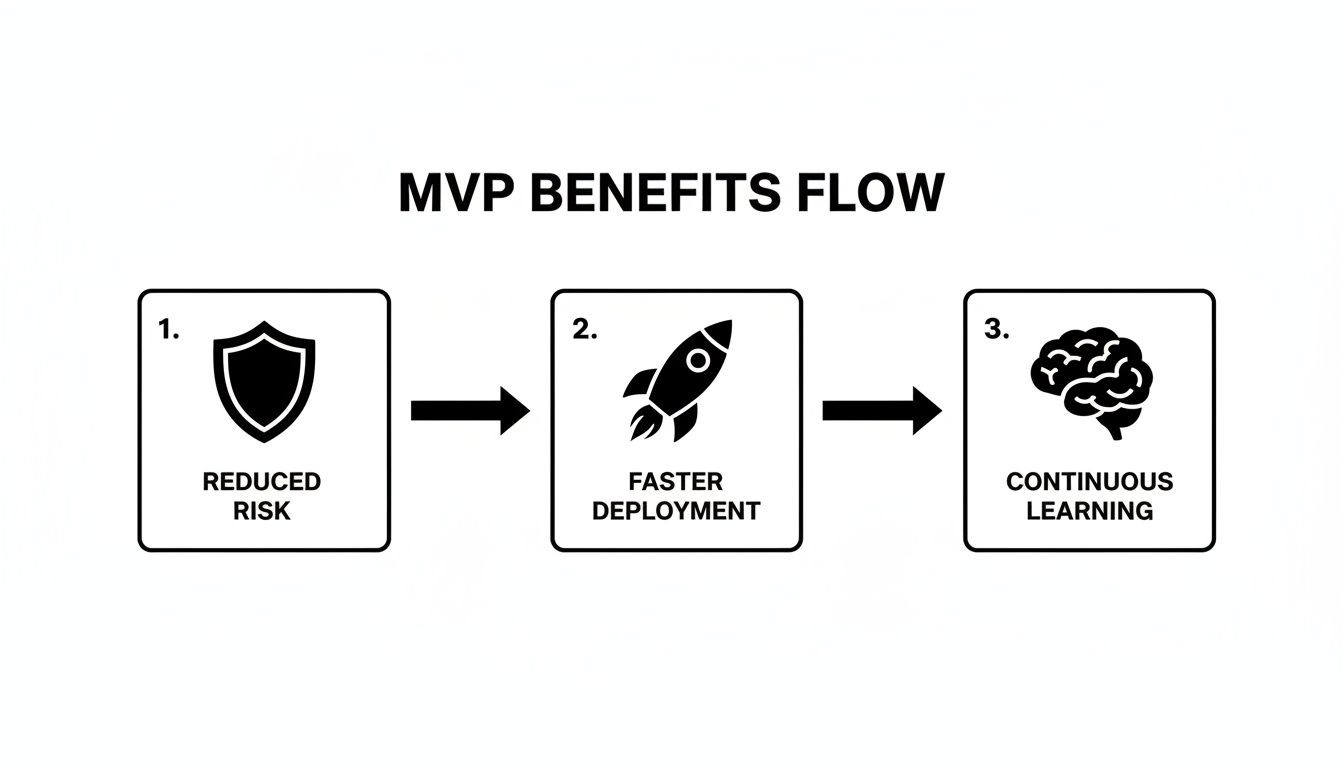
A Minimum Viable Product is a strategic framework for reducing risk, accelerating time-to-market, and making data-driven decisions. By focusing on a core feature set to solve a specific problem, you can validate your business idea with real users before committing significant resources.
Key Takeaways:
- Focus on a Core Hypothesis: Define the single most important assumption you need to test.
- Prioritize Ruthlessly: Build only the “Must-Have” features required to deliver value and learn.
- Build-Measure-Learn: Use real user data and feedback to guide your next steps: persevere, pivot, or shelve the project.
- Avoid Common Pitfalls: Guard against scope creep, analysis paralysis, and ignoring critical feedback.
Ready to turn your idea into a strategic MVP? Group107 specializes in building dedicated development teams that help founders and product leaders transform their vision into market-ready products that deliver results.