Building a minimum viable product is a strategic process for validating your core business idea with maximum efficiency. It's about ruthless focus: identify the single most critical problem your product solves, build only the features needed to deliver that solution, and get it into the hands of real users. Their feedback isn't just data—it's the strategic asset you'll use to build a scalable, market-ready product.
Why an MVP Is Your Most Critical First Step

An MVP isn't a buzzword; it's a strategic survival tool. The core purpose of a Minimum Viable Product is to test your fundamental business hypothesis with the smallest possible investment of time and capital. It's your first, most important conversation with the market, designed to generate validated learning.
This approach acts as a powerful filter, separating your internal assumptions from market reality. Instead of allocating months and significant budget to a feature-rich product no one asked for, an MVP accelerates your time-to-market. This speed provides an invaluable asset: real-world data from actual users on what they need, not just what a focus group speculates they might want. This process is fundamental to understanding how to build a minimum viable product that achieves product-market fit.
The Strategic Value of Starting Small
For startups, particularly in competitive sectors like SaaS, fintech, or e-commerce, the MVP is the bedrock of sustainable growth. The data is clear: startups that launch an MVP increase their chances of long-term success.
This is because the primary reason for startup failure is a lack of market need. An MVP directly confronts this risk by validating demand before you commit significant resources. You can explore the early-stage journey further with these insights from a startup founder.
This lean methodology delivers critical business advantages:
- Financial Risk Reduction: It dramatically lowers your initial investment, preventing capital drain on unproven features and maximizing ROI.
- Accelerated Time-to-Market: Getting a functional product to users quickly not only provides a competitive edge but also massively shortens your learning cycle.
- Validated Learning: The strategic focus shifts from simply building features to learning what to build next, ensuring your product roadmap is guided by real user behavior and data.
- Investor Confidence: An MVP with tangible user traction is concrete proof that your business model is viable, making it significantly easier to secure follow-on funding.
Skipping the MVP is like trying to navigate complex terrain without a map or compass. You might be moving fast, but you have no validation that you're headed in the right direction. It's a high-stakes gamble with your budget, timeline, and ultimately, your company's future.
By framing your initial launch as a strategic learning opportunity, you build a foundation for a product that the market genuinely needs and is willing to pay for. This is the core principle of building a successful minimum viable product.
2. Define Your Core Problem and Solution
Before a single line of code is written, the journey to a successful MVP begins with a deceptively simple question: What specific, high-value problem are we solving, and for whom?
Answering this incorrectly is the fastest path to building a product nobody wants. A precise answer, however, aligns your entire team, prevents feature creep, and establishes a clear benchmark for success. The objective isn't to solve every problem for everyone. It's to identify one acute pain point for a well-defined audience and solve it better than anyone else. This requires moving beyond internal assumptions and into deep market analysis.
Identify the Real Problem with Targeted Research
Effective research isn't a massive, expensive undertaking; it's a focused, tactical investigation. You must prove that the problem you believe exists is one that your target users are actively trying to solve—and, critically, are willing to pay to fix.
A highly effective starting point is competitive analysis. Don't just review their feature lists. Dive deep into their customer reviews, social media mentions, and community forums. What are the recurring complaints and friction points? These are the strategic opportunities your MVP can be built to eliminate. For example, if users of a competing SaaS tool consistently complain about a clunky reporting feature, your MVP can focus on delivering a streamlined, intuitive reporting experience as its core value proposition.
Once you have this intelligence, engage directly with potential users through one-on-one interviews or targeted surveys. Ask open-ended questions designed to reveal their daily frustrations and workflows:
- "Walk me through the last time you tried to accomplish [core task]."
- "What tools are you currently using to manage [problem]? What are the biggest limitations?"
- "If you could change one thing about how you handle this process, what would it be?"
This process transforms your mindset from "I want to build an innovative product" to "I'm going to solve a real-world business challenge." This is the only foundation for a successful MVP.
Define Your Target Audience and Build a Persona
One of the most common mistakes is designing a product for "everyone." The most successful MVPs are engineered for a highly specific user persona—a detailed profile of your ideal customer. This goes far beyond demographics to encompass their goals, motivations, and professional challenges.
- For a B2B SaaS tool: Your persona might be "Marketing Maria," a manager at a mid-sized e-commerce company who is overwhelmed by spreadsheet-based campaign ROI tracking.
- For a new fintech app: It could be "Freelancer Frank," who needs a simple, automated way to set aside funds for quarterly tax payments.
Building a detailed user persona is a practical decision-making tool, not a marketing exercise. Every time a new feature is proposed, the team must ask, "How does this directly help Maria automate her reporting and save time?"
This laser focus ensures that every component of your MVP, from the user interface to the backend logic, is purposefully designed to solve a specific need. This is what makes the product feel immediately valuable and is a cornerstone of learning how to build a minimum viable product that gains early traction.
Use the MoSCoW Method to Ruthlessly Prioritize Features
With a clear problem and user persona, you must now define your MVP's scope. This is where feature creep can derail a project. A battle-tested framework to combat this is the MoSCoW method. It provides a simple yet powerful system for categorizing every potential feature into one of four buckets, eliminating ambiguity and enforcing focus.
MVP Feature Prioritization Framework (MoSCoW Method)
The MoSCoW method transforms a feature wishlist into a strategic, defensible plan. By categorizing features, you ensure development effort is allocated only to what is absolutely essential to validate your core concept and deliver immediate value.
| Category | Description | Example (Fintech App MVP) |
|---|---|---|
| Must-Have | The MVP is non-viable without these. They are non-negotiable and directly solve the core problem. | User registration/login, linking a bank account, viewing transaction history. |
| Should-Have | Important features that add significant value but are not critical for the initial launch. These are your fast-follows. | Setting budget categories, basic spending push notifications. |
| Could-Have | "Nice-to-have" features that improve the experience but have a smaller impact. Build only if time and resources permit. | Dark mode, exporting transaction data to a CSV file. |
| Won't-Have | Features explicitly out of scope for this release. Documenting them here prevents scope creep. | Investment tracking, loan applications, cryptocurrency wallets. |
Using a framework like this provides a clear, defensible roadmap. It aligns developers, stakeholders, and product managers, guaranteeing you build only what is absolutely necessary to test your core hypothesis and get your product into the hands of real users.
Designing A User Experience That Converts

An MVP is minimal by definition, but that is never an excuse for a frustrating user experience. If users cannot intuitively access your product's core value, you have failed before you've begun. An effective, lean user experience (UX) is non-negotiable—it ensures your initial feedback is about the solution itself, not a confusing interface.
The design phase translates your prioritized feature list into a tangible user journey. The goal is to build a clear, frictionless path that guides users from their problem to your solution as efficiently as possible. Getting this right allows you to gather meaningful feedback before committing to expensive development cycles.
Map The Core User Flow
Before opening a design tool, map out a simple user flow diagram. This flowchart outlines every step a user takes to achieve their primary goal with your MVP. Think of it as the product's narrative from the user's perspective.
For our fintech app example, that narrative might be: Sign Up → Link Bank Account → View Transaction Dashboard.
Visualizing this journey reveals potential points of friction—unnecessary steps, confusing dead ends, or logical gaps—long before they are coded into the product. The objective is to make this primary user flow as short and intuitive as possible.
From Low-Fidelity Wireframes to High-Fidelity Prototypes
With a validated user flow, you can begin to visualize the interface. This process is most effective when broken down into two distinct stages, each serving a specific purpose in the feedback loop.
- Low-Fidelity Wireframes: These are the architectural blueprints of your application. Using tools like Balsamiq or even pen and paper, you create simple, black-and-white layouts. The focus is exclusively on structure, placement, and function. Their rough nature invites honest feedback on the core layout without distractions like colors or fonts.
- High-Fidelity Prototypes: Once the foundational structure is validated, you bring it to life in a tool like Figma. Here, you create realistic, interactive mockups that look and feel like the final product, complete with branding, typography, and clickable elements. These are essential for user testing to observe how people actually interact with your proposed design.
The most common mistake is jumping directly to a polished high-fidelity design. Wireframes are inexpensive and fast to iterate, making them the most efficient way to achieve early-stage design validation.
Build Accessibility In from Day One
Accessibility is not a feature to be added later; it is a fundamental component of good design. Integrating accessibility principles from the very beginning ensures your product is usable by the widest possible audience, including individuals with disabilities. This is not just about compliance—it's a significant strategic advantage.
A few foundational practices can make all the difference:
- Color Contrast: Ensure text is clearly legible against its background according to WCAG standards.
- Clear Labels: Use descriptive, intuitive labels for all forms, inputs, and buttons.
- Keyboard Navigation: Design the interface so it can be fully operated without a mouse, a critical requirement for many assistive technologies.
Building an accessible MVP prevents costly redesigns and immediately opens your product to a larger market. The MVP approach has transformed product development, helping companies avoid the 17% failure rate attributed to user-unfriendly products. In a market where 40% of companies that embrace MVPs have a better chance of securing funding, delivering a usable and accessible experience is a key differentiator. You can discover more product development statistics to understand the full impact of this approach.
Choosing The Right Tech Stack And Team
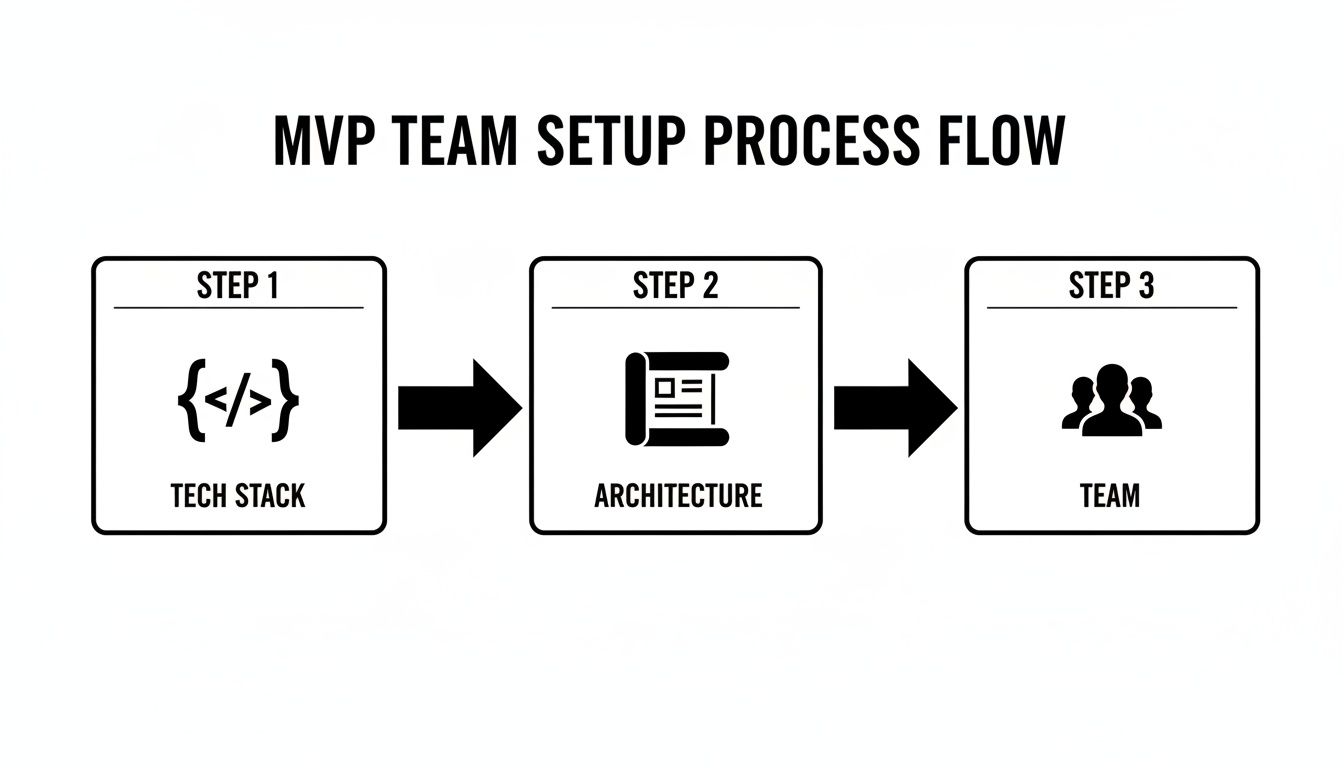
The technology and team decisions you make at the MVP stage will have long-term consequences. This is about more than just writing code; it's about laying a foundation that supports both rapid iteration and future scalability. A poor choice can lead to a costly, time-consuming rewrite just as you achieve product-market fit. The goal is not to chase the latest framework but to select the tools and talent that provide the optimal balance of development speed today and architectural stability for tomorrow.
Selecting A Tech Stack That Balances Speed and Scalability
Your MVP's tech stack has one primary objective: get a functional product into the hands of real users as quickly as possible. However, speed cannot come at the cost of stability. You need tools that enable pivots and iterations without creating significant technical debt.
For web applications, frameworks like React or Vue.js for the front end, paired with Node.js or Python (Django/Flask) for the back end, are popular for good reason. They offer extensive libraries and large communities, allowing your developers to focus on solving unique business problems rather than reinventing core functionality.
For mobile applications, cross-platform frameworks like React Native or Flutter are game-changers. Building for both iOS and Android from a single codebase delivers massive time and cost savings—precisely what an MVP requires.
Consider these common trade-offs:
- Speed & Simplicity: For building feature-rich applications quickly, Ruby on Rails and Python with Django are excellent choices due to their "batteries-included" nature.
- Performance & Scalability: For applications anticipating high traffic or requiring real-time features (e.g., chat, live data), Go and Node.js are architected for high-concurrency performance.
- Cross-Platform Mobile: React Native is ideal if your team has existing JavaScript expertise. Flutter is gaining significant traction for its high-performance UIs and developer experience.
Ultimately, the best stack is often the one your team already knows well. Leveraging existing expertise is almost always the fastest path to launch.
Monolith vs. Microservices: An MVP Dilemma
This is a classic architectural debate: should you build one unified application (monolith) or a collection of smaller, independent services (microservices)?
For an MVP, the answer is almost always a scalable monolith.
A microservices architecture introduces significant operational complexity that is unnecessary for an early-stage product. You risk spending more time managing infrastructure than learning from users. A well-architected monolith provides the development speed you need while keeping the door open for future evolution.
A "scalable monolith" is not an unstructured mess. It is a single codebase designed with clean, logical boundaries between components. This architecture is fast to develop, test, and deploy. As the product grows and certain features require independent scaling, you can strategically extract them into their own microservices. This approach provides the best of both worlds: launch quickly now with a clear path to scale when necessary.
Assembling Your Core Team
You don't need a large team to build a successful MVP, but you absolutely need the right expertise in key roles. A lean, effective MVP squad typically includes:
- Product Manager/Owner: The strategic lead who owns the product vision, prioritizes the roadmap, and makes data-informed decisions.
- UI/UX Designer: The user's advocate, responsible for ensuring the product is intuitive, accessible, and effectively solves the core problem.
- Full-Stack Developer(s): The engineers who build the product. A team of two to three is often the sweet spot, with expertise across both front-end and back-end development.
- QA Engineer: A dedicated resource focused on quality assurance to identify and resolve bugs before they impact your first users.
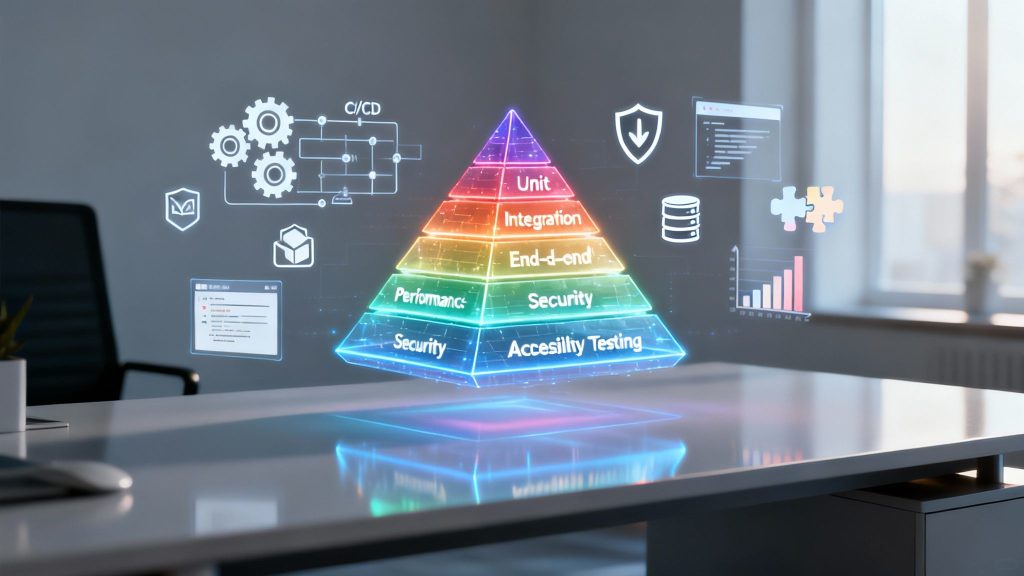
To ensure quality and consistency, the team should operate on a foundation of modern software engineering best practices for development, testing, and deployment.
Finding this talent locally can be slow and expensive. Augmenting your team with a strategic external partner is often a more efficient solution. Working with a dedicated offshore engineering team can reduce development costs by up to 60%, accelerate your timeline, and provide access to world-class talent. Our guide explains exactly how to hire a dedicated development team that functions as a seamless extension of your own, giving you the resources to build, launch, and scale effectively.
Launching And Learning From Real Users
With your core features defined and the first version of your product built, it's time to transition from theory to reality. This is where the build-measure-learn feedback loop begins. The objective shifts from simply shipping code to systematically validating your core assumptions with user data.
This process is not a single launch event but a continuous cycle fueled by agile development, automated deployments, and a strategic rollout plan. Each component is designed to shorten your feedback loop, turning user interactions into your most valuable strategic asset.
Adopting an Agile Mindset
An MVP is inherently designed for iteration, and the most effective framework for this is an agile development process, typically organized into sprints. Sprints are short, time-boxed periods of work—usually one or two weeks—where your team commits to building and deploying a small, specific set of features.
This approach delivers significant advantages:
- Rapid Feedback: Instead of a high-stress launch every six months, you deliver new value to users every few weeks, allowing for constant course correction based on real data.
- True Adaptability: If user feedback invalidates a key assumption, you can pivot in the next sprint without derailing the entire project.
- Enhanced Focus: Sprints force the team to break down large, complex problems into manageable tasks, keeping them aligned, motivated, and consistently shipping code.
At its core, an agile MVP process is about delivering tangible business value on a predictable cadence. Every sprint should end with a measurable product improvement, setting the stage for the next round of validated learning.
Automating Your Releases with CI/CD
To maintain a rapid sprint cadence, you must be able to release new code quickly and reliably. This is where a Continuous Integration/Continuous Deployment (CI/CD) pipeline becomes an essential tool, even for an early-stage MVP.
A CI/CD pipeline automates the error-prone process of testing and deploying software. Every time a developer commits new code, the pipeline automatically runs a suite of tests. If the tests pass, it can deploy the update directly to a staging or production environment.
A CI/CD pipeline is your MVP’s engine for velocity. It removes the friction between writing code and getting it into the hands of users, transforming your development process into a well-oiled machine for learning and iteration.
This level of automation is a strategic necessity, not a luxury. It frees up your engineers to focus on building high-value features instead of managing manual deployments, enabling you to react to user feedback in near real-time.
Executing a Strategic Launch
Your MVP launch should be a phased rollout designed to gather high-quality feedback while minimizing risk. A proven strategy is to progress from a private alpha to a public beta.
- Soft Launch (Alpha Testing): This is a controlled, internal release to a small, hand-picked group of trusted early adopters. The goal is to identify and resolve major bugs and gather raw, unfiltered feedback on the core user experience.
- Public Beta: Once the product is stable, you open it to a wider audience. This is where you begin collecting quantitative data at scale, tracking how users actually behave within the product to identify patterns and opportunities.
For a detailed playbook on navigating these critical early stages, our guide on alpha and beta testing breaks down how to structure tests to gather actionable insights.
Interpreting Data and Validating What Matters
This is the final and most critical piece of the loop: learning. The data you collect is only valuable if you use it to validate or invalidate your initial hypotheses. This requires analyzing both quantitative and qualitative data.
- Quantitative Data (The "What"): Tools like Google Analytics or Mixpanel show you what users are doing. Track key metrics like activation rates, feature adoption, and session duration to see where users are finding value and where they are dropping off.
- Qualitative Data (The "Why"): Tools like Hotjar or user interviews provide the "why" behind the numbers. Heatmaps, session recordings, and direct conversations reveal moments of confusion or frustration that quantitative data alone cannot explain.
By synthesizing these two data sources, you develop a complete, evidence-based understanding of user behavior. This ensures your next development cycle is focused on solving real, documented user problems—moving you one step closer to building an indispensable product.
Frequently Asked Questions About Building an MVP
If you are preparing to build an MVP, you likely have many questions. This is a positive sign, as it indicates you are thinking through the critical decisions that will shape your product's future. Here are answers to some of the most common questions we hear from founders and product leaders.
How Much Should I Budget for an MVP?
There is no universal number, but a well-scoped MVP typically costs between $25,000 and $75,000. The final cost depends on feature complexity, the chosen technology stack, and the composition of your development team.
Key factors that influence the budget include:
- Feature Scope: This is the primary cost driver. A ruthless prioritization process using a framework like MoSCoW is non-negotiable for controlling costs.
- Team Composition: Hiring a local development team in North America has a different cost structure than partnering with an offshore team. A dedicated offshore team can often reduce labor costs by up to 60% without compromising engineering quality.
- Technology Stack: Utilizing a popular, open-source stack like React with Node.js is generally more cost-effective than relying on niche technologies that require specialized, expensive talent.
View your MVP budget as an investment in validated learning. You are spending just enough to determine if your core business idea is viable before committing to a larger investment.
How Long Does It Take To Build?
Aim for a timeline of three to six months. This is the optimal window to balance development speed with product quality. It provides enough time to build a stable, reliable product but is fast enough to maintain momentum and enter the market before conditions change.
- Exceeding six months? Your scope is likely too large. You are no longer building a minimum viable product; you are building the full product, which introduces significant risk by delaying user feedback.
- Under three months? You risk delivering a buggy, fragile product that creates a poor first impression. Users will attribute issues to poor execution, and you will learn nothing about the validity of your core idea.
The art of the MVP lies in finding the perfect balance: simple enough to build quickly, but polished enough to deliver a quality user experience that generates honest, meaningful feedback.
What’s the Real Difference Between an MVP and a Prototype?
These terms are often used interchangeably, but they serve entirely different strategic purposes. Understanding the distinction is crucial to avoid wasted effort.
- A prototype is a non-functional or semi-functional mockup. It is often a series of clickable screens designed to answer the question: "Do users understand how this is intended to work?" It is a tool for validating a design concept before investing in engineering.
- An MVP is a real, functional product. It includes the minimum set of features required to ship to early users. Its purpose is to answer the larger business question: "Should we be building this product at all?" It is a tool for validating market demand with real data.
In short: a prototype tests the design; an MVP tests the business.
Does "Minimum" Mean Lower Quality?
Absolutely not. This is one of the most dangerous misconceptions about MVPs. "Minimum" refers to the scope of features, never the quality of the implementation. For a product to be "viable," it must be stable, secure, and usable.
Cutting corners on quality assurance or engineering best practices to launch faster is a critical error. A buggy, unreliable MVP will frustrate your early adopters—the very users whose feedback you need most. If their initial experience is negative, they will not return, and the entire learning opportunity is lost. Every feature in your MVP must be built to a production-ready standard.
While focusing on the product, don't neglect the business structure. Many founders find themselves deciding whether to incorporate your business during the MVP phase to establish a legal foundation and protect personal assets.
What Happens After the MVP Launches?
The launch is not the finish line; it is the starting point. Your strategic focus shifts from building the initial product to executing the Build-Measure-Learn loop.
This iterative cycle works as follows:
- Measure: Track everything—user engagement, sign-ups, feature usage, and retention—to see what is working and what isn't.
- Learn: Combine quantitative data with qualitative feedback. Conduct user interviews, send surveys, and analyze support tickets to understand the why behind the numbers.
- Build (or Iterate): Use these insights to inform your next development sprint. Decide what new features to build, what existing features to improve, and what to remove.
This is a continuous process of refinement, moving you closer to true product-market fit with each iteration.
Summary and Next Steps
Building a Minimum Viable Product is a disciplined, strategic process designed to reduce risk, accelerate learning, and increase your chances of building a successful product. By focusing on a single core problem, ruthlessly prioritizing features, and designing for user value, you can validate your business idea with real market data before committing significant resources.
Actionable Next Steps:
- Define Your Core Problem: Clearly articulate the single most important problem you are solving and for whom. Create a detailed user persona.
- Prioritize Your Features: Use the MoSCoW method to categorize all potential features and define the absolute minimum scope for your MVP.
- Map the User Journey: Create a simple user flow diagram for the core task your MVP enables.
- Develop a Phased Launch Plan: Outline your strategy for alpha and beta testing to ensure you gather high-quality, actionable feedback.
- Assemble Your Team: Determine whether to build an in-house team or accelerate your timeline by partnering with a dedicated development team.
Ready to turn your idea into a high-quality, market-ready MVP? At Group107, we provide dedicated offshore engineering teams that help you build, launch, and scale faster and more cost-effectively. https://group107.com