
Alpha and beta testing are not just technical QA steps; they are strategic business processes that validate product-market fit and mitigate launch risks. In simple terms, alpha testing is an internal dress rehearsal with your team, while beta testing is a semi-public preview for a select group of real users. Executing both phases effectively is critical for confirming customer value, preventing costly post-launch failures, and ensuring a positive return on your development investment.
The Strategic Role of Alpha and Beta Testing in Business
Launching a new software product without rigorous testing is a high-stakes gamble. The risks extend beyond technical bugs to include releasing a product that fails to meet user expectations or solve a real-world problem. Alpha and beta testing serve as critical quality gates, bridging the gap between internal development and external user value.
These testing phases represent two distinct, yet complementary, stages of validation. Alpha testing is the first gate, conducted internally in a controlled environment. Here, your own team rigorously tests the product to identify and resolve major defects, performance bottlenecks, and security vulnerabilities before any external user is exposed to it.
Beta testing is the product's first foray into the real world. A near-final version is released to a curated group of external users to evaluate its performance in uncontrolled environments. This phase provides unfiltered feedback on usability, feature relevance, and overall user experience—insights that are impossible to replicate in a lab.
Why This Matters for Business Success
Integrating these testing phases into your product lifecycle isn't just a best practice; it's a strategic imperative that prevents expensive, reactive fixes after launch and builds early user trust. For any SaaS, fintech, or enterprise solution, the business impact is clear:
- Risk Mitigation: Catching critical bugs during alpha testing prevents the reputational damage and emergency fixes associated with a flawed public launch.
- Market Validation: Beta testing is your ultimate reality check. It confirms that you have built a solution that solves a genuine problem, a core principle of developing a successful Minimum Viable Product (MVP).
- Improved Product Quality: The combined feedback from both testing phases leads to a more stable, intuitive, and polished final product—one that users will adopt and advocate for.
- Data-Driven Decisions: The qualitative and quantitative insights gathered are actionable data. This data empowers your team to make informed product decisions and allocate development resources where they will deliver the most value to users.
Understanding The Key Differences Between Alpha And Beta Testing
To deliver a product that resonates with your target market, it's essential to understand the distinct roles that alpha and beta testing play. While both are designed to enhance product quality, they differ significantly in their objectives, participants, and execution environments.
Consider the analogy of a chef launching a new dish.
Alpha testing is the process that occurs within the kitchen. The head chef, line cooks, and kitchen staff (your internal developers and QA team) prepare and taste the dish repeatedly. This happens in a controlled setting, focused on identifying major flaws—like an incorrect ingredient or a flawed cooking technique—long before it appears on the menu.
Beta testing, in contrast, is the restaurant's soft launch. A select group of trusted customers is invited to order the new dish and provide honest feedback on the entire experience. They comment on taste, presentation, and service. The goal is no longer to confirm if the dish can be made, but to determine if customers enjoy the final product.
This diagram visualizes the distinction between the internal, controlled nature of alpha testing and the external, real-world focus of beta testing.
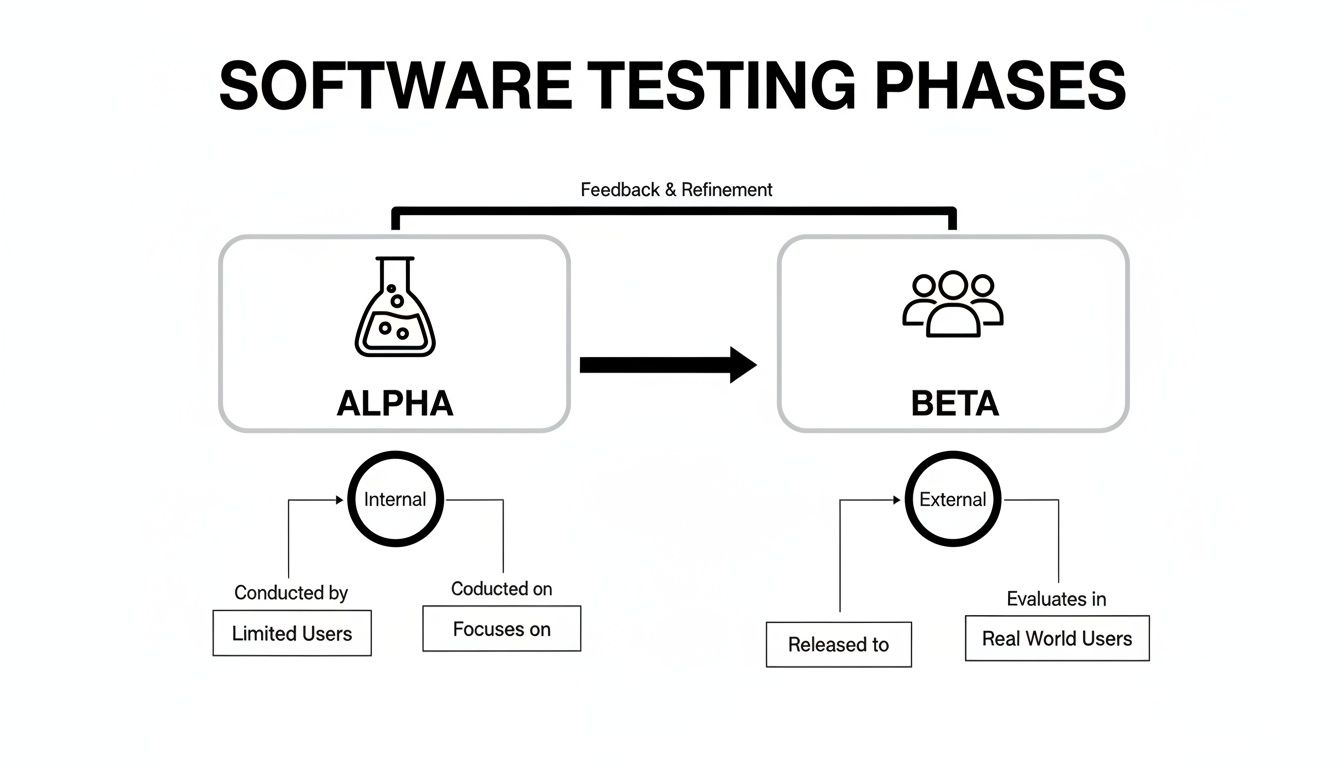
As illustrated, alpha testing is a contained, lab-like process focused on core product stability, while beta testing opens the product up to real-world conditions to gauge user satisfaction and performance.
To further clarify the comparison, here is a side-by-side breakdown.
Alpha Testing vs Beta Testing at a Glance
| Attribute | Alpha Testing | Beta Testing |
|---|---|---|
| Participants | Internal teams only (devs, QA, PMs) | External, real-world users |
| Environment | Controlled, lab, or staged environment | Uncontrolled, users' own devices & networks |
| Goal | Find & fix major bugs, crashes, and blockers | Gather usability feedback, find edge-case bugs |
| Timing | Early in the development cycle | Late in the development cycle, near launch |
| Product State | May be feature-incomplete, less stable | Feature-complete and generally stable |
| Feedback Focus | Technical functionality and stability | User experience, satisfaction, and sentiment |
This table highlights how each phase serves a unique purpose. Alpha testing builds a stable technical foundation, while beta testing ensures the final product is a valuable and desirable solution for its target audience.
The Nuts And Bolts Of Alpha Testing
Alpha testing is your first and most important line of defense against critical defects. It occurs early in the development lifecycle, sometimes before all features are implemented, with one primary goal: to identify and eliminate major bugs, crashes, and performance issues.
Key characteristics define this phase:
- The Testers: It's an internal process. Your QA engineers, developers, product managers, and other internal stakeholders are the ones testing the product.
- The Environment: All testing occurs in a staged or lab environment where servers, data, and network conditions are controlled to ensure reproducible test cases.
- The Focus: The mission is to validate core functionality and ensure application stability. This involves a combination of "white-box" testing (examining the code) and "black-box" testing (verifying functional requirements).
The Real World Of Beta Testing
Once your product is feature-complete and stable, it graduates to beta testing. This phase is entirely focused on real-world user validation and answering the critical question: "Is this product valuable and easy to use for our target customers?"
Here’s what makes beta testing unique:
- The Testers: Real users from outside your company—representing your target audience—are invited to provide unfiltered, authentic feedback.
- The Environment: Testing occurs "in the wild" on users' own devices, operating systems, and network conditions, which is crucial for uncovering compatibility and real-world performance issues.
- The Focus: The objective shifts from finding show-stopping bugs to gathering feedback on usability, feature value, and overall customer satisfaction.
Ultimately, alpha and beta testing are complementary, not interchangeable. Alpha testing builds a solid product, while beta testing ensures that product meets the needs of real users. For a deeper dive into building a robust QA strategy, review our guide to software testing best practices. Leveraging both phases correctly helps de-risk your launch and deliver a product that achieves market success.
How to Implement a Successful Alpha Testing Process
A successful alpha test is more than an internal bug hunt; it is a structured process that validates core functionality and confirms your product is stable enough for external release. A well-executed alpha test requires a clear plan, from defining success criteria to managing feedback efficiently. Think of it as the final quality gate that prevents show-stopping issues from ever reaching your users.
This internal validation provides the opportunity to rigorously test the application in a controlled setting. A methodical approach transforms early findings into actionable fixes, saving significant time and resources that would otherwise be spent on post-launch damage control.
Define Razor-Sharp Success Criteria
Before testing begins, your team must align on what "done" looks like. Vague goals lead to endless testing cycles. Your success criteria must be specific, measurable, and directly tied to product readiness.
For example, instead of a goal like "the product must be stable," define it with specific metrics:
- Zero Critical Errors: No blocker bugs that prevent core user flows, such as logging in, completing a purchase, or submitting essential data.
- Performance Benchmarks: The application must meet predefined speed and responsiveness targets under simulated load conditions.
- Feature Completeness: All features planned for the release must be fully implemented and pass their initial functional test cases.
These criteria serve as your exit conditions, providing a clear signal that the alpha phase is complete and the product is ready for the next stage.
Assemble Your Internal Testing Team
The effectiveness of an alpha test is amplified by the diverse perspectives of your internal testers. While QA engineers are essential, involving stakeholders from other departments provides a more holistic assessment of the product.
Your ideal alpha testing team should include:
- QA Engineers: To execute formal test plans, identify bugs, and verify fixes.
- Product Managers: To ensure the product aligns with business objectives and user stories.
- Engineers/Developers: To provide deep technical expertise and assist in diagnosing complex issues.
Bringing these roles together helps identify a wider range of issues, from functional defects to subtle deviations from the product vision. For refining the user experience aspect, our guide on how to conduct usability testing offers valuable frameworks for gathering qualitative feedback.
Establish an Efficient Bug Reporting System
A disorganized feedback process undermines the entire alpha test. It is critical to implement a centralized system for reporting, tracking, and prioritizing every issue discovered. A streamlined workflow ensures no bug is overlooked and that development can act on feedback immediately.
A great bug report is one that can be reproduced. It should contain clear steps, screenshots or videos, and details about the test environment (e.g., browser, OS). This precision dramatically accelerates the debugging process.
Your bug tracking system, whether it is Jira, Asana, or another platform, must serve as the single source of truth. Implementing a standardized reporting process is a core component of our recommended software testing best practices, as it transforms bug hunting from a reactive task into a proactive quality-building activity. This structure ensures your product is fundamentally solid before it faces a real user.
Executing a High-Impact Beta Testing Program

Once your product has passed the internal rigor of alpha testing, it is ready for its first real-world exposure: the beta test. This phase shifts the focus from internal bug detection to validating whether your product truly resonates with its intended audience. A well-executed beta program delivers the raw, unfiltered user feedback necessary to confirm product-market fit and launch with confidence.
The business value of this stage is widely recognized. The global beta testing software market is projected to grow from USD 9.3 billion in 2025 to USD 33.8 billion by 2035. This rapid growth highlights how essential companies view this phase for delivering high-quality products. You can explore the market dynamics in this beta testing software market research.
Recruiting the Right Beta Testers
The quality of your beta testing insights is directly proportional to the quality of your testers. The goal is not merely to find users but to recruit participants who accurately represent your target personas. Randomly selected testers will not provide the strategic feedback needed to make informed product decisions.
Here are proven methods for finding the right beta testers:
- Tapping Your Waitlist: Individuals who have already expressed interest are often your most motivated early adopters.
- Leveraging Your Existing User Base: Invite power users of a current product to test new features. Their existing expertise provides an invaluable perspective.
- Using Specialized Platforms: Services like Betabound or UserTesting.com connect you with pre-vetted testers from specific demographics.
- Community Engagement: Recruit testers from online communities where your target audience is already active, such as industry forums or social media groups.
Choosing Your Beta Model: Open vs. Closed
You can structure your beta test in one of two primary ways. The right choice depends on your product's maturity, confidentiality requirements, and strategic goals.
A closed beta is an exclusive, invite-only test with a small, carefully selected group of participants. This model is ideal for early-stage products, as it creates a controlled environment for collecting in-depth, qualitative feedback while maintaining confidentiality. It fosters a high-quality feedback loop with a core group of engaged users.
An open beta, by contrast, is publicly available. This approach is excellent for stress-testing infrastructure, identifying bugs at scale, and gauging broader market sentiment before a full launch. While it generates a high volume of data, it can be more challenging to manage.
Building a Structured Feedback Loop
Even with a great product and enthusiastic testers, a beta program will fail without a clear process for collecting and acting on feedback. You need a system that simplifies feedback submission for users and enables your team to translate those insights into actionable product improvements.
A successful feedback loop is not just about collecting bug reports. It's about understanding the user's context, sentiment, and the "why" behind their experience to drive meaningful product improvements.
An effective feedback loop should incorporate a mix of tools:
- Surveys and Questionnaires: Use platforms like Google Forms or SurveyMonkey to gather structured, quantitative data on specific features and user flows.
- In-App Feedback Tools: Integrate widgets that allow users to report bugs or usability issues directly from within your application, often capturing valuable context like screenshots and device logs.
- Community Forums: Establish a dedicated space, such as a private Slack channel or online forum, where testers can discuss their experiences, share ideas, and engage directly with your product team.
For many organizations, managing this process effectively can be resource-intensive. Partnering with a specialized team can provide the expert program management and vetted tester community required to maximize the value of your beta testing investment.
Choosing Your Testing Model: In-House or Outsourced
A key strategic decision is whether to build an internal QA team or partner with an external specialist. This choice directly impacts your budget, product quality, and time-to-market. The decision balances the need for control, cost-efficiency, and access to specialized expertise.
For many large enterprises, particularly in regulated industries like finance and government, an in-house model is standard. The stringent requirements for data security and direct oversight make internal control a non-negotiable, ensuring all intellectual property and sensitive user data remain secure.
The In-House Advantage: Control and Deep Product Knowledge
An in-house testing team develops deep, institutional knowledge of your product over time. They become experts who can identify subtle regressions after minor updates and understand the strategic "why" behind each feature.
This model provides clear advantages:
- Maximum Control: You retain complete authority over the entire QA process, from hiring to test strategy.
- Enhanced Security: All sensitive data and intellectual property remain within your company's secure infrastructure.
- Deep Integration: Testers work directly alongside developers, enabling faster communication and tighter feedback loops.
The Outsourced Model: Efficiency and Scalability
Outsourcing QA offers significant benefits in terms of efficiency and flexibility. This model is increasingly popular among startups and product companies that need to scale quickly without the overhead of hiring and managing a full-time team.
Market data reflects this trend. While in-house testing still commands a majority market share at approximately 55%, outsourced beta testing is a rapidly growing segment, now accounting for nearly 35%. This shift highlights the increasing value placed on external expertise. You can explore these beta testing software market trends for a deeper analysis.
Partnering with a firm like Group107 for a dedicated offshore team provides a hybrid solution. You gain the cost-efficiency and specialized talent pool of outsourcing combined with the focus of a team 100% dedicated to your product's success.
The Future of Testing with AI and Automation

The landscape of quality assurance is being reshaped by AI and automation. Traditional manual testing is evolving into a hybrid approach where intelligent systems augment human expertise. This transformation is making both alpha and beta testing more efficient, insightful, and impactful.
AI-driven tools can now generate thousands of test cases, uncovering edge cases that a human team might miss. Natural Language Processing (NLP) can analyze feedback from hundreds of beta testers, instantly identifying critical issues and sentiment trends. This technology is no longer a future concept—it is rapidly becoming the new standard for modern QA.
Augmenting Human Expertise with Intelligent Tools
The goal of automation is not to replace human testers but to empower them. By automating repetitive, time-consuming tasks, QA professionals can focus on high-value activities that require human ingenuity, such as exploratory testing, creative problem-solving, and analyzing complex user journeys.
This human-AI collaboration delivers significant advantages:
- Predictive Analytics: AI algorithms can analyze code changes to predict which areas of an application are most likely to contain defects, allowing teams to focus testing efforts where they are needed most.
- Smart Test Generation: AI-powered tools can automatically create and maintain test scripts as the product evolves, dramatically reducing manual effort.
- Automated Feedback Analysis: Sentiment analysis can process large volumes of beta tester feedback to quickly highlight urgent complaints and popular features.
The market for AI in software testing is projected to grow from USD 2.80 billion in 2024 to USD 10.21 billion by 2033, signaling a fundamental shift in how high-quality software is developed.
Integrating these automated checks into your development workflow is key. For more discussions on AI's impact on software development, visit the Parakeet-AI blog for more insights.
Common Questions About Alpha and Beta Testing
Even a well-defined testing strategy will encounter practical questions. Clarifying these points ensures your team remains aligned on goals, timelines, and the tools needed for successful alpha and beta testing.
How Long Should These Tests Last?
There is no one-size-fits-all answer; the duration depends on your product's complexity and your testing objectives.
- Alpha testing is typically a short, intensive sprint, often lasting 1-2 weeks per cycle. The goal is to rapidly identify and resolve major internal bugs before external release.
- Beta testing is a longer-term engagement, usually running from 4 to 8 weeks. This provides real users sufficient time to integrate the product into their routines and provide meaningful feedback.
Pro Tip: Focus on goal attainment rather than the calendar. Define clear exit criteria, such as a specific bug count or a target user satisfaction score. The test concludes when these goals are met, ensuring quality, not time, drives your release schedule.
Can We Skip Alpha and Go Straight to Beta?
While it may seem like a shortcut, skipping the internal alpha test is a high-risk strategy that often backfires. Releasing an unstable product to external beta testers can result in poor-quality feedback and damage your brand's reputation before you even launch.
Alpha testing serves as an essential quality checkpoint, confirming that the product is stable enough for real users to evaluate. A failed beta test is far more costly and damaging than investing the time to conduct a thorough internal review first.
What Are the Best Tools for Managing Tests?
The right tools depend on your team's size and specific needs, but several platforms are industry standards.
For bug and issue tracking in both alpha and beta phases, tools like Jira, Asana, and Trello are excellent choices.
For beta testing, dedicated platforms such as TestFairy, Instabug, and UserTesting are effective for build distribution and collecting in-app feedback. For communication, simple solutions like Slack channels or feedback forms via Google Forms can be highly effective. The key is to establish a centralized system to manage all feedback.