The digital product development process isn't just a series of tasks; it's the strategic framework that transforms an innovative idea into a market-ready, value-driven solution. A disciplined process aligns teams, mitigates risks, and ensures the final product solves a genuine user problem. For any business in a competitive landscape like SaaS, finance, or e-commerce, mastering this process is the foundation for sustainable growth and a significant competitive advantage.
The Architectural Blueprint for Digital Success
Think of building a digital product like constructing a skyscraper. You wouldn't start laying bricks without a detailed architectural blueprint. Engineers and architects spend months on discovery, planning, and design to ensure the structure is safe, functional, and fit for purpose. Skipping these foundational steps is a recipe for disaster.
The same principle applies to software. A haphazard approach leads to blown budgets, missed deadlines, and, worst of all, a product that fails to resonate with users. A structured digital product development process provides a clear roadmap, guiding a concept from its initial spark through its entire lifecycle. Getting this right isn't just a best practice—it's essential for survival and market leadership.
The Seven Core Stages of Development
The journey from idea to impact is broken down into distinct, interconnected phases. Each stage has specific goals and deliverables, building on the previous one to create momentum and ensure you’re building the right product, the right way. This systematic approach brings order and predictability to the inherent chaos of innovation.
This flowchart outlines the seven critical stages that constitute the end-to-end digital product development lifecycle.
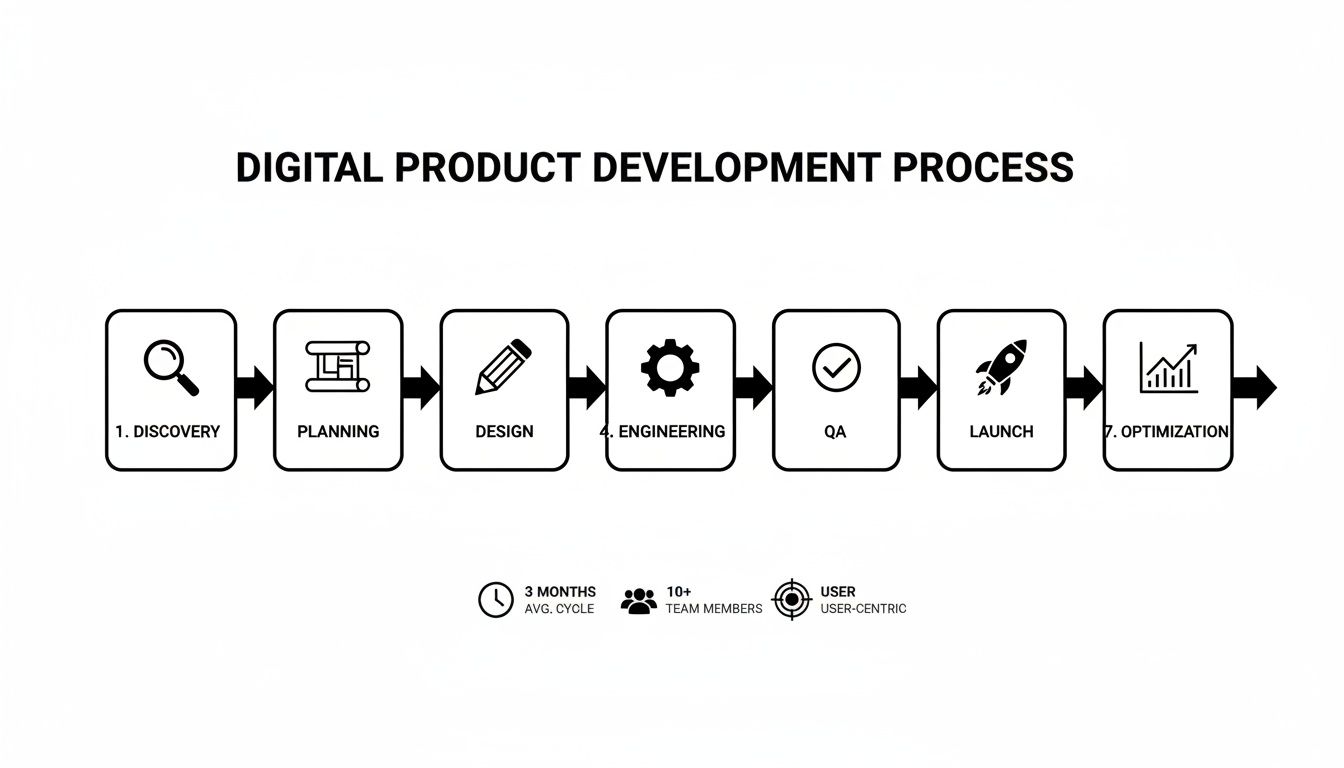
This visual underscores a critical reality: development is never truly "done." It's a continuous cycle where post-launch learnings directly inform the discovery phase for the next feature set or product iteration, driving perpetual improvement.
Why a Structured Process Matters
A formal process shifts your team from a reactive, fire-fighting mode to a proactive, preventative one. It’s about de-risking the entire venture by validating assumptions early, which saves significant time, money, and resources. While it shares principles with other frameworks, you can learn more about the specifics in our guide to the software development life cycle explained.
A disciplined approach delivers tangible business benefits:
- Improved Predictability: Gain clearer insight into project timelines and budgets, enabling better resource allocation and stakeholder management.
- Enhanced Collaboration: Align all teams—from stakeholders to developers—around a shared language and common objectives, eliminating silos.
- Higher Quality Outcomes: Integrate quality assurance, security, and accessibility from day one to build a robust, reliable, and inclusive product.
- Faster Time-to-Market: The structure eliminates bottlenecks and streamlines workflows, accelerating the delivery of your product into users' hands.
Laying the Foundation with Discovery and Planning
Every successful digital product begins with a deep understanding of the problem, not a line of code. The discovery and planning phase is where you transform assumptions into an evidence-backed strategy. Building without this step is like navigating without a map—a surefire way to waste resources and end up with a product no one wants.
This is the stage to rigorously validate your idea before committing significant capital. It involves a deep dive into the market, competitive landscape, and, most importantly, the target users you aim to serve. The goal is to uncover genuine pain points and pinpoint precisely where your product can deliver a unique, compelling solution. This isn't guesswork; it's disciplined research that sets the stage for success.
From Insights to a Strategic Roadmap
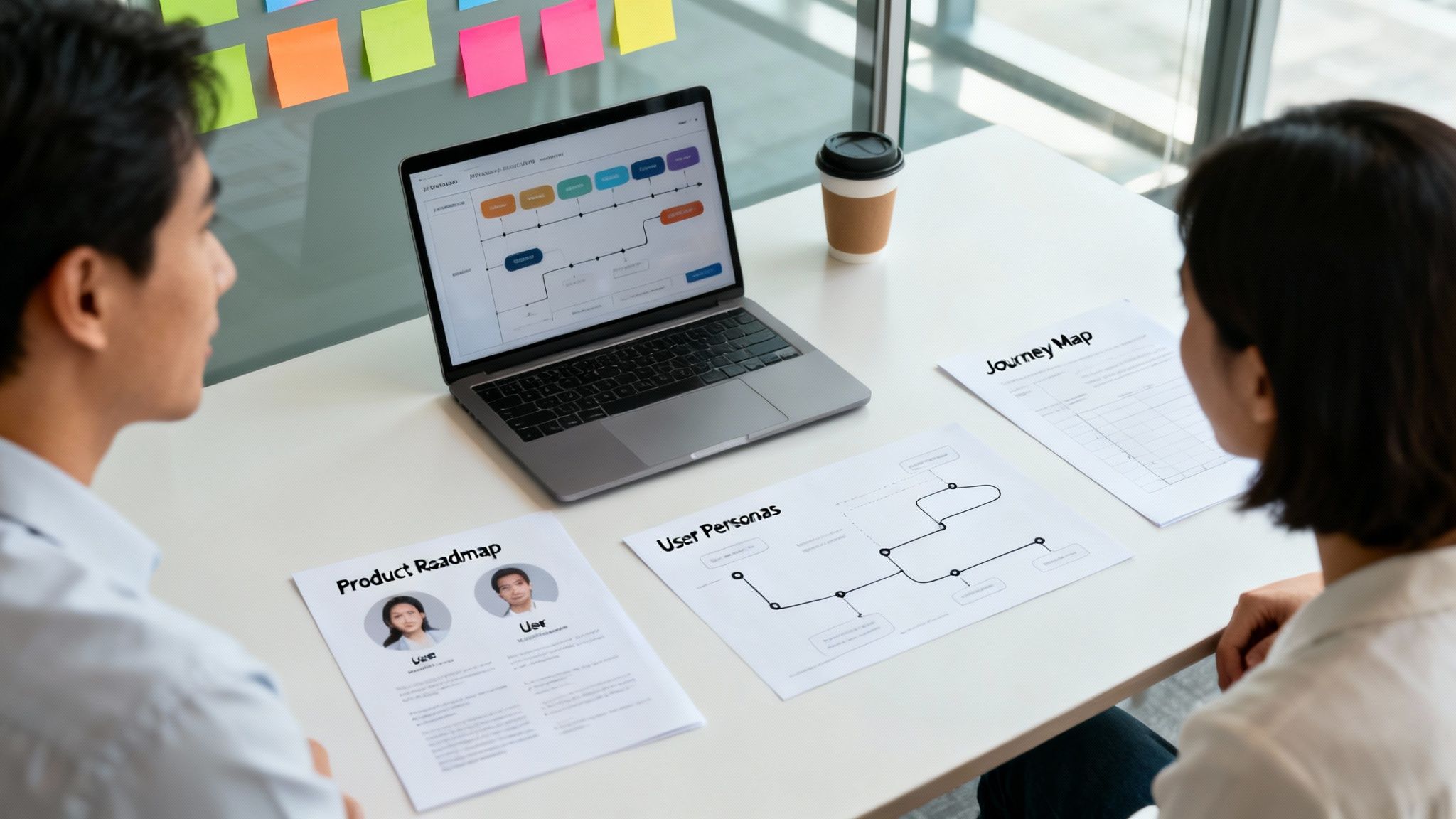
With research complete, the next step is to synthesize the raw data into a clear, actionable strategy. This involves creating tangible assets that guide your design and engineering teams, turning abstract concepts into a concrete plan.
Key deliverables from this phase form the backbone of your project:
- User Personas: Detailed profiles of your ideal users, built from real research. These keep the team relentlessly focused on solving problems for actual people.
- Customer Journey Maps: Visual representations of a user's interaction with your product from start to finish. This helps identify potential friction points and opportunities for a superior experience.
- Prioritized Feature Backlog: The master to-do list for your product, where features are ranked by business and user value. This ensures the team is always working on what matters most.
A clear product vision, backed by solid discovery, serves as the team's North Star. It keeps everyone aligned, simplifies prioritization, and prevents the "feature creep" that derails projects.
Setting the Metrics for Success
A plan is meaningless without a way to measure success. Defining Key Performance Indicators (KPIs) from the outset is critical for making data-driven decisions. These metrics transform broad goals like "increase user engagement" into specific, measurable targets that demonstrate ROI.
Data-driven decision-making is at the heart of 80% of successful digital product development processes. Top-performing teams aren't just shipping features; they are measuring impact. Reports show that leading teams can slash their idea-to-prototype timelines by up to 50%, enabling faster validation and market entry. You can explore more about modern product development methods to see how data is reshaping the industry.
The table below outlines the essential deliverables from these initial phases and their critical business impact.
| Phase | Key Deliverable | Purpose and Business Impact |
|---|---|---|
| Discovery | User Personas & Journey Maps | Ensures a user-centric product, addressing real needs and reducing the risk of market failure. |
| Discovery | Competitive Analysis | Identifies market gaps and opportunities for differentiation, informing a unique value proposition. |
| Planning | Prioritized Feature Backlog | Focuses development on high-impact features, maximizing ROI and preventing resource waste. |
| Planning | Product Roadmap | Provides a strategic, long-term view of the product's evolution, aligning stakeholders with the vision. |
| Planning | Key Performance Indicators (KPIs) | Establishes measurable success criteria, enabling data-driven optimization and proving business value. |
By defining these success metrics early, you create a framework for accountability and continuous improvement. It provides an objective way to measure feature impact, pivot when necessary, and demonstrate ROI to stakeholders. This proactive approach is how you avoid costly missteps and ensure your product doesn't just launch but succeeds.
Bringing Your Vision to Life with Design and Engineering
With a solid strategic plan in place, the digital product development process shifts from abstract ideas to concrete creation. This is where User Experience (UX/UI) design and engineering collaborate to transform validated concepts into a functional, intuitive, and user-friendly product.
The design phase is analogous to creating the architectural blueprints. It extends far beyond aesthetics to craft a seamless and engaging user journey. This stage is critical for ensuring the final product is not only powerful but also a pleasure to use.
Crafting an Intuitive User Experience
The first step in design is translating user stories and features from the backlog into a visual and interactive structure. This process is entirely user-centric, built on the principles of mastering user experience design.
The process typically progresses in fidelity:
- Wireframes: Low-fidelity skeletons of the application focusing purely on structure, layout, and information hierarchy—no colors or fonts.
- Interactive Prototypes: Wireframes are evolved into clickable prototypes that simulate user flows. This allows stakeholders and test users to experience the product’s navigation long before development begins.
- High-Fidelity Mockups: Pixel-perfect visual designs complete with branding, color palettes, typography, and iconography, showing exactly how the final product will look and feel.
Usability testing at this stage is non-negotiable. Observing real users interact with a prototype is the only way to validate design choices and ensure the product effectively solves their problems.
Engineering a Scalable and Resilient Product
Once designs are approved, the engineering team takes over, writing clean, efficient, and scalable code to turn mockups into a working digital product. The technical decisions made here—from technology stack to architecture—profoundly impact the product's future performance, security, and ability to grow.
Choosing the right technology stack (programming languages, frameworks, and tools) is a critical decision based on project requirements, scalability goals, and long-term maintenance. Equally important is designing a robust software architecture that can accommodate future features and increased user load without requiring a complete overhaul. At Group107 Digital, our web development services are architected for this kind of long-term resilience.
Integrating Accessibility for Broader Reach
Building an inclusive product is a core component of modern development, not an afterthought. Integrating accessibility standards like the Web Content Accessibility Guidelines (WCAG) from the beginning of the design and engineering phase is the most effective and cost-efficient approach.
This practice ensures your product is usable by people with disabilities, which expands your market, improves the experience for all users, and mitigates legal risks.
AI is also revolutionizing the design process. By 2026, an estimated 93% of designers will leverage AI tools in their daily work. This has already enabled 58% of design teams to increase their output without expanding headcount—a major efficiency gain. You can discover more insights about these product design stats to understand how technology is accelerating innovation. By weaving together thoughtful design, solid engineering, and inclusive practices, you are building a product for lasting success.
Ensuring Quality with QA, DevOps, and Security
Building a product with compelling features is only half the battle. Long-term success depends on ensuring those features are reliable, secure, and scalable. This is where three critical disciplines converge: Quality Assurance (QA), DevOps, and Security. They form the support structure that transforms a good idea into a trustworthy, enterprise-grade product.
Treating these as final, sequential stages is a critical error. Modern, effective development integrates these practices throughout the entire lifecycle, preventing issues rather than fixing them at the last minute when they are most expensive.
Continuous Quality Assurance as a Mindset
Effective Quality Assurance is a continuous process, not a final inspection. It fosters a proactive culture focused on preventing bugs rather than simply catching them before release. This involves a comprehensive suite of tests that validate everything from individual code components to the complete user journey.
This layered testing approach builds confidence at every step:
- Unit Testing: Developers write automated tests to verify that individual functions or components work as intended.
- Integration Testing: Ensures that different parts of the application work together correctly.
- End-to-End (E2E) Testing: Simulates real user scenarios to validate entire workflows, such as user registration or a purchase process.
- User Acceptance Testing (UAT): Real users or stakeholders conduct a final review to confirm the product meets their requirements before launch.
Understanding concepts like functional testing is essential for verifying that the software behaves as specified and meets user needs. This disciplined approach catches issues early, when they are significantly cheaper and faster to resolve.
Streamlining Delivery with a DevOps Culture
DevOps is more than a set of tools; it's a cultural shift that breaks down the silos between Development (Dev) and Operations (Ops). Its purpose is to automate and streamline the process of building, testing, and releasing software, enabling faster and more reliable delivery to market.
The engine of DevOps is the Continuous Integration/Continuous Delivery (CI/CD) pipeline, an automated workflow that moves code from a developer's machine to production. To understand how this can transform your projects, read our deep dive on what is a CI/CD pipeline.
A well-implemented CI/CD pipeline is a significant competitive advantage. It allows teams to deploy small, frequent updates with confidence, respond faster to customer feedback, and reduce the risk associated with large-scale releases.
By automating repetitive manual tasks, DevOps frees engineers to focus on creating value, resulting in faster release cycles, fewer human errors, and a more scalable system.
Integrating Security from Day One
In an era of persistent cyber threats, treating security as an afterthought is not an option. A "security-by-design," or DevSecOps, approach embeds security checks directly into the development process. This means identifying and mitigating potential vulnerabilities at every stage, from initial design to final deployment.
This proactive stance is non-negotiable for businesses in SaaS, finance, and e-commerce that handle sensitive data. Waiting to perform security scans until the end often reveals deep architectural flaws that are complex and costly to remediate.
Key DevSecOps practices include:
- Static Application Security Testing (SAST): Automated tools scan source code for known vulnerabilities.
- Dynamic Application Security Testing (DAST): Tools test the running application to find security weaknesses from an external perspective.
- Penetration Testing: Ethical hackers attempt to breach your system to expose vulnerabilities before malicious actors can.
- Dependency Scanning: Automated tools check third-party libraries for known security issues.
By integrating QA, DevOps, and security, you create a robust framework for innovating at speed without compromising quality or user trust. This ensures your digital product is not only well-built but also dependable and secure for the long term.
Choosing the Right Development Methodology
After defining what to build, you must decide how to build it. Selecting a development methodology is a strategic decision that shapes team workflow, communication, and responsiveness to change. This choice is a critical component of the digital product development process, directly impacting timelines, budget, and final product quality.
The goal is to select a model that aligns with your project's specific needs, your organizational culture, and your market dynamics. The right methodology creates a development engine that is both efficient and adaptable.
Agile vs. Waterfall: Two Competing Philosophies
The two most prominent methodologies represent opposite ends of the spectrum. Waterfall follows a linear, sequential path, while Agile is an iterative, cyclical process. Understanding their core differences is the first step toward choosing the right fit for your project.
For a comprehensive breakdown, explore our guide on Agile vs. Waterfall vs. Scrum.
The Rise of Hybrid Models
In practice, many organizations, particularly large enterprises, find that a pure methodology is often too restrictive or too unstructured. They require the speed and flexibility of Agile to compete but also need the predictable planning and governance of Waterfall to manage risk and align with stakeholder expectations.
This has led to the adoption of Hybrid models.
A Hybrid approach strategically combines elements from both methodologies. For instance, a team might use a Waterfall approach for initial high-level planning and requirements definition, then switch to Agile sprints for the actual design and development work.
This blend enables businesses to innovate rapidly while maintaining the strict oversight necessary in complex or regulated industries like finance or government. It provides a structured yet flexible framework that is rapidly becoming the standard for enterprise-level product development.
This trend is accelerating. Reports indicate that by 2026, over 70% of product development teams in major markets will have adopted hybrid strategies, a significant increase from 45% in 2023. This shift is driven by the need for faster delivery in unpredictable market conditions.
Choosing the right methodology is about finding the optimal balance of speed, structure, and adaptability to deliver an exceptional product.
To help you decide, here’s a quick comparison of the three primary approaches.
Comparison of Development Methodologies
| Methodology | Best For | Key Advantages | Potential Challenges |
|---|---|---|---|
| Waterfall | Projects with fixed, well-defined requirements and a stable scope, such as compliance or infrastructure upgrades. | Highly structured, thorough documentation, predictable timelines, and simple to manage. | Extremely rigid; adapting to changes once a phase is complete is difficult and costly. |
| Agile | Innovative products in dynamic markets where requirements are expected to evolve, common in SaaS or mobile apps. | High flexibility, continuous feedback, enhanced customer satisfaction, and rapid delivery. | Can lead to "scope creep" if not managed with strong product ownership and discipline. |
| Hybrid | Large enterprises needing both structured governance and iterative development to balance innovation with risk. | Combines predictability with flexibility, ideal for complex projects in regulated sectors. | Requires skilled management to integrate two different philosophies without creating friction. |
Ultimately, the best methodology depends on your organization's culture, team expertise, and the specific demands of your project.
Executing a Successful Launch and Driving Growth
Completing development isn't the finish line; it’s the start of a new phase. A product launch is the critical transition from a controlled development environment to the dynamic real world. A successful launch is a carefully orchestrated event, not a simple deployment, and it’s where the value of a disciplined digital product development process is fully realized.
A successful launch is anchored by a robust go-to-market (GTM) strategy. This is a coordinated effort across marketing, sales, and technical teams. Long before launch day, all assets—landing pages, email campaigns, ad creative, and press kits—must be ready. Concurrently, the technical team must plan a flawless deployment, often using a phased rollout to minimize risk and ensure stability. A smooth launch builds crucial initial momentum and user trust.
Establishing a Continuous Improvement Loop
Once your product is live, the real work of optimization begins. The most successful products evolve with their users. The post-launch phase is dedicated to creating a continuous feedback loop, transforming your product into a living entity that adapts to customer needs.
This improvement cycle is powered by key activities:
- Performance Monitoring: Continuously tracking application performance, uptime, and server health to identify and resolve technical issues before they impact users.
- User Analytics: Analyzing data to understand how people actually use your product. Identifying popular features and friction points reveals key optimization opportunities.
- Direct User Feedback: Gathering qualitative insights through surveys, support tickets, and reviews to understand the "why" behind the quantitative data.
This constant cycle of measuring, learning, and iterating is the engine of sustainable growth. It replaces guesswork with a data-driven strategy for future development.
Driving Long-Term Growth and ROI
The insights gathered from the feedback loop directly inform the post-launch roadmap. This is where you revisit the KPIs defined during planning to measure success and demonstrate the product's return on investment. The focus shifts from simply building the product to optimizing it for customer retention and long-term value.
Key growth activities include:
- A/B Testing: Systematically testing variations of features, user flows, or UI elements to identify what performs best with your audience.
- Prioritizing Bug Fixes: Responding quickly to user-reported issues to maintain a high-quality, trustworthy experience.
- Feature Enhancements: Using data to confidently prioritize new features that solve real user problems and deliver maximum value.
By committing to this ongoing optimization, you ensure your product doesn’t just launch; it thrives. It remains relevant, competitive, and continues to deliver measurable business results long after its initial release.
Frequently Asked Questions
Navigating the journey from concept to market-ready product raises many questions for business leaders and product managers. Here are clear, actionable answers to some of the most common inquiries.
What Is the Average Timeline for Digital Product Development?
There is no one-size-fits-all answer; the timeline depends entirely on scope and complexity. A lean Minimum Viable Product (MVP) can often be launched in 3-6 months. In contrast, a complex enterprise platform for the finance or SaaS industry could take 12-18 months or more.
The primary factors influencing the timeline are:
- Scope Complexity: The number and intricacy of features is the single largest determinant of the development timeline.
- Team Capacity: The size and experience of your development team directly impact velocity and speed of execution.
- Technology Stack: The chosen technologies can accelerate or prolong development, depending on their maturity and the availability of talent.
How Much Does It Cost to Develop a Digital Product?
Similar to the timeline, cost is directly tied to project complexity and team size. A straightforward MVP may range from $50,000 to $150,000. A full-featured enterprise product for a SaaS company or financial institution can easily exceed $500,000.
Your largest investment will always be engineering hours. The most effective way to manage your budget is to invest in a rigorous discovery and planning phase. This ensures that every dollar is spent building features that deliver measurable value to both users and the business.
What Are the Most Common Pitfalls to Avoid?
Even the most well-structured projects can encounter obstacles. Product failure is rarely due to a technical breakdown; it’s more often a failure in the process itself.
Be vigilant for these common mistakes:
- Skipping Discovery: Rushing to code without first validating the problem is the leading cause of product failure.
- Vague Requirements: Unclear goals and feature specifications lead to wasted time, budget overruns, and endless rework.
- Ignoring User Feedback: Building in a vacuum without continuous input from real users almost guarantees a product that misses the mark.
- Accumulating Technical Debt: Taking coding shortcuts to meet deadlines may provide short-term gains but creates significant long-term maintenance costs.
A structured digital product development process is your roadmap to turning an ambitious vision into a high-performing digital asset. It requires expertise, discipline, and a relentless focus on delivering value.
Next Steps:
- Assess your current process: Identify gaps in your discovery, planning, or QA stages.
- Define your KPIs: If you don't have them, establish clear, measurable success metrics for your product.
- Engage an expert partner: A seasoned development partner can provide the structure, talent, and strategic oversight needed to de-risk your project and accelerate your path to market.
Ready to transform your idea into a successful digital product? Contact Group 107 to discover how our end-to-end development services can accelerate your time-to-market and maximize ROI. Learn more at https://group107.com.