
Prioritizing a product backlog isn't just about shuffling a to-do list; it's the strategic art of deciding what your team builds next. This process transforms a long list of features, bug fixes, and ideas into a clear roadmap that directly fuels business goals. Mastering this discipline ensures you maximize ROI, eliminate wasted effort, and ship valuable updates that resonate with your customers.
Why Backlog Prioritization Separates Success from Failure
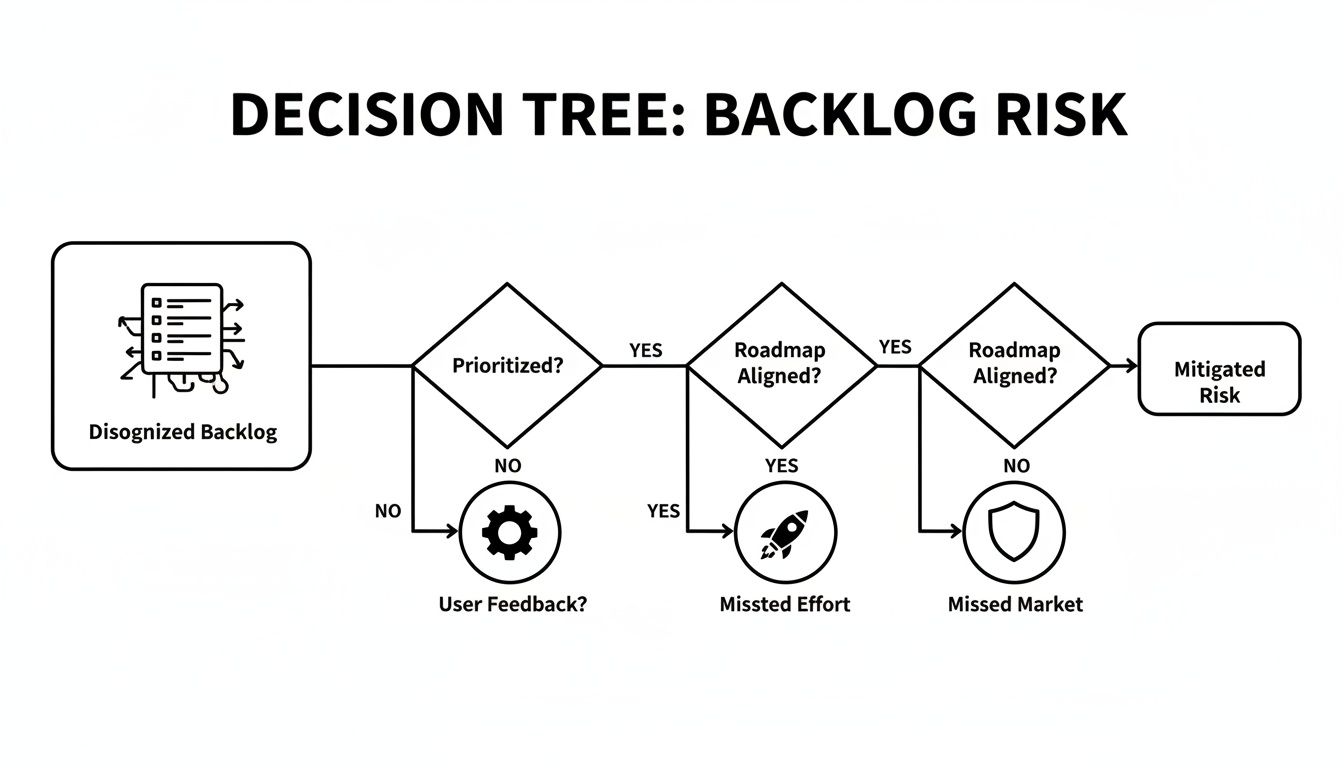
A disorganized product backlog is a silent killer for products. It bleeds resources, misallocates your best talent, and creates a massive gap between what your team is building and what your customers actually need. Ineffective prioritization is a leading cause of product failure, turning a strategic asset into an operational bottleneck.
Without a clear strategy, teams inevitably fall into a reactive mode, chasing feature requests from the loudest client or squashing low-impact bugs that grab attention. These tasks feel productive, but they often drag the product off course, away from its core vision and long-term viability. This reactive firefighting is the enemy of innovation.
The True Cost of a Disorganized Backlog
The damage of poor prioritization goes far beyond wasted time. When developers pour energy into building features that get shelved or ignored by users, their morale plummets. This leads directly to disengagement and burnout, poisoning the quality of their work and slowing down the entire development lifecycle. The product itself suffers, becoming bloated with features that clutter the user experience and create a maintenance nightmare.
This disconnect between effort and impact is shockingly common. Studies show that a significant portion of product features are rarely or never used, meaning a huge amount of development effort is simply wasted. Knowing how to prioritize tasks effectively is non-negotiable for any product leader. The shift from reactive firefighting to proactive value creation changes the entire game.
A poorly managed backlog guarantees you are building something. A well-prioritized backlog ensures you are building the right thing at the right time. This distinction is what separates stagnant products from market leaders.
Let's look at the real-world consequences of weak versus strong prioritization. It's not just about efficiency; it's about survival.
The Strategic Impact of Backlog Prioritization
| Business Metric | Weak Prioritization (The Risk) | Strong Prioritization (The Reward) |
|---|---|---|
| Return on Investment (ROI) | Engineering budget is burned on low-value features that see little or no user adoption. | Every development cycle is focused on delivering the highest possible business and customer value. |
| Time-to-Market | Teams get bogged down building a bloated MVP, delaying launch and critical market feedback. | A lean, focused MVP gets into users' hands faster, accelerating the learning loop. |
| Stakeholder Confidence | Executives and sales teams lose faith when engineering efforts seem disconnected from business goals. | A transparent, logical roadmap builds trust that development resources are aligned with company strategy. |
| Developer Morale & Attrition | Engineers become disengaged and frustrated building features that nobody uses, leading to burnout. | Teams are motivated and energized by seeing their work directly impact customer satisfaction and business growth. |
| Product-Market Fit | The product becomes bloated and difficult to use, drifting further away from what the market actually needs. | The product evolves with purpose, consistently solving real user problems and strengthening its market position. |
The difference is stark. Moving from a reactive to a strategic approach fundamentally changes your team's output and your product's trajectory. A well-prioritized backlog becomes the engine of an agile organization, enabling you to pivot quickly, respond to market shifts, and consistently deliver value that drives sustainable growth.
Choosing the Right Prioritization Framework
Prioritizing a product backlog based on gut feelings or who shouts the loudest is a recipe for disaster. Mature product teams use structured, defensible frameworks to make decisions, turning ambiguity into clarity and ensuring every development cycle is laser-focused on delivering real value.
There is no single best framework. The optimal choice depends on your context: your product's lifecycle stage, your team’s maturity, and the strategic goals for the next release. A SaaS startup sprinting toward an MVP has different priorities than an enterprise team managing a complex, mature platform.
Quick Wins and High-Impact Features with the Value vs. Effort Matrix
One of the most straightforward yet powerful tools is the Value vs. Effort Matrix. This simple 2×2 grid helps teams instantly visualize where to focus their energy for maximum impact by plotting backlog items based on their potential business value and the estimated development effort.
This visualization is incredibly effective for spotting low-hanging fruit and making smart trade-offs. It breaks down into four clear quadrants:
- High Value, Low Effort (Quick Wins): This is your goldmine. Prioritize these to build momentum and deliver immediate value. For a SaaS platform, this could be a simple UI tweak that significantly improves user onboarding.
- High Value, High Effort (Major Projects): These are strategic initiatives that demand significant investment but promise huge returns. Break these down into smaller, manageable epics and plan them carefully.
- Low Value, Low Effort (Fill-ins): Tackle these tasks when you have small gaps in a sprint, but they should never jump the queue ahead of high-value items.
- Low Value, High Effort (Time Sinks): Avoid these entirely. They burn resources for minimal gain and should be deprioritized or cut from the backlog.
Without this framework, it's dangerously easy to get stuck working on "Time Sinks" without even realizing it.
Defining Scope with the MoSCoW Method
When you need absolute clarity on the scope of a release, the MoSCoW method is an excellent choice. It forces candid conversations among the team and stakeholders about what is truly essential versus what is a nice-to-have. This approach is a cornerstone of many Agile models. (We dive deeper into this in our guide comparing agile vs. waterfall vs. scrum).
The acronym breaks down as follows:
- Must-Have: Non-negotiable features. The product is not viable or functional without them.
- Should-Have: Important features that add significant value, but the release can proceed without them if necessary.
- Could-Have: Desirable but less critical features. These are often the first to be cut when timelines are tight.
- Won't-Have: Items the team has explicitly agreed not to include in the current release scope, though they may be revisited later.
MoSCoW excels at managing stakeholder expectations and preventing scope creep, making it ideal for defining an MVP or planning a major product update.
Data-Driven Decisions with the RICE Model
For complex scenarios where you need to remove bias and rely on data, the RICE scoring model provides a quantitative formula. RICE stands for Reach, Impact, Confidence, and Effort. By assigning a score to each factor, you can generate a priority score to objectively rank competing features.
Here's the breakdown:
- Reach: How many users will this feature affect in a given timeframe? (e.g., 500 customers per quarter)
- Impact: How much will this affect each user? (Use a scale: 3 for massive, 2 for high, 1 for medium, 0.5 for low)
- Confidence: How sure are you about your estimates? (e.g., 100% for high, 80% for medium, 50% for low)
- Effort: How much time will this require from your team, usually in "person-months"?
The formula is straightforward: (Reach x Impact x Confidence) / Effort.
The result is a single, comparable score that helps remove personal opinions from the decision-making process. This framework is particularly effective for mature products with a large user base and a constant stream of feature requests. For a deeper dive, this list of 10 essential product prioritization frameworks is a great starting point.
Achieving Stakeholder Alignment on Priorities
A perfectly prioritized backlog is useless if stakeholders aren’t bought in. Misalignment leads to scope creep, blown deadlines, and internal friction that can derail a project. Achieving and maintaining consensus isn't a "soft skill"—it's a core competency for any product leader.
This is even more critical when working with augmented or offshore development teams. Without a clear, unified direction, you risk wasted effort and confusion. You need everyone, regardless of their time zone, pulling in the same direction.

Establish a Clear Governance Model
First, establish a clear governance model for how backlog decisions are made. Ambiguity is your enemy. Everyone needs to understand who makes the final call and how their input is factored into the equation. This isn't about adding bureaucracy; it's about creating clarity and accountability.
Your model should define:
- The Decider: Typically the Product Owner, who is solely accountable for the backlog's content and order.
- The Contributors: Key stakeholders from sales, marketing, support, DevOps, and leadership who provide critical context.
- The Process: A clear map of how requests are submitted, when they are reviewed, and what criteria (like RICE or Value vs. Effort) are used.
For example, in a fintech company, the Product Owner might have the final say, but only after a mandatory review with compliance and security teams. This simple rule prevents massive headaches and last-minute scrambles.
Run Collaborative Backlog Grooming Sessions
Treat backlog refinement (or grooming) sessions as collaborative workshops, not debates. The goal is to tap into the team's collective intelligence to clarify details, estimate effort, and understand the work ahead. When done right, prioritization becomes a team sport.
To run effective sessions:
- Set an Agenda: The Product Owner should prepare a shortlist of top-priority items for discussion. Do not attempt to groom the entire backlog in one meeting.
- Focus on the "Why": For each major item, explain the user problem it solves and the business value it creates. Always tie work back to strategic goals.
- Encourage Questions: Create a safe space for the development team to challenge assumptions, identify technical risks, and ask for clarity. Their perspective is invaluable.
- Timebox Everything: Keep the meeting on track. If an item sparks a prolonged debate, park it and schedule a separate follow-up with a smaller group.
The goal of a grooming session isn't just to get estimates; it's to build a shared understanding. When the engineering team truly understands the 'why' behind a feature, they build better, more effective solutions.
Communicate Your Rationale Transparently
Stakeholders will accept a decision—even one they dislike—if they understand the reasoning behind it. When you have to tell the sales team their requested feature is being pushed, don't just say "no." Walk them through the data-driven rationale.
For instance: "I know how important this feature is for that enterprise client. Right now, our data shows that fixing this critical performance bug will likely reduce customer churn by 15% this quarter, which is our number one company objective. We will absolutely revisit your request in the next planning cycle."
This approach transforms a subjective argument into an objective, data-backed decision. It's how you manage competing priorities from across the business. According to recent project management statistics, projects with fast, clear decision-making have a significantly higher success rate, underscoring the importance of efficient communication.
Balancing New Features with Technical Health
Prioritizing a product backlog often feels like a tug-of-war. Sales clamors for new integrations, marketing needs a specific feature for a campaign, and customers always have a wishlist. However, focusing only on visible features is a strategic error.
Ignoring your product's underlying technical health is like building a skyscraper on a shaky foundation. Sooner or later, it will collapse. This "hidden" work—refactoring legacy code, upgrading infrastructure, and patching security vulnerabilities—won't earn applause in a product demo, but it's essential for keeping your product stable, scalable, and secure. A well-managed backlog strategically balances new value with essential maintenance.

Making the Business Case for Addressing Technical Debt
Technical debt is the implied cost of rework caused by choosing an easy, limited solution now instead of using a better approach that would take longer. To non-technical stakeholders, it’s invisible, making it difficult to prioritize over features that promise immediate revenue.
The key is to frame it in the language of business: risk and ROI.
Quantify the impact of technical debt with metrics that matter to the business:
- Rising Bug Counts: "This specific module is generating 30% more support tickets than any other, costing us X hours in support time and eroding user trust."
- Slowing Development Velocity: "New features in this part of the app now take twice as long to build because the code is so complex. This is directly impacting our time-to-market."
- Security & Compliance Risks: "This outdated library has a known vulnerability that puts us at risk of a data breach and non-compliance fines."
When you translate technical issues into business risks—lost revenue, security threats, sluggish innovation—you shift the conversation from a technical debate to a strategic discussion about managing long-term risk.
Allocating Capacity for Technical Work
One of the most effective ways to ensure technical health isn't constantly deprioritized is to formalize it. Dedicate a specific percentage of your team's capacity in every sprint to non-feature work. This is a direct investment in the long-term viability and scalability of your product.
A proven approach is the 20% rule. Reserve one-fifth of your development capacity each sprint for paying down tech debt, refactoring, infrastructure upgrades, and automation improvements.
This rule eliminates the need for constant negotiation. Technical health becomes a fixed, non-negotiable part of your development rhythm, preventing debt from accumulating into a crisis. Implementing code review best practices is another excellent way to build quality in from the start.
Mapping and Prioritizing Dependencies
Dependencies are silent project killers. A high-value feature might be blocked by a necessary API upgrade that no one has prioritized. Ignoring these connections creates delays, frustration, and blocked workstreams.
To effectively manage dependencies:
- Visualize the Connections: Use a tool like Jira to map how backlog items are linked. Make it clear which tasks are blockers for others.
- Sequence the Work Logically: During backlog grooming, ensure foundational work (the "enablers") is prioritized before the features that depend on it. An "unsexy" infrastructure story might be the most important task this sprint because it unlocks three high-value features next month.
- Communicate with Other Teams: In large organizations, cross-team dependencies are common. Product Owners must maintain constant communication to align roadmaps and ensure one team isn't left waiting on another.
Balancing features with technical health is an ongoing discipline. It requires transparent communication, a strategic mindset, and a commitment to building a product that is not just innovative, but also resilient, secure, and built to last.
Using Tools to Power Your Prioritization Process
A great prioritization framework remains theoretical until put into practice. Tools like Jira and Trello must be more than just digital to-do lists; they should be the operational engine that brings your product strategy to life.
The key is to configure these platforms to mirror your chosen framework, whether it's RICE, MoSCoW, or a custom model. A proper setup makes your prioritization decisions transparent, keeps everyone aligned, and transforms a messy backlog into an actionable roadmap.
This visual workflow provides clarity, allowing you to track every item from idea to completion, spot bottlenecks, and measure progress against strategic goals.
Embedding Frameworks Directly Into Your Workflow
Configuring your tools to handle specific frameworks requires some initial setup but pays dividends in every subsequent backlog refinement session by enforcing consistency.
For a Value vs. Effort Matrix:
- Trello: Use a Power-Up like "Matrix for Trello" to add custom "Value" and "Effort" fields to cards, then visualize your backlog as a 2×2 grid.
- Jira: Create two custom fields: a number field for "Effort" (using story points) and a dropdown for "Value" (e.g., a 1-5 scale). Use Jira Query Language (JQL) to filter your backlog or build dashboard gadgets that sort items into the four quadrants.
For MoSCoW Tagging:
- In either tool, create labels or a custom dropdown field with your four categories: Must-Have, Should-Have, Could-Have, and Won't-Have. This simplifies filtering and brings immediate clarity to sprint planning.
For RICE Scoring:
- In Jira, create four custom number fields: Reach, Impact, Confidence, and Effort.
- Use a tool like "Automation for Jira" to create a rule that automatically calculates the RICE score using the formula:
({{issue.Reach}} * {{issue.Impact}} * {{issue.Confidence}}) / {{issue.Effort}}. - Set the rule to run whenever any of the input fields are updated and save the result to a fifth custom field. You can then sort your entire backlog by this objective score, saving hours of manual calculation.
Automating Backlog Maintenance
Beyond implementing frameworks, you can automate the most tedious parts of backlog hygiene. Automation rules act as your personal assistant, keeping the backlog clean and manageable.
Automation transforms your project management tool from a passive repository of tasks into an active participant in your workflow. It enforces your process so you don't have to.
Consider these essential automations:
- Stale Issue Alerts: Create a rule that automatically applies a "Needs Review" label to any backlog item untouched for over 90 days and notifies the Product Owner. This prevents the backlog from becoming a graveyard of forgotten ideas.
- Automated Triage: When a new bug or feature request is submitted, an automation can assign it a default "Triage" status and add it to a specific board for review, ensuring nothing gets lost.
- Dependency Flagging: If one issue is linked as "is blocked by" another, a rule can automatically add a "Blocked" label and prevent it from being moved into a sprint until the blocker is resolved.
By implementing these systems, your backlog begins to maintain itself. This is critical for our clients at Group107, especially those working with augmented or offshore software development teams. A clean, automated backlog provides a single source of truth, ensuring global teams are always aligned.
Measuring Success and Adapting Your Strategy
Prioritizing your product backlog is not a one-time task; it's a continuous feedback loop that requires you to measure what’s working and adapt what isn’t. Without data, you are flying blind. You might feel productive, but you can't be sure if your prioritization strategy is delivering business value or just keeping the team busy.
A data-informed approach transforms your backlog from a simple to-do list into a dynamic, strategic asset. To evaluate the effectiveness of your prioritization, track the right Key Performance Indicators (KPIs). These metrics provide objective proof of your team's velocity, efficiency, and the real-world impact of the features you ship.
Key Metrics for Backlog Health and Prioritization Effectiveness
Three core metrics offer a powerful snapshot of your entire process:
- Lead Time: The total time from when an idea is added to the backlog to when it is delivered to customers. A consistently high lead time can indicate a bloated backlog or that high-value items are getting buried.
- Cycle Time: The time from when a developer begins working on an item to when it is released. If cycle time is fast but lead time is slow, you likely have a prioritization problem, not a development problem.
- Feature Adoption Rate: The ultimate measure of value. This metric tracks how many users are actively engaging with a new feature post-launch. A low adoption rate is a clear signal of a disconnect between what you built and what customers truly need.
Tracking these metrics transforms backlog management from a subjective guessing game into a data-driven discipline. It gives you the evidence you need to defend your strategy and make smart adjustments on the fly.
By systematically collecting and analyzing data, you build a culture of continuous improvement. This closes the feedback loop, ensuring your backlog evolves with your business and consistently directs your team toward maximum impact.
Summary and Next Steps
Effective product backlog prioritization is a strategic imperative that drives business results. It aligns teams, maximizes ROI, and ensures you are consistently building what matters most to your customers. By moving from reactive decision-making to a structured, data-informed approach, you can transform your backlog from a source of chaos into an engine of sustainable growth.
Your Actionable Next Steps:
- Audit Your Current Process: Are you prioritizing based on data or on the loudest voice in the room? Identify the biggest bottleneck in your current system.
- Select a Framework: Choose a framework that fits your team’s maturity and product stage (e.g., Value vs. Effort for quick wins, RICE for data-driven decisions).
- Implement and Automate: Configure your project management tool (like Jira or Trello) to support your chosen framework. Set up at least one automation rule this week to improve backlog hygiene.
- Define Your Metrics: Start tracking Lead Time, Cycle Time, and Feature Adoption Rate to measure the effectiveness of your prioritization strategy.
- Schedule a Review: Book a backlog refinement session with your team and key stakeholders to communicate the new process and begin prioritizing with strategic intent.