
Choosing between an active-active vs. active-passive architecture is a foundational decision with significant ripple effects on business performance, user experience, and cost. An active-active design distributes traffic across multiple live servers for maximum uptime and performance, while an active-passive configuration keeps a backup server on standby, ready to take over only when the primary one fails. This choice directly shapes your system's resilience, scalability, and operational budget.
Understanding High Availability Architectures

High availability (HA) is not just a technical checkbox; it's a strategic business imperative. For any platform where revenue and reputation are on the line—think SaaS, fintech, and e-commerce—downtime means lost sales, a damaged brand, and customers seeking alternatives. The architecture you choose to deliver HA determines how effectively your application can weather a storm.
The two dominant models are active-active and active-passive. Each represents a distinct philosophy on managing resources and handling failure, with significant consequences for everything from user experience to your operational spend.
The Core Architectural Difference
At its heart, the decision comes down to resource utilization and failover strategy. An active-passive setup is like having a backup generator for your home—it sits idle, unused, until the main power grid fails. It’s effective for recovery, but there’s a moment of darkness before it activates.
An active-active system is like being powered by two separate grids simultaneously. Both are always on, sharing the load. If one grid fails, the other is already carrying part of the load and can absorb the rest instantly, with no interruption.
The decision between active-active and active-passive architecture is a trade-off between the highest possible uptime and operational simplicity. The former aims for zero downtime, while the latter prioritizes cost-effective redundancy.
Why This Choice Matters for Your Business
Your infrastructure must be aligned with your business goals. A fintech platform processing real-time payments cannot afford a single second of downtime, making an active-active model a non-negotiable requirement. Conversely, an internal analytics dashboard can likely tolerate a few minutes of failover time, making an active-passive configuration a more practical and budget-friendly choice.
Getting this right is the first step toward building a system that's both resilient and efficient. This guide will dig into the real-world nuances of the active active vs active passive debate to provide a clear framework for making that decision. As you map out your infrastructure, remember that solid infrastructure monitoring best practices are what will ultimately validate the health and performance of whichever path you choose.
| Attribute | Active-Passive Architecture | Active-Active Architecture |
|---|---|---|
| Server State | One primary server is active; others are on standby. | All servers are active and handle traffic simultaneously. |
| Resource Use | Standby resources are idle, leading to lower utilization. | All resources are actively used, maximizing efficiency. |
| Failover | A brief delay occurs as the standby server comes online. | Failover is instantaneous with no service interruption. |
| Ideal For | Cost-sensitive applications where minor downtime is acceptable. | Mission-critical systems requiring continuous availability. |
How An Active-Passive Architecture Works
In an active-passive setup, one server—the primary or "active" node—handles 100% of the production workload. It's the workhorse, fielding all user requests and processing every transaction. Meanwhile, a second server, a mirror image with identical software and configuration, sits on the sidelines, completely idle.
This "passive" node's sole purpose is to be ready to spring into action the moment the primary server goes down. When a failure occurs, a failover process redirects all traffic to the standby node, which instantly steps up to become the new active server.
The Failover Mechanism in Detail
The switch from the active to the passive node is the core of this model. It's a coordinated handoff that relies on several critical components working in concert:
- Heartbeat Monitoring: The servers maintain constant communication via a "heartbeat" signal. The passive node continuously listens; if that heartbeat falters or stops, it recognizes that the primary node is in trouble.
- Data Replication: For the standby server to take over seamlessly, it needs an up-to-date copy of the application's data. This is typically managed with synchronous or asynchronous database replication, ensuring the passive node can pick up where the other left off.
- Traffic Redirection: Once a failure is confirmed, a load balancer or a DNS update reroutes all incoming traffic from the failed server to the newly promoted one. The time this switch takes is your Recovery Time Objective (RTO).
Strategic Value for Startups and SMBs
For many companies, especially startups and small to mid-sized businesses (SMBs), the active-passive model hits the sweet spot between cost and reliability. It’s the practical choice when you need solid uptime but aren't in a position where every second of downtime translates to catastrophic business losses.
This architecture is the backbone for systems aiming for three-nines (99.9%) availability. That standard allows for roughly eight hours of downtime per year—a perfectly acceptable window for many internal tools, single-region SaaS platforms, or non-critical e-commerce sites.
The primary benefit is cost. An active-passive configuration can reduce resource consumption by nearly 50% since the standby server is idling, not processing requests. This simplicity and efficiency make it a default for teams building out their initial infrastructure. You can explore a more detailed breakdown of the trade-offs in this comparison of active-passive vs. active-active models.
Understanding the Inherent Limitations
Of course, this approach isn't a fit for every use case. The active-passive model comes with clear drawbacks that make it a non-starter for truly mission-critical applications. The most obvious limitation is the downtime experienced during a failover. Even if it's just a few seconds or minutes, that's an eternity for systems like payment processors or high-frequency trading platforms.
You're also paying for hardware that sits idle. That passive node represents an underutilized asset, which can feel wasteful from an ROI standpoint. This is a stark contrast to an active-active architecture, where every resource is always contributing—a key point to consider in the active active vs active passive debate.
How An Active-Active Architecture Works

Think of an active-active architecture as a system where every component is always on and pulling its weight. Nothing sits idle. In this model, all server nodes are live, simultaneously handling real production traffic distributed across multiple locations.
This is orchestrated by an intelligent load balancer that acts as a traffic director. It takes all incoming user requests and intelligently distributes them across every available server. This distribution not only boosts performance by ensuring no single server is overwhelmed but also creates a powerful foundation for resilience. If one server fails, the load balancer simply stops sending traffic its way, redirecting it to the other healthy nodes without missing a beat.
The Gold Standard for Mission-Critical Systems
When even seconds of downtime can have major financial or reputational consequences, the active-active model is the only viable path. It’s the architectural backbone for industries like fintech, global e-commerce, and enterprise SaaS, where the demands for performance and reliability are non-negotiable.
This approach delivers on two critical fronts:
- Instantaneous Failover: With all nodes already active, there's effectively zero downtime if one fails. The system doesn't need to perform a "switchover" to a standby machine; it just redistributes the workload among the nodes that are still running.
- Superior Performance: By spreading traffic across multiple servers—often in different geographic locations—an active-active setup can dramatically reduce latency and improve response times for users around the world.
Adopting this model is often a major milestone in a company's growth. Data from various industry infrastructure transitions shows that teams migrating to active-active setups can see performance gains of 60-80% in response times and overall throughput.
The real beauty of an active-active architecture is that it redefines failure. A server outage isn't a crisis—it's just a normal operational event that the system is built to handle seamlessly, with no impact on the end user.
Navigating the Complexity and Cost
This level of performance and resilience comes at a price. The biggest trade-offs with an active-active configuration are a significant increase in both complexity and cost. Implementing and managing this architecture requires a high degree of technical expertise and a much larger budget.
You'll run into several key engineering challenges:
- Data Synchronization: This is a major hurdle. You must ensure that every active node has a consistent, real-time copy of the data, which often demands sophisticated database replication and conflict-resolution logic.
- Distributed Session Management: User sessions must be accessible across all nodes so that if a user's request is routed to a different server, they aren't forced to log in again.
- Sophisticated Tooling: You'll need advanced load balancers, global traffic managers, and comprehensive monitoring systems, all of which add to the operational burden.
These hurdles make it a challenging path, but the business impact is immense. Getting familiar with different deployment patterns, like the various Kubernetes deployment strategies, can offer a framework for managing these distributed systems. Ultimately, the choice between active active vs active passive comes down to a hard look at your business needs for uptime versus your team's capacity to handle the operational overhead.
Active-Active vs. Active-Passive: A Detailed Comparison
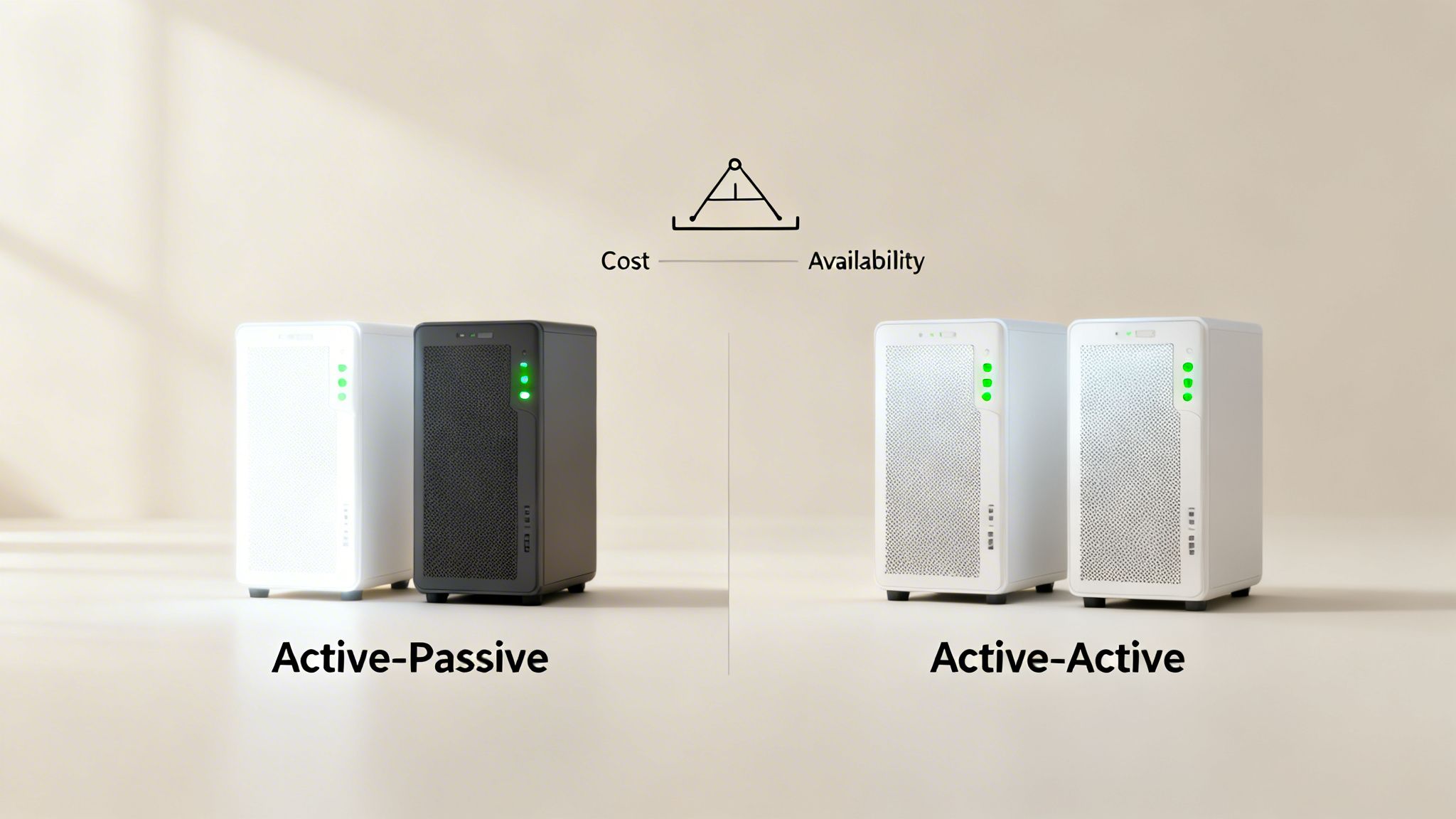
When architecting a system for resilience, the active-active vs. active-passive debate comes up fast. It’s more than a technical choice; it’s a business decision. The right answer isn’t about which model is "better," but which one aligns with your real-world needs for uptime, performance, and budget.
This breakdown cuts through the jargon to walk through the six critical factors that matter most when deciding between these two models. This is from the perspective of CTOs, DevOps leads, and architects who must balance the ideal with the practical, whether building a regional SaaS app or a global payment gateway.
Availability and Failover Speed
This is where the two models diverge most sharply. An active-passive setup is built for high availability, but not continuous availability. When the primary node fails, a failover process kicks in. You'll have a brief, but noticeable, period of downtime as traffic is rerouted to the standby node. This Recovery Time Objective (RTO) can range from seconds to minutes—often perfectly acceptable for internal tools or B2B platforms where a momentary blip is tolerable.
An active-active architecture is designed to eliminate downtime entirely. All nodes are live, so if one fails, it’s not a "failover" in the traditional sense. A global load balancer simply stops sending it requests, and the other nodes pick up the slack instantly. For users, the experience is seamless, resulting in a near-zero RTO.
The core trade-off here is between recovering from downtime (active-passive) and avoiding downtime altogether (active-active). For a fintech application processing millions in transactions, even seconds of downtime are unacceptable, making active-active the only viable option.
Performance and Latency
With an active-passive model, you funnel all traffic to a single active server. This simplicity can become a bottleneck during peak hours, as your system's capacity is limited to what that single node can handle. You can scale that server vertically (add more power), but you leave the combined power of your full infrastructure on the table.
This is where active-active truly shines. By distributing traffic across multiple servers, often in different geographic regions, you get two massive wins:
- Load Balancing: No single server gets overwhelmed, which means consistently faster response times for all users.
- Reduced Latency: You can route users to the data center closest to them. For a global e-commerce site, sending a customer in Paris to your Frankfurt data center instead of one in Virginia is a game-changer for user experience.
Active-Active vs. Active-Passive Feature Comparison
| Criterion | Active-Passive Architecture | Active-Active Architecture |
|---|---|---|
| Availability | High (e.g., 99.9% to 99.99%) | Continuous (e.g., 99.999%+) |
| Failover | Brief downtime (seconds to minutes) | Instantaneous and seamless |
| Performance | Limited to a single active node | Distributed across all nodes for higher throughput |
| Latency | Dependent on the location of one data center | Minimized with geo-routing to the nearest node |
| Cost | Lower; standby hardware is underutilized | Higher; requires more active hardware and sophisticated software |
| Complexity | Simpler to manage and troubleshoot | Complex; requires distributed systems expertise |
| Data Consistency | Easier to manage (single writer) | Challenging; requires multi-master replication strategies |
| Scalability | Primarily vertical (scaling up) | Primarily horizontal (scaling out) |
This table makes the trade-offs clear: simplicity and cost-effectiveness on one side, versus near-perfect uptime and superior performance on the other.
Infrastructure and Operational Cost
Cost is a huge factor in the active-active vs. active-passive decision. Active-passive is unquestionably the more budget-conscious choice. You pay for the standby hardware, but operational simplicity and potentially lower software licensing costs keep the total cost of ownership down. The main drawback is that your standby infrastructure is a sunk cost waiting for a disaster.
Active-active comes with a significantly higher price tag, and the costs stack up quickly:
- Hardware: You're running and maintaining multiple fully active server environments, often in pricey, geographically separate data centers.
- Software: This model demands sophisticated global load balancers and robust data replication technologies, which are not cheap.
- Operational Overhead: Managing a complex distributed system requires a larger, more specialized engineering team and a serious investment in automation and tooling.
Complexity and Management
If you value simplicity, active-passive is your ally. With only one node handling writes and traffic at any given moment, tasks like troubleshooting, patching, and maintenance are far more straightforward. Data replication is a simple one-way street from active to passive, which minimizes consistency issues.
Active-active is a different beast entirely, introducing a massive layer of complexity. Your engineering teams must solve some of the hardest problems in distributed systems: multi-node data synchronization, global session management, and write-conflict resolution. Getting this right requires deep expertise and a mature DevOps culture. To get a feel for what’s involved, you can dive into microservices architecture best practices, as many of the principles overlap.
Data Consistency
In an active-passive setup, maintaining data consistency is a relatively solved problem. Since only one database node accepts writes, you can use standard synchronous or asynchronous replication to keep the standby node up to date. It’s a well-understood process.
In an active-active world, data consistency becomes one of your biggest challenges. When multiple nodes across the globe are accepting writes simultaneously, you're at constant risk of data conflicts, race conditions, and corruption. This requires a rock-solid strategy, which usually involves complex multi-master replication, globally distributed databases, or designing your application to handle eventual consistency. This isn't just an operational challenge—it adds significant development effort.
Scalability
Both architectures can scale, but they do so in fundamentally different ways. An active-passive system primarily scales vertically. To handle more load, you add more CPU, RAM, or faster storage to the active node. This works, but only up to a point. You eventually hit physical hardware limits, and each upgrade becomes exponentially more expensive.
Active-active architectures are designed for horizontal scalability. Need to handle more traffic? Just spin up another active node and add it to the cluster. This model provides a clear path to almost limitless, cost-effective growth, making it the go-to choice for hyper-growth startups and global enterprises.
How to Choose the Right Architecture
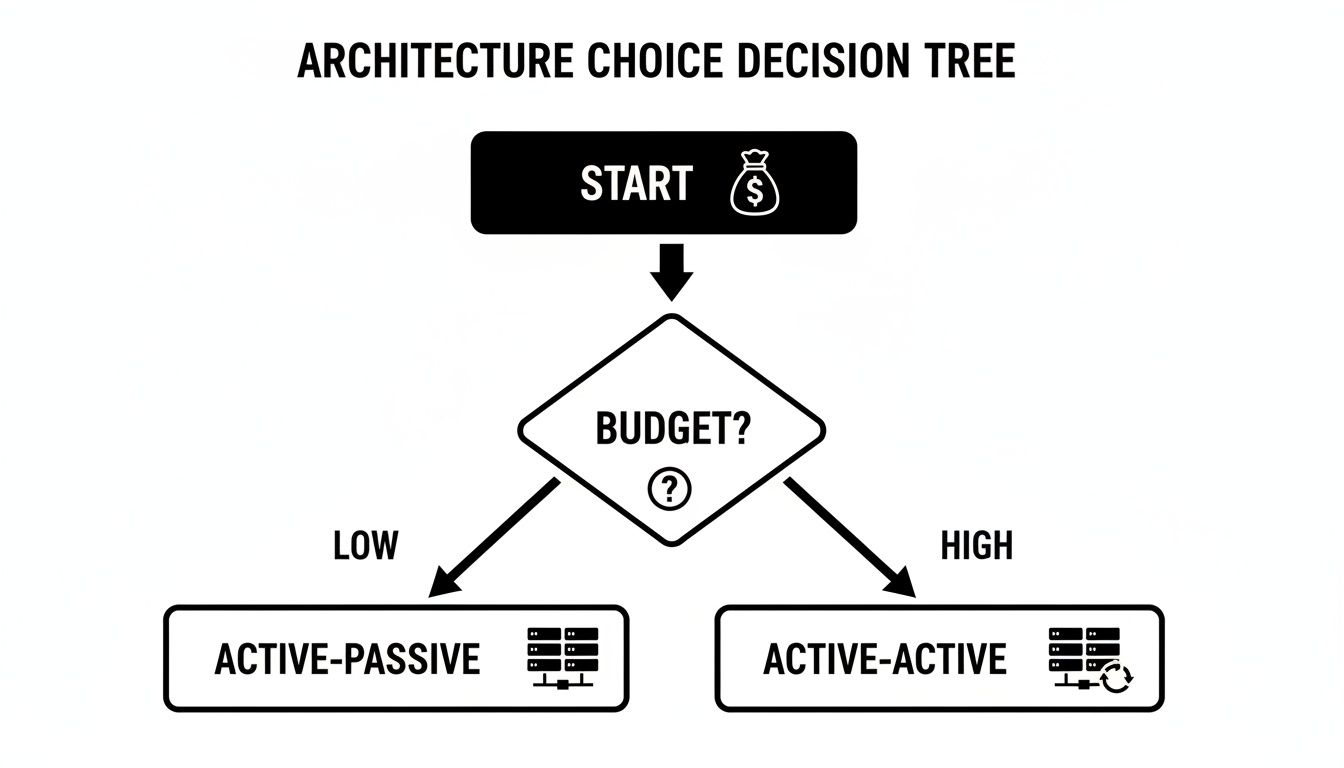
Deciding between an active-active vs active-passive setup is a strategic choice that must align with your business's current stage, risk tolerance, and growth plans. The "right" architecture isn't a one-size-fits-all solution; it's the one that solves today's problems while enabling tomorrow's opportunities. This decision comes down to a clear-headed assessment of your uptime requirements, user expectations, and budget.
When to Choose Active-Passive
This model is the pragmatic choice for many businesses, particularly when absolute continuous availability is not the primary driver.
- Startups and MVPs: For new companies building a Minimum Viable Product (MVP), active-passive is the clear winner. The goals are to validate an idea and achieve product-market fit without burning cash. This model is simple, lean, and cost-effective, allowing your team to focus on feature development, not complex infrastructure.
- Internal Tools and Non-Critical Applications: Systems like internal dashboards, CRMs, or content management systems can typically tolerate a few minutes of downtime during a failover. Active-passive provides sufficient reliability without the high cost and complexity of an active-active setup.
- Budget-Constrained Environments: When cost is a primary constraint, active-passive provides a strong balance of resilience and affordability.
For an MVP, the goal is market validation, not building an impenetrable fortress. An active-passive configuration offers robust protection without diverting critical resources from innovation.
When to Choose Active-Active
This architecture is reserved for systems where downtime is not an option and performance is paramount.
- Fintech, E-commerce, and Regulated Industries: In banking, payment processing, and high-volume e-commerce, trust and continuous availability are foundational. For these organizations, active-active is a non-negotiable requirement. Even seconds of downtime can cause failed transactions, data integrity issues, and significant financial penalties.
- Global SaaS Platforms: For a SaaS company with a worldwide user base, latency is a major obstacle. An active-active architecture is crucial for delivering a fast, responsive experience to a global audience. By deploying active nodes in multiple geographic regions, you can route users to the nearest data center, drastically reducing latency.
- High-Growth, Scalable Applications: The horizontal scalability of active-active is essential for handling rapid growth. When a marketing campaign brings a flood of new users, you can simply add more nodes to handle the load without a drop in performance.
Planning for Architectural Evolution
The choice is not permanent. Many successful companies begin with a practical active-passive setup to launch quickly and iterate. As the business scales and expands globally, they strategically migrate to an active-active model. A phased migration is key:
- Define the Tipping Point: Identify the business metrics—such as revenue lost per minute of downtime or user growth rate—that will signal it's time to transition.
- Modularize Your Application: Refactor your application into smaller services that can be moved individually. Adopting microservices architecture best practices provides a strong roadmap for this process.
- Migrate Incrementally: Begin by moving less critical services to an active-active model. This allows your team to build expertise and refine the process before touching core, mission-critical systems.
This evolutionary approach ensures your infrastructure investment always aligns with your business needs, preventing over-engineering in the early days while guaranteeing resilience when it matters most.
Key Implementation and Operational Insights
Moving from an architectural blueprint to a live, resilient system is where the real work begins. The success of either an active-active or active-passive setup depends not just on the design, but on the details of implementation and the rigor of day-to-day operations.
This is where theory meets practice. It involves the 'how-to' of building a system that can withstand failure, from the specifics of load balancing and data replication to managing application state and conducting relentless testing.
Load Balancing and Database Replication Strategies
A smart load balancer is the heart of any HA architecture. In an active-passive system, its job is simple: monitor the primary server and, if it fails, reroute all traffic to the standby. For an active-active setup, the task is far more sophisticated. It must use intelligent routing rules—like geo-proximity or least connections—to distribute traffic efficiently across all active nodes.
Database replication is another critical decision point with significant trade-offs:
- Synchronous Replication: A write is confirmed only after it's saved on both the primary and replica databases. This delivers an RPO of zero (no data loss) but introduces latency, making it a better fit for active-passive systems within the same data center.
- Asynchronous Replication: The primary database confirms a write instantly and then copies it to the replicas. This provides low latency but carries the risk of losing a few seconds of data if the primary fails. This is a common trade-off for geographically dispersed active-active systems.
Application State and Operational Best Practices
How your application handles user session data, or "state," greatly influences your architectural choice. Stateless applications are a perfect match for active-active, as any server can process any request without needing prior context. In contrast, stateful applications that store session data locally create challenges and often require an external solution like Redis to share state across all nodes in an active-active cluster.
Operational readiness isn't about having a failover plan in a document. It's about a culture of constantly proving that the plan works. Automated, frequent failover drills are the only way to build confidence that your system will perform as expected when things go wrong.
Keeping data consistent across distributed systems is non-negotiable. While both architectures require solid monitoring, active-active demands a much closer watch on metrics like replication lag and data conflicts. Creating clear operational playbooks and automating extensively is vital for managing this complexity. Many of these principles are also covered in our guide to microservices architecture best practices.
Ultimately, choosing between active active vs active passive is just the first step. True resilience is built on disciplined implementation and a proactive operational culture that treats testing and monitoring as mission-critical, not as afterthoughts.
Summary and Next Steps
The active-active vs active-passive debate is a pivotal strategic decision. There is no single "best" answer—only the right fit for your specific business context.
- Active-Passive is the practical, cost-effective choice for startups, SMBs, and applications where minor, brief downtime is acceptable. It prioritizes simplicity and controlled spending while still providing strong high availability (99.9%).
- Active-Active is the required standard for mission-critical systems in fintech, global e-commerce, and enterprise SaaS where continuous availability (99.999%+) and low-latency performance are non-negotiable. It offers superior resilience and scalability at a higher cost and complexity.
Actionable Next Steps:
- Assess Your Uptime Requirement: Quantify the business impact of one minute of downtime. Is it a minor inconvenience or a significant financial loss? This will be your primary guide.
- Evaluate Your Budget and Team: Be realistic about your financial constraints and your team's expertise in managing complex distributed systems.
- Map Your Growth Trajectory: Choose an architecture that solves today's needs but also provides a clear, evolutionary path for the future. Consider starting with active-passive and planning a phased migration to active-active as you scale.
At Group 107, our expertise is in designing and building resilient, scalable infrastructure that directly supports your business goals. Our DevOps team can guide you through the complexities of high availability and deliver an architecture that performs. Learn how we can accelerate your growth.