
Slow, clunky software drives customers away. The difference between an application that performs and one that fails isn't just about writing code—it's about writing smart code. This is the core of algorithm design and analysis, the strategic blueprint for how your software solves problems.
Getting this right isn't just a technical detail; it's a critical business driver for any SaaS, e-commerce, or enterprise platform seeking a competitive edge.
Why Algorithm Design and Analysis Is a Business Imperative
A well-designed algorithm enables an application to handle a sudden surge in users without faltering. A poorly chosen one leads directly to bloated cloud bills, poor user experience, and customer churn.

Smart algorithmic choices create responsive user experiences, reduce infrastructure costs, and build a significant competitive advantage. This discipline directly impacts your bottom line by turning technical efficiency into measurable business results.
The Business Case for Algorithmic Efficiency
At its heart, algorithm design is problem-solving under real-world constraints like time, memory, and budget. The goal is not just a solution that works, but one that is ruthlessly efficient. That efficiency translates directly to the balance sheet.
- Benefit: An e-commerce site that shaves milliseconds off its product search can see a measurable lift in conversion rates.
- Benefit: A fintech app that processes transactions more efficiently can handle higher volume without scaling up expensive hardware.
These are not just technical victories; they are tangible business outcomes.
As we push the boundaries of automation, it's worth watching developments like the world's first autonomous AI software engineer, which offers a glimpse into the future of automated problem-solving and efficiency at scale.
From Theory to Tangible Results
Algorithm analysis provides a predictive lens into your software's future performance. It empowers you to answer critical business questions before they become production emergencies:
- Will a new feature grind the entire application to a halt as we scale?
- Can our infrastructure handle a Black Friday traffic surge without crashing?
- Are we overspending on cloud services due to inefficient code?
Mastering these principles transforms development from reactive firefighting to proactive, strategic engineering. Your teams can build systems designed not just for today's needs, but for the demands of tomorrow. To effectively measure these performance metrics, learn more by mastering how to analyze quantitative data to drive smarter decisions.
Core Strategies for Solving Complex Problems
When faced with a complex software challenge, you don't need to reinvent the wheel. Experienced engineers rely on a playbook of fundamental algorithm design strategies that serve as proven roadmaps for building efficient, scalable systems.
These strategies provide a structured framework to deconstruct a problem and engineer a high-performing solution. Knowing which tool to apply is the first step toward building an application that excels under pressure, whether it's an e-commerce platform, a SaaS application, or a high-frequency trading system.
Divide and Conquer
The Divide and Conquer strategy breaks a large, complex problem into smaller, more manageable sub-problems. Each piece is solved independently, and the solutions are then combined to solve the original challenge.
A classic example is the Merge Sort algorithm. To sort a list of one million customer records, a naive approach would fail. Merge Sort repeatedly splits the list until it has tiny, easy-to-sort lists, then efficiently merges them back into a single, perfectly sorted result.
- Business Application: In a DevOps and cloud management context, a massive CI/CD test suite can be divided and run in parallel across multiple machines. The results are aggregated at the end, dramatically reducing build validation time and accelerating time-to-market.
Greedy Algorithms
A Greedy Algorithm makes the locally optimal choice at each step, hoping that a series of short-term wins will lead to a globally optimal solution. It focuses on the best immediate move without overanalyzing downstream consequences. While not always perfect, it's incredibly fast and effective for many optimization problems.
Consider a logistics platform calculating a delivery route. At each junction, a greedy algorithm might choose the road with the least traffic right now, making a series of instantaneous, locally optimal choices to build an efficient route.
- Real-World Example: A fintech platform might use a greedy algorithm for portfolio construction, selecting the most profitable assets available at each stage to quickly assemble a high-yield portfolio. This prioritizes speed and immediate value.
Dynamic Programming
Dynamic Programming (DP) is a more deliberate strategy for problems with overlapping sub-problems. It breaks down a complex problem but, crucially, saves (memoizes) the result of each sub-problem to avoid re-computation. This focus on memory and efficiency makes it ideal for optimization challenges.
Imagine building a system to calculate the shortest shipping route with multiple stops. A DP approach would determine the best route between two points and store that result. When calculating a longer route involving those same two points, it reuses the stored solution instead of re-calculating, saving significant time.
- SaaS Example: A project management tool can use DP to identify the critical path for a project with many dependent tasks. It finds the most efficient schedule without re-analyzing the same task sequences, helping teams allocate resources effectively.
- Business Impact: In bioinformatics, DP is essential for DNA sequence alignment, where finding similarities in massive genetic datasets would be computationally impossible without it. This accelerates research and drug discovery.
These are not just abstract computer science concepts. Divide and Conquer, Greedy algorithms, and Dynamic Programming are the battle-tested foundations enabling the fast, reliable, and scalable systems that modern businesses depend on.
Predicting Performance with Complexity Analysis
How do you ensure an application built for 100 users won't collapse under the load of 100,000? The answer isn't guesswork; it's complexity analysis. This discipline moves beyond timing code with a stopwatch to understanding its fundamental growth rate, predicting how performance will scale as data and user load increase.
This is where you learn to speak in Big O notation—a powerful language for measuring an algorithm's efficiency. It helps you identify why one solution is a rocket ship and another is a sinking stone before you write a single line of production code. This predictive capability is what separates scalable, robust systems from those that crack under pressure.
Understanding Big O Notation
Big O notation provides a high-level view of an algorithm's runtime or memory usage as the input size (n) grows. It describes the worst-case scenario, which is precisely what engineers must plan for when building reliable software.
Consider searching for a single customer in a database of one million records:
- An efficient binary search has a complexity of O(log n). It can find the customer in about 20 steps.
- A naive linear search has a complexity of O(n), requiring up to one million steps.
- A sluggish, poorly designed algorithm might have O(n²) complexity, requiring a staggering one trillion steps.
Formalizing this type of analysis became standard practice in the 1970s, heavily influenced by Donald Knuth's foundational work, The Art of Computer Programming. You can explore this history by learning about the evolution of algorithmic thinking.
The strategies below are what complexity analysis helps us evaluate.
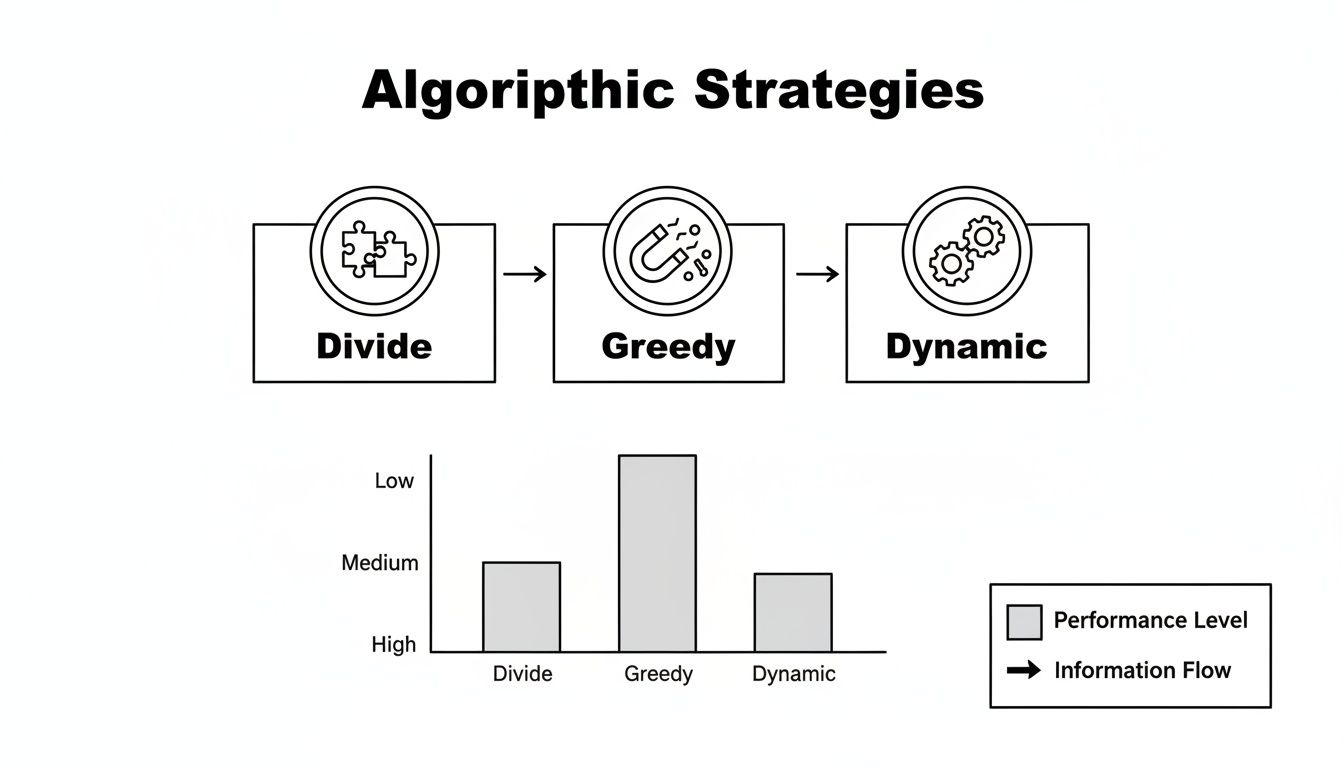
As this shows, different approaches yield vastly different performance outcomes—a crucial insight confirmed through complexity analysis.
Big O Notation Cheat Sheet for Business Impact
Understanding a few common Big O classifications can immediately help you identify potential performance bottlenecks and their business implications.
| Big O Notation | Name | Performance Impact | Example Use Case |
|---|---|---|---|
| O(1) | Constant | Excellent. Performance is fixed, regardless of data size. The gold standard. | Accessing an array element by its index. |
| O(log n) | Logarithmic | Very Good. Scales exceptionally well; performance degrades very slowly. | Finding an item in a sorted database (binary search). |
| O(n) | Linear | Good. Performance scales directly with data size. Acceptable for many tasks. | Iterating through a list to send a marketing email to all users. |
| O(n log n) | Log-linear | Fair. The workhorse of efficient sorting. Handles large datasets effectively. | Sorting a product catalog by price or popularity. |
| O(n²) | Quadratic | Poor. Becomes unusable quickly as data grows. A major red flag. | A naive algorithm comparing every element in a list to every other. |
| O(2ⁿ) | Exponential | Terrible. Only feasible for tiny datasets. Often indicates a brute-force approach. | Solving certain combinatorial problems without optimization. |
Each notation tells a story about future costs, user satisfaction, and scalability. Choosing wisely is a strategic advantage.
Why This Matters for Your Business
Selecting the right algorithm is a direct financial and strategic decision that impacts your bottom line.
- Reduced Infrastructure Costs: An O(log n) algorithm requires far less CPU and memory than an O(n²) one, directly lowering your monthly cloud bill.
- Improved User Experience: Fast, responsive applications lead to higher customer satisfaction, retention, and conversion rates.
- Future-Proof Scalability: By analyzing complexity upfront, you build systems that handle growth predictably, avoiding costly refactors when you hit a performance wall.
Ultimately, complexity analysis provides the framework to make informed trade-offs between speed, cost, and development time. It is a foundational skill for any team aiming to build high-quality digital products.
Algorithms in Action Across Modern Industries
The real value of algorithm design and analysis is most evident when applied to solve tangible business problems. From fintech to e-commerce, efficient algorithms are the engines driving performance, user experience, and profitability. These logical blueprints turn abstract goals into measurable outcomes.

Here is how specific algorithmic applications create a competitive edge in sectors Group107 and Group107 Digital serve.
Fintech Security and Fraud Detection
The financial technology sector runs on trust and speed. Identifying fraudulent activity in real time is a mission-critical task perfectly suited for graph algorithms.
Fintech platforms can model their transaction network as a graph, where users are nodes and transactions are edges. By applying pathfinding and clustering algorithms, these systems can:
- Identify fraud rings: Graph algorithms can detect hidden networks of criminals laundering money or using stolen credentials by spotting unusual connections that simple rules-based systems would miss.
- Calculate real-time risk scores: By analyzing a new user's proximity to known fraudulent accounts, these algorithms generate risk scores to block suspicious activity before damage occurs.
- Optimize transaction routing: For legitimate payments, algorithms find the fastest, most cost-effective path through banking networks, minimizing fees and settlement times.
This approach transforms security from a reactive, manual review process into a proactive, automated defense that protects both the business and its customers.
E-commerce Performance and Personalization
In e-commerce, speed is revenue. A delay of just a few hundred milliseconds in search results can send a potential customer to a competitor. Hyper-efficient sorting and searching algorithms are the unsung heroes of high-converting online stores.
The process often involves a two-step approach:
- Indexed Searching: Using structures like inverted indexes, the system can instantly retrieve all products matching a search query.
- Relevance-Based Sorting: A secondary algorithm then sorts these results based on a complex formula weighing relevance, popularity, reviews, and profit margin, delivering the best options to the user in a blink.
Beyond search, recommendation engines use collaborative filtering algorithms to suggest products based on a user's browsing history and the behavior of similar shoppers. This personalizes the experience, directly increasing conversion rates and average order value. To see how this is evolving, explore the applications of computer vision in retail.
DevOps and CI/CD Pipeline Optimization
For development teams, "developer wait time" is a significant productivity killer. Scheduling algorithms are critical for optimizing CI/CD (Continuous Integration/Continuous Deployment) pipelines, ensuring code moves from development to production as efficiently as possible.
A well-optimized pipeline doesn't just run jobs sequentially; it intelligently manages limited resources like build servers. Scheduling algorithms prioritize critical builds, execute tasks in parallel, and manage dependencies to create the most efficient sequence.
This algorithmic orchestration can slash deployment cycles from days to hours. It accelerates time-to-market and frees up developers to innovate instead of waiting, directly fueling business growth.
Turning Theory Into High-Performing Code
Knowing the right algorithm is one thing; translating that theory into code that performs flawlessly in the real world is another. This is where abstract concepts become tangible business value and where smart decisions directly impact performance and budget.
It starts with choosing the right data structure. For fast lookups, a hash map provides near-instant O(1) access. Trying to achieve the same with an array search is an O(n) operation that slows to a crawl as data grows. That single choice can be the difference between a happy user and a lost customer.
A Framework for Pragmatic Implementation
In the real world, theoretical perfection must be balanced with deadlines and budgets. The "perfect" algorithm may be too complex or time-consuming to implement. The key is to make intelligent trade-offs that deliver maximum impact without over-engineering.
Follow this practical framework for implementation:
- Prioritize Correctness First: Before optimizing for speed, ensure the algorithm works correctly. Test relentlessly with edge cases like empty inputs, single-item lists, and maximum values. Solid unit tests are non-negotiable.
- Profile Before You Optimize: Never guess where your bottlenecks are. Use a profiler to pinpoint the exact functions or lines of code that are consuming the most resources. This data-driven approach ensures you focus your efforts where they will have the biggest payoff.
- Write for Maintainability: Code is read far more often than it is written. Use clear variable names, break complex logic into smaller functions, and write comments that explain the why, not just the what.
The most elegant algorithm is worthless if it's implemented incorrectly or is so complex that no one on the team can maintain it. The goal is production-ready code that is both efficient and clear.
This practical mindset empowers your teams to build software that doesn't just work, but excels under pressure. For your business, that means faster applications, more satisfied users, and a more reliable product. For data-heavy applications, our guide on database performance tuning offers additional strategies for maintaining peak performance.
Connecting Modern Code to Foundational Principles
These implementation principles are built on decades of computer science. The groundwork was laid in the 1940s and 1950s with algorithms we still use today, like Merge Sort (1945), Hamming codes (1950), and Kruskal's algorithm (1956).
The arrival of FORTRAN in 1954 gave developers the first high-level language to implement these powerful ideas at scale. You can explore a timeline of these foundational algorithms to see how early breakthroughs continue to shape the software we build today. It's a reminder that behind every high-performing modern system is a well-chosen and well-implemented algorithm.
Summary and Next Steps
Mastering algorithm design and analysis is not a one-time task but a continuous discipline for building smarter, more resilient software. By embedding these principles into your development process, you create technology that delivers measurable business value through superior performance and efficiency.
When you shift from just shipping features to engineering with purpose, you directly impact your bottom line by reducing cloud spend, improving customer retention, and accelerating time-to-market.
Your Actionable Roadmap
Putting these concepts into practice starts with a clear plan. Use this framework to embed algorithmic thinking into your team and drive immediate impact.
- Conduct a Performance Audit: Use profiling tools to identify the most critical and resource-intensive parts of your application. Pinpoint the specific functions or processes that are creating bottlenecks or consuming excessive memory. This data-first approach ensures your efforts are focused where they matter most.
- Establish Team Learning Initiatives: Empower your development teams with the knowledge to succeed. Organize workshops, use code reviews as a forum for discussing performance, and provide access to high-quality learning resources like the Parakeet-AI blog. An informed team makes better architectural decisions.
- Define and Track Scalability Metrics: You can't improve what you don't measure. Establish clear Key Performance Indicators (KPIs) for your systems, such as response time under load, transaction throughput, and infrastructure cost per user. Tracking these metrics validates the impact of your optimizations and guides future efforts.
Strategic algorithm design isn't about premature optimization. It's about making deliberate, informed choices that prevent future performance issues and ensure your technology can scale with your business.
Partner for Scalable Growth
Building and maintaining high-performance, scalable systems requires deep expertise. For many companies, partnering with a specialized team is the most direct path to success. An expert partner brings the knowledge needed to fast-track your progress, ensuring your technology is efficient, robust, and ready for future growth.
At Group107, we integrate algorithm design and analysis into every project. Whether you're building a SaaS MVP, overhauling a fintech platform, or optimizing an enterprise system, our approach ensures you make the smart architectural decisions that deliver tangible results.
If you’re ready to build software that performs flawlessly at scale and drives real business growth, let's connect. We can help you turn your vision into a high-performing reality.
Frequently Asked Questions
Here are straightforward answers to common questions we receive from business leaders, product managers, and developers about algorithm design and analysis.
Why can't I just use a library and ignore algorithm details?
Using a library without understanding its underlying mechanics is like driving a high-performance car without knowing how to use the gearbox. Libraries are powerful tools, but they are not magic. Blindly choosing a function with poor computational complexity—like an O(n²) operation—for a large dataset will cause your application's performance to degrade as you scale. A solid grasp of algorithm analysis empowers you to make intelligent choices, diagnose performance bottlenecks, and build systems that are truly scalable.
How does algorithm choice impact our cloud infrastructure costs?
Your choice of algorithms has a direct, measurable impact on your bottom line. In a pay-as-you-go cloud environment like AWS or Azure, an inefficient algorithm that consumes excess CPU and memory translates directly into a higher monthly bill. An optimized algorithm runs faster and uses fewer resources, which can slash your compute costs by allowing you to run on smaller, cheaper instances. For data-intensive workloads, this can reduce processing times from hours to minutes, unlocking massive savings.
When should we focus on algorithm optimization in development?
Deciding when to optimize is a strategic balancing act. The timing depends on your product's lifecycle stage:
- MVP Stage: When building a Minimum Viable Product, speed to market is paramount. A "good enough" algorithm is often the right choice, as long as the architecture doesn't create future roadblocks.
- Growth Stage: As your user base and data volumes increase, performance issues will surface. This is the ideal time to conduct performance audits and dedicate development cycles to optimizing identified bottlenecks.
- Enterprise/Critical Systems: For applications in fintech, government, or other mission-critical sectors, performance and reliability are non-negotiable from day one. Rigorous algorithm design and analysis must be a core part of the initial architecture.
At Group107, we build strategic algorithm design into every project to create software that’s efficient, scalable, and ready for whatever comes next. If you’re ready to transform your vision into a high-performing reality, visit us at group107.com to see how we can help.