
In practical terms, digital transformation consulting services rewire your entire business for today’s market, using technology as the engine for change. This isn't just an IT project; it’s a fundamental overhaul of your operations, culture, and customer experience to ensure your tech investments directly serve your business goals. This guide explains how to leverage these services for measurable growth, efficiency, and a sustainable competitive advantage.
What Are Digital Transformation Consulting Services?
A digital transformation consultant is both the architect and the general contractor for your business’s future. We don’t just hand you a blueprint; we ensure the foundation is solid, internal systems run efficiently, and the entire structure is built to handle future growth. It's a strategic partnership designed to turn a high-level vision into a functional, revenue-generating reality.
For a scaling SaaS company, this means building a minimum viable product (MVP) that won’t buckle under rapid user growth. For an established enterprise, it could mean modernizing legacy systems to reduce technical debt and increase agility. The goal is always the same: use technology to solve real business problems and build a lasting competitive edge.
Aligning Technology with Business Goals
The true value of digital transformation consulting lies in the direct line it draws between a technology investment and a measurable business outcome. Instead of adding new tech for its own sake, every decision is tied to a strategic objective. This focus ensures resources are spent on initiatives that will actually move the needle.
We help clients achieve critical objectives like:
- Capturing New Market Segments: Building digital products or services that open doors to previously unreachable customer bases.
- Boosting Operational Efficiency: Automating manual processes, optimizing workflows, and cutting overhead with smarter, integrated systems.
- Enhancing Customer Experience: Designing seamless, intuitive digital journeys that foster loyalty and increase lifetime value.
- Future-Proofing Against Disruption: Creating a flexible, resilient infrastructure that can pivot when the market shifts or new competitors emerge.
A consultant's job is to transform your technology stack from a cost center into a growth engine. We provide the roadmap, expert teams, and project oversight needed to turn ambitious goals into market-ready solutions.
An Essential Investment for Growth
In today's market, standing still is the same as falling behind. Whether you’re a fintech innovator building a secure payment platform or an SMB competing against larger players, smart technology adoption is non-negotiable. This is where effective digital transformation consulting services provide the seasoned expertise to guide you through the process successfully.
For example, a financial institution might partner with us to implement a robust DevOps and cloud infrastructure, gaining both top-tier security and the speed to innovate. This isn’t an expense; it’s a critical investment in your company's ability to compete and grow, allowing you to deliver value to customers faster and more reliably.
The Core Services That Drive Transformation
Let's get practical. Moving from a big-picture idea to real-world results is where effective digital transformation consulting services deliver value. Each service acts as a strategic lever; together, they rewire your company for growth, efficiency, and resilience. This is where strategy becomes working solutions that impact your bottom line.
The demand for this expertise is clear. The global market for digital transformation strategy consulting was valued at USD 123.8 billion in 2024 and is projected to reach USD 492 billion by 2033. This reflects a market-wide race to modernize, and a clear understanding that it can't be done alone.
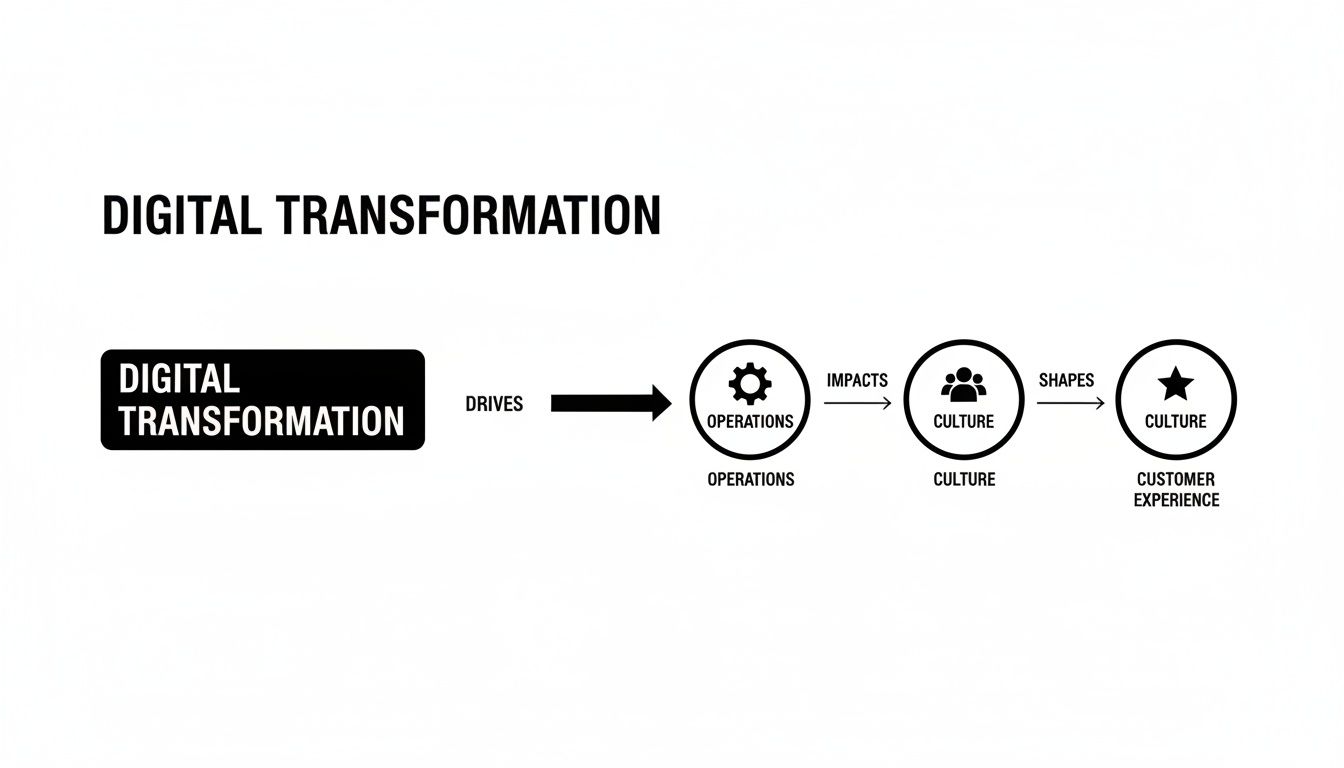
The key insight is that buying new tech isn't enough. True transformation happens when you improve operations, build a culture that embraces change, and deliver an exceptional customer experience—all at once.
Strategy and Discovery
Before a single line of code is written, every successful project starts with Strategy and Discovery. This is the blueprinting phase where we map your technology investments directly to your business goals to ensure we’re solving the right problems.
This hands-on process includes:
- Stakeholder Workshops: Aligning with leadership to define clear, measurable goals and the KPIs to track them.
- Market and Competitor Analysis: Identifying competitive advantages and market gaps where your digital product can win.
- Technical Feasibility Audits: Assessing your current systems to create a realistic, actionable roadmap for new development.
For a SaaS startup, this discovery phase is critical. It ensures their first product is built on a scalable foundation, preventing a costly and painful rebuild later on.
Dedicated Engineering Teams
Scaling an in-house tech team is slow and expensive. A core component of modern consulting is providing dedicated engineering teams—giving you access to top-tier talent without the overhead of recruiting and HR. These aren't temporary freelancers; they are seasoned professionals who integrate directly into your company and operate as a true extension of your team.
This approach offers the control and deep integration of an in-house team combined with the flexibility and efficiency of a global talent network. It’s the fastest way to accelerate your roadmap and fill critical skill gaps.
We specialize in helping businesses build new digital capabilities, from core infrastructure to customer-facing applications. A dedicated team brings the specialized skills needed to turn vision into reality—fast.
AI and Automation Integration
Artificial Intelligence (AI) and automation are powerful, practical tools for optimizing your business and creating superior customer experiences. By integrating these technologies, you can automate back-office work, deliver personalized interactions at scale, and unlock valuable insights from your data.
For an e-commerce company, this could be an AI-driven recommendation engine that understands customer behavior and increases average order value. For a finance company, it could be automating compliance checks to reduce risk and manual effort.
DevOps as a Service
Your ability to quickly release, test, and deploy new features is a massive competitive advantage. DevOps as a Service streamlines your development pipeline by implementing Continuous Integration and Continuous Deployment (CI/CD), automating the path from code to production.
This service radically cuts time-to-market, reduces deployment errors, and enhances system stability. For a fintech company, this means deploying a critical security patch in minutes instead of weeks. This often goes hand-in-hand with an updated infrastructure plan, which you can explore in our guide to creating an enterprise cloud migration strategy.
Security and Accessibility
In a world filled with cyber threats and evolving regulations, building unbreakable trust with your users is non-negotiable.
- Security & Compliance: We integrate security from day one through proactive threat modeling, penetration testing, and implementing airtight protocols to safeguard user data—essential for our fintech and government clients.
- Accessibility Audits: Ensuring your digital products are usable by everyone, including people with disabilities, isn't just about meeting WCAG standards. It’s smart business that opens your product to a wider audience and demonstrates inclusivity.
The Real-World Business Impact of Transformation

Investing in technology is one thing; seeing it directly improve your P&L is another. The entire purpose of digital transformation consulting services is to draw a straight line from complex technical work to tangible, bottom-line results.
Transformation isn’t about chasing trends. It's about hitting specific, measurable goals that fall into three key areas: growing revenue, cutting operational costs, and improving customer loyalty. With an experienced partner, technology ceases to be an expense and becomes the engine driving these critical metrics.
The market validates this. The tech consulting sector, the engine room for digital transformation, is projected to exceed $400 billion in 2026. This is driven by the fact that 84% of business buyers are planning tech upgrades in the next year, and 94% plan to increase spending on digital initiatives in the next 18 months.
Accelerating Revenue and Market Share
A sharp digital strategy directly fuels top-line growth. By building better products, entering new markets, and optimizing sales processes, you can unlock new revenue streams and capture greater market share.
Real-World Example: A fintech startup needs to launch a secure, user-friendly mobile app to market quickly. They partner with a dedicated engineering team to accelerate development.
- Outcome: The app’s seamless UX and robust security lead to a 3x increase in user acquisition within six months.
- Business Impact: This rapid growth attracts a new round of venture capital funding, solidifying the company's market position and funding future innovation.
Slashing Operational Costs and Boosting Efficiency
One of the quickest wins in digital transformation is eliminating operational waste. By modernizing legacy infrastructure and implementing automated workflows, businesses can dramatically lower their overhead.
For many companies, legacy systems and manual processes are a silent drain on the budget. Smart DevOps optimization plugs that leak, converting a major expense into a strategic advantage by freeing up capital for innovation.
Real-World Example: An enterprise is burdened by an inefficient, costly cloud setup. Deployments are manual and take weeks.
- Outcome: A DevOps expert overhauls their infrastructure, implementing a CI/CD pipeline and optimizing their cloud architecture. This results in a 40% reduction in monthly cloud costs.
- Business Impact: The savings are reallocated to fund a new data science team. The automated pipeline shrinks the software release cycle from weeks to days, enabling a near-instant response to market changes.
Enhancing Customer Retention and Lifetime Value
It costs far more to acquire a new customer than to retain an existing one. Digital transformation provides the tools to earn loyalty by creating personalized, high-value experiences that keep customers engaged. For a closer look, read our guide on applying key digital transformation best practices.
Real-World Example: An e-commerce brand is struggling with high customer churn due to a clunky user journey and a lack of personalization.
- Outcome: The company integrates an AI-powered recommendation engine and revamps its checkout process to be fully responsive and frictionless.
- Business Impact: Over the next year, customer retention increases by 25%, and average customer lifetime value (LTV) grows by 15%. The investment in a better experience creates a loyal base of repeat buyers.
How to Choose the Right Transformation Partner

Selecting a partner for your digital transformation is one of the most critical decisions your business will make. The right firm acts as a force multiplier for your growth, while the wrong one can lead to costly delays, technical debt, and wasted resources.
To make the right choice, look beyond the initial price tag to evaluate the long-term value a partner provides. This isn't just about hiring a coder; it's about finding a team that operates as a genuine extension of your own, bringing strategic guidance to the table, not just lines of code.
Create a Partner Evaluation Checklist
Before you start conversations, establish a clear framework for evaluating potential partners. A checklist of your non-negotiables ensures you compare every firm against the same high standard, making it easier to identify teams that can truly deliver.
Your evaluation should cover these key areas:
- Deep Technical Expertise: Do they have specialists or generalists? Look for proven, in-house experts in technologies crucial to your success, like DevOps as a Service, AI integration, or secure development.
- Relevant Case Studies: Demand to see their work. Vague success stories are a red flag. You need concrete examples of problems they solved for companies in your industry and what the measurable business results were.
- Clear Engagement Models: How will you work together? A strong partner offers flexible yet clearly defined models, such as dedicated engineering teams that integrate with your organization for continuity and deep project knowledge.
- Robust IP Protection: Your intellectual property is your most valuable asset. The contract must include strict, unambiguous clauses stating that you retain 100% ownership of all code, designs, and data from day one.
A partner’s true value isn't their hourly rate. It's their ability to slash your time-to-market and build a resilient, scalable product. Prioritize proven expertise and a collaborative spirit over a low-cost bid that lacks substance.
Choosing a Partner: Commodity Provider vs. Strategic Partner
Not all digital transformation consulting services are created equal. You have low-cost commodity providers on one end and true strategic partners on the other. The first group provides temporary resources to complete a task; the second invests in your long-term success.
The difference is clear when you compare their approaches.
| Attribute | Commodity Provider | Strategic Partner (e.g., Group107) |
|---|---|---|
| Focus | Completing short-term tasks and delivering code. | Achieving long-term business outcomes and driving growth. |
| Team Structure | Provides individual freelancers or a shared resource pool. | Offers dedicated, fully-integrated teams that work only for you. |
| Expertise | Generalist skills across a wide range of technologies. | Deep, specialized expertise in key areas like DevOps, AI, and security. |
| Communication | Often limited to a project manager; lacks direct access to engineers. | Fully transparent with direct communication channels to the entire team. |
| IP Protection | Ambiguous or weak IP clauses that can create ownership risks. | Airtight IP protection, ensuring you own 100% of the work. |
| Outcome | A functional piece of software that may require future refactoring. | A scalable, secure, and market-ready product built for the future. |
Ultimately, choosing a partner is a strategic move that will define your company's trajectory. A commodity provider might seem like a bargain, but the hidden costs of technical debt, missed deadlines, and security vulnerabilities can be crippling. A strategic partner like Group107, focused on dedicated teams and measurable results, provides the foundation for sustainable growth and a powerful competitive edge.
How the Partnership and Pricing Works
Understanding how you will engage with and pay for digital transformation consulting services is critical to making the right decision. The model you choose directly impacts your budget, team integration, and ability to adapt to change. It's about matching the financial model to your project's goals, whether it's a fixed-scope initiative or a product requiring continuous evolution.
The Dedicated Team Model
The Dedicated Team Model is like scaling your own engineering force without the headaches of recruiting and HR. It is ideal for long-term projects or companies needing sustained development velocity. You get a full-time, hand-picked team of engineers, project managers, and QA specialists working exclusively for you.
They become a true extension of your own crew, adopting your culture and integrating into your daily workflows. The benefits are significant:
- Predictable Costs: You pay a fixed monthly fee for the entire team, making budgeting straightforward and transparent.
- Deep Project Knowledge: Since the team is 100% focused on your work, they build unparalleled knowledge of your product, codebase, and business goals.
- Total Flexibility: You have complete control over the team's priorities. If market feedback or business needs shift, you can pivot instantly—perfect for agile development.
Project-Based Pricing
Project-Based Pricing is the best choice for a mission with a clearly defined scope and a fixed deadline. This model works exceptionally well for building a Minimum Viable Product (MVP), conducting a one-time accessibility audit, or migrating a specific application to the cloud.
We assess the project requirements and provide a single, fixed price for completion. This offers absolute budget certainty from day one. The trade-off is reduced flexibility; any scope changes or new ideas mid-project typically require a new quote, which can add cost and extend timelines.
Retainer-Based Consulting
If you don't need a full development team but require consistent, high-level strategic guidance, the Retainer-Based Model is the solution. You pay a recurring monthly fee to reserve a block of expert hours for technology roadmapping, strategic planning, performance tuning, or security advice.
This model ensures you always have an expert on speed dial to navigate tough decisions, without the commitment of a full-scale project. It’s ideal for companies with an in-house team that needs a specialized layer of expertise.
At Group107, our model leverages elite global talent to provide the benefits of a dedicated team with significant cost advantages. You get superior quality, complete control, and rock-solid security. To dive deeper, learn how different software development pricing models compare in our detailed guide.
Summary and Next Steps
True transformation is not a one-time project; it's a continuous commitment to evolving how you operate and serve your customers. The right partner provides the strategic insight and technical muscle to keep you ahead of the curve. Your path forward depends on your starting point—a nimble startup has different priorities than a major financial institution. The key is to take the right next step that moves you closer to your biggest goals.
For Startups and Product Companies
Your success depends on speed, scale, and product-market fit. You must move fast without accumulating technical debt that will require a costly rebuild later.
Your Actionable Next Steps:
- Map a Minimum Viable Product (MVP): Define a lean, actionable plan to build the core of your product. Focus on solving a real problem with a solution built to scale from day one.
- Scale Your Engineering Team: If you've found product-market fit but can't build fast enough, bring in reinforcements. A dedicated engineering team provides the horsepower to clear your backlog and accelerate your roadmap.
For Enterprises and Financial Institutions
Your challenges center on modernization, security, and efficiency. You're likely wrestling with legacy systems that hinder innovation while navigating a complex landscape of security and compliance requirements.
Your Actionable Next Steps:
- Modernize Legacy Systems: Begin replacing clunky, expensive platforms with modern, cloud-native architecture. This cuts operational costs and empowers your teams to innovate freely.
- Implement Secure DevOps: Integrate security into your development process with automated CI/CD pipelines. Ship updates faster and more reliably without last-minute security scrambles.
- Develop Next-Generation Fintech: Move beyond functional but frustrating platforms. Build secure, user-friendly experiences that simplify complex financial tasks.
No matter where you are, the goal is the same: turn your vision into a scalable, high-impact digital reality. That journey starts with a single step, and Group107 is ready to help you take it.
Frequently Asked Questions
Investing in your business's future naturally brings up questions. When it comes to digital transformation consulting services, clarity is key. Here are the most common questions we hear from organizations.
How Is Transformation Different from an IT Upgrade?
The two are worlds apart. An IT upgrade is tactical—swapping old tools for new ones, like updating servers or software. It's a refresh. Digital transformation is strategic—it fundamentally rethinks how your business operates to create new value.
An upgrade is like buying a better cash register. A transformation is building a complete e-commerce platform integrated with your inventory, customer data, and marketing automation. One makes a single task faster; the other changes how you sell, operate, and build customer relationships.
How Do You Measure the ROI of Digital Transformation?
We measure success with real-world business results, not technical jargon. The return on investment is tied directly to key performance indicators (KPIs) that demonstrate tangible improvement.
We track concrete outcomes, including:
- Lower Customer Acquisition Cost (CAC): Achieved by automating marketing and targeting higher-quality leads.
- Higher Customer Lifetime Value (LTV): Driven by creating superior user experiences that improve retention and loyalty.
- Faster Time-to-Market: Realized by implementing streamlined DevOps pipelines that cut feature deployment from months to days.
Measuring ROI isn't about the cost of the technology. It's about quantifying the business value that technology unlocks, from increased revenue to significant operational savings.
How Long Does a Typical Transformation Project Take?
There is no one-size-fits-all answer, as every business journey is unique. It’s best viewed as a phased journey, not a single project. We can deliver high-impact results, like a Minimum Viable Product (MVP), in just 3-6 months to provide quick wins and immediate value.
However, true, enterprise-wide change is an ongoing commitment. The initial project builds the foundation, but the full benefits come from continuous optimization and a culture that embraces new ways of working. A strong partner delivers early victories while equipping you with a roadmap for long-term growth.
Can My In-House Team Handle Digital Transformation?
Your internal team's business knowledge is invaluable, but they are often stretched thin with daily operations. Partnering with a consultant provides three critical advantages: speed, specialized skills, and an objective perspective.
An external firm brings a ready-made team of experts in specialized fields like AI, DevOps, or security, allowing you to move much faster than hiring. They also offer a fresh perspective, identifying bottlenecks and opportunities that can be invisible from the inside. This powerful combination accelerates results and reduces risk.