
In a market that moves at lightning speed, adaptability isn't just a strategic advantage; it's a core requirement for survival and growth. The agile development cycle is an iterative framework for building and delivering high-value products. It champions rapid delivery, continuous feedback, and constant improvement over rigid, traditional planning. This methodology empowers businesses to pivot on a dime, ensuring the product you build is always the product your customers need.
Why the Agile Development Cycle Is Your New Competitive Edge
Traditional project management methodologies, like Waterfall, are increasingly ill-suited for the modern digital landscape. In a world of shifting customer expectations and relentless technological advancement, the classic linear model—where one phase must be completed before the next begins—is a recipe for budget overruns, missed deadlines, and products that are obsolete by launch.
The agile development cycle fundamentally re-engineers this process.
At its core, Agile is a mindset focused on delivering tangible value in small, consistent increments and learning from real-world feedback. The goal is not just to build the product right, but to consistently build the right product.
This approach breaks down massive, complex projects into manageable iterations called sprints. Each sprint, typically lasting one to four weeks, produces a working, potentially shippable increment of the product. This structure unlocks significant business advantages that provide a real competitive edge.
Agile vs. Waterfall: A Practical Comparison
To understand Agile's impact, it’s useful to compare it directly with the Waterfall model. Waterfall is a linear path from start to finish, while the agile development cycle is a continuous loop of building, testing, and learning.
| Characteristic | Agile Development Cycle | Traditional Waterfall |
|---|---|---|
| Structure | Iterative & cyclical | Linear & sequential |
| Planning | Adaptive; plans evolve based on feedback | Fixed; extensive upfront planning |
| Delivery | Small, frequent releases of working software | One single, final product release |
| Feedback | Continuous; gathered after each cycle | Gathered only at the end of the project |
| Flexibility | High; changes are welcomed and integrated | Low; changes are difficult and costly to implement |
| Risk | Lower; spread across small, manageable cycles | High; concentrated in the final delivery |
This comparison highlights why modern development teams have embraced Agile. It is purpose-built for the dynamic reality of today's business environment.
Accelerate Time-to-Market and Increase ROI
By delivering working software in short cycles, Agile gets your product in front of real users faster. This early delivery is invaluable, providing immediate feedback that can be integrated into the next sprint. This tight feedback loop ensures that development efforts remain focused on features customers truly value, preventing wasted time and resources on unused functionality.
This directly translates to measurable business outcomes:
- Faster Revenue: Launching a Minimum Viable Product (MVP) allows you to start generating revenue and collecting user data much sooner.
- Reduced Risk: Building iteratively mitigates the financial risk of large-scale projects. If a feature fails to resonate with users, you can pivot quickly without scrapping months of work.
- True Adaptability: Agile provides the flexibility to respond to competitor moves or emerging market trends without derailing your entire product roadmap.
The data confirms this shift. When global uncertainty surged in 2020-2021, agile adoption skyrocketed from 37% to 86% as companies sought greater resilience. Today, over 70% of organizations use Agile, cementing its status as the modern standard for software development.
At Group107, we leverage the agile development cycle to deploy elite offshore teams that build digital products with a clear, measurable ROI. Our entire process is grounded in the 12 agile principles to transform your vision into a market-ready reality—faster and more effectively than traditional models allow.
The 6 Phases of the Agile Development Cycle
Agile does not replace structure with chaos; it replaces a rigid, linear path with a smarter, cyclical one. Instead of a single, high-stakes launch, the Agile process is a series of focused sprints that deliver incremental value and enable continuous improvement.
This flow is organized into six distinct phases. Understanding the core ideas behind what is agile development methodology is key to appreciating the "why" behind this powerful structure.
Phase 1: Concept and Ideation
Every successful product begins with a clear business case. The Concept phase is where the initial idea is defined and validated. The goal is to articulate the core problem you're solving and identify the market opportunity.
The product owner leads this phase, collaborating with stakeholders to define the project's high-level vision. This includes initial market research, competitive analysis, and an outline of the potential ROI. The phase concludes once you have a clear project charter and a high-level list of features, which forms the initial product backlog.
Phase 2: Inception and Planning
With a solid concept, you move to Inception. Here, the team assembles, and the "what" transforms into a practical "how." You identify the required skills and technology stack and create the initial product roadmap.
Unlike traditional project management, this phase does not map out every task from start to finish. The focus is on planning the first few sprints to build momentum.
Key activities in this phase include:
- Team Formation: Assembling the core team, including developers, QA specialists, a Scrum Master, and other essential roles.
- Initial Backlog Creation: The product owner and the development team collaborate to break down high-level features into granular user stories.
- Architecture & Design: Outlining a foundational UX/UI design and system architecture that is robust enough to build upon but flexible enough to evolve.
The objective is to establish a shared understanding and prepare the team to begin the first sprint with clarity and purpose.
Phase 3: Iteration and Construction
This is the engine room of the agile development cycle. The Iteration phase, commonly called a sprint, is where the team actively builds and improves the product. In these short, focused work periods—usually one to four weeks—the team commits to completing a specific set of user stories from the product backlog.
Each sprint delivers a potentially shippable increment of the product. For example, a Group107 dedicated team building a new fintech application might deliver a functional login system in one sprint and a user dashboard in the next. Quality is embedded from the start through continuous integration and testing, not deferred until the end.
The primary goal is to deliver working software frequently. Each completed sprint adds tangible value, moving the product forward and creating opportunities for immediate feedback and course correction.
Phase 4: Release and Deployment
After a sprint (or several) has produced a feature set that delivers genuine user value, it's time to deploy it to production. The Release phase encompasses deploying the working software into the live environment.
This step includes final testing, documentation updates, and the deployment itself. In mature Agile and DevOps environments, this process is highly automated through CI/CD pipelines, enabling frequent and reliable releases with minimal downtime. For high-stakes applications, such as in finance or government, this phase also includes rigorous security audits and compliance checks before going live.
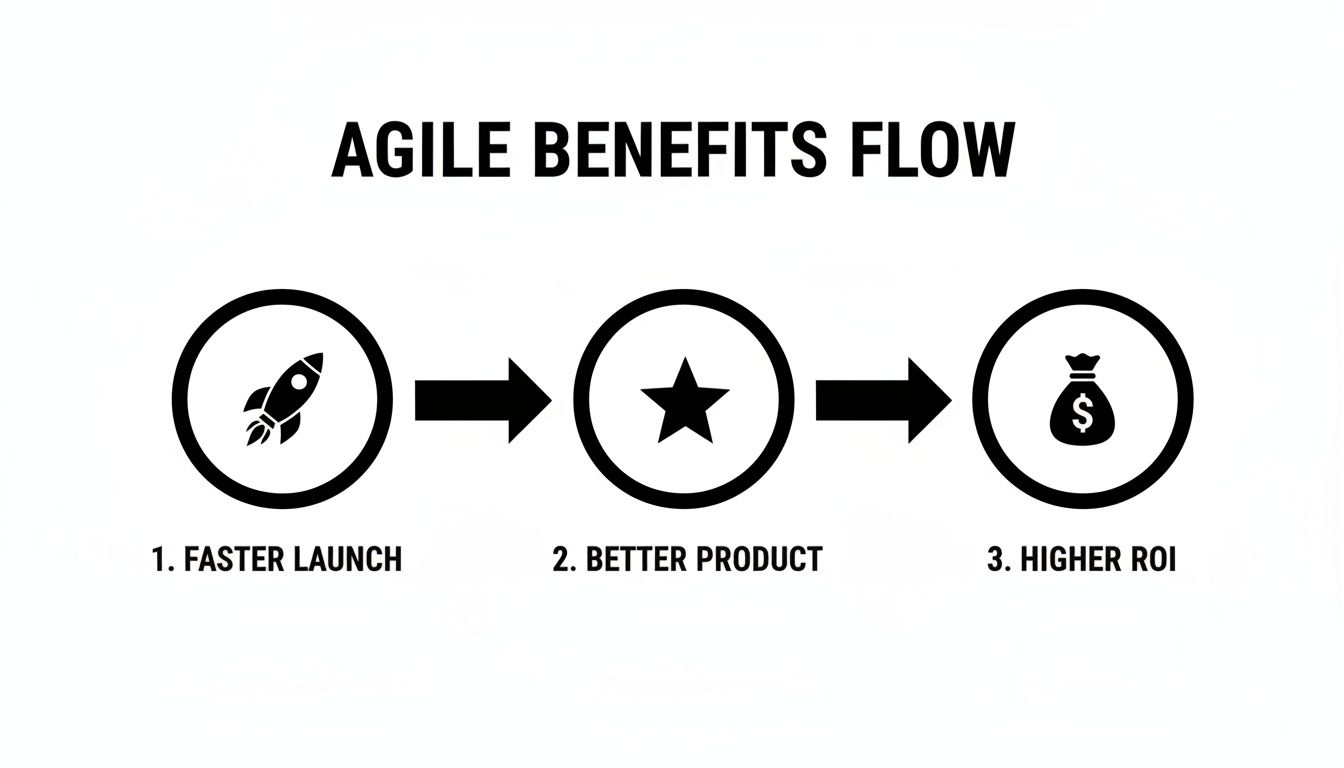
This iterative release process is the engine that drives the core business benefits of Agile: faster launches, superior products, and a healthier return on investment.
Phase 5: Maintenance and Operations
The work is not finished once the code is live. The Maintenance phase involves the ongoing support of the software in production. This includes monitoring system health, resolving user-reported bugs, and providing customer support.
This is where the Agile feedback loop truly shines. All information gathered here—bug reports, feature requests, and user feedback—is channeled directly back into the product backlog. These insights become the user stories for future sprints, ensuring the product continuously evolves to meet real-world user needs. This is a critical part of the agile methodology SDLC, where the development cycle becomes a continuous loop of value delivery and improvement.
Phase 6: Retirement
No product lasts forever. Eventually, a product or version will reach its end of life. The Retirement phase is the planned decommissioning of the software. This may occur because it is being replaced by a newer system or no longer aligns with the business strategy. This final stage involves migrating remaining users to a new solution and securely shutting down the old system's infrastructure.
Key Roles and Ceremonies That Power Agile Success
The agile development cycle is not self-executing. It is powered by specific roles and structured meetings, known as "ceremonies," that foster clear communication, transparency, and relentless improvement.
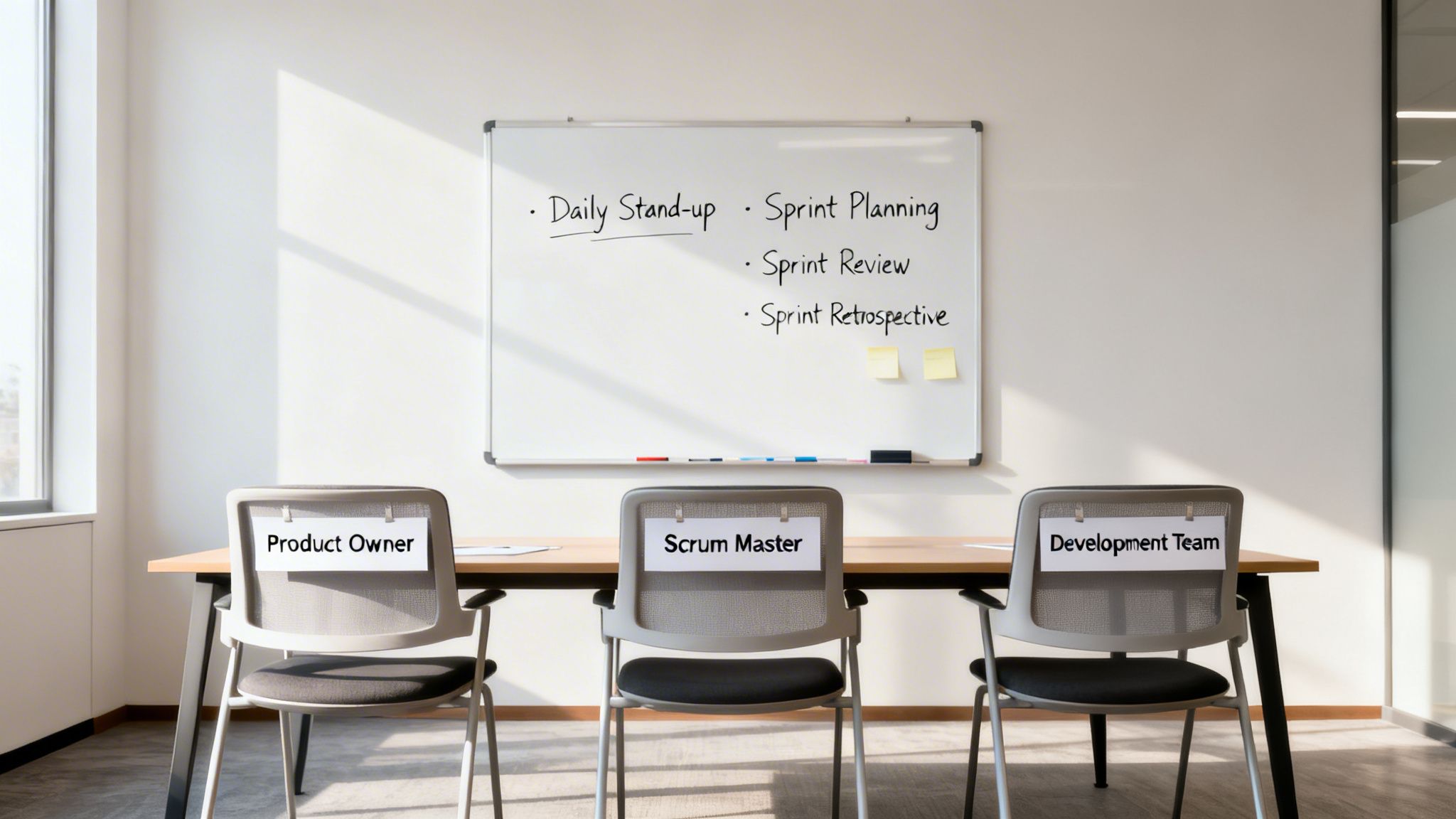
Without this framework, an agile project can quickly descend into chaos. With it, you create a high-performing system that delivers measurable results, sprint after sprint.
The Three Core Agile Roles
While many individuals contribute to a project, the Scrum framework—the most popular Agile methodology—relies on three pivotal roles. Each has a distinct focus, and together they create a powerful balance between vision, process, and execution.
Product Owner (The "What"): The Product Owner is the voice of the customer and the business. They are the sole owner of the product backlog—the prioritized list of all work for the project. Their primary responsibility is to decide what gets built and in what order to maximize business value. An effective Product Owner has a deep understanding of the market, the users, and the company's strategic goals.
Scrum Master (The "How"): The Scrum Master acts as the team's coach and facilitator. They are not a traditional project manager who assigns tasks; they are a servant-leader. Their mission is to enable team success by facilitating Agile ceremonies, removing impediments, and ensuring the team adheres to Agile principles. A seasoned Scrum Master, like those within a Group107 offshore team, ensures the process runs smoothly and protects the team from distractions.
Development Team (The "Creators"): This is the cross-functional group of professionals who build the product. The team typically includes developers, QA engineers, designers, and any other specialists needed to transform an idea into a working increment of software. They are self-organizing, meaning they determine how to accomplish the work, and are collectively accountable for delivering a high-quality product at the end of each sprint.
The Four Essential Agile Ceremonies
Agile ceremonies provide the rhythm for a sprint, creating a consistent cadence for planning, collaboration, and learning. These are not just meetings; each serves a critical purpose in keeping the agile development cycle on track.
These ceremonies create a powerful, tight feedback loop. They enforce transparency, maintain alignment, and provide dedicated time for the team to inspect its own work and processes, then adapt. Done right, this framework eliminates waste and keeps the entire team focused on delivering value.
Here is how the four key events structure a sprint:
Sprint Planning: This meeting kicks off every sprint. The Product Owner presents the highest-priority items from the product backlog. The entire team collaborates to determine what can be achieved and commits to a body of work, creating the "sprint backlog."
Daily Stand-up: A brief, 15-minute daily synchronization meeting. It is not a status report for management but a planning session for the team. Each member answers three questions: What did I do yesterday? What will I do today? Am I blocked by anything? This surfaces problems immediately for the Scrum Master to address.
Sprint Review: At the end of the sprint, the team demonstrates what they built. This is a "show, don't tell" session where the team presents the working software to the Product Owner and other stakeholders. It is a critical opportunity for real-time feedback that informs the next sprint.
Sprint Retrospective: This is the final, and arguably most important, ceremony. The team reflects on the process itself: What went well? What were the challenges? What will we do differently next time? A skilled Scrum Master facilitates this discussion to generate concrete, actionable improvements for the next sprint.
Choosing the Right Agile Framework for Your Business
Adopting Agile is not a one-size-fits-all decision. Agile is a philosophy, and frameworks like Scrum and Kanban are the practical applications of that philosophy.
Selecting the right framework is a strategic choice that directly impacts project success. Each offers a different approach to managing work, communication, and value delivery. The optimal choice depends on your team's size, project complexity, and ultimate business objectives.
Scrum and Kanban are the two most prevalent frameworks. While both stem from Agile values, they operate in fundamentally different ways. Understanding their respective strengths is the first step in optimizing your agile development cycle.
Scrum: The Structured Sprint Powerhouse
Scrum's popularity is well-earned. Its structured, time-boxed approach is designed for tackling complex product development, especially when requirements are expected to evolve.
Scrum operates in sprints—fixed-length cycles, usually one to four weeks. In each sprint, the team commits to building and delivering a specific increment of the product. This rhythm creates a predictable delivery cadence for the business and a sense of focus and urgency for the development team. The system is supported by specific roles (Product Owner, Scrum Master) and ceremonies (Sprint Planning, Daily Stand-ups) that ensure alignment and continuous improvement.
Scrum is often the best fit when:
- You're building a new product from the ground up. The sprint structure is ideal for developing an MVP and iterating based on user feedback.
- Your project is complex with many unknowns. Scrum's iterative nature allows you to adapt to new information without derailing the project.
- You need predictable delivery timelines. Sprints provide a regular, reliable schedule for releasing new features, which is crucial for roadmap planning and stakeholder communication.
For many of our clients at Group107, particularly in SaaS and finance, Scrum is the framework of choice. It provides an essential balance between structure and the flexibility needed to adapt to market demands.
Kanban: The Visual Flow Optimizer
While Scrum is defined by time-boxed sprints, Kanban is defined by continuous flow. Originating in manufacturing, its primary goal is to help you visualize your workflow, limit work-in-progress (WIP), and maximize efficiency. There are no prescribed sprints or roles; instead, work is pulled across a visual Kanban board, typically with columns like "To Do," "In Progress," and "Done."
The core principle of Kanban is limiting work-in-progress (WIP). By setting a cap on the number of tasks in any given column, you prevent team overload and instantly identify bottlenecks. This makes it an excellent tool for teams managing a continuous stream of tasks with varying priorities, such as operations, support, and DevOps teams.
Kanban’s greatest strength is its flexibility. It doesn’t require you to overhaul your process overnight. Instead, it helps you visualize your current process to make intelligent, incremental improvements.
For example, a DevOps team can use Kanban to smoothly manage a mix of incoming requests—infrastructure updates, urgent bug fixes, and deployment support—without being locked into a rigid sprint schedule. Work is pulled in as capacity becomes available, creating a steady, continuous flow of completed tasks.
The data supports this dual approach. Recent surveys show that Scrum is used by an impressive 87% of organizations, making it the clear leader. However, Kanban is used by 56% of teams, often in conjunction with Scrum, to manage continuous delivery pipelines and operational tasks. You can explore more about these adoption rates to see how companies are implementing these frameworks.
This trend demonstrates that Agile is no longer confined to development teams (48%). It is now a core methodology for operations (29%) and even marketing (17%) teams.
How to Measure the Business Impact of Agile
Adopting Agile is not just about shipping software faster; it's about driving tangible business results. To demonstrate its value, you must move beyond vanity metrics and focus on Key Performance Indicators (KPIs) that connect your team's work directly to executive-level priorities: ROI, speed, and quality.
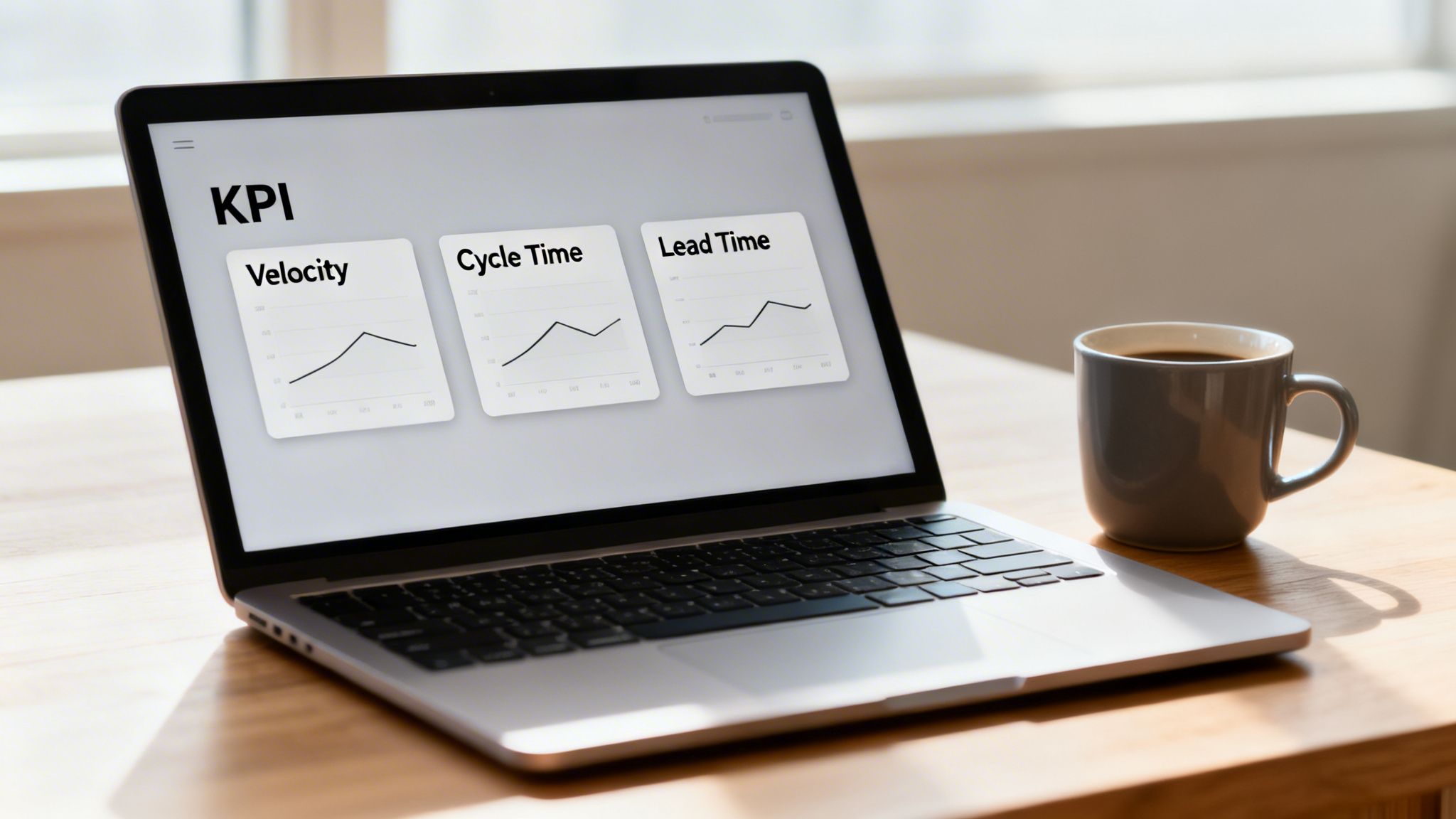
The key is to use data for strategic improvement, not micromanagement. When you track the right KPIs, you can forecast with greater confidence, identify and eliminate bottlenecks, and ensure every sprint delivers maximum value.
Lead Time and Cycle Time
Two of the most powerful metrics for measuring agility are Lead Time and Cycle Time. Though often confused, they measure distinct parts of your delivery pipeline.
Lead Time: This is the total time from when a new feature is requested (added to the backlog) until it is delivered to the customer. It represents the customer's waiting time. A long lead time may indicate inefficiencies in your planning or prioritization process.
Cycle Time: This metric measures your team's internal efficiency. It is the time it takes to complete a task after work has begun. A short cycle time indicates your team is effective at turning ideas into working software.
We observed this with a fintech client. By tracking cycle time, we identified a persistent bottleneck in their QA process. Addressing that single issue reduced their feature deployment time by 30%, enabling them to outpace competitors by responding to market shifts much faster.
Tracking both metrics provides a complete picture. For instance, a short cycle time combined with a long lead time is a red flag, indicating that while the development team is fast, work is languishing in the backlog before being started.
Velocity and Predictability
Velocity is a measure of the amount of work a team can complete in a single sprint, typically calculated by summing the story points of all completed user stories.
However, velocity is not a tool for comparing teams. Its true value lies in establishing a predictable delivery rhythm. Once a team's velocity stabilizes over several sprints, you can use that average to reliably forecast how long a larger set of features will take to complete.
For a SaaS company, a stable velocity chart is invaluable. It enables predictable roadmap forecasting, allowing them to provide stakeholders with reliable estimates for upcoming releases. This builds trust and aligns the entire organization around a shared timeline.
Connecting Metrics to Business Outcomes
Ultimately, Agile's value is proven through superior project outcomes. The data is clear: projects using Agile methods have a 75% success rate, far surpassing the 56% for traditional waterfall approaches. Furthermore, 60% of companies report increased profits after adopting Agile, and 42% see significant improvements in software quality. You can discover more about these Agile statistics and their bottom-line implications.
The goal is to tie every metric to a clear business objective:
- Shorter Cycle Time → Faster time-to-market and quicker ROI.
- Stable Velocity → Predictable product roadmaps and budgets.
- Low Defect Rate → Higher customer satisfaction and lower support costs.
- High Team Morale → Improved employee retention and productivity.
Focusing on these KPIs transforms the conversation from "How busy are we?" to "How much value are we delivering?" This data-driven mindset ensures your agile development cycle is not just a process but a strategic engine for business growth.
Your Next Steps to Implement the Agile Development Cycle
You understand the theory behind the agile development cycle. Now it's time to put it into practice. Executing this framework effectively is what separates high-performing organizations from the rest.
The objective is clear: build better software, faster. You need the ability to pivot with the market, deliver features customers truly need, and eliminate wasted effort. This isn't a trend; it's how modern teams compete and win.
If you're ready to make the transition, here is a practical checklist to guide your implementation or refine your existing process.
Your Agile Implementation Checklist
- Secure Leadership Buy-in: You need champions, not just approval. Frame the move to Agile in terms they care about: accelerated time-to-market, enhanced ROI, and a superior product that outperforms the competition.
- Start Small, Win Big: Do not attempt to transform the entire organization overnight. Select one pilot project with an enthusiastic team. A successful pilot will generate tangible proof and build momentum for a broader rollout.
- Define Roles and Responsibilities: Clearly assign the roles of Product Owner, Scrum Master, and Development Team. Ensure everyone understands their responsibilities and has the necessary support to succeed.
- Choose the Right Agile Framework: Is the structured, time-boxed nature of Scrum the best fit? Or does your team's workflow align better with the continuous flow of Kanban? The right answer depends on your team and project context.
- Protect Your Ceremonies: Sprint Planning, Daily Stand-ups, Sprint Reviews, and Retrospectives are the heartbeat of Agile. Treat this time as sacred. It is where alignment, feedback, and improvement happen.
- Implement the Right Tools: You cannot manage what you cannot see. Use a robust project management tool like Jira or Asana to visualize your backlog, track work in progress, and monitor key metrics.
- Measure What Matters: Avoid vanity metrics. From day one, define the KPIs that will measure your success. Focus on tangible indicators like Cycle Time, Velocity, and Lead Time.
Adopting Agile is a culture shift, not just a process change. It requires a genuine commitment to transparency, collaboration, and continuous improvement. While not always easy, the result is a more resilient, productive, and successful team.
Partner with Group107 to Accelerate Your Agile Journey
Transitioning to a smooth, effective Agile workflow can be challenging. At Group107, we act as your strategic partner, helping you navigate common pitfalls and achieve your goals faster. Our dedicated offshore teams are not just developers for hire; they are experienced Agile professionals who integrate seamlessly into your operations.
We provide the expert Scrum Masters, talented developers, and DevOps engineers you need to build, scale, and innovate with confidence.
Whether you are launching a fintech MVP or modernizing a legacy enterprise system, we help you implement a world-class Agile process tailored to your specific needs. By collaborating with you to create a robust agile release plan, we ensure your roadmap is directly aligned with your most critical business objectives.
Ready to build better software, faster? Let's discuss how Group107's dedicated Agile teams can help you turn your vision into a reality.
Frequently Asked Questions
As teams begin implementing the agile development cycle, several common questions arise. Here are practical answers to some of the most frequent ones.
How Do You Start Agile With a Small Team?
The best way to begin is to start small. Avoid trying to implement every practice from a textbook on day one. Choose a single, low-risk project and a team that is open to trying a new approach.
Focus on establishing a few core habits:
- Establish a Backlog: Create a prioritized to-do list in the form of user stories. This will be your single source of truth.
- Run Short Sprints: Aim for one or two-week sprints to build momentum and create rapid feedback loops.
- Hold Daily Stand-ups: This quick, daily check-in is non-negotiable for maintaining alignment and resolving blockers quickly.
- Conduct Retrospectives: After each sprint, hold an honest discussion about what went well and what didn't. This is arguably the most critical ceremony for improvement.
The goal is not initial perfection but to create a rhythm and achieve early wins that build confidence and momentum.
What Should You Do When a Sprint Fails?
First, understand that a "failed" sprint—where the team did not complete all planned work—is not a catastrophe. It is a valuable learning opportunity. Use the Sprint Retrospective to diagnose the "why" without assigning blame.
A failed sprint is simply data. Treat it as an insight into your process. Did you overestimate capacity? Were the user stories unclear? Was the team blocked by external dependencies?
Identify the root cause and agree on one concrete action to implement in the next sprint. For example, if user stories were too large, the team's action item might be to dedicate more time to breaking them down during planning. This is how you transform a setback into a stronger, more resilient process.
How Can You Measure the ROI of Adopting Agile?
Measuring the return on investment from Agile requires looking beyond simple cost savings. Focus on metrics that reflect genuine business impact and operational efficiency.
Key metrics to track include:
- Time to Market: How much faster are you delivering features to customers? Measure the duration from idea to deployment.
- Product Quality: Track the number of critical defects found after a release. Fewer bugs lead to lower support costs and higher customer satisfaction.
- Predictability: Over time, does your team's velocity stabilize? A predictable team makes long-term planning and budgeting far more reliable.
- Customer Satisfaction: Are your iterative releases meeting user needs? Use surveys, feedback forms, and direct conversations to gauge satisfaction.
Connecting these improvements to core business goals builds a powerful case for the ROI of your Agile transformation. This is also where an expert partner like Group107 can significantly enhance these results.
Ready to harness the full power of the agile development cycle with an expert team? Group107 provides premium offshore software development teams that integrate seamlessly into your projects, driving efficiency and accelerating your time to market. Contact us today to build your dedicated agile team.