
The product life cycle is a strategic framework that maps a product's journey through four distinct phases: Introduction, Growth, Maturity, and Decline. Understanding this model is critical for aligning your engineering, marketing, and financial strategies to maximize ROI at every step.
Mastering this cycle allows you to make informed decisions on resource allocation, anticipate market shifts, and maintain a competitive edge. Misinterpreting a product's stage can lead to critical errors, such as overspending on marketing for a mature product or underfunding a product poised for growth.
By identifying your product's current stage, you can answer key strategic questions with clarity:
- Introduction: How do we validate our solution and achieve product-market fit?
- Growth: How do we scale operations and capture maximum market share efficiently?
- Maturity: How do we defend our market position and optimize for profitability?
- Decline: What is the optimal strategy to sunset this product or pivot to a new opportunity?
This timeline illustrates how a product's sales and profitability evolve through these four phases.
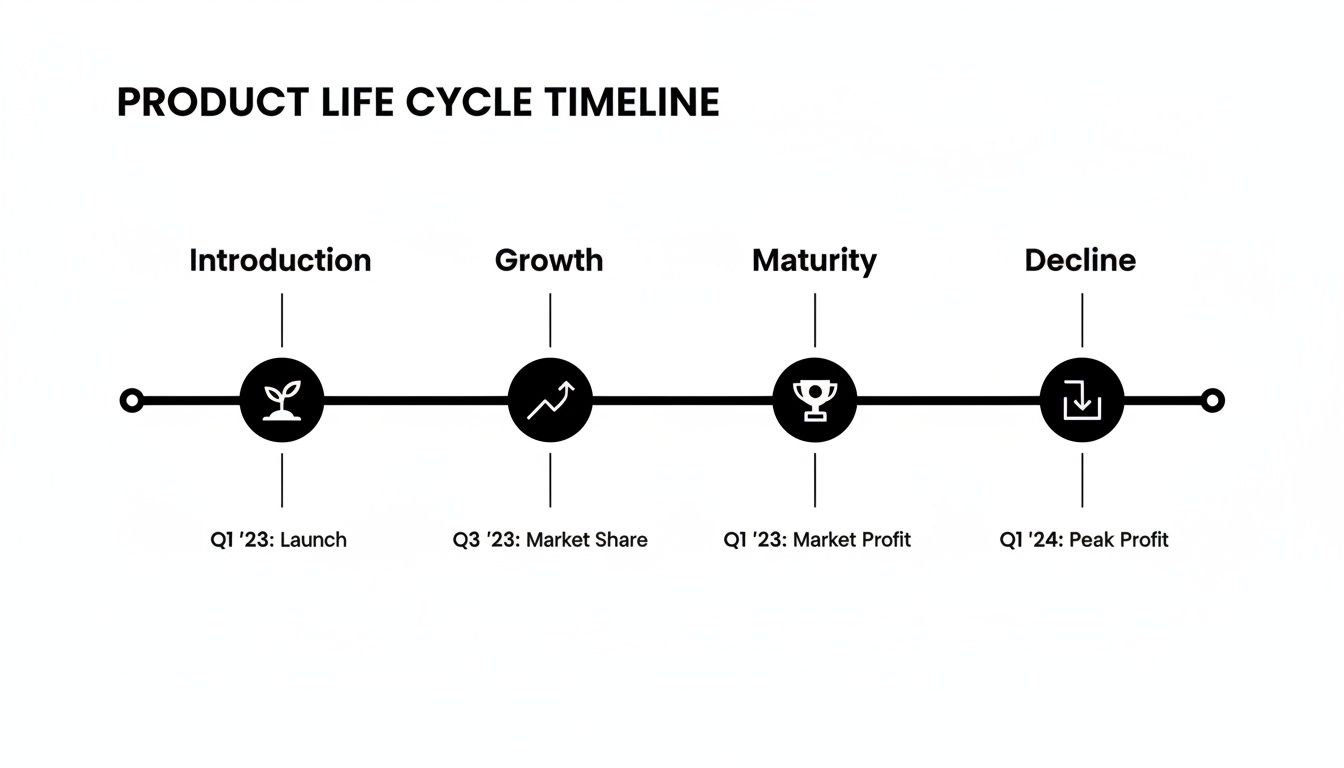
Sales and profits typically follow a predictable curve, starting low, peaking during maturity, and tapering off as the product enters decline.
This table provides a high-level overview of the defining characteristics of each stage.
The 4 Product Life Cycle Stages at a Glance
| Stage | Primary Goal | Market Characteristics | Key Challenge |
|---|---|---|---|
| Introduction | Establish product-market fit and build initial awareness. | Low sales, minimal competition, high costs. | High failure rate; gaining market traction. |
| Growth | Maximize market share and scale operations. | Rapidly increasing sales, new competitors entering. | Maintaining quality and customer support during rapid scale. |
| Maturity | Maximize profit while defending market share. | Peak sales, fierce competition, market saturation. | Differentiating from competitors and avoiding price wars. |
| Decline | Reduce costs and harvest remaining value. | Falling sales, declining profits, shrinking market. | Deciding when to divest or pivot without losing customer trust. |
While this table outlines the core attributes of each phase, let's delve deeper into the strategic implications for your business.
The Foundation of Strategic Planning
The classic 4 stages of the product life cycle provide the foundational framework for strategic planning in any technology-driven organization, particularly when scaling a new product or MVP.
The introduction stage is characterized by high uncertainty and low sales. Data shows that new products often capture less than 5% of their target market within the first year, requiring a significant upfront investment in R&D and marketing that can consume 20-30% of the initial budget.
The primary objective during this phase is validation. You must prove the market viability of your concept and iterate based on real-world user feedback. Rigorous testing is non-negotiable. For a detailed guide on this critical process, explore our article on the differences between alpha and beta testing.
Successfully navigating this first stage establishes the foundation for future growth. A clear understanding of the entire product journey enables your organization to proactively align its engineering, marketing, and financial strategies for long-term success.
Navigating the Introduction Stage to Find Product-Market Fit
Every product's journey begins in the introduction stage, where the singular mission is to achieve product-market fit. The goal is not merely to launch a new product but to validate that you have built a viable solution to a significant problem that customers are willing to pay for.

During this period, sales are typically low, costs are high, and the risk of failure is at its peak. The primary objective is not profit but learning. Success requires establishing robust feedback loops, generating initial brand awareness, and building a foundational product that can evolve based on early user input.
The Central Role of the Minimum Viable Product
The Minimum Viable Product (MVP) is the cornerstone of the introduction stage. An MVP is not an unfinished product; it is the most streamlined version of your solution that delivers core value to initial users, allowing you to test your fundamental business hypothesis with minimal investment.
Building a successful MVP requires a strategic balance. It must be robust enough to solve a genuine pain point yet lean enough to enable rapid iteration and pivots. We explore this concept in depth in our guide on what an MVP is in software development. This approach prevents over-engineering a product before market validation.
From an engineering perspective, the challenge is building an architecture that's flexible enough for pivots but scalable for future growth. You need a foundation that supports quick changes without accumulating debilitating technical debt.
A strategic partner can be a significant asset here. Engaging a dedicated offshore team provides a cost-effective path to developing your MVP, accelerating time-to-market while ensuring you retain full control and intellectual property protection.
Foundational Marketing and User Feedback
In the introduction stage, marketing should focus on targeted outreach to cultivate a small, engaged user base, not large-scale campaigns. To gain initial traction, it is crucial to implement effective data-driven product launch strategies that concentrate on specific, high-value customer segments.
The key to success is creating a tight feedback loop with these early adopters. Their insights are invaluable for prioritizing your product roadmap and validating your initial assumptions.
Key activities in this stage include:
- Customer Discovery: Conduct interviews and surveys to gain a deep understanding of user pain points, both before and after they engage with your MVP.
- Alpha/Beta Testing: Release the product to a controlled audience to identify bugs, gather usability feedback, and refine features.
- Content Creation: Develop foundational content, such as blog posts and landing pages, that educates the market on the problem your product solves.
- Early Adopter Programs: Offer incentives for your first users to provide detailed feedback and become your initial brand advocates.
This early feedback directly informs your engineering priorities, ensuring that development resources are allocated to features that deliver maximum user value.
Measuring Success in the Introduction Stage
Profitability is not the primary measure of success at this stage. Instead, success is defined by learning and validation. The metrics that matter are those that indicate you are on the correct path to achieving product-market fit.
Essential KPIs for the Introduction Stage:
- User Engagement: Are users actively utilizing your product's core features? Monitor metrics like Daily Active Users (DAU) and session duration.
- Activation Rate: What percentage of new users complete a key action that demonstrates they understand the value proposition?
- Customer Feedback Volume & Quality: Are you receiving a consistent stream of actionable feedback? A silent user base is a significant warning sign.
- Early Retention/Churn Rate: Are your initial users continuing to use the product? High early churn indicates a disconnect between your solution and market needs.
A well-executed introduction stage de-risks the entire venture and provides the data-driven confidence required to invest in the next phase of the 4 stages of product life cycle: growth.
Fueling the Growth Stage to Capture Market Share
Once product-market fit is achieved, the product enters the growth stage. This phase is characterized by a strategic shift from validating an idea to aggressively expanding market presence. Sales accelerate, brand awareness increases, and new competitors emerge. The objective is no longer survival but rapid market share acquisition.

This is the time to scale what works. Resources are increasingly allocated to marketing to reach a broader audience, while the product must evolve to support a growing user base. The primary challenge is scaling all operations—from the technology stack to customer support—without compromising quality.
Evolving Product and Engineering Priorities
In the growth stage, the product roadmap must be guided by data. Feedback from early adopters serves as the blueprint for strategic feature development. The focus is on enhancing the core product, increasing user stickiness, and building a competitive moat to deter new entrants.
The engineering team's focus must also shift. The agile, flexible architecture of the introduction stage must now be fortified for performance, reliability, and security as the user base expands.
Key technical initiatives in the growth stage include:
- Performance Optimization: Identify and resolve bottlenecks in the application and database to ensure a seamless user experience under heavy load.
- Enhanced Security Protocols: Implement robust security measures to protect a growing user base, which represents a larger target for malicious actors.
- Scalable Infrastructure: Migrate to or optimize a cloud infrastructure that can handle traffic spikes and support an increasing number of concurrent users.
- Dedicated QA Processes: Establish a formal Quality Assurance (QA) process to detect and resolve bugs before they impact a large customer base.
This transition is where a specialized partner becomes invaluable. Services like DevOps as a Service and dedicated QA teams help you build a resilient, scalable backend without distracting your core team from feature development.
Ramping Up Marketing and Sales Efforts
With a validated product and a scalable technical foundation, it is time to accelerate growth. Marketing efforts transition from targeted outreach to broader campaigns aimed at establishing brand dominance. This involves experimenting with new acquisition channels, refining messaging, and building a predictable customer acquisition model.
This period is critical for e-commerce and SaaS companies. Mastering this phase is essential for long-term success, and there are many efficient and inexpensive ways of scaling your e-commerce business that can maximize the return on every marketing dollar.
Tracking the Right Metrics for Growth
The Key Performance Indicators (KPIs) you monitor must evolve with your strategic goals. While user engagement remains important, the focus shifts to financial and market penetration metrics that demonstrate sustainable business growth.
Data validates this shift. During the growth stage, global SaaS companies often see a user base expansion of 150% in their second year. This is frequently driven by product enhancements that a dedicated QA partner and skilled growth marketers can help optimize, leading to conversion rate increases between 20-40%.
Essential KPIs for the Growth Stage:
- Monthly Recurring Revenue (MRR) Growth Rate: The primary indicator of a healthy subscription business. This should increase consistently month-over-month.
- Customer Lifetime Value (CLV): CLV should be increasing, demonstrating that you are retaining customers and growing their value over time.
- Customer Acquisition Cost (CAC): Ideally, CAC should remain stable or decrease as you discover more efficient acquisition channels. A healthy CLV:CAC ratio (typically 3:1) is a key benchmark.
- Net Promoter Score (NPS): A measure of customer satisfaction and loyalty. A high NPS is a leading indicator of organic, word-of-mouth growth and reduced churn.
Successfully navigating the growth stage solidifies your market position. It requires a balance of aggressive expansion and operational discipline, paving the way for the long-term profitability of the maturity stage.
Winning the Maturity Stage with Optimization and Defense
When rapid growth begins to plateau, the product enters the maturity stage. This phase is defined by market saturation and intense competition, not explosive expansion. The focus shifts from aggressive customer acquisition to a defensive strategy centered on maximizing profitability and retaining market share.

The maturity stage is often the most profitable phase of the product life cycle, but only with precise execution. Your product is established, but complacency leads to irrelevance. Success requires a strategic balance of operational efficiency, customer retention, and targeted product evolution to defend against competitors and maximize revenue.
Shifting Focus From Acquisition to Retention and Efficiency
In the maturity stage, the cost of acquiring a new customer is typically at its highest. Consequently, the primary objective shifts to increasing the Customer Lifetime Value (CLV) of your existing user base. The focus is on fostering loyalty and extracting maximum value from the market share you have already captured.
Operationally, the focus is on optimization. Engineering and operations teams must concentrate on reducing costs, streamlining workflows, and enhancing system reliability. A mature DevOps practice becomes a significant competitive advantage, enabling faster, more reliable updates while maintaining lean overhead.
The maturity stage is less about chasing explosive growth and more about building an impenetrable fortress. Every decision—from feature updates to marketing spend—should be evaluated based on its impact on profitability and customer loyalty.
Key Strategies for Dominating the Maturity Stage
Defending market share requires a multi-faceted strategy. You must differentiate your product, strengthen customer relationships, and optimize every aspect of your operations.
The following core tactics are essential for success:
- Strategic Feature Enhancements: Shift from developing large new features to implementing smart, targeted improvements that solve specific user problems or add unique value. For example, an AI-powered personalization feature can make a mature product feel more relevant and increase user stickiness.
- Deep Customer Loyalty Programs: Implement programs that offer exclusive access, premium content, or a strong sense of community. The goal is to integrate your product into your customers' daily lives or workflows.
- Exploring New Use Cases and Markets: Your existing solution may be applicable to adjacent markets. A B2C SaaS tool, for instance, could be adapted for small business use, opening a new revenue stream with minimal R&D investment.
- Improving Accessibility: Making your product compliant with WCAG standards is not only an ethical imperative but also a powerful strategy to unlock a new market segment of users with disabilities.
To prolong this profitable phase, businesses can adopt several proven strategies. The table below details common approaches and how an expert partner like Group107 can support their execution.
Strategies for Extending the Maturity Stage
| Strategy Type | Description | Example Tactic | How Group 107 Supports It |
|---|---|---|---|
| Product Modification | Improving or altering the product's features, quality, or performance to attract new users or increase usage. | Adding AI-driven personalization features to an existing platform to boost engagement. | Our AI integration services and dedicated engineering teams can design and implement sophisticated features that differentiate your product. |
| Market Modification | Finding new market segments, new users, or new use cases for the existing product. | Adapting a B2C fintech app to serve the needs of freelance and small business owners. | We provide market analysis and leverage our fintech expertise to help you pivot or expand your product for new audiences. |
| Marketing Mix Modification | Adjusting elements like pricing, distribution channels, advertising, or sales promotions to stimulate demand. | Launching a tiered pricing model that includes a new premium plan with exclusive features. | We can help implement complex pricing logic and promotional tools, ensuring your backend systems are robust and secure. |
| Cost Reduction | Streamlining operations and reducing production or service delivery costs to improve profit margins. | Migrating infrastructure to a more efficient cloud setup and automating manual deployment processes. | Our DevOps experts specialize in optimizing cloud infrastructure and building CI/CD pipelines to lower operational costs and improve reliability. |
By strategically applying these modifications, a mature product can continue to generate steady revenue long after its initial growth has subsided.
The Role of Technology in Defending Market Share
In a crowded market, advanced technology is a critical defensive tool. Data analytics, AI, and automation are essential for maintaining a competitive advantage.
AI-Driven Personalization: Utilize machine learning models to analyze user behavior in real-time. This enables you to deliver personalized content, recommendations, and offers that are difficult for competitors to replicate.
Advanced Data Analytics: Move beyond basic dashboards. Use predictive analytics to identify at-risk customers and intervene proactively. Analyze usage patterns to uncover opportunities for upselling and cross-selling.
Consider a mature fintech platform. Instead of competing on price, it can leverage AI to offer personalized investment advice or automate complex financial management tasks, creating value beyond simple transactions.
Metrics That Matter in Maturity
Your KPI dashboard must be updated to reflect your new strategic priorities. While revenue remains important, the focus shifts to efficiency and customer health.
Core KPIs for the Maturity Stage:
- Customer Churn Rate: Your primary adversary. The goal is to minimize this metric, as even small reductions can significantly impact profitability.
- Customer Lifetime Value (CLV): This metric reflects the total revenue generated from a single customer. The objective is to consistently increase this value.
- Net Promoter Score (NPS): A high NPS indicates strong customer loyalty and a lower likelihood of churn, serving as a vital sign of brand health.
- Average Revenue Per User (ARPU): Monitor this metric to ensure you are effectively monetizing your user base through upsells, add-ons, and new feature adoption.
Mastering this phase within the 4 stages of product life cycle requires a disciplined, data-driven approach to secure your market position for the long term.
Managing the Decline Stage for Strategic Advantage
The final phase in the 4 stages of product life cycle is not a failure but a strategic inflection point. When sales consistently decrease and market relevance fades, the product has entered the decline stage. This phase requires a methodical approach to manage the product's sunset, extract remaining value, and reallocate resources to future innovations.
Ignoring the signs of decline—such as shrinking market share, negative cash flow, or the emergence of superior alternatives—is a costly error. Proactive management protects brand reputation, maintains customer goodwill, and frees up capital for new ventures. The objective is a controlled exit, not a chaotic shutdown.
Data-Driven Triggers and Strategic Paths
Identifying the decline stage requires monitoring key data points. Triggers include a sustained drop in sales despite marketing support, declining profitability, and an eroding user base. Once confirmed, you have three primary strategies to consider.
- Harvesting: This strategy focuses on maximizing remaining profit by cutting costs. Marketing spend is reduced, support is streamlined, and new feature development ceases. The goal is to extract maximum cash flow from the loyal but shrinking customer base.
- Divesting: This involves selling the product line or its underlying technology to another company. This is a viable option if the product retains a dedicated user base or valuable IP but no longer aligns with your company's strategic direction.
- Pivoting: This forward-looking strategy uses the product's core assets—technology, customer data, or brand equity—as the foundation for a new offering. This could involve relaunching with a significant innovation or repurposing the core technology for a different market.
The product life cycle concept has been a cornerstone of business strategy for decades, with its principles remaining relevant even as technology accelerates the stages. Read more about the evolution of the product life cycle.
A Framework for Calculated Decisions
Selecting the right strategy requires a data-driven framework that balances financial realities, long-term goals, and brand impact.
The decline stage is a strategic opportunity disguised as an endpoint. How you manage it determines whether you simply close a chapter or use its momentum to write the next one.
To make an informed decision, assemble a cross-functional team to evaluate the product against these key criteria:
- Financial Viability: Is the product still profitable? Can a harvesting strategy generate positive cash flow, or is it a resource drain?
- Strategic Fit: Does the product align with your company's current mission and future objectives?
- Customer Impact: How will discontinuing or divesting the product affect existing customers? What is the transition plan?
- Resource Allocation: Could the capital and talent allocated to this product generate a higher ROI on a new initiative?
Data analytics and AI can enhance this decision-making process. AI models can analyze market trends to identify pivot opportunities, while automation can help maintain legacy systems cost-effectively during a harvesting phase. A calculated, informed decision ensures that the end of one product's journey serves as a strategic launchpad for future innovation.
Your Strategic Partner Through Every Product Stage
Understanding the 4 stages of the product life cycle is not an academic exercise but a practical tool for building long-term value. By accurately identifying your product's stage, you can apply the right strategic levers at the optimal time.
The cycle demands adaptation. The agile, experimental tactics of the introduction stage are ineffective for defending market share in maturity.
A Unified Approach to the Product Journey
From initial concept to final sunset, your technology decisions must be perfectly synchronized with your business objectives.
- Introduction: The focus is on speed, learning, and cost control to validate an idea with a robust MVP before significant investment.
- Growth: The priority shifts to building a scalable, secure, and reliable platform that can support a rapidly expanding user base while outpacing competitors.
- Maturity: The strategy pivots to optimization, retention, and efficiency. Technology should drive profitability through personalization, improved accessibility, and streamlined operations.
- Decline: Decisions must be data-driven, focusing on maximizing remaining value, automating legacy systems, or reallocating resources to new opportunities.
Moving through these stages requires more than a good plan. It demands a true end-to-end technology partner who gets how to build, scale, and optimize for the unique challenges of each phase.
Group107 is that partner. We help you launch a cost-effective MVP with a dedicated offshore team, manage explosive growth with robust DevOps, and optimize performance with AI and data analytics.
Actionable Next Steps
Apply this framework to your product strategy today.
- Assess Your Current Stage: Analyze your sales data, market share, and competitive landscape to determine your product's current position.
- Align Your Strategy: Ensure your current engineering and marketing priorities match the requirements of your product's life cycle stage. Realign if necessary.
- Plan for the Future: Identify the key indicators that will signal a transition to the next stage and begin preparing your strategy in advance.
Ready to build a technology roadmap that aligns with your product’s entire journey? Explore our custom software development services to see how we can help.
Frequently Asked Questions
When applying the 4 stages of product life cycle to a business, several key questions arise. Here are the answers to the most common inquiries from founders and product leaders.
How Can You Determine Which Stage Your Product Is In?
Determining your product's current stage requires a holistic analysis of several core business metrics.
Analyze these indicators collectively to gain a comprehensive view:
- Sales Growth Rate: Is revenue accelerating (Growth), stabilizing (Maturity), or decreasing (Decline)?
- User Adoption Trends: Are you attracting new customer segments, or is market penetration reaching saturation?
- Market Share: Is your portion of the market expanding, holding steady, or contracting?
- Competitive Landscape: Are new competitors entering the market, or are existing rivals exiting?
By evaluating these trends together, you can form a clear, data-backed assessment of your product's current stage.
Can a Product Go Backward or Skip a Stage?
Yes. The product life cycle is a model, not a rigid law. A product can move between stages in a non-linear fashion.
For example, a significant product innovation or a successful relaunch campaign can shift a mature product back into the Growth stage. Conversely, a disruptive new technology can cause a product to move directly from Maturity to Decline, bypassing a gradual fade.
What Is the Most Critical Stage of the Product Life Cycle?
While every stage is important, the Introduction and Maturity stages present the most critical strategic challenges and opportunities. The Introduction stage is foundational; failing to achieve product-market fit here is a fundamental error that is difficult and costly to correct later.
However, the Maturity stage is where a successful business becomes a market leader. This phase is dedicated to maximizing profitability, building a defensible market position, and converting customers into long-term advocates. Mastering this stage delivers the ultimate return on the initial investment and effort.