
Acceptance criteria are the specific, testable conditions a software feature or user story must meet to be considered "done." They serve as an agreed-upon definition of success, ensuring the development team and stakeholders share a common understanding of the required functionality from the very beginning. By defining the boundaries of a user story, they prevent scope creep and align everyone on a unified goal.
Why Clear Acceptance Criteria Are Non-Negotiable in Development

In a fast-paced development environment, ambiguity is the enemy. Vague user stories inevitably lead to misinterpretations, wasted engineering cycles, and features that completely miss the business objective. Well-defined acceptance criteria act as the single source of truth, forming a clear contract between the product owner and the engineering team.
This clarity removes guesswork and aligns everyone—from designers and developers to QA testers—on what needs to be built. For a fintech startup building an MVP or an enterprise launching a new digital product, that level of precision is often the difference between a successful launch and a project stuck in a development quagmire.
The Business Impact of Precision
Writing effective acceptance criteria isn't just a technical box-ticking exercise; it has a direct and measurable impact on your project's velocity, budget, and ROI. It is a foundational component of effective product development that ensures every feature delivers tangible business value.
- Reduces Rework: Clear conditions eliminate the classic "this isn't what I asked for" conversation, drastically cutting down on expensive rework and frustrating delays. Projects with vague requirements often see rework rates as high as 50%.
- Accelerates Delivery: When developers know exactly what to build and testers know exactly what to validate, the entire development lifecycle moves faster, improving time-to-market.
- Improves Product Quality: By defining success upfront, teams build quality into the product from day one. This proactive approach means fewer bugs make it to production, enhancing the end-user experience.
- Enables Test Automation: Scenario-based criteria, especially those in the Gherkin format, can be translated directly into automated tests, creating a powerful and efficient feedback loop that drives continuous integration and delivery.
Mastering this discipline provides a significant competitive edge. It is a core tenet of our approach to Agile development best practices, turning vision into reality more efficiently.
Choosing the Right Format: Checklist vs. Gherkin
Not all acceptance criteria are created equal. The two most common formats—rule-based checklists and scenario-driven Gherkin—are each suited for different situations. Selecting the right one is key to maximizing clarity and value.
A simple checklist is often perfect for straightforward technical stories, like a back-end API enhancement. However, for describing complex user interactions and business logic, the Gherkin format ("Given-When-Then") is far superior and has become the industry standard for most user-facing features.
A Quick Comparison
| Attribute | Checklist (Rule-Based) | Gherkin (Scenario-Based) |
|---|---|---|
| Best For | Simple features, technical tasks, non-functional requirements | Complex user interactions, business rules, end-to-end flows |
| Structure | A list of individual rules or conditions that must be met. | A structured Given-When-Then format describing system behavior. |
| Readability | Easy to scan for simple conditions. | Highly readable for both technical and non-technical stakeholders. |
| Automation | Difficult to automate directly; serves as a manual test guide. | Easily translated into automated tests using BDD frameworks. |
| Example | [ ] Password must be at least 8 characters long. |
Scenario: User logs in with valid credentialsGiven I am on the login pageWhen I enter my valid email and passwordThen I should be redirected to my dashboard |
The Gherkin structure, rooted in Behavior-Driven Development (BDD), makes your criteria directly testable through automated scripts. For many enterprise teams, this can slash manual QA time by 40-50%—a massive efficiency gain that directly impacts the bottom line.
A Repeatable Framework for Crafting Powerful Criteria
Great acceptance criteria don't happen by accident. They are the product of a structured, collaborative process that the entire team buys into. This isn't about theory; it's about building a repeatable framework to ensure every user story is backed by criteria that are clear, testable, and tied directly to user outcomes.
The foundation is a simple shift in perspective: treat acceptance criteria not as a final checklist for developers, but as the definitive guide for everyone involved—product, design, engineering, and QA. To achieve this, you must first master how to create user stories that provide a clear and concise direction.
1. Anchor Every Criterion in a User Outcome
First, every single criterion must answer the question, "What is the successful outcome for the user?" This habit prevents you from writing criteria that are just technical tasks disguised as requirements. An outcome-focused criterion describes what the user can do, not how the system technically implements it.
For example, instead of writing, "The system uses JWT for authentication," you’d frame it as, "The user can securely log in and access their personal dashboard." This subtle but powerful change keeps the team focused on user value and gives engineers the autonomy to find the best technical solution. This mindset is a core part of our approach to agile project plans.
2. Define Measurable and Testable Conditions
Ambiguity is the enemy of "done." Each criterion must be written so it can be proven true or false, with no grey area. Subjective words like "user-friendly," "fast," or "easy to use" are impossible to test and must be translated into concrete, measurable conditions.
- Vague: The dashboard should load quickly.
- Measurable: The dashboard and all its widgets must fully render in under 2 seconds on a standard broadband connection.
When you define success with specific metrics, you eliminate guesswork. This clarity helps QA write precise test cases and gives developers a clear target. The condition either passed or it failed—it's that simple.
Key Takeaway: If a criterion cannot be tested, it cannot be met. Make every condition a clear, verifiable statement that leaves no room for interpretation.
3. Systematically Explore Scenarios
A robust feature does more than just work on the "happy path." A critical part of this framework is thinking through all possible scenarios to build a resilient and professional user experience. This means considering what happens when things go right, when they go wrong, and when something unexpected occurs.
Break your thinking down into three distinct areas:
- Positive Scenarios: The ideal user flow where everything works as expected. For an e-commerce checkout, it’s a user with a valid credit card who successfully completes a purchase.
- Negative Scenarios: These cover expected errors and invalid inputs. What happens if the credit card is declined? Or if the user enters an invalid shipping address? Define the exact error messages and system responses.
- Edge Cases: These are the less common but still possible situations. What happens if the user's session times out mid-purchase? What if they try to buy an item that just went out of stock? Addressing these scenarios is what separates a good product from a great one.
Real-World Acceptance Criteria in Action
Understanding the theory is one thing, but seeing it applied to complex, real-world problems is where the value truly clicks. Let's walk through concrete examples from industries we serve at Group107, showing how to translate business needs into clear, testable instructions for a development team.
Before diving in, it's helpful to visualize how every criterion should connect back to a measurable outcome while exploring all possible scenarios.
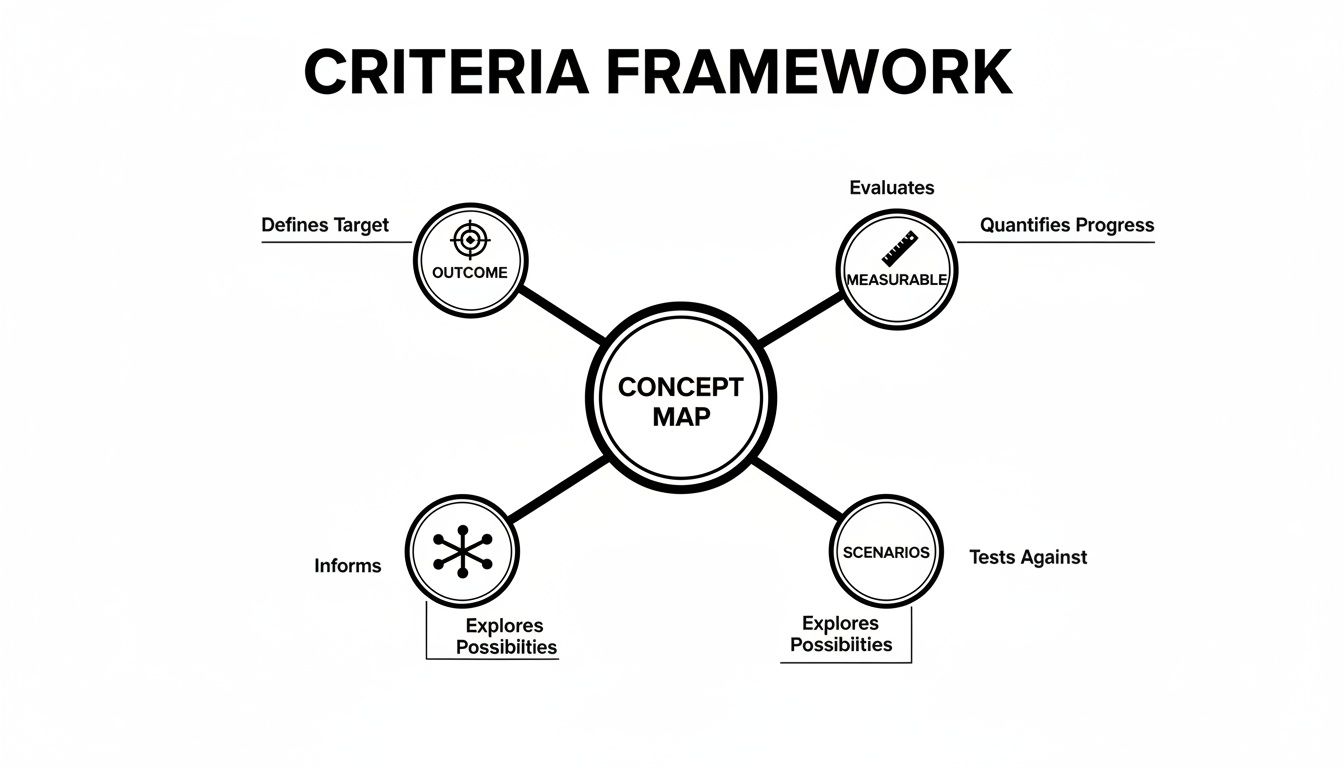
This map serves as a reminder that the ultimate goal is to define what success looks like and to think through every path a user might take to build a complete, well-tested feature.
Example 1: Fintech Funds Transfer
In the high-stakes world of fintech, there is zero room for error. A user story for a funds transfer must perfectly address security, speed, and user feedback.
User Story: "As a banking customer, I want to transfer funds between my accounts so that I can manage my money efficiently and securely."
Checklist (Rule-Based) Example:
This format is ideal for laying out the non-negotiable rules and constraints the system must enforce.
- User must select a "from" account and a "to" account.
- The transfer amount cannot exceed the available balance in the "from" account.
- A confirmation screen must display all transfer details before final submission.
- Upon successful transfer, a confirmation message with a transaction ID is displayed.
- An email notification is automatically sent to the user's registered address.
- The end-to-end transaction must complete in under 3 seconds.
Gherkin (Scenario-Based) Example:
The Gherkin format shines when describing user behavior and system reactions, making it perfect for automation.
Scenario: Successful funds transfer
  Given I am logged in and on the "Transfer Funds" page
  And I have a checking account with a balance of $1000
  And I have a savings account with a balance of $500
  When I enter "100.00" in the amount field
  And I select my checking account as the "from" account
  And I select my savings account as the "to" account
  And I click the "Confirm Transfer" button
  Then I should see a success message: "Your transfer of $100.00 is complete."
  And my checking account balance should now be $900
  And my savings account balance should now be $600
Example 2: SaaS User Onboarding Flow
For any SaaS company, a clunky onboarding experience can kill user retention. The criteria here must ensure the flow is intuitive and helps the user achieve value immediately.
User Story: "As a new user, I want to complete a guided setup tour so that I can understand the core features and start using the product effectively."
Gherkin (Scenario-Based) Example:
Scenario: Skipping the onboarding tour
  Given I am a new user who has just logged in for the first time
  And the guided setup tour modal is displayed
  When I click the "Skip Tour" button
  Then the tour modal should close
  And I should be taken to the main application dashboard
  And the tour should not appear on my next login
Example 3: Enterprise API Endpoint for Data Sync
Not all features are user-facing. For enterprise systems, backend processes like API integrations are the backbone of the business. Here, acceptance criteria pivot to focus on performance, security, and data integrity.
User Story: "As a system administrator, I need a secure API endpoint to synchronize customer data from our CRM to our marketing automation platform so that our marketing campaigns have the most current information."
Checklist (Rule-Based) Example:
- The endpoint must be authenticated using an OAuth 2.0 token.
- The API must accept a POST request with customer data in a valid JSON format.
- It must validate all incoming data fields (e.g., email format, presence of required fields).
- The endpoint must process up to 1,000 records per minute with an average response time of less than 500ms.
- In case of a validation error, the API must return a
400 Bad Requeststatus with a clear error message.
Industry analysis shows that 92% of high-performing Agile teams rely on the Given-When-Then format, leading to a 55% boost in on-time delivery. You can discover more insights about their role in product development on uxplanet.org. This disciplined approach is how you turn complex business needs into tangible, measurable outcomes.
Common Mistakes to Avoid When Writing Criteria
When defining acceptance criteria for user stories, knowing what not to do is as important as knowing what to do. Even well-intentioned teams fall into common traps that create confusion, slow development, and lead to a product that misses the mark.
Pitfall 1: Being Overly Prescriptive with Technical Details
Acceptance criteria should always focus on the what (the user outcome) and the why (the business value), never the how (the technical solution). When you start prescribing specific technologies, database schemas, or code libraries, you are overstepping into the engineering domain. This stifles innovation, removes team autonomy, and can lock you into brittle solutions that are difficult to maintain.
- Before (Too Technical): "The system must use a React component with Redux for state management to display the user's profile information."
- After (Outcome-Focused): "When a user navigates to their profile page, their name, email, and membership level are displayed correctly within 1 second."
The "after" example provides a clear, testable goal without handcuffing the development team to a specific implementation.
Expert Insight: Give your engineers the problem, not the solution. When you define success from a user's perspective, you empower your team to use their expertise to deliver the most efficient and robust technical solution.
Pitfall 2: Letting Scope Creep Disguise Itself as Criteria
Scope creep is a notorious project killer, and it often sneaks in disguised as "just one more little thing" added to the acceptance criteria. Each user story should be small and focused on a single piece of functionality. When you add criteria that introduce new features or dramatically expand the original intent, you are bloating the story. This makes accurate estimation impossible and puts sprint commitments at risk. If a new requirement emerges, capture it as a separate user story to be prioritized accordingly.
From Vague to Valuable: Common Pitfalls and How to Fix Them
| Common Mistake | Why It's a Problem | How to Fix It (The Solution) |
|---|---|---|
| Using Ambiguous Language | Terms like "fast," "easy," or "better" are subjective and cannot be tested objectively. They mean different things to different people. | Replace subjective words with specific, measurable metrics. Instead of "fast," specify "loads in under 2 seconds." |
| Assuming Knowledge | Criteria that rely on unstated assumptions or "tribal knowledge" create confusion, especially for new team members or offshore partners. | Write each criterion as if for someone completely new to the project. Define all terms and spell out every condition explicitly. |
| Combining Multiple Conditions | A single criterion that tests multiple things (e.g., "User can log in and see their dashboard") is hard to test and debug. | Break down complex criteria into individual, atomic statements. Each should test a single, discrete condition. |
Avoiding these mistakes ensures your acceptance criteria for user stories serve their true purpose: creating a rock-solid shared understanding and a clear definition of "done."
Weaving Criteria into Your Development Lifecycle

Crafting brilliant acceptance criteria for user stories is only half the battle. If they remain buried in a document, they are useless. The real value is unlocked when you integrate them into the fabric of your team's workflow, turning them from a static checklist into a dynamic tool for alignment and quality.
This process begins long before coding starts, during collaborative refinement sessions where product, design, engineering, and QA participate. It must be a cross-functional conversation to challenge ideas, identify edge cases, and build a shared vision of what "done" looks like.
From Criteria to High-Quality Test Cases
Your acceptance criteria are the perfect springboard for your testing efforts, laying out a clear path for both manual and automated testing.
- Behavior-Driven Development (BDD): Gherkin-formatted criteria (Given-When-Then) can be translated directly into automated tests using frameworks like Cucumber or SpecFlow. This creates living documentation that is always synchronized with your system's actual behavior.
- Manual Test Plans: For rule-based criteria or complex scenarios that are difficult to automate, they form the core of your manual test plan. Each condition becomes a clear test case for a QA analyst, guaranteeing every requirement is validated.
This tight coupling between requirements and testing is the bedrock of any effective quality assurance process. For a deeper dive, explore our guide on building comprehensive quality assurance process steps.
Expert Takeaway: Treat your acceptance criteria as the single source of truth for all test cases. If a test case doesn't map back to a specific criterion, it's a red flag that you are either testing something unnecessary or have missed a requirement.
The Link to Your Definition of Done
It’s easy to confuse acceptance criteria with your team's Definition of Done (DoD), but they serve different purposes. Acceptance criteria are unique to one specific user story, defining what it takes for that story to be complete.
Your Definition of Done, on the other hand, is a universal checklist that applies to every single story. It’s your team's broader commitment to quality, covering items like code reviews, passing unit tests, and successful deployment.
A story is only truly "done" when it meets both its unique criteria and the team’s global DoD.
A story is complete when:
- All its specific acceptance criteria have been met (e.g., the user can successfully transfer funds).
- It passes all items on the team's Definition of Done (e.g., the code is peer-reviewed and deployed to staging).
Embedding criteria throughout your entire lifecycle creates a powerful feedback loop that drives clarity, slashes rework, and helps you consistently ship high-quality software that achieves business goals.
Summary and Next Steps
Mastering the art of writing acceptance criteria for user stories is a strategic discipline that drives project success. It's about creating an unambiguous, shared understanding of what "done" means for every piece of work. By focusing on user outcomes, ensuring testability, and collaborating across teams, you can eliminate rework, accelerate delivery, and build higher-quality products.
Your Actionable Checklist for Writing Better Criteria
Use this checklist in your next backlog refinement session to build the right habits and elevate your team's performance.
- Focus on the User Outcome: Does each criterion describe what the user can do, not how the system is built?
- Eliminate Ambiguity: Is every condition specific, measurable, and testable? (e.g., "loads in under 2 seconds" instead of "loads fast").
- Explore All Scenarios: Have you considered the happy path, negative cases (errors), and unexpected edge cases?
- Ensure Team Alignment: Has the entire team—product, design, engineering, and QA—reviewed and agreed upon the criteria?
By making this process a core part of your workflow, acceptance criteria transform from a documentation chore into your most powerful tool for building software that delivers real business value.
At Group 107, we build premium offshore software development teams that live and breathe these best practices. We don't just add developers; we integrate a culture of clarity and quality into your organization, helping you scale your product development the right way. Find out how our dedicated teams can help you get to market faster at group107.com.