
An agile release plan is your tactical blueprint for execution. It bridges the gap between your high-level product vision and the day-to-day sprints your development teams live in. Think of it as the critical link between the strategic why of your product roadmap and the tactical how of individual sprint plans, ensuring every cycle delivers tangible business value.
This plan isn't just a schedule; it's an alignment tool that outlines the scope, timeline, and features for your product's next major release, giving every stakeholder—from engineering to marketing—a clear forecast of what's coming and when.
What an Agile Release Plan Is (and Isn't)
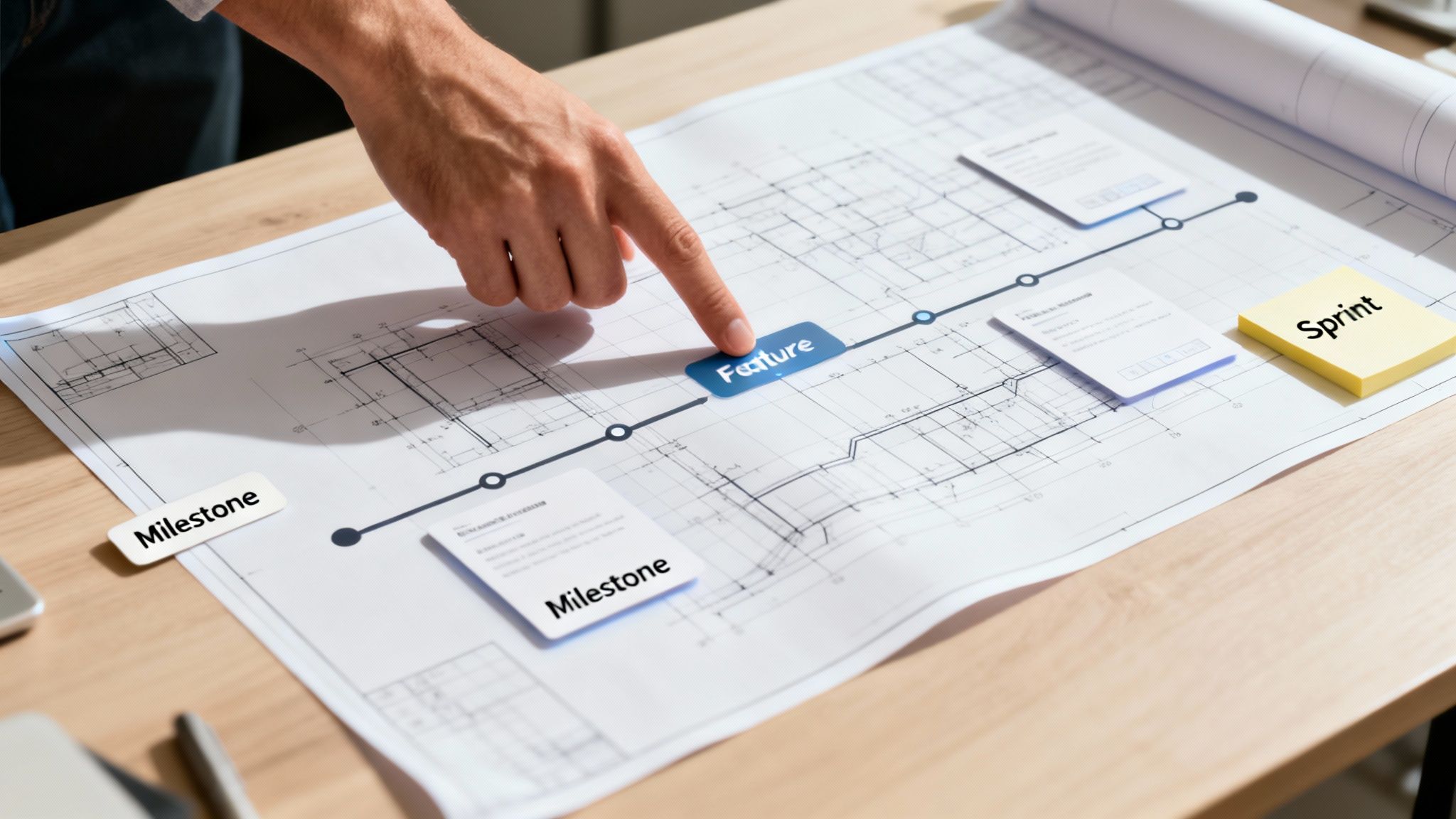
It’s easy to get lost in different planning documents. A product roadmap paints the long-term strategic direction, often looking quarters or even years ahead. In contrast, the agile release plan is a tactical forecasting tool focused on a specific, shorter-term delivery window. It translates broad strategic goals into an actionable delivery schedule.
While the city plan (your roadmap) shows where a new building will go, the blueprint (your release plan) details its structure, materials, timeline, and dependencies. This level of clarity is vital for aligning stakeholders, managing expectations, and ensuring the development team builds the right thing at the right time.
Distinguishing Plans by Purpose
To execute efficiently, you need the right tool for the job. The same applies to agile planning. Each artifact serves a unique purpose and audience, working together to guide development from high-level strategy down to daily tasks.
Here’s a practical breakdown of how they differ:
| Artifact | Primary Purpose | Timeline | Level of Detail |
|---|---|---|---|
| Product Roadmap | Defines the "why" and "what" of the product's strategic direction. | 6-18+ months | Low (themes, high-level goals) |
| Agile Release Plan | Outlines the "what" and "when" for the next major product version. | 1-3 months | Medium (epics, key features) |
| Sprint Plan | Details the "how" for the immediate development cycle. | 1-4 weeks | High (user stories, specific tasks) |
Each layer builds on the previous one, providing teams and stakeholders with the right level of information at the right time.
An effective agile release plan does more than just schedule work; it creates a shared understanding of the value being delivered. It forces teams to prioritize ruthlessly, identify dependencies early, and communicate a realistic delivery forecast.
This approach has become the industry standard for a reason. Agile planning adoption skyrocketed from 37% in 2020 to 86% among software teams by 2021, demonstrating its critical role in connecting strategy to execution.
Why Your Business Needs a Release Plan
Without a release plan, development teams risk flying blind. Sprints can become a series of disconnected tasks, resulting in a jumble of features that fail to deliver a cohesive, valuable product update. A solid agile release plan prevents this chaos by drawing a clear line from daily work to the ultimate release goal.
This structured approach is a cornerstone of the agile software development lifecycle, ensuring every sprint contributes to a larger, well-defined objective. Before diving deeper, it's helpful to understand the broader context of Agile Web Development methodologies.
A great plan is also a critical communication tool. It gives sales, marketing, and support teams a reliable forecast of what’s coming, allowing them to prepare launch activities, update documentation, and manage customer expectations. This cross-departmental alignment is essential for a successful product launch and is a hallmark of a mature agile organization. You can see how this fits into the bigger picture by reading our guide to the agile methodology in the SDLC.
The Core Components of an Effective Release Plan
An agile release plan is more than a calendar; it’s a strategic document built from several interconnected components. Each part adds critical context, ensuring the plan is grounded in business reality and actionable for the development team. Skipping any of these elements invites confusion and introduces unnecessary risk.
To build a robust plan, you need the complete story: the "why" behind the work, the "what" you're building, the "when" it will be delivered, and a strategy for handling the inevitable "what ifs."
1. Vision and Tangible Goals
Every release must start with a clear, shared understanding of its purpose. The product vision is the anchor connecting this release to the company’s strategic goals. It answers the most important question: "Why are we building this now?"
From that vision, you must define tangible, measurable goals. This translates the high-level idea into specific business outcomes. For example, "Improve the user dashboard" is a weak goal. A strong one is, "Increase user engagement with the reporting dashboard by 15% within Q1 post-launch." That’s a target you can build toward and measure against.
Release goals must be:
- Specific: Clearly define what you aim to achieve.
- Measurable: Define success with concrete metrics (e.g., higher adoption rate, better conversion, fewer support tickets).
- Achievable: Be realistic about what the team can accomplish with the available time and resources.
- Relevant: Ensure each goal directly supports the overarching product vision.
2. Scope Mapped to Features and Epics
With clear goals, you can define the scope. This involves breaking down the work into manageable pieces, typically organized as epics (large bodies of work) and features (specific functionalities that deliver user value). The goal is to identify the major building blocks needed to achieve your objectives without getting lost in granular task-level details.
Your prioritized product backlog is your primary source here. You'll pull the highest-value items that align with the release's goals. A well-defined scope provides clarity for everyone and is your best defense against scope creep—the insidious addition of new requirements mid-stream that can derail your timeline.
3. Key Milestones and Realistic Timelines
A timeline provides the structural backbone of your plan. Instead of a single, distant launch date, a strong agile release plan uses key milestones to demonstrate meaningful progress. These act as checkpoints where the team and stakeholders can review completed work, provide feedback, and adjust the plan as needed.
Milestones could include:
- Completion of a core epic.
- An internal demo of a major new feature.
- Readiness for an alpha or beta test.
- Successful completion of security and accessibility audits.
These markers break a large release into smaller, more manageable phases, making the entire effort more predictable and transparent.
4. Resource and Capacity Planning
You must be honest about what your team can deliver. Capacity planning involves determining how much work your team can realistically complete in a given timeframe. The most reliable way to do this is by analyzing their historical velocity—the average amount of work (measured in story points) completed in past sprints.
A release plan built on wishful thinking instead of actual data is destined to fail. You must factor in holidays, vacations, and buffer time for bug fixes or technical debt. This is how you build a timeline the team can commit to with confidence.
This step is your reality check. It prevents you from over-promising and burning out your team, which inevitably leads to poor quality and missed deadlines. It’s about striking a sustainable balance between ambition and operational reality.
5. Proactive Risk Assessment
Every project has risks; ignoring them is a recipe for failure. Proactive risk assessment means actively identifying potential threats to your schedule, budget, or scope before they become crises.
Common risks include:
- Technical Risks: Encountering unexpected technical complexity or relying on new, unproven technology.
- Dependency Risks: Delays caused by another team, a third-party vendor, or an external API.
- Resource Risks: A key team member leaving or being reassigned to another priority project.
Once identified, risks must be managed. A useful framework is ROAM (Resolved, Owned, Accepted, Mitigated). This assigns a clear owner and an action plan to each risk, enabling you to tackle problems proactively and keep your release on track.
How to Build Your Agile Release Plan Step-by-Step
An agile release plan isn't a rigid, long-term prediction; it’s a living forecast created through a collaborative, structured process. It’s how you translate a high-level product vision into a realistic, step-by-step execution strategy that everyone understands and supports.
Following a proven sequence is critical. It ensures your plan is tied to business value, grounded in your team's actual capacity, and clearly communicated to all stakeholders. This structured approach turns strategic goals into an executable plan where every sprint drives meaningful progress.
The process connects the vision, scope, and the plan itself.
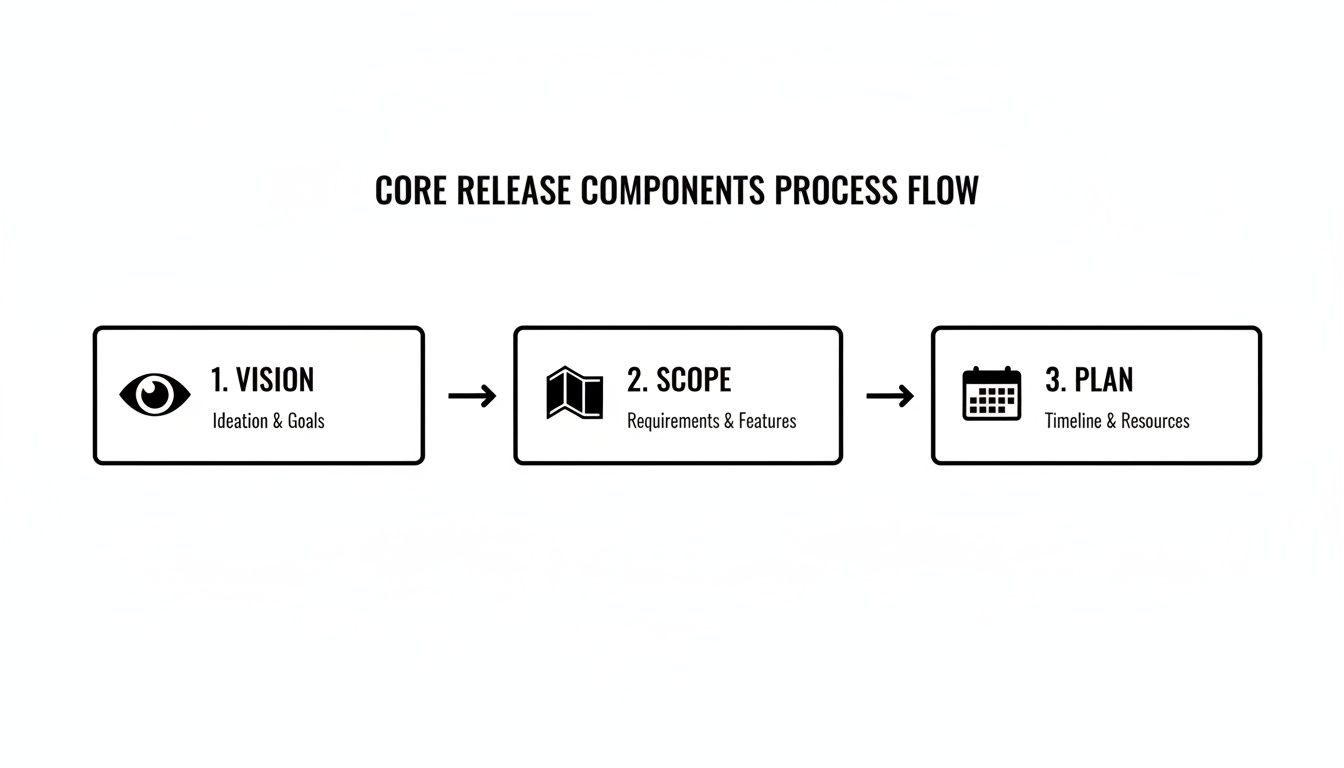
This flow illustrates how a powerful plan begins with a clear vision, which is translated into a defined scope and then mapped onto a practical timeline. Let's break down each step.
1. Anchor the Plan with a Compelling Product Vision
Before debating a single feature, the entire team must rally around the why. A clear product vision serves as the North Star for your release. It’s a concise statement that defines the purpose of the release, its target audience, and the value it will deliver.
This isn’t a corporate formality; it’s a critical filter for every subsequent decision. When debates arise over feature priority or design choices, the vision statement realigns everyone on the primary objective. It ensures you’re building a cohesive solution to a real customer problem, not just a random collection of features.
2. Build and Prioritize Your Product Backlog
With the vision locked in, it’s time to populate the product backlog with the epics and user stories that will bring it to life. The backlog is a dynamic, ordered list of everything you could build. The key is ruthless prioritization—you can't do it all at once.
Effective prioritization is both an art and a science. Frameworks like MoSCoW (Must-have, Should-have, Could-have, Won't-have) provide a simple yet powerful method for categorizing features. This forces the tough but essential conversations about what truly drives business value versus what is merely "nice to have."
A well-prioritized backlog is the foundation of any realistic plan. To dig deeper into structuring this, check out our guide on the agile project plan.
3. Estimate Work and Establish Team Velocity
You cannot create a reliable timeline without knowing how much work the team can handle. This is where estimation and velocity come into play. Estimation isn’t about predicting the exact number of hours; it’s about understanding the relative effort of different work items using story points.
Techniques like planning poker, where team members collaboratively vote on story points, are effective for this. This process surfaces diverse perspectives on complexity, leading to more accurate estimates than a single person’s guess.
Team velocity is the measure of the average amount of work a team completes during a sprint, typically calculated over the last 3–5 sprints. This historical data is your most reliable predictor of future capacity, making it a non-negotiable input for any credible release plan.
4. Map Features to a Sprint Cadence
Now it’s time to connect the dots. Take your prioritized backlog (the what) and combine it with your team's velocity (the how much). This step involves grouping user stories from the top of the backlog into sprints, forming a high-level release schedule.
The goal isn't to create a rigid, set-in-stone schedule. Instead, you're building a forecast that balances ambition with the reality of your team's delivery capacity. This visual timeline is incredibly valuable for stakeholders, as it shows them when they can expect key features to be delivered.
5. Socialize the Plan and Create a Feedback Loop
An agile release plan is a team sport, not a top-down decree. The final and most crucial step is to share the draft plan with all key stakeholders—from development and product to marketing, sales, and leadership. This meeting is for alignment, not just a rubber stamp.
This session serves two vital purposes:
- Building Alignment: It ensures everyone understands the release goals, scope, and timeline. It provides a forum for questions and concerns.
- Creating a Feedback Loop: Stakeholders often have valuable input that was missed, such as market deadlines or customer commitments. This is the chance to make adjustments before work begins.
This collaborative spirit is paramount. In fact, 59% of practitioners cite improved team synergy as a primary benefit of agile planning, which directly enhances release quality. With engineering and R&D teams now comprising 48% of agile users, collaborative planning is more critical than ever for keeping distributed teams synchronized. By involving everyone, you create shared ownership—the ultimate driver of a plan's success.
Agile Release Plans in the Real World: 3 Examples

An agile release plan is not a rigid template. Its structure and focus shift dramatically based on business context. A plan for a startup racing to find product-market fit looks nothing like one for a major financial institution overhauling a core system.
To illustrate this, let's explore three distinct scenarios. Each demonstrates how the plan adapts to specific goals, proving its versatility as a strategic forecasting tool.
Example 1: SaaS MVP Launch
Imagine a new SaaS company preparing for its market debut. Here, speed is paramount. The release plan is laser-focused on getting a Minimum Viable Product (MVP) to early adopters as quickly as possible. The primary goal is learning, not perfection.
The plan relentlessly prioritizes only the features that solve the most critical user problem. Everything else is deferred to a future release.
- Primary Focus: Validating the core value proposition and gathering user feedback.
- Key Milestones: An internal alpha release, a closed beta for select customers, and the public MVP launch.
- Success Metrics: User sign-up rates, feature adoption metrics, and qualitative feedback from beta testers.
This type of plan is lean and designed to adapt rapidly. It may be adjusted weekly based on feedback, enabling the startup to pivot without being constrained by a long-term schedule.
Example 2: Fintech Platform Security Upgrade
Now, consider a platform upgrade for an established fintech company. The priorities are entirely different. The plan must balance delivering new features with the non-negotiable demands of security, compliance, and system stability.
In a heavily regulated industry like finance, a release isn't a simple deployment. The release plan must detail a phased rollout, including internal security audits, penetration testing, and validation against standards like SOC 2 or PCI DSS.
This plan is far more granular and risk-averse. A bug that is a minor inconvenience for a SaaS MVP could trigger a financial and legal crisis in a fintech application.
- Primary Focus: Ensuring security, maintaining data integrity, and meeting all compliance requirements.
- Key Milestones: Successful security audits, user acceptance testing (UAT) with a pilot group, and a carefully managed, phased rollout to user segments.
- Success Metrics: Zero critical security vulnerabilities, flawless data migration, and a smooth user transition that avoids overwhelming support channels.
The plan must also address accessibility compliance, ensuring the platform is usable for everyone. Navigating these complex requirements is why Group 107 provides specialized accessibility services for financial institutions.
Example 3: Enterprise DevOps CI/CD Integration
In a large enterprise, a release plan might be used for an internal initiative, such as rolling out a Continuous Integration/Continuous Deployment (CI/CD) pipeline. Here, the "customer" is the company's own development organization, and the "product" is a more efficient software delivery process.
The focus shifts from user-facing features to internal process improvements. Success is measured in efficiency gains and reduced deployment friction, not revenue.
- Primary Focus: Automating the build, test, and deploy cycle to increase development velocity and reliability.
- Key Milestones: Achieving automated unit testing, deploying to a staging environment without manual intervention, and completing the first zero-touch deployment to production.
- Success Metrics: Increased deployment frequency (e.g., from monthly to weekly), a lower change failure rate, and a reduced lead time for changes.
This is a deeply technical plan rooted in DevOps principles. By improving core infrastructure, it empowers all other product teams to deliver value faster. To accelerate such initiatives, many enterprises leverage DevOps as a Service to bring in specialized expertise.
Release Plan Focus by Use Case
This table summarizes how the focus of an agile release plan adapts to different business objectives.
| Use Case | Primary Focus | Key Milestones | Success Metrics |
|---|---|---|---|
| SaaS MVP Launch | Speed to market & user feedback | Alpha/Beta releases, Public MVP | Sign-up rate, feature adoption |
| Fintech Upgrade | Security, compliance, & stability | Security audits, UAT, Phased rollout | Zero critical vulnerabilities, data integrity |
| Enterprise CI/CD | Process automation & efficiency | Automated testing, Staging deploy | Deployment frequency, change failure rate |
This adaptability is what makes the agile release plan such a powerful tool—it’s not just a schedule, but a strategic guide tailored to the specific mission at hand.
Best Practices for Long-Term Success
Creating a solid agile release plan is a critical first step, but its true value is realized through disciplined execution and continuous adaptation. A plan that gathers dust is useless. High-performing teams treat their release plan as a living document that evolves with new information and changing realities. This flexibility is what separates predictable delivery from chaotic, missed deadlines.
Maintaining this agility requires commitment to a few core practices that build resilience and stakeholder trust. Without them, even the most meticulous plan can quickly become obsolete.
Treat Your Plan as a Living Document
The most common mistake is treating the release plan as a one-and-done artifact. Markets shift, customer feedback provides new insights, and technical challenges emerge. Your plan must evolve accordingly.
Establish regular review cadences—at least monthly or at the end of each program increment—to assess progress against goals. This is a strategic checkpoint to ask critical questions:
- Are our initial assumptions still valid?
- Has new information changed our priorities?
- Is our team's actual velocity aligned with our forecast?
Answering these questions honestly allows you to make intelligent adjustments, keeping the plan a reliable guide.
Communicate Changes Proactively
When the plan changes, silence is your enemy. Transparent and proactive communication is the bedrock of stakeholder trust. Don't hide delays or scope changes. Instead, address them head-on, explain the why behind the shift, and clarify the impact.
Visual tools are invaluable for this. A burnup chart clearly shows the total release scope versus the work completed over time. When scope is added, the top line of the chart moves up, making it instantly clear why a delivery date might need to shift. This visual evidence fosters a shared understanding and moves the conversation from blame to collaborative problem-solving.
Build in Continuous Feedback Loops
An agile release plan cannot exist in a vacuum. It must be fueled by a constant stream of feedback from two crucial sources: your customers and your development team.
A release plan without a feedback loop is just a guess. Integrating user feedback after each incremental release ensures you are building what the market actually wants, while internal retrospectives help you refine the planning process itself.
This build-measure-learn cycle prevents teams from wasting months on features nobody values. It also gives developers a voice to flag technical debt or process bottlenecks that could jeopardize future releases, improving the health of the entire system. Exploring effective project management strategies can help embed these feedback loops into your daily operations.
Avoid Common Pitfalls
Even with the best intentions, teams fall into predictable traps. Awareness is the first step to avoidance.
- Overcommitting and Ignoring Capacity: Ambition is valuable, but planning based on fantasy is not. Always ground your plan in historical data on your team's velocity. Ignoring your team's real capacity is the fastest way to cause burnout and destroy morale.
- Ignoring Technical Debt: Deferring essential work like refactoring or infrastructure upgrades will eventually grind progress to a halt. A robust release plan allocates dedicated capacity to manage technical debt.
- Failing to Map Dependencies: Assuming other teams will complete their work on time is a recipe for disaster. Clearly identify and map all cross-team dependencies and secure firm commitments early in the planning process.
Adhering to these principles transforms your release plan from a static schedule into a dynamic strategic asset. This disciplined approach is a hallmark of high-performing teams. You can learn more in our detailed guide on agile development best practices.
Your Questions, Answered
Even with a solid grasp of the fundamentals, common questions often arise during implementation. Let’s address some of the most frequent ones to clarify confusion and help you avoid common pitfalls.
How Often Should an Agile Release Plan Be Updated?
Think of your agile release plan as a living map, not a static blueprint. The best teams formally review and adjust their plan on a predictable cadence—typically once a month or after every Program Increment (PI). This maintains alignment without creating constant churn.
However, you must also update it in response to significant events, such as:
- A major shift in business priorities.
- Critical customer feedback that invalidates initial assumptions.
- An unforeseen technical dependency or blocker.
Treating the plan as a dynamic guide ensures it remains relevant and useful for forecasting.
The key is to find the right balance between stability and flexibility. A plan that changes daily creates chaos, but one that never changes is merely wishful thinking. Regular, structured check-ins provide the rhythm for intelligent adaptation.
Release Plan vs. Release Train: What's the Difference?
These terms are often confused, but they serve very different purposes, especially within the Scaled Agile Framework (SAFe). Understanding the distinction is crucial for managing workflow in larger organizations.
- A release plan is a strategic document for a specific, time-bound release. It details the scope, timeline, and goals for a single product delivery initiative. It’s the itinerary for one specific journey.
- A SAFe Agile Release Train (ART) is a long-lived, virtual organization of multiple agile teams. The ART is a "team of teams" that collaborates to deliver a continuous stream of value. The train is always moving; the release plan simply defines its destination for the next major journey.
What are the Best Tools for Managing an Agile Release Plan?
The right tool can be a game-changer for visualizing scope, tracking progress, and managing dependencies. While a spreadsheet may suffice for a small team, dedicated platforms offer far more power and clarity for complex initiatives.
Here are the top contenders we see teams using successfully:
- Jira with Advanced Roadmaps: As the industry standard, this combination is excellent for mapping epics to a timeline, visualizing cross-team dependencies, and forecasting delivery dates based on actual team velocity.
- Azure DevOps: Microsoft's integrated solution provides boards, backlogs, and pipelines in one place. Its delivery plans feature is particularly effective for tracking the progress of multiple teams against a shared timeline.
- Aha! Roadmaps: Known for high-level roadmapping, Aha! excels at connecting broad strategy directly to detailed release plans. Its superior visualizations make it incredibly easy to communicate plans to stakeholders.
The best choice depends on your team's size, existing tech stack, and release complexity. The most important factor is selecting a platform that brings clarity to your process and enhances team collaboration.
A well-executed agile release plan is the engine of predictable, high-value delivery. By aligning your strategic vision with a realistic and adaptive forecast, you can consistently ship impactful products, build trust with stakeholders, and maintain a competitive edge. At Group 107, we specialize in building the high-performing offshore teams and implementing the DevOps practices that turn great plans into exceptional products.
Ready to improve your delivery process? Let's build your next release together.