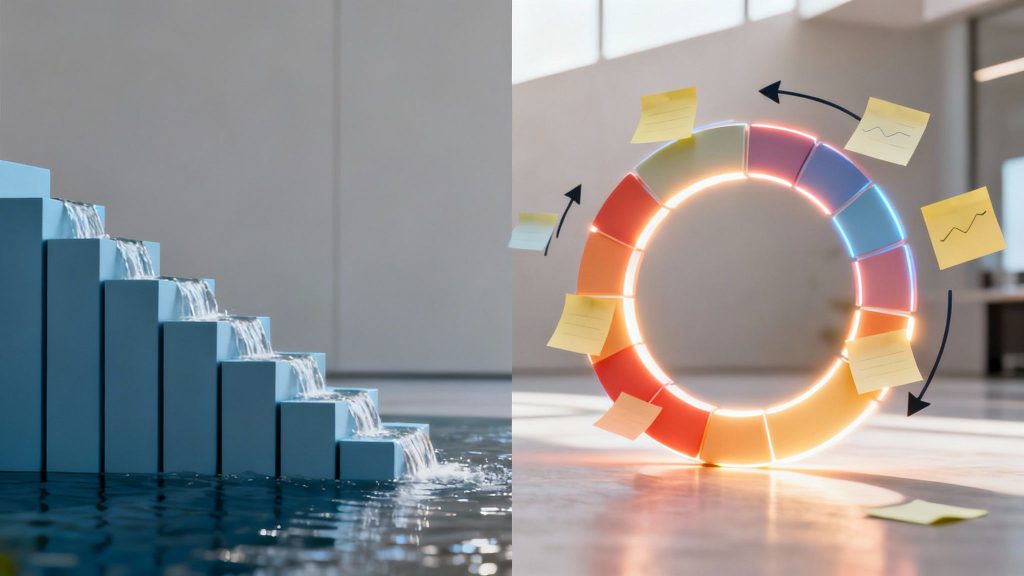
The core of the agile vs waterfall methodology debate is a strategic choice between structure and flexibility. Waterfall is a traditional, linear path where each phase must be completed before the next begins—like a series of cascading falls. Agile, conversely, is an iterative model built on rapid cycles that allow for continuous adaptation and feedback. This isn't just a technical decision; it's a business choice that dictates how you manage risk, involve stakeholders, and deliver value.
Understanding The Foundational Methodologies
Choosing the right project management framework is a strategic decision that shapes your project's outcome, your team's operational rhythm, and your ability to respond to market changes. The classic Agile vs Waterfall matchup represents two fundamentally different philosophies for bringing a product from concept to reality. Each provides a distinct playbook for planning, executing, and delivering.
To grasp the difference, you must understand the Software Development Life Cycle (SDLC), the foundational framework within which both methodologies operate. However, they navigate its phases in unique ways. For a deeper dive into this structure, explore our guide on the software development life cycle explained.
Core Principles At A Glance
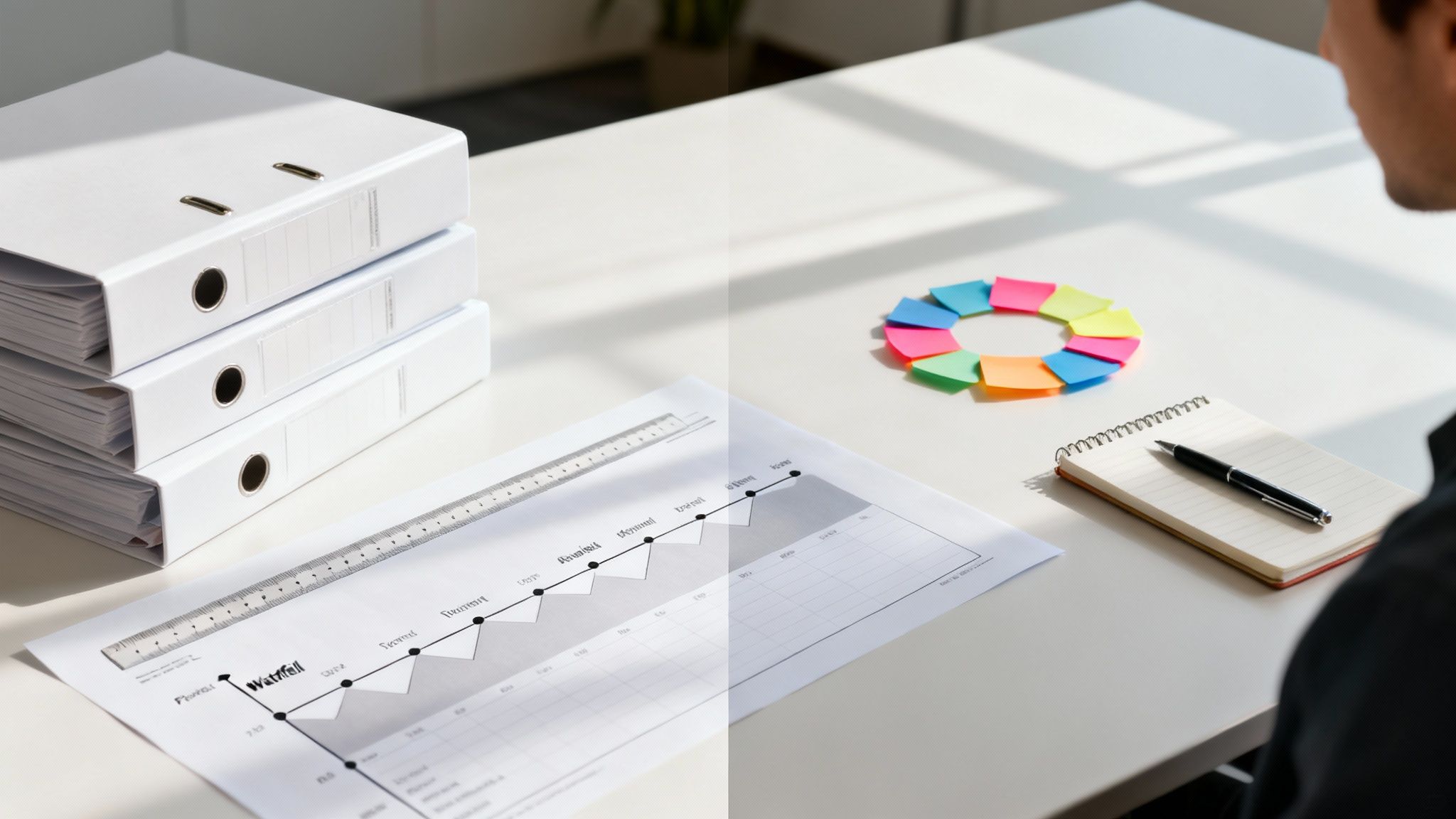
The Waterfall approach is a classic, sequential method. It is built on comprehensive upfront planning, where all project requirements are defined and signed off before any development starts. The project then flows step-by-step through distinct phases like Requirements, Design, Implementation, and Testing. A phase must be 100% complete before the next begins, and backtracking is both difficult and costly.
Agile is the opposite—it's an adaptive framework engineered for change. It works by delivering functional pieces of the project in short, iterative cycles called sprints. This continuous loop of building, testing, and gathering feedback allows teams to pivot and adjust on the fly, ensuring the final product aligns with what stakeholders and the market actually need.
The core trade-off is simple: Waterfall prioritizes predictability and control, while Agile prioritizes adaptability and speed to market. Your project's nature—whether it has fixed requirements or needs to evolve—is the primary factor in this decision.
To simplify, these two methodologies are built on fundamentally different philosophies. The table below breaks down their core principles for a quick side-by-side comparison.
Quick Comparison of Core Principles
| Attribute | Waterfall Methodology | Agile Methodology |
|---|---|---|
| Project Flow | Linear and sequential; one phase must be fully completed before the next begins. | Iterative and cyclical; the project is broken into small sprints that repeat. |
| Flexibility | Rigid and resistant to change; altering scope mid-project is difficult and costly. | Highly flexible; changes are welcomed and can be incorporated in any sprint. |
| Client Involvement | Limited to the initial requirements phase and final delivery review. | Constant and collaborative; feedback is integrated throughout the entire lifecycle. |
| Documentation | Extensive and created upfront; serves as a contract for the entire project. | Minimal and emergent; focuses on working software over comprehensive documents. |
Ultimately, understanding these foundational differences is the first step in deciding which path is the right one for your specific project and team.
Comparing the Project Lifecycles in Action
While the theoretical differences between Agile and Waterfall are clear, their true impact becomes evident during a real-world project lifecycle. Your choice of methodology shapes everything from requirements gathering and stakeholder communication to the first time a working product is demonstrated.
Let's ground this in a practical scenario: your team is tasked with building a secure payment gateway for a new fintech platform. This is a high-stakes project requiring compliance, robust security, and seamless integration with various banking APIs. How each methodology approaches this challenge reveals its core DNA.
The Waterfall Lifecycle: A Linear March
Under a Waterfall model, the fintech project begins with an exhaustive requirements-gathering phase. Every detail—security protocols, API specifications, UI elements, compliance checks—is documented and signed off before any code is written. This phase alone can take months.
Once requirements are locked, the project proceeds sequentially through distinct, gated phases:
- Design: Architects create detailed system blueprints and UI mockups based on the approved documentation.
- Implementation: Developers build the system, strictly adhering to the design specifications.
- Testing: A dedicated QA team receives the fully built gateway and begins comprehensive testing.
- Deployment: The completed product is released to the market.
Each phase must be 100% complete before the next begins. There is no overlap. If a new regulation emerges or a competitor launches a new feature mid-project, making changes is incredibly disruptive and expensive. Stakeholders only see the final product at the very end, potentially a year or more after kickoff.
The Agile Lifecycle: A Cyclical Approach
Agile tackles the same fintech project with a completely different mindset. Instead of a single "big bang" launch, the team's objective is to deliver value in small, iterative cycles called sprints, typically lasting two to four weeks.
The project starts with a high-level vision and a backlog of features (or user stories). The first sprint might focus on delivering a Minimum Viable Product (MVP) that can process a single transaction from one major credit card.
Here’s the Agile workflow for our payment gateway:
- Sprint Planning: The team selects a small set of high-priority features from the backlog to complete in the current sprint.
- Daily Stand-ups: The team syncs for 15 minutes daily to discuss progress, goals, and any impediments.
- Development & Testing: Features are built and tested concurrently within the sprint. Continuous integration ensures new code is merged and tested frequently, catching bugs early.
- Sprint Review: At the end of the sprint, the team demonstrates the working software to stakeholders to gather immediate, actionable feedback.
- Retrospective: The team reflects on the sprint to identify process improvements for the next cycle.
This loop repeats, with each sprint adding more functionality—support for new payment types, enhanced security, or an improved UI.
The most significant difference is the feedback loop. With Agile, stakeholders see a working, albeit incomplete, version of the payment gateway every few weeks. This allows for rapid course correction, ensuring the final product aligns perfectly with market needs and business goals.
Key Operational Differences Illuminated
Placing the two methodologies side-by-side in this fintech example makes the practical distinctions clear. Waterfall's rigidity offers predictability, which is valuable for projects with unchangeable requirements. But what if a new payment standard emerges mid-project? The entire plan is thrown into chaos.
Agile is built for such uncertainty. The team can add the new standard to the backlog and prioritize it for an upcoming sprint. This adaptability minimizes risk and ensures the final product is relevant at launch. While Waterfall delivers one massive product at the end, Agile provides a series of smaller, functional releases, delivering tangible business value much sooner.
Choosing Agile for Dynamic and Unpredictable Projects
When a project is defined by uncertainty, Waterfall’s rigid structure can become a liability. Agile was created for these exact scenarios—where requirements are expected to evolve, market feedback is critical, and speed-to-market provides a competitive advantage.
Instead of a single, high-stakes launch, Agile delivers value in small, consistent increments. This cycle of building, testing, and learning makes it the default choice for innovation-led projects where the full scope is not known from the start.
The Power of Iteration and the MVP
At the heart of Agile’s strength is the Minimum Viable Product (MVP). Rather than spending months building a feature-complete product, an Agile team focuses on launching a core, functional version to real users as quickly as possible. This approach fundamentally de-risks product development.
This strategy is highly effective for:
- SaaS Product Development: Where continuous user feedback is essential for refining features and achieving product-market fit.
- E-commerce Feature Rollouts: Enabling A/B testing of a new checkout flow with a small user segment before a site-wide launch.
- Complex AI Automation Projects: Where the optimal solution is discovered through experimentation and refining algorithms with real-world data.
By launching an MVP, you start gathering tangible user data almost immediately. In a volatile market, that feedback loop is your most valuable asset. It lets you pivot based on evidence, not assumptions, slashing the risk of wasted investment.
This adaptive mindset is now the standard. Recent industry data shows that 70–86% of software teams now use Agile practices. This trend extends beyond IT, with engineering and R&D teams adopting its principles to drive innovation. You can see more data on this by reviewing current Agile statistics.
Driving Tangible Business Outcomes
The choice between Agile and Waterfall ultimately comes down to business impact. Agile is more than a workflow; it's a strategic tool for succeeding in fast-moving industries. For a closer look at execution, check out these agile development best practices.
Adopting Agile delivers measurable business results:
- Faster Time-to-Market: Shipping functional software in weeks, not months, allows you to capture market share and respond to competitors.
- Higher Customer Satisfaction: Continuous stakeholder and user involvement ensures the final product solves real problems, leading to better adoption and loyalty.
- Improved ROI: By focusing on high-value features first, Agile ensures development resources are allocated to what truly impacts the bottom line.
- Reduced Project Risk: Issues are identified and resolved in each short sprint, avoiding the catastrophic, late-stage failures that can sink a Waterfall project.
For projects demanding rapid iteration, concepts like no-code development further highlight why Agile is often the superior choice. Its focus on rapid prototyping and incremental improvement is a perfect match for today's development challenges, ensuring the final product is not just well-built but also deeply relevant.
Where Waterfall Wins: Predictability, Compliance, and Control
While Agile dominates modern development discussions, the Waterfall methodology remains essential and, in some cases, the only logical choice. Its strength lies not in flexibility but in its rigid structure, predictability, and control.
When requirements are immutable, the scope is locked, and compliance is non-negotiable, Waterfall provides the disciplined framework needed for successful execution. It’s like building a skyscraper: the final blueprint must be approved before the foundation is poured.
When Certainty is More Important Than Flexibility
At its core, the Waterfall model is engineered for predictability. For projects with a clearly defined endpoint and zero tolerance for scope creep, its sequential process ensures alignment from day one. This makes it the ideal methodology when hitting a specific budget and deadline is the absolute top priority.
Waterfall excels in scenarios like:
- Government Infrastructure Systems: Large-scale public sector projects are often bound by strict legal requirements and rigid procurement processes that demand comprehensive upfront planning and fixed-price contracts.
- Medical Device Software: Software for medical equipment is subject to regulatory bodies like the FDA, which mandate exhaustive documentation and a traceable, step-by-step process where patient safety is paramount.
- Large-Scale Enterprise Migrations: Migrating a legacy ERP system to a new platform often has a fixed scope and a hard deadline. The objective is flawless execution, not innovation.
In these situations, Waterfall's resistance to change isn't a weakness—it's a strategic asset. The rigorous documentation and formal sign-offs at each stage create a bulletproof audit trail, ensuring total accountability and compliance.
The Undeniable Need for Documentation and Compliance
In heavily regulated industries, detailed documentation is a legal necessity, not a preference. Waterfall’s built-in emphasis on creating exhaustive requirement documents, design specifications, and test plans is a perfect fit. This meticulous record-keeping is crucial for demonstrating due diligence to auditors and regulators.
For example, government projects often must meet strict accessibility standards. It is far simpler to ensure compliance when all requirements are defined upfront, as detailed in our guide to Section 508 compliance requirements. Attempting to retrofit these standards in an iterative model can lead to significant delays and budget overruns.
Waterfall's relevance is evident in industry trends. While tech startups embrace Agile, sectors like government, healthcare, and finance continue to rely on Waterfall's structured approach. This is often driven by compliance rules and procurement models designed for a single-pass, documentation-heavy process, as reflected in data on Agile adoption rates across different industries.
Ultimately, choosing Waterfall is a strategic decision. When success is measured by adherence to a predefined plan, budget, and set of mandates, its disciplined, linear path is often the most reliable route to completion.
A Practical Framework for Making Your Decision
Moving from the theory of Agile vs. Waterfall to the right choice for your project requires structured thinking. You need a practical way to evaluate your project's specific context, constraints, and ultimate goals. This is about mapping critical business factors like risk, scope, and budget to the operational reality of each methodology.
Decision Matrix for Project Methodologies
The best choice often becomes clear when you compare Agile and Waterfall against the fundamental constraints of your project. The table below breaks down the key decision factors to guide your evaluation.
| Decision Factor | Waterfall Approach | Agile Approach | Best Fit For |
|---|---|---|---|
| Risk Management | Risks are identified upfront during planning. However, major risks are often discovered late in testing, making them expensive to fix. | Risks are addressed continuously in short cycles. Early and frequent testing allows issues to be identified and mitigated quickly, preventing project derailment. | Waterfall for low-risk projects with known variables; Agile for high-risk, innovative projects with inherent uncertainty. |
| Scope Flexibility | The scope is fixed and locked down before development begins. Any changes require a formal—and often cumbersome—change control process. | The scope is dynamic and expected to evolve. New requirements are welcomed and prioritized in upcoming sprints, not treated as disruptions. | Waterfall when requirements are unchangeable and set in stone; Agile when requirements are likely to change based on feedback and learning. |
| Budgeting and Cost | The budget is determined upfront based on a detailed project plan, offering cost predictability but risking inaccuracy if initial estimates are flawed. | The budget is flexible, typically based on a time-and-materials model for each sprint. This enables adaptability but provides less certainty on the final cost from day one. | Waterfall for fixed-price contracts where the budget is non-negotiable; Agile for projects where delivering value is more important than a rigid, upfront budget. |
| Stakeholder Involvement | Stakeholders are heavily involved at the beginning (requirements) and end (acceptance testing), with minimal engagement during the development phase. | Constant collaboration is required. Stakeholders provide feedback after every sprint, actively shaping the product from start to finish. | Waterfall when stakeholder availability is limited; Agile when active stakeholder partnership is possible and critical for success. |
This matrix clarifies that the "right" methodology is entirely situational, depending on which constraints you need to prioritize.
The Waterfall Decision Tree
This simple decision tree visualizes the ideal conditions for a Waterfall project, highlighting its reliance on a fixed scope, strict rules, and a set deadline.
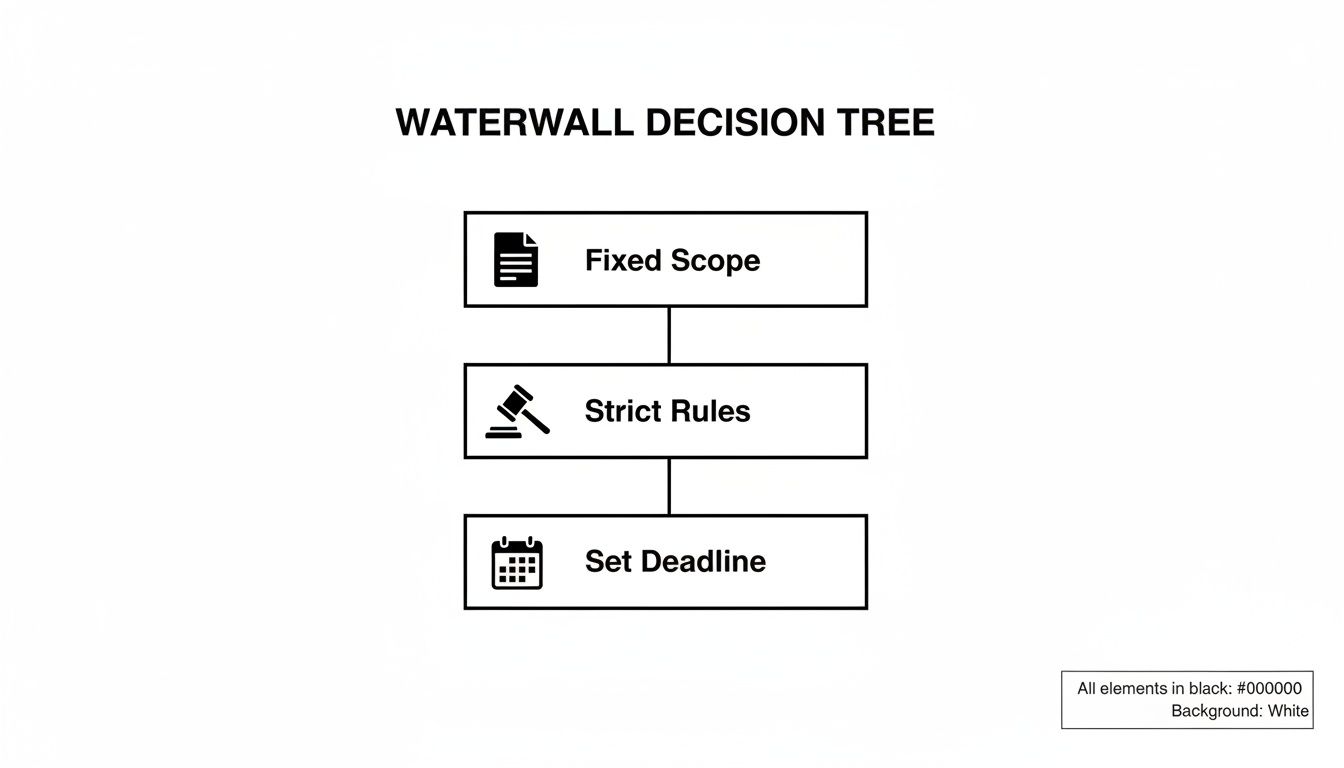
Waterfall is engineered for predictability. If your project meets these three conditions, this method provides a clear and tightly controlled path to completion.
Your choice between Agile and Waterfall is fundamentally a strategic decision about how you want to manage uncertainty. Waterfall tries to eliminate it with exhaustive upfront planning. Agile embraces it through iterative feedback and adaptation.
A Strategic Checklist for Your Project
Use this checklist to determine what your project truly needs. Answering these questions honestly will point you directly to the methodology that maximizes your chances of success.
-
Are your project requirements fully understood and unchangeable?
- Yes: Your project has a crystal-clear scope with little to no chance of changing. Waterfall is a strong candidate.
- No: You expect requirements to evolve as you gain insights or receive market feedback. Agile is designed for this flexibility.
-
Is early and frequent user feedback critical to success?
- Yes: The project's success depends on building a product that users value, requiring their constant input. Agile's iterative sprints are designed for this.
- No: The final product is based on a technical specification or a non-negotiable contract, not subjective user preference. Waterfall can deliver this efficiently.
-
Is exhaustive documentation for compliance a primary driver?
- Yes: The project is in a regulated industry (e.g., finance, government, healthcare) that requires a complete audit trail. Waterfall's focus on comprehensive documentation is a major asset.
- No: The primary goal is a working product, and minimal documentation is sufficient. Agile's principle of "working software over comprehensive documentation" is a perfect fit.
By systematically evaluating these factors, you can make an informed decision tailored to your project’s DNA, setting your team up for success from the start.
Making Your Chosen Methodology Work in the Real World
Choosing between Agile and Waterfall is the first step; successful execution is what truly matters. Even the right framework can fail without proper implementation. At Group 107, we bridge the gap between theory and reality, ensuring your development process delivers tangible business results.
We begin by analyzing your project's unique context—not just the technical specifications, but your company culture, risk tolerance, and long-term business objectives. This holistic view allows us to design an implementation plan that aligns your team, tools, and workflows for maximum efficiency and impact.
Your Partner in Putting Theory into Practice
Whether you are transitioning to Agile or refining a Waterfall process, our expertise in web development, DevOps, and AI ensures a smooth and effective implementation. We provide the hands-on guidance necessary to navigate the complexities of adopting a new operational model.
Here’s how we can help:
- Tailoring the Framework: We help adapt Agile ceremonies or Waterfall milestones to fit your team's specific needs, avoiding a rigid, one-size-fits-all approach.
- Integrating DevOps: We build the CI/CD pipelines that power your methodology, whether that means enabling continuous delivery for Agile sprints or ensuring stable, controlled releases for Waterfall.
- Measuring What Matters: We help you define and track the right Key Performance Indicators (KPIs) to provide a clear, data-driven view of project health and ROI.
A great implementation is less about new software and more about building a culture of excellence. We make sure your team has the support and structure to turn your chosen methodology into a real competitive edge.
Ultimately, the goal is a development process that is both efficient and laser-focused on your business goals. The agile vs waterfall methodology debate is resolved when your team consistently ships high-quality products on time and on budget.
If you’re ready to move from decision to delivery, our team has the expertise to make your project a success. Discover how we approach custom web and enterprise development and build frameworks that create a measurable impact.
Frequently Asked Questions
When deciding between Agile and Waterfall, several common questions arise. Here are straightforward answers based on our experience to help clarify your choice.
What Is The Main Difference Between Agile And Waterfall?
The primary difference lies in their approach to change and workflow. Waterfall is a linear, sequential model where one phase must be completed before the next can begin, making it inherently rigid.
Agile is an iterative process that operates in short cycles called sprints. This structure is designed for flexibility, continuous feedback, and adaptation, making it ideal for projects with evolving requirements. The choice ultimately depends on whether your project requires predictability (Waterfall) or adaptability (Agile).
Can You Combine Agile And Waterfall Methodologies?
Yes, and this hybrid approach is increasingly common. Many organizations combine the detailed upfront planning of Waterfall with the iterative execution of Agile to leverage the strengths of both.
A common use case involves projects with both hardware and software components. Hardware development, with its long lead times and fixed requirements, can follow a Waterfall model. Meanwhile, the software team can use Agile sprints to build, test, and refine features based on continuous user feedback. This blend provides structure where needed and agility where it delivers the most value.
How Does Project Risk Differ Between Agile And Waterfall?
The two methodologies manage risk in fundamentally different ways. In Waterfall, risk is back-loaded. Because comprehensive testing occurs only after development is complete, discovering a major issue late in the process can be catastrophic, leading to costly rework and significant delays.
Agile is designed to tackle risk head-on, continuously. By working in small sprints, teams are testing and validating a piece of the final product every few weeks. This feedback loop means problems are caught early before they can spiral out of control.
In short, Waterfall attempts to mitigate risk through exhaustive upfront planning, while Agile manages it in small, digestible increments throughout the project lifecycle. For complex projects with changing requirements, Agile’s approach to risk management is far more effective at preventing last-minute surprises.
What is the best project methodology for DevOps?
Agile is overwhelmingly the preferred methodology for DevOps environments. The core principles of DevOps—continuous integration, continuous delivery (CI/CD), and collaboration—are perfectly aligned with Agile's iterative nature. Agile sprints provide a natural rhythm for the frequent, automated releases that DevOps enables, creating a seamless pipeline from development to deployment. While you can implement DevOps practices with Waterfall, the long, infrequent release cycles of the Waterfall model limit the potential benefits of automation and rapid feedback.
Summary and Next Steps
Choosing between Agile and Waterfall is a critical strategic decision that directly impacts your project's success.
- Waterfall is the ideal choice for projects with fixed requirements, strict compliance mandates, and a low tolerance for change. Its strength is in predictability and control.
- Agile excels in dynamic environments where requirements are expected to evolve. It prioritizes flexibility, customer collaboration, and speed-to-market, delivering value incrementally.
Next Steps:
- Assess Your Project: Use the strategic checklist provided to evaluate your project’s requirements, risk tolerance, and stakeholder needs.
- Align Your Team: Ensure your team understands the chosen methodology and has the tools and training to execute it effectively.
- Optimize Your Process: Don't just adopt a framework—adapt it. Continuously refine your processes to maximize efficiency and business impact.
Ready to implement a development methodology that aligns perfectly with your business objectives? Group 107 provides the strategic guidance and technical expertise to ensure your process drives efficiency, scalability, and measurable impact.
Learn more about Group 107