
Analyzing quantitative data is not merely about crunching numbers; it's the strategic process of using statistical methods to reveal patterns, test hypotheses, and convert raw figures into actionable business intelligence. This discipline is the critical pivot from instinct-based guesswork to evidence-driven decision-making, a process essential for optimizing everything from marketing funnels to complex DevOps pipelines.
Why Analyzing Quantitative Data Drives a Competitive Edge
In today's competitive landscape, the ability to correctly interpret numerical data is a core strategic function, not a siloed task for data scientists. When you effectively analyze quantitative data, you empower your organization to measure performance accurately, forecast future trends, and build a sustainable competitive advantage. It is the engine that powers smarter strategies, enhanced customer experiences, and streamlined operations.
The real-world applications are direct and impactful. A fintech company can mitigate risk by identifying anomalous transaction patterns indicative of fraud. A SaaS platform can reduce customer churn by pinpointing user behaviors that signal an imminent cancellation. In every scenario, the objective is the same: transform abstract numbers into tangible business outcomes. This guide provides a complete, actionable framework to help you master this critical skill.
The Power of Data-Driven Growth
The global data analytics market is experiencing explosive growth, underscoring its importance for scalable business operations. Valued at USD 108.79 billion in 2026, the market is projected to reach USD 438.47 billion by 2031, expanding at a remarkable 32.15% CAGR. This surge reflects a deep reliance on quantitative analysis to accelerate decision-making and achieve faster go-to-market execution.
The process is a simple but powerful feedback loop: gather raw data, analyze it for insights, and translate those findings into strategic actions.
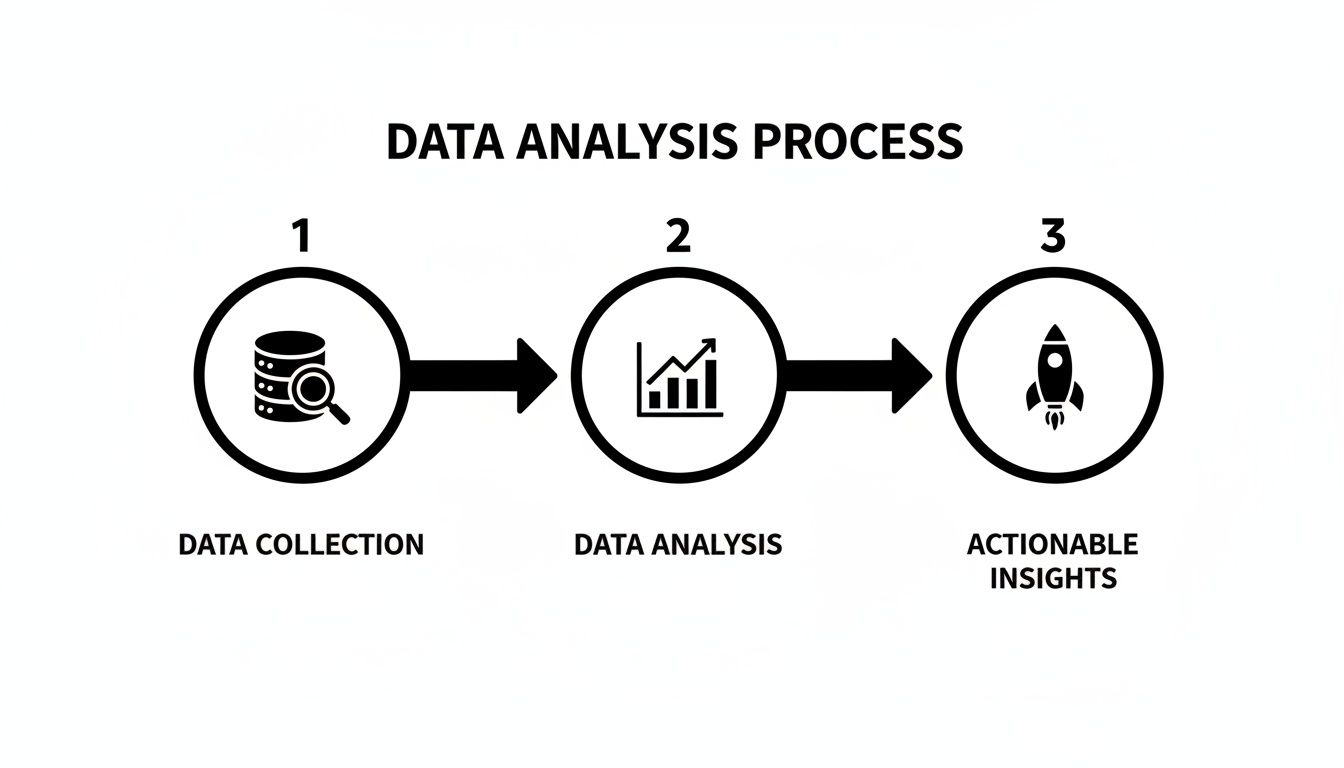
This workflow is not a one-time task but the foundational cycle for continuous improvement, where each iteration sharpens the next strategic decision.
To structure this process, here is an overview of a typical quantitative analysis project from inception to deployment.
The Quantitative Data Analysis Workflow at a Glance
This table outlines the essential phases of a structured quantitative data analysis project, from initial strategy to final implementation.
| Phase | Objective | Key Activities |
|---|---|---|
| 1. Define Questions & Metrics | Establish clear, measurable goals to ensure the analysis is focused and aligned with business objectives. | Frame business problems as questions, identify relevant KPIs, and develop testable hypotheses. |
| 2. Collect & QA Data | Gather accurate and relevant data from various sources and ensure its integrity. | Use APIs, web scraping, or database queries; perform checks for completeness, accuracy, and consistency. |
| 3. Clean & Preprocess Data | Prepare the raw data for analysis by handling errors, missing values, and inconsistencies. | Handle outliers, impute missing data, standardize formats, and transform variables for modeling. |
| 4. Exploratory Data Analysis (EDA) | Uncover initial patterns, trends, and relationships in the data to inform deeper analysis. | Use summary statistics (mean, median), create histograms, and generate scatter plots to visualize distributions. |
| 5. Statistical Tests & Modeling | Apply rigorous statistical methods to test hypotheses and build predictive models. | Run A/B tests, correlation analysis, or regression models to validate findings and forecast outcomes. |
| 6. Visualization & Storytelling | Communicate findings clearly and persuasively to stakeholders, regardless of their technical background. | Create dashboards, charts, and presentations that translate complex data into a compelling business narrative. |
| 7. Reproducibility & Deployment | Ensure the analysis is repeatable and integrate models into production systems for ongoing value. | Document code, version control datasets, and deploy models via APIs for real-time, automated decision-making. |
Each phase is a critical link in the chain, ensuring the final insights are both statistically sound and strategically valuable.
From Numbers to Narratives
Ultimately, the goal is to translate complex datasets into a clear story that drives your strategy forward. Whether you're optimizing an e-commerce checkout flow or refining a financial model, the core principles remain the same. Strong banking data analytics, for instance, can be the catalyst that ignites growth and transforms performance for financial institutions.
By framing business questions correctly and applying rigorous analytical methods, organizations can uncover hidden opportunities for efficiency and ROI. The key is not just having data, but knowing how to ask the right questions of it.
Setting the Stage with Clear Questions and Quality Data
Effective quantitative analysis begins long before you touch a dataset. The foundational work starts with asking sharp, focused business questions. Skipping this step leads to unfocused analysis and reports that generate noise instead of signal. The entire process hinges on establishing this strategic foundation from day one.
This initial step is about tying your analysis directly to a tangible business outcome. A vague objective like "increase website traffic" is a recipe for wasted effort. A superior question is, "Which marketing channels deliver the highest lifetime value (LTV) customers for our new SaaS product?" This level of specificity guides your entire workflow, from data collection to the final narrative.
From Vanity Metrics to Actionable KPIs
It's easy to fall into the trap of chasing vanity metrics—numbers that look impressive in a presentation but offer no real insight into business health. For an e-commerce company, obsessing over raw page views is a classic example. 100,000 page views sounds great, but it’s meaningless if the conversion rate is a dismal 0.1%.
The key is to focus on Key Performance Indicators (KPIs) that are directly linked to business outcomes. That same e-commerce store should be laser-focused on its conversion rate, average order value (AOV), and customer acquisition cost (CAC). Similarly, a SaaS company gains far more value from tracking customer lifetime value (CLV) and monthly recurring revenue (MRR) than from simply counting free trial sign-ups.
Shifting from vanity metrics to actionable KPIs is the first step in transforming data analysis from a reporting function into a strategic asset. It’s about measuring what matters, not just what’s easy to count.
When this is done correctly, every analysis is geared toward driving measurable impact, whether that’s boosting revenue, reducing churn, or improving operational efficiency.
Sourcing Reliable Data
Once you have defined your questions, it’s time to acquire the data. Methods generally fall into two categories: primary and secondary data collection. Understanding the distinction is critical for building a trustworthy dataset.
- Primary Data Collection: This is data you gather yourself for a specific purpose. Examples include A/B testing a new landing page headline, distributing a customer satisfaction survey, or implementing custom event tracking for a new product feature. It is perfectly tailored to your needs but can be time-consuming and costly.
- Secondary Data Collection: This involves using data that already exists. It could be pulling reports from an internal CRM, analyzing third-party market research, or using an API to access data from platforms like Google Analytics or a payment processor. This approach is often faster and more cost-effective, but you must verify its accuracy and relevance to your specific question. For a deeper look, our guide on collecting and analyzing data for business growth provides valuable insights.
Ensuring Data Integrity from the Start
Your analysis is only as good as the data that fuels it. The adage "garbage in, garbage out" is a cliché for a reason—it's unequivocally true. That’s why data integrity must be a top priority from the outset.
To ensure your raw data is clean and reliable, implement a few essential guardrails.
- Data Validation Rules: These are your first line of defense. Set up automated checks to enforce correct data formats. For example, an email field in a form should reject entries that are not valid email addresses, and a date field should not accept arbitrary text. These simple rules prevent countless downstream issues.
- Consistent Sampling: When dealing with large datasets, you often work with a sample. The key is ensuring that the sample accurately represents the entire population. Using a technique like stratified sampling ensures that all key customer segments (e.g., enterprise vs. SMB clients) are proportionally represented, leading to findings you can confidently apply to your entire user base.
Preparing Your Data for Meaningful Analysis
You've defined your questions and collected the data. Now comes the crucial step that separates reliable insights from flawed conclusions: data cleaning and preprocessing.
Raw data is almost always messy. It's typically filled with missing values, outliers, duplicates, and formatting inconsistencies that can corrupt your analysis. Rushing this stage is like building a house on an unstable foundation—the entire structure is at risk of collapse.

Handling Common Data Quality Issues
Every dataset presents unique challenges, but a few common issues appear consistently.
First, duplicate entries are notorious for inflating counts and distorting statistics. Imagine a single customer sign-up is logged three times; your daily acquisition metrics are now artificially inflated. The fix is often straightforward: write a script to identify and remove duplicate rows based on a unique key like a transaction ID or customer email.
Next, inconsistent formatting creates analytical chaos. A "Country" column might contain "USA," "U.S.A.," and "United States." To a computer, these are three distinct entities. You must standardize these entries to a single format (e.g., "USA") to ensure data can be grouped and analyzed correctly.
Strategies for Missing Values and Outliers
Missing data and outliers are more complex challenges. Your approach to handling them can dramatically alter your results, so there is no one-size-fits-all solution. The choice must align with the context of your data and your analytical goals.
For missing values, several strategies are available:
- Deletion: The simplest method is to remove any row containing a missing value. This is only viable if you have a massive dataset and the missing data is completely random. Otherwise, you risk discarding valuable information.
- Mean/Median Imputation: A common technique is to fill gaps in a numerical column with the average or median value. This is fast but can artificially reduce the natural variance in your data.
- Regression Imputation: A more sophisticated approach involves building a model to predict the missing value based on other variables. For instance, you could predict a user's missing age based on their purchase history and device type.
Outliers require investigation. Is that unusually large transaction in your e-commerce data a data entry error, or have you identified a high-value customer? Deleting it could mean ignoring a critical segment. You must investigate the reason for the outlier before deciding whether to remove it, transform it (e.g., with a log transformation), or retain it.
The Importance of Data Transformation
Once the data is clean, it often needs to be transformed. This involves changing the scale or distribution of variables to make them compatible with certain statistical models.
Two common techniques are normalization and standardization.
- Normalization rescales your data into a fixed range, typically 0 to 1. This is useful when features are on vastly different scales—like age (18-65) and income ($30k-$300k)—and prevents one feature from dominating the analysis.
- Standardization rescales data to have a mean of 0 and a standard deviation of 1. Many machine learning algorithms perform better when data is normally distributed, and this technique helps achieve that.
This preparatory work is absolutely critical. The market for big data and business analytics is booming, expected to jump from USD 343.4 billion in 2026 to a staggering USD 970.44 billion by 2035. This growth is driven by organizations that master the entire data workflow, especially these foundational steps.
Investing time in cleaning, preprocessing, and transforming your data sets your entire project up for success. For a deeper dive into building these robust systems, consult our guide on data engineering best practices.
Uncovering Insights with Analysis and Modeling
With clean, organized data in hand, the discovery phase begins. This is where you move from preparation to actively searching for patterns, testing hypotheses, and building models that can predict future outcomes. It is the point where raw numbers begin to tell a compelling story.
The first step in this journey is Exploratory Data Analysis (EDA). Think of it as a reconnaissance mission. Before committing to complex statistical models, you must understand the landscape of your dataset.
Getting a Feel for Your Data with EDA
EDA involves using descriptive statistics and simple visualizations to generate a high-level summary of your data. It is a low-effort, high-reward process that helps you spot initial patterns, identify anomalies, and formulate hypotheses for deeper investigation.
Here’s what this looks like in practice:
- Calculating Descriptive Statistics: You will examine the mean, median, and mode to understand central tendency, and the standard deviation and range to understand dispersion. For example, a SaaS company might find their mean user session duration is 15 minutes, while the median is only 5 minutes. This immediately reveals that a small group of power users is skewing the average upward.
- Creating Histograms and Density Plots: These visualizations are excellent for understanding the distribution of a single variable. A histogram of customer purchase values might show a right-skewed distribution, indicating that most customers make small purchases while a few high-value customers make very large ones.
- Using Scatter Plots: These are ideal for identifying relationships between two variables. A product team could plot user engagement scores against time spent in the app to see if a positive correlation exists, quickly validating their hypothesis that increased usage leads to higher engagement.
This initial exploration is not about finding definitive answers but about learning to ask better questions and directing your analysis effectively. It prevents you from wasting resources on complex models that are inappropriate for your data.
From Description to Prediction
Once you have a solid understanding of your data's landscape, you can advance to more formal analysis. This is the leap from describing what happened to predicting what will happen—and even recommending what to do about it.
This analytical maturity can be broken down into three levels:
- Descriptive Analysis: The "what happened?" stage, largely covered by EDA. It focuses on summarizing past data to create a clear picture.
- Predictive Analysis: The "what will happen?" stage. Here, you use historical data to forecast future events, such as which customers are most likely to churn next month.
- Prescriptive Analysis: The "what should we do?" stage. This takes analysis a step further by recommending specific actions to achieve a desired outcome, like offering a targeted discount to a high-risk customer to improve retention.
The real business impact comes from moving beyond descriptive reports into predictive and prescriptive analytics. It’s the difference between looking in the rearview mirror and using a GPS to navigate the road ahead.
The push toward predictive and prescriptive analytics is a major industry growth driver. The global market is projected to reach USD 69,543.5 million in 2024 and is expected to surge to USD 302,006.0 million by 2030, growing at a compound annual rate of 28.7%. While predictive analytics currently generates the most revenue, prescriptive analytics is the fastest-growing segment, fundamentally changing how organizations from startups to banks gain actionable foresight. You can explore these data analytics market trends in the full report.
Applying Foundational Modeling Concepts
To build these predictive and prescriptive capabilities, you need to leverage statistical models. Two of the most common and powerful types are regression and classification.
Regression models are used to predict a continuous numerical value. They help you understand how a dependent variable changes as one or more independent variables are adjusted.
- Real-World Example: An e-commerce company can use a regression model to predict a customer’s lifetime value (LTV). The model would use inputs like their first purchase amount, acquisition channel, and demographic data to forecast their future spending.
Classification models, on the other hand, predict a categorical outcome—essentially, assigning an item to a specific group.
- Real-World Example: A fintech firm can use a classification model to identify potentially fraudulent transactions. The model analyzes features like transaction amount, location, and time of day, then classifies the event as either "legitimate" or "fraudulent." This enables the system to automatically flag high-risk activity for human review.
By applying these modeling techniques, you transform your static dataset from a record of the past into a dynamic tool for shaping the future. This is the core of effective quantitative data analysis—turning information into intelligence that drives real, measurable results.
Communicating Findings with Visualization and Storytelling
You have completed the heavy lifting: the cleaning, exploring, and modeling. However, the most brilliant insight is useless if it remains trapped in a spreadsheet or a complex algorithm. The true value is unlocked when you translate your findings into a story that stakeholders can understand and act upon.
This is where data visualization and storytelling become critical. It is the art of crafting a clear, compelling narrative that answers the original business questions, moving beyond raw numbers to reveal the story hidden within the data.
Moving Beyond Basic Charts
Effective visualization is about selecting the right tool for the job. A simple pie chart may be aesthetically pleasing, but it is often a poor choice for comparing more than a few categories. The goal is always clarity and impact.
Bar charts, for example, are excellent for comparing distinct groups, like monthly recurring revenue across different customer segments. Line graphs are the standard for showing trends over time, such as tracking user engagement following a new feature launch. Heatmaps can brilliantly visualize complex correlations, like which product features are most frequently used together.
When communicating with executives focused on ROI, exploring the top financial data visualization techniques can make a significant difference.
Choosing the right chart is not about aesthetics; it’s about telling the most accurate and compelling story. A well-chosen visualization can mean the difference between an insight being ignored and one that drives strategy.
Choosing the Right Visualization for Your Data
| Goal | Recommended Chart Type(s) | Best For |
|---|---|---|
| Comparing values | Bar Chart, Column Chart | Showing how different categories or groups stack up against each other. |
| Showing a trend over time | Line Chart, Area Chart | Tracking performance or changes across days, months, or years. |
| Understanding relationships | Scatter Plot, Bubble Chart | Revealing correlations or clusters between two or more variables. |
| Showing parts of a whole | Stacked Bar/Column Chart, Treemap | Illustrating composition, like market share or budget allocation. |
| Visualizing distribution | Histogram, Box Plot | Understanding the spread and frequency of data points in a single variable. |
This table serves as a starting point. The best choice always depends on the specific context and the story you need to tell.
Building a Narrative Around Your Data
An effective data story is more than a sequence of charts. It is a structured narrative with a clear beginning, middle, and end that guides your audience from the initial problem to the final recommendation.
This simple framework is incredibly effective:
- Set the Context: Begin by restating the original business question. What problem were you trying to solve? This immediately engages your audience and reinforces the analysis's relevance.
- Present the "Aha!" Moment: This is the core of your story. Unveil your key finding with a clear, impactful visualization. Explain not just what the data shows, but what it means for the business.
- Provide Supporting Evidence: Substantiate your main point with additional data points or secondary charts. This builds credibility and preemptively answers questions.
- Conclude with Actionable Recommendations: End with a clear call to action. Based on your findings, what should the business do next? This transforms your analysis into a strategic roadmap.
The most effective data presentations are not just a series of charts; they are persuasive arguments backed by evidence. Your role is to be the translator who turns complex quantitative analysis into a simple, compelling story that drives action.
Tailoring Your Story for the Audience
Finally, always consider your audience. The way you present findings to an engineering team should be fundamentally different from your pitch to the C-suite.
- For Technical Teams: Dive deeper into the methodology. They will appreciate the rigor of the statistical models and want to understand the "how."
- For Executive Leadership: Focus on the "so what." They require a high-level summary that connects directly to business outcomes like revenue, costs, and strategic goals. Lead with the bottom-line impact and use simple, clear visuals.
By adapting your narrative, you ensure your message resonates, dramatically increasing the likelihood that your hard-won insights will spark meaningful change. That is the ultimate goal: not just to find answers, but to inspire action.
Turning Insights into Action and Long-Term Value
This is where analysis translates into business value. The most brilliant insights are purely academic if they are not integrated into operational workflows. The ultimate goal is to embed your findings into daily processes and cultivate a sustainable, data-driven culture.
This requires moving beyond one-off reports toward creating reproducible, automated systems that deliver continuous value. This means documenting your methodology in scripts, using version control systems like Git to track changes, and building automated data pipelines. For instance, a churn prediction model should be deployed into a production environment where it can score customers in real-time and automatically trigger retention campaigns. The objective is to make your insights a living, breathing part of the organization.
Deploying and Monitoring Models in Production
Deploying a model into a live environment is a significant milestone. Whether it's a fraud detection algorithm for a fintech application or a recommendation engine for an e-commerce platform, its performance must be monitored relentlessly. Models are not static; their performance can degrade over time as customer behavior evolves or market conditions shift—a phenomenon known as model drift.
To combat this, you must monitor key performance metrics to ensure the model remains accurate and effective.
- Accuracy and Precision: Are the model's predictions still aligning with real-world outcomes? This requires constant validation.
- Business KPIs: How is the model impacting the bottom line? Is the churn model actually reducing churn? Is the fraud detection system preventing financial losses?
- Data Drift: Monitor for significant changes in the input data. A sudden shift can be an early warning sign that the model needs to be retrained.
This continuous feedback loop ensures your analytical work provides lasting value instead of becoming obsolete.
Ensuring Governance, Privacy, and Compliance
For any organization in regulated industries like finance, government, or healthcare, data governance is non-negotiable. Translating insights into action must be done responsibly, with a steadfast focus on privacy, security, and compliance.
Adhering to regulations like GDPR or CCPA is not just a legal requirement; it is fundamental to building and maintaining customer trust.
A robust data governance framework doesn't just make your analytical practices powerful—it makes them ethical and secure. It transforms data from a potential liability into a protected, strategic asset.
This means implementing clear, documented protocols for data access, storage, and anonymization. When creating a business intelligence report, for example, you must ensure that sensitive personal information is masked and access is restricted to authorized personnel. To learn more, read our guide on creating an effective business intelligence report that incorporates these principles from the start. Strong governance makes your data practices defensible, transparent, and built for long-term success.
Common Questions About Quantitative Data Analysis
As you delve into quantitative data analysis, several common questions often arise. Addressing them can help you start on the right foot.
How Do You Choose the Right Statistical Test?
The choice of a statistical test depends on your research question and the type of data you have. It's about matching the right tool to the job.
If you are comparing the average outcomes between two groups, a t-test is a common choice. If you want to understand how two continuous variables—like advertising spend and sales revenue—move together, you would likely start with a correlation analysis. To predict an outcome based on multiple factors, regression analysis is the appropriate method.
What’s the Best Way to Handle Large Datasets?
When working with massive datasets, you cannot simply load everything into memory at once. It's crucial to be efficient. One effective technique is to process data in smaller, manageable pieces. Using a library like Python’s Pandas, you can implement "chunking" to work through the data incrementally.
For truly large-scale data, consider cloud platforms like AWS or Google Cloud. These services are designed for distributed computing, which can dramatically accelerate your analysis. Another best practice is to perform aggregations directly within the database before pulling the data for analysis.
Can You Explain Correlation vs. Causation?
Understanding this distinction is one of the most critical lessons in data analysis. It is a classic pitfall.
Correlation simply means that two variables move in a similar pattern. A famous example is the correlation between ice cream sales and shark attacks—they both increase in the summer, but one does not cause the other.
Causation, however, implies that a change in one variable is the direct cause of a change in another. Proving causation is much more difficult and typically requires a controlled experiment, such as an A/B test, rather than just observational data.
At Group 107, we transform complex data challenges into clear, actionable strategies. Our data specialists and AI experts can help you build robust analytical workflows that drive real business growth. Learn more about our end-to-end digital solutions.