
In a market where speed is the ultimate competitive edge, relying on manual testing alone is like trying to win a Formula 1 race in a horse-drawn cart. You're guaranteed to fall behind, losing revenue and market share with every delayed release.
Why Manual Testing Is Holding Your Business Back
Sticking to a purely manual testing process creates massive bottlenecks that directly harm business outcomes. It delays your releases, frustrates your developers, and quietly drives up operational costs. Your entire quality assurance effort becomes a reactive, time-consuming slog that grinds innovation to a halt. The system must wait for people to manually click through the same workflows—a process that simply can’t keep pace with modern development cycles.

The Real Cost of Human-Powered QA
Consider a typical SaaS company aiming for weekly releases. Their manual regression testing suite takes three full days to complete. Here’s what that really means for the business:
- Wasted Resources: Over 60% of the QA team's time is burned on repetitive, low-value checks.
- Reduced Developer Velocity: Developers get bug feedback days after they’ve moved on, forcing expensive context-switching and rework.
- Lost Market Agility: The release schedule is always at risk, damaging customer trust and giving competitors an opening.
This reactive approach makes scaling impossible. As your product grows, the list of manual tests gets longer, demanding more time and more people just to keep from falling behind. Innovation dies because your team is stuck in a maintenance cycle, not an improvement one.
Manual vs. Automated Testing: A Business Impact Comparison
The difference in business outcomes between these two approaches is stark. One creates bottlenecks, while the other accelerates growth.
| Business Metric | Manual Testing (The Bottleneck) | Automated Testing (The Accelerator) |
|---|---|---|
| Release Velocity | Slow; gated by human capacity. Days or weeks. | Fast; integrated into CI/CD. Hours or minutes. |
| Development Feedback | Delayed; bugs found days later, increasing fix costs. | Immediate; bugs caught within minutes of a code commit. |
| Test Coverage | Limited and inconsistent; prone to human error. | Broad and reliable; covers thousands of scenarios consistently. |
| QA Team Focus | Repetitive regression checks; low-value tasks. | High-value exploratory testing and strategy. |
| Scalability | Poor; costs increase linearly with product complexity. | Excellent; handles growing complexity with minimal overhead. |
| Return on Investment (ROI) | Low; an ongoing operational expense. | High; an asset that compounds value over time. |
This is precisely where strategic automation becomes a business necessity. You can dive deeper into the financial and operational benefits of automated testing and see how it directly drives ROI.
Expert Insight: The core issue isn't that manual testing is useless—it's that relying on it for everything is inefficient. It’s perfect for exploratory and usability testing, but it fails spectacularly at providing the fast, consistent feedback that modern CI/CD pipelines demand.
The solution is a strategic shift from a manual-first QA process to a proactive, automated one. This transformation isn’t led by just anyone. It requires a specialized expert: the automation test engineer. This role is about architecting a complete quality framework that lets your business innovate faster, scale efficiently, and build a powerful reputation for rock-solid reliability.
The Modern Automation Engineer's Daily Mission

The role of a top-tier automation test engineer goes far beyond writing scripts. They are proactive quality architects who build the digital safety nets that protect your product and your business reputation. They don’t just find bugs; they build entire systems to prevent those bugs from ever reaching customers.
An engineer's day often starts not with a blank code editor, but with analysis. They dig into automated test reports from the overnight CI/CD pipeline run. Before the development team has even had their first coffee, the automation engineer has already found a critical API regression, traced it to the exact code commit, and filed a perfectly detailed, reproducible bug report. This early-warning system is a massive part of their value, enabling developers to fix issues immediately while the code is still fresh.
The Architect and The Builder
A huge part of an automation engineer's time is spent building the testing infrastructure itself. This isn’t a side task; it's a full-blown software development project dedicated to quality. A typical day blends high-level strategy with hands-on execution:
- Framework Development: Architecting and building reusable, scalable test frameworks to ensure consistency and efficiency across projects.
- Test Case Implementation: Writing clean, dependable automated test code for everything from the user interface to back-end APIs, including validating responses and checking database states.
- Pipeline Integration: Working with the DevOps team to weave automated tests directly into the CI/CD pipeline, guaranteeing that every single code change is tested automatically.
- Failure Triage: Investigating failed tests to determine if it’s a real bug, a flaky test, or an environment issue. This requires sharp debugging skills to provide clear, actionable feedback.
Expert Insight: The goal is to create a culture where quality is a shared responsibility, with the automation engineer providing the tools and processes to make it a reality. They build the foundation that gives developers the confidence to move fast and innovate safely.
A Focus on Scalability and Maintenance
An elite automation engineer always thinks three steps ahead. They understand that a test suite that is difficult to maintain will eventually be ignored and become useless. Because of this, they focus on writing code that is not just effective but also easy for others to read, update, and expand.
This means applying core software design principles like DRY (Don't Repeat Yourself) and creating smart abstractions (like page object models for UI testing) to manage complexity. Their mission is to build a living quality system that evolves with the product, ensuring long-term stability and enabling the business to move faster with less risk. This strategic thinking is the foundation of our own quality assurance process, where we insist on building maintainable automation from day one.
The Skills That Separate Great from Good
When you hire an automation test engineer, you’re not just looking for someone who can code. You need a professional who combines deep technical skill with a sharp business acumen. A great engineer accelerates your entire development lifecycle; a merely good one adds another layer of technical overhead.
Core Competencies for an Automation Test Engineer
The must-have skills fall into two categories: the technical abilities that form the "what" and the crucial soft skills that define "how" an engineer drives results. Both are essential for building a quality-first culture.
| Technical Skills (The 'What') | Soft Skills (The 'How') |
|---|---|
| Strong command of Python or JavaScript to build scalable test frameworks. | An analytical, detective-like mindset for quickly diagnosing test failures. |
| Deep knowledge of frameworks like Selenium, Cypress, or Playwright and their trade-offs. | The ability to translate complex technical findings into clear business impact. |
| Expertise in API testing with tools such as Postman, Insomnia, or REST Assured. | Strong communication skills to align with developers, PMs, and stakeholders. |
| Fluency in CI/CD integration using tools like Jenkins, GitLab CI, or GitHub Actions. | A pragmatic approach to problem-solving, focused on solutions, not just issues. |
Essential Technical Capabilities
A high-impact automation engineer demonstrates mastery in a few key areas that work together.
Programming Languages: A strong grasp of a language like Python or JavaScript is non-negotiable. This is for building robust, maintainable, and scalable test frameworks from the ground up.
Automation Frameworks and Tools: They need to understand the pros and cons of the major players. For instance, Selenium is the classic workhorse for cross-browser testing, while Cypress often provides faster, more reliable feedback in modern JavaScript applications. Newer tools like Playwright offer powerful features for handling dynamic content and parallel execution.
API Testing: Expertise with tools like Postman is vital. A smart engineer knows that testing directly at the API layer is faster and more stable than relying solely on the UI, catching business logic errors before they impact the user.
CI/CD Integration: The engineer must be comfortable working within your DevOps pipeline, using tools like Jenkins, GitLab CI, or GitHub Actions. The goal is to integrate tests so seamlessly that they provide instant feedback on every code commit.
Expert Insight: A valuable automation test engineer doesn’t just ask, “How can I test this feature?” They ask, “How can I build a system that automatically verifies the quality of this feature and every feature after it?” This architectural mindset is a game-changer.
The Soft Skills That Drive Business Impact
Technical skills define what an engineer can do; soft skills define how effectively they do it. In high-stakes industries like fintech, SaaS, or e-commerce, these are often the difference-makers.
Analytical and Debugging Skills: When an automated test fails, a great engineer operates like a detective. They quickly determine if the failure is a genuine bug, an environment issue, or a flaw in the test script. This diagnostic skill saves countless developer hours.
Strong Communication: An engineer must translate complex technical failures into clear business impact. A product manager doesn’t need a lecture on API response codes but needs to know that the "add to cart" button is broken for 15% of users on mobile devices.
By mastering both technical and soft skills, an automation test engineer moves from being a simple tester to a strategic partner in quality. You can see how these skills fit into a wider strategy by reviewing these essential software testing best practices that successful teams adopt.
Decoding Automation Engineer Salaries and ROI in 2026
To bring a top-tier automation engineer onto your team, you have to talk numbers. A competitive salary isn’t just about filling a seat; it's a direct investment in your product quality, development speed, and business stability.
The average salary for an automation test engineer is approximately $105,445 per year. An entry-level engineer might start around $97,500, while a senior professional with 4-7 years of experience can command upwards of $154,077 annually. For a broader look at compensation, you can check current salary benchmarks.
Calculating the True Return on Investment
It's easy to see a six-figure salary as an expense. In reality, that single salary can save you millions by preventing catastrophic failures and unlocking major efficiencies. The real ROI of a skilled automation engineer shows up in critical areas:
- Defect Prevention: The cost of a single show-stopping bug in production—one that corrupts data, takes your service offline, or creates a security hole—can far exceed an engineer's entire annual salary.
- Accelerated Release Cycles: Automation shrinks release timelines from months to weeks or even days. This means getting features to market faster than competitors, reacting to customer feedback quickly, and generating revenue sooner.
- Developer Productivity: Automation frees your most expensive resource—your developers—from manual regression testing, allowing them to focus on building innovative features that drive business growth.
This flowchart maps out the decision-making process when weighing whether to hire an in-house expert or explore a global talent model.
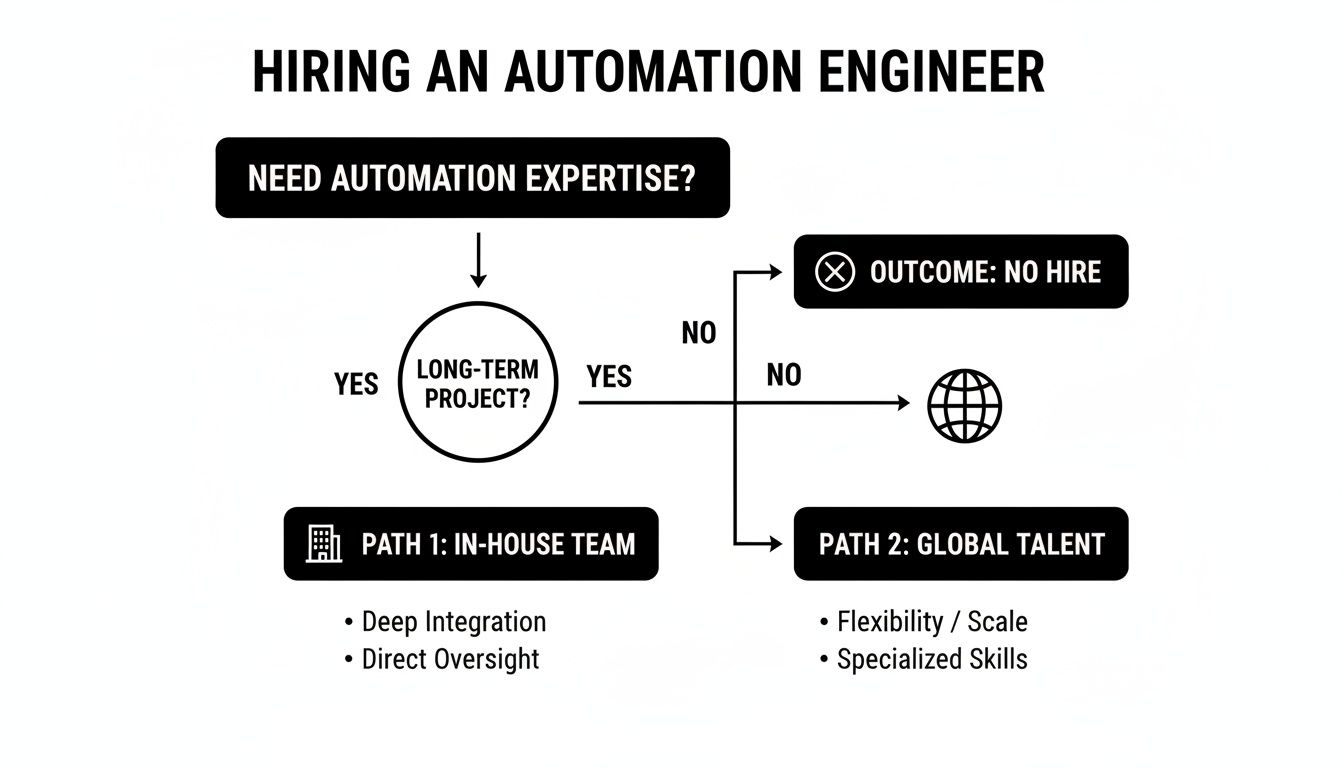
An Alternative Model for High-Impact QA
While the ROI is clear, the upfront salary can be a challenge for some budgets. This is where leveraging global talent pools becomes a powerful strategic move. It provides access to world-class expertise without the premium price tag of a high-cost domestic market.
Real-World Example: Group107's dedicated engineers in Ukraine offer the same high-impact skill set—designing frameworks, integrating with CI/CD, and speeding up releases—at up to 60% lower cost. This approach makes elite quality assurance accessible for businesses of all sizes, from SaaS startups to large enterprises.
This isn’t about sacrificing quality for a lower price. It’s about making a smarter investment to get world-class results and a much faster ROI, turning your QA function from a cost center into a true engine for growth.
A Strategic Framework for Hiring Your Next QA Lead
Hiring a top-tier automation test engineer is a critical decision that directly impacts your engineering culture and product velocity. To find a true quality architect—not just a scriptwriter—you need a hiring plan that prioritizes strategic thinking.

This level of expertise commands a significant salary. Verified US profiles show these professionals have an average total compensation of $120,000, with the top 10% earning over $177,000 annually. You can explore salary trends for automation test engineers to ensure your offers are competitive.
Assess Architectural Thinking, Not Just Coding Chops
Many companies get this wrong by focusing on abstract algorithm quizzes. A senior automation engineer’s real value is in their architectural vision. Ditch the standard whiteboard problems and give them a real-world challenge instead.
Practical Hiring Step: The Coding Challenge
- Assign the Task: "Here’s a link to our SaaS application. Design and build a small proof-of-concept test framework for the user login flow and one other core feature."
- Set Expectations: "Show us how you would structure the code to be scalable, maintainable, and ready for CI/CD pipeline integration."
- Evaluate for What Matters:
- Framework Design: Do they build a solid, reusable structure or just disposable scripts?
- Scalability: How easily could another engineer add 100 more tests to their framework?
- Tool Selection: Can they clearly explain why they chose Python with Playwright over JavaScript with Cypress?
In-House Hire vs. a Dedicated Partner
Next, decide on your hiring model. Bringing someone in-house is traditional but often slow and expensive. A more direct path is working with a dedicated team provider.
Solution-Oriented Approach: At Group107, we eliminate the hiring headaches. We provide pre-vetted, dedicated engineers who integrate directly into your team. They’re in your Slack, they join your daily stand-ups, and they push code to your repository from day one—acting as a true extension of your crew.
This model delivers the focus of an in-house employee with the speed and cost-effectiveness of a global talent strategy. As you figure out how to hire your next QA Lead, this approach offers a proven way to get top talent in the door, fast. For a deeper dive, review our complete guide to quality assurance process steps.
Build Your Elite Automation Team with Group107
Finding, vetting, and retaining a top-tier automation test engineer is a slow, expensive process that diverts focus from your core business. For companies in SaaS, fintech, and enterprise, this talent bottleneck is a primary cause of delayed innovation and stalled growth.
Group107 offers a more direct path. We provide immediate access to elite, dedicated automation engineers from Ukraine's world-class talent pool, enabling you to scale your team efficiently and effectively.
Your Dedicated Automation Partner
Our model is built on genuine integration. When you partner with us, you get a fully embedded engineer who becomes a core member of your team. They’re in your daily stand-ups, active in your Slack channels, and committing code directly to your repositories.
This seamless partnership delivers immediate business impact:
- Accelerate Time-to-Market: Dramatically shorten release cycles and outpace the competition with an expert building your automation framework from day one.
- Achieve Significant Cost Savings: Access premier engineering talent for up to 60% less than domestic market rates, massively improving your ROI.
- Gain Expert Peace of Mind: Work with seasoned professionals who build the robust, scalable quality systems your product deserves.
The Group107 Advantage: Our model isn't about outsourcing tasks; it’s about insourcing talent. We bring the strategic expertise you need right into your team, embedding quality directly into your product and creating a powerful competitive advantage.
Whether you're a startup driving for rapid growth or an established enterprise needing to modernize, Group107 has the strategic talent to make it happen. Stop searching for the right automation engineer and start building a more reliable product today.
Summary and Next Steps
Manual testing creates bottlenecks that slow releases, increase costs, and stifle innovation. A skilled automation test engineer solves this by building a scalable, automated quality framework that provides immediate feedback within the CI/CD pipeline. This role requires a unique blend of software development expertise, architectural vision, and strong communication skills to translate technical issues into business impact.
While hiring an in-house expert is one path, it can be slow and expensive. A more strategic approach is to partner with a provider of dedicated global talent to accelerate ROI and gain immediate access to elite engineers.
Your Actionable Next Steps:
- Assess Your Current Process: Identify where manual testing is creating delays and calculating the cost of those bottlenecks.
- Define Your Needs: Use the skills framework in this guide to create a clear job description focused on architectural thinking.
- Explore Your Options: Compare the timeline, cost, and ROI of hiring in-house versus partnering with a dedicated team provider.
- Take Action: Explore our expert dedicated teams and get in touch to build the team that will drive your success.
Frequently Asked Questions
Here are clear, straightforward answers to the most common questions business leaders ask when considering hiring an automation test engineer.
What Is the Difference Between a Manual Tester and an Automation Engineer?
A manual tester follows a script to find bugs, mimicking user behavior. This is crucial for usability and exploratory testing but is slow and doesn't scale. An automation test engineer is a developer who builds, architects, and maintains a system to run tests automatically. They write code that integrates with your CI/CD pipeline to catch bugs moments after a developer commits a change.
In short, a manual tester finds bugs; an automation engineer builds a machine that prevents bugs from reaching customers.
When Should Our Company Hire an Automation Engineer?
The moment you feel QA is becoming a bottleneck. Is your two-week manual testing cycle holding up a one-week development sprint? Are developers spending more time fixing recurring bugs than building new features? If yes, you should have hired one yesterday.
Expert Insight: For a startup, bringing in an automation engineer before the product becomes complex is a game-changing strategic move. You're not just hiring a tester; you're investing in a scalable foundation that prevents crippling technical debt.
Can One Engineer Handle All Types of Automated Testing?
A great automation engineer is a master of functional and regression testing—the core of modern QA. Many can also set up baseline performance tests with tools like JMeter or k6 and integrate basic security scans.
However, for specialized work like rigorous penetration testing or large-scale load testing, you will need a dedicated specialist. The mark of a top-tier automation engineer is that they build an extensible framework where specialists can plug in their own tests, creating a single, unified quality platform.
Ready to stop searching for talent and start accelerating your development? Partner with Group107 to build your elite, dedicated automation team. Contact us today to get the strategic expertise you need to build quality into your product and outpace the competition.