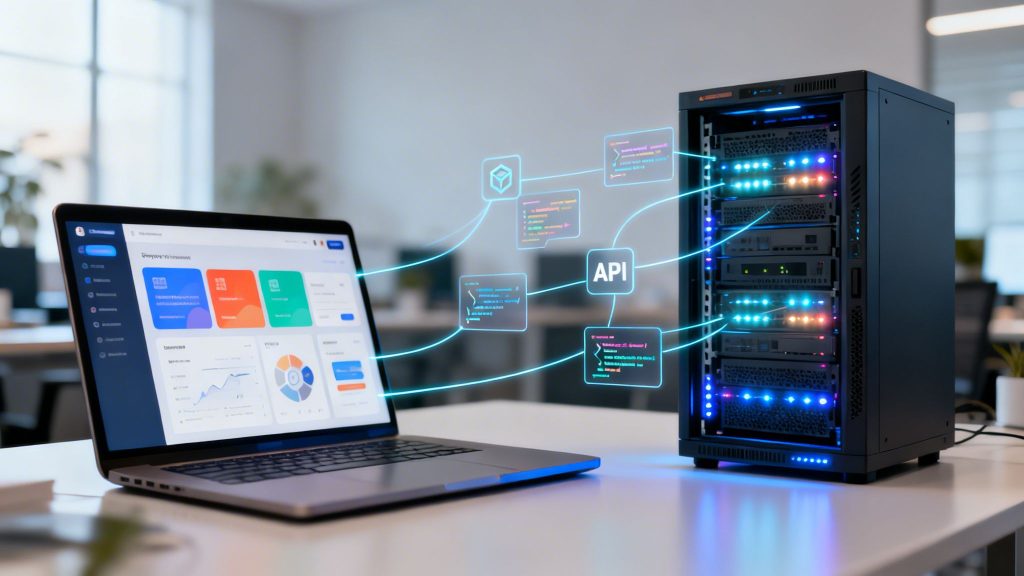
Understanding the backend vs. frontend distinction is more than a technical discussion; it's a core business decision that directly shapes your product's performance, scalability, and market success. The frontend is everything your user sees and interacts with (the client-side). The backend is the hidden engine processing data, executing business logic, and making it all work (the server-side).
For business leaders, mastering this concept is essential for allocating resources effectively, mitigating risk, and delivering a digital product that achieves its strategic objectives.
Why Backend vs. Frontend Matters for Business Strategy
A misaligned development strategy, where the frontend and backend are out of sync, leads to project delays, budget overruns, and a subpar product that fails to meet user expectations. Conversely, a well-integrated approach delivers a seamless user experience that drives conversions, all built on a secure and scalable foundation. This balance is the key to maximizing the ROI of any digital investment.
A strategic understanding allows you to align your technical teams with your business goals. For example, a SaaS company launching a new feature will pour resources into the frontend to perfect the user onboarding flow. A fintech firm, however, must prioritize backend development to secure transactions and ensure regulatory compliance from day one.

Core Distinctions for Informed Decision-Making
To make smart decisions, you must understand the different goals and pressures that drive each side of development.
- Frontend Focus (Client-Side): This is purely user-centric. How does the app look and feel? Is it intuitive? Does it load instantly? A polished frontend is what keeps users engaged and drives conversions. It's the face of your brand.
- Backend Focus (Server-Side): This is about system integrity. Is our customer data secure? Can the architecture handle a sudden spike of 10,000 new users? Is the business logic executing flawlessly? A robust backend builds trust and ensures reliability.
From a business perspective, the backend vs frontend debate translates to a simple question: Are we building the right product (backend logic) and are we building the product right for our users (frontend experience)? Excelling at one without the other is a recipe for failure.
Quick Comparison: Frontend vs. Backend Fundamentals
This table breaks down the fundamental differences between frontend and backend development, from their main roles to their core technologies.
| Aspect | Frontend Development (Client-Side) | Backend Development (Server-Side) |
|---|---|---|
| Primary Role | Creates the visual and interactive elements of a website or application that users see and interact with. | Manages the server, application logic, and database to ensure everything behind the scenes runs smoothly. |
| Core Concerns | User experience (UX), user interface (UI), responsiveness, accessibility, and website performance. | Security, scalability, data integrity, database management, and server-side logic. |
| Key Technologies | HTML, CSS, JavaScript (and frameworks like React, Angular, Vue.js). | Python, Ruby, Java, Node.js, PHP (and frameworks like Django, Ruby on Rails, Spring). |
| Business Impact | Directly influences user engagement, brand perception, conversion rates, and customer satisfaction. | Directly influences application reliability, data security, operational efficiency, and ability to scale. |
Ultimately, both are two sides of the same coin. A beautiful, user-friendly frontend is useless if the backend can't support it, and a powerful, secure backend is worthless if the frontend is impossible to use.
How Frontend Excellence Drives Business Outcomes
The frontend is where business happens. It’s far more than a technical layer of HTML, CSS, and JavaScript; it’s the bridge connecting your business strategy to the user. A masterful frontend shapes customer perception, keeps them engaged, and ultimately drives revenue.
Viewing your frontend as a mere cost center is a critical mistake. It's an investment with a direct, measurable return. For any digital product—from a SaaS platform to an e-commerce store—the user interface is how you deliver value.

The Business Case for a Superior Frontend
- Higher Engagement & Lower Bounce Rates: Modern frameworks like React and Vue.js build dynamic, responsive interfaces that load fast and feel natural. A slick, seamless experience holds user attention, encouraging them to stay longer and explore deeper.
- Increased Conversions: From the placement of a call-to-action button to the flow of a checkout process, every pixel influences conversion. Fine-tuning these user journeys is a core frontend responsibility that directly impacts your bottom line.
- Enhanced Brand Loyalty: A polished, reliable, and accessible interface builds trust. When users enjoy using your product, they are far more likely to become loyal customers who advocate for your brand.
This user-centric mindset is the bedrock of a successful digital strategy. To explore the principles that guide this work, our article on what user experience design is offers crucial insights.
Strategic Frontend Implementation in Practice
Effective frontend development translates business objectives into tangible user experiences.
- E-commerce Example: A business aiming to convert on-the-go shoppers must prioritize a lightning-fast mobile experience. This goal dictates technical requirements like image optimization, lazy loading, and choosing a framework known for performance.
- SaaS Example: In the SaaS world, an intuitive dashboard is a key differentiator. A well-designed frontend allows users to navigate complex data and configure settings with ease, demonstrating the product's value and reducing customer churn.
A truly modern frontend must also be inclusive. Adhering to Web Content Accessibility Guidelines (WCAG) is no longer a "nice-to-have"; it's a business and ethical imperative that expands your market, mitigates legal risks, and strengthens your brand.
Why a Robust Backend Is Your Application's Engine
While the frontend captures attention, the backend is the powerhouse that delivers on your digital promises. It’s the engine ensuring your application is reliable, scalable, and secure. Without a strong backend, even the most beautiful user interface is an empty shell.
A well-architected backend is what makes your business run. It handles core logic, manages mission-critical data, and integrates with other systems via APIs. These functions are the foundation for any serious digital product, from an internal enterprise tool to a customer-facing fintech app.
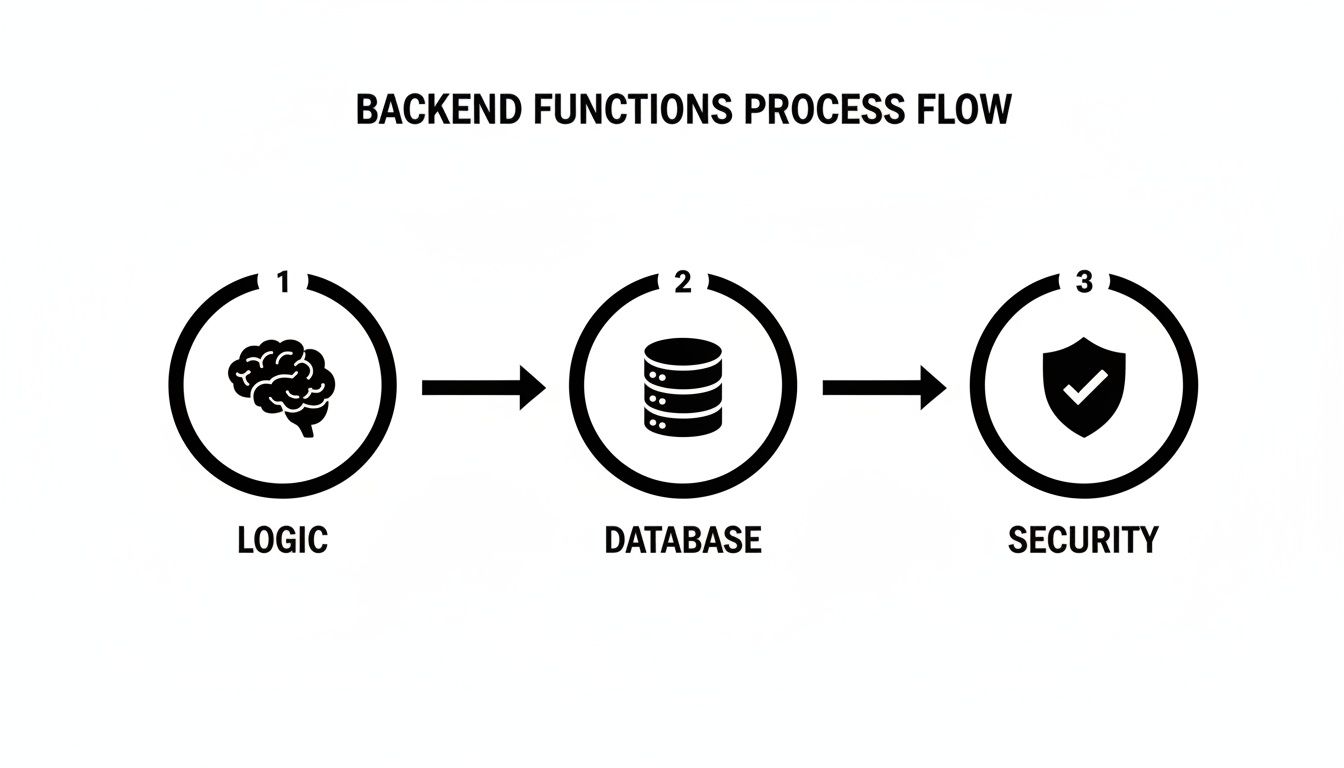
The Backend's Core Business Functions
A strong backend is designed not just for today's needs but for future growth and potential threats.
- Application Logic: This is the "brain" of your software. It executes the business rules that turn user actions into outcomes—processing an order, calculating complex financial data, or authenticating a user's login.
- Database Management: The backend is the gatekeeper to your data. It securely stores, retrieves, and modifies information, ensuring data integrity and consistency.
- Server and API Communication: It manages the server environment and provides controlled access points (APIs) for the frontend, ensuring all data is exchanged seamlessly and securely.
A strong backend is your first and most important line of defense. For any company in a regulated industry like finance or healthcare, or any business handling sensitive customer data, backend security isn't just a feature—it's a prerequisite for staying in business.
Choosing the Right Backend Technology for Business Goals
Selecting a backend technology is a strategic decision that impacts development speed, performance, and long-term maintenance costs.
- Data-Intensive AI Applications: Python, often paired with a framework like Django, is an exceptional choice. Its powerful libraries for data analysis and machine learning are ideal for building intelligent systems.
- Real-Time Financial Systems: Node.js shines for fast, event-driven applications handling numerous simultaneous connections, making it perfect for fintech platforms processing real-time trades or data feeds.
- Enterprise-Grade Platforms: For large organizations, languages like Java (with Spring) or C# offer the robust, scalable, and secure environments needed to build complex, mission-critical systems.
We explore these technologies in greater detail in our complete guide to backend web development.
Architecture for Scalability and Performance
A poorly designed backend architecture leads to slow performance, frequent downtime, and an inability to scale. In contrast, a strategic architecture built with modern principles like microservices or serverless computing allows your application to grow gracefully. This approach, central to effective DevOps, turns your infrastructure into a competitive advantage instead of a bottleneck.
Connecting Frontend and Backend Through APIs
Think of the frontend as the car's dashboard and the backend as its engine. The Application Programming Interface (API) is the wiring that connects them, allowing them to communicate. An API is a set of rules—a contract—that defines how the client and server exchange information.
This "API-as-a-contract" approach is key to efficient development. It allows frontend and backend teams to work in parallel. Frontend developers can use mock data that mimics the API to build and test the user interface, confident it will connect seamlessly to the live backend later. This decoupling is a massive accelerator for getting products to market.
The critical link between the frontend and backend layers often relies on robust APIs; understanding how an API integrations platform can optimize this connection is essential for seamless communication.
Tracing the Data Flow: An E-commerce Example
Let's walk through a simple action: buying a product online.
- User Action (Frontend): You click the "Buy Now" button.
- API Request (Frontend to Backend): The frontend packages details (product ID, quantity) into an API request and sends it to a backend endpoint like
/api/orders. - Request Processing (Backend): The backend validates the request: Is the user logged in? Is the item in stock? This is where business logic and security are enforced.
- Database Interaction (Backend): The backend updates the inventory in the database, creates a new order record, and calls another API (e.g., Stripe) to process the payment.
- API Response (Backend to Frontend): The backend sends a response. A success message includes an order confirmation number; an error message explains what went wrong (e.g., "Payment method declined").
- UI Update (Frontend): The frontend receives the response and updates the interface, showing a "Thank You" page on success or an error message on failure.
This entire round trip demonstrates the critical frontend-backend partnership. A well-designed API ensures this dialogue is reliable, fast, and secure. Our guide on API development best practices offers expert frameworks for building these crucial communication lines.
Building Your Ideal Development Team Structure
The backend vs. frontend discussion directly informs how you structure your team—a choice that impacts product quality, scalability, and time-to-market. The right model depends on your business maturity, product complexity, and strategic goals.
Comparing Team Models: Specialist vs. Generalist
- Specialized Teams: Hiring separate frontend and backend experts provides deep expertise, which is essential for complex applications in sectors like fintech or government. The challenge is ensuring seamless collaboration and avoiding silos.
- Full-Stack Developers: A full-stack developer is a generalist who works across the entire stack. This model offers agility, making it ideal for startups building an MVP. The potential downside is their knowledge may lack the depth required for highly specialized, large-scale systems.
Deciding between specialists and generalists is a strategic trade-off between depth and speed. Specialists provide the robust, secure foundation needed for enterprise-grade applications, while full-stack generalists offer the agility to get a new product off the ground quickly.
The Strategic Advantage of a Dedicated Team
A powerful third option is partnering with a dedicated team. This model provides a strategic mix of specialization and flexibility without the high costs and recruitment challenges of hiring locally. You gain immediate access to a pre-vetted pool of experts across the full technology stack.
For example, a SaaS company can onboard a dedicated team with senior frontend React developers to polish the user experience while expert backend Python engineers build a powerful data-processing engine. This secures top-tier talent for every part of the project, offering a significant advantage over searching for a single "unicorn" full-stack developer.
Making a Data-Informed Decision
Market trends should also inform your staffing strategy. By reviewing software development statistics for 2026, we see that while frontend frameworks like React are popular, the demand for backend expertise remains exceptionally high. Technologies that power critical enterprise functions, like SQL, Python, and Node.js, are consistently in demand.
This data tells a clear story: while ample frontend talent exists for building a great MVP, deep backend proficiency is a strategic imperative for creating secure, scalable platforms. Ultimately, your team structure should be a direct reflection of your business goals, risk tolerance, and growth ambitions.
Summary: From Technical Debate to Strategic Advantage
The backend vs. frontend discussion is not about choosing one over the other, but about strategically allocating resources to drive specific business outcomes. The right balance depends entirely on your product’s lifecycle stage, your target market, and your immediate strategic priorities.
Actionable Next Steps
- Define Your Immediate Goal: What is the single most important outcome you need to achieve right now? Is it validating an MVP, fixing poor user engagement, preparing for scale, or ensuring security compliance? Your answer dictates where to focus your investment.
- Prioritize Frontend Investment If:
- You are launching an MVP or prototype to attract investors.
- You are running a marketing campaign where conversion rates are paramount.
- Your analytics show high bounce rates or low user engagement.
- Prioritize Backend Investment If:
- You are building a data-intensive platform (AI, complex analytics).
- You operate in a regulated industry like finance or healthcare.
- Your system is struggling with performance under increasing user load.
- Evaluate Your Team Structure: Assess whether your current team (in-house specialists, generalists, or a dedicated team partner) is aligned with your top priorities. A mismatch between your goals and your team's expertise is a direct path to failure.
By aligning your development priorities with your business strategy, you transform a technical choice into a powerful competitive advantage.
At Group107, we build and manage dedicated engineering teams with the specialized frontend, backend, and full-stack expertise you need to scale. We partner with you to turn your vision into a secure, high-performing digital product.
Learn how our dedicated teams can accelerate your development