
Automated testing isn't just a technical upgrade; it's a strategic business decision that directly impacts your bottom line. It replaces slow, error-prone manual checks with high-speed, repeatable scripts that empower your team to ship new features with confidence. The primary business objective is to accelerate your time-to-market, enhance product quality, and achieve a significant return on investment.
Why Automated Testing Is a Modern Business Imperative
Relying on a manual testing process is like running a modern assembly line by hand—it’s a massive bottleneck that stifles innovation and obstructs growth. For any modern business in SaaS, finance, or e-commerce, automated testing is no longer a "nice-to-have." It's the engine that powers reliable, scalable development.

Manual testing often prevents startups from launching their MVP on time and hinders enterprises from modernizing legacy systems. The process isn't just slow; it's riddled with the risk of human error and inconsistent checks, which is how critical bugs slip into production, eroding customer trust and revenue.
In contrast, automation delivers exactly what your business needs:
- Accelerated Speed to Market: Launch features and updates faster than your competitors, capturing market share and responding to customer needs in real-time.
- Reduced Operational Costs: Free your skilled engineers from repetitive, low-value tasks and empower them to focus on innovation and product development.
- Mitigated Business Risks: Ensure quality and compliance standards are met, a critical requirement in high-stakes sectors like finance, government, and enterprise tech.
The urgency is underscored by significant market trends. The global automation testing market was valued at USD 28.1 billion in 2023 and is projected to reach USD 55.2 billion by 2028, growing at a CAGR of 14.5%. This rapid expansion highlights how essential automation has become for maintaining a competitive edge.
Manual vs. Automated Testing: A Strategic Comparison
To put the business impact into perspective, a side-by-side comparison makes the strategic advantage of automation clear.
| Metric | Manual Testing | Automated Testing |
|---|---|---|
| Speed | Slow, linear, and resource-intensive. | Extremely fast, with parallel execution capabilities. |
| Scope | Limited by human capacity and budget. | Broad; can cover thousands of scenarios across platforms. |
| Cost | High long-term operational costs due to recurring labor. | Higher initial setup, but delivers a lower total cost of ownership (TCO). |
| Reliability | Prone to human error, fatigue, and inconsistency. | Highly consistent, repeatable, and reliable. |
| Scalability | Difficult and expensive to scale with product complexity. | Scales seamlessly with the codebase and business growth. |
While manual testing remains valuable for exploratory and usability checks, automation is the only viable foundation for building a rapid, reliable, and scalable delivery pipeline.
When you frame automation as a business driver instead of a technical task, you unlock its true potential. It's about engineering a resilient, agile delivery process that directly fuels your company's strategic goals. To dig deeper into the mechanics, review this guide: Software Test Automation: A Practical Guide to Faster, Safer Releases.
Accelerate Your Time to Market and Release Velocity
In today's competitive landscape, speed is a critical differentiator. The most significant business benefit of automated testing is radical acceleration. Manual testing inevitably creates a bottleneck where QA teams spend days—or even weeks—meticulously clicking through features, slowing the entire development lifecycle and delaying value delivery to customers.

Automated testing completely revolutionizes this dynamic. Automated scripts can execute thousands of checks in minutes, a task that would take a human tester days. It's the equivalent of upgrading your delivery process from a horse-drawn carriage to a high-speed freight train.
This power is fully realized when integrated into a modern DevOps workflow. By embedding automated tests directly into your CI/CD pipeline, you establish a system of continuous validation. If you're new to the concept, our guide on what a CI/CD pipeline is provides an excellent starting point.
Create a Continuous Feedback Loop
With automation integrated into your pipeline, a full suite of tests runs automatically every time a developer commits new code. This creates a near-instantaneous feedback loop, flagging bugs or regressions almost immediately after they are introduced.
This immediate feedback allows developers to identify and fix issues while the context is still fresh, dramatically reducing the time and cost associated with debugging. You catch problems early when they are small and cheap to fix, not weeks later during a dedicated QA phase.
By running automated tests with every change, you transform quality assurance from a final gatekeeper into an ongoing, collaborative process. This shift is fundamental to achieving the speed and agility needed to outpace competitors.
Enable More Frequent and Predictable Releases
The speed and reliability gained from automation translate directly into measurable business outcomes. With a safety net of automated checks protecting core functionality, you can release new features and updates with greater confidence and frequency.
This new operational rhythm empowers your business to:
- Respond Instantly to Market Shifts: Quickly adapt your product to changing customer demands or competitive threats.
- Deliver Customer Value Faster: Shorten the cycle from idea to implementation, getting valuable improvements into the hands of your users sooner.
- Increase Release Predictability: Move away from chaotic, high-stakes release cycles toward smaller, more frequent, and lower-risk deployments.
For a SaaS company, this means deploying multiple feature enhancements per week instead of a single major update each quarter. For a fintech platform, it means pushing critical security patches in hours, not days. The takeaway is clear: automated testing is the engine that drives modern software delivery, enabling faster and more reliable innovation.
Enhance Product Quality and Reduce Critical Defects
Beyond speed, automated testing builds a fortress of quality around your product. This is about systematically eliminating the risks associated with manual checks, boosting software reliability, and protecting your brand's reputation.
Manual testing, especially for repetitive tasks, is a breeding ground for human error. A tester might miss a subtle UI defect after performing the same check for the hundredth time. In contrast, an automated script executes its commands with perfect consistency, every single time. This precision ensures your core features are always held to the same high standard, preventing regressions from slipping through.
Expand Test Coverage to Catch More Bugs
Another key benefit is the ability to dramatically expand test coverage—the measure of how much of your application's code is validated by tests. A manual team can only cover a limited number of scenarios, device combinations, and edge cases. Automation shatters this limitation.
For example, an e-commerce platform can automatically test its entire checkout flow across dozens of browser, OS, and device combinations in minutes. Manually, this task would be logistically impossible and prohibitively expensive. This expanded coverage directly translates to finding more bugs before they reach production.
Industry data confirms this. According to Gartner, organizations that implement test automation realize significant quality improvements: 43% achieve higher test accuracy, and 40% gain wider test coverage. This proves automation directly reduces defects and enhances product reliability. You can find more insights on the benefits of AI-enabled automation at solutionshub.epam.com.
Automation acts as a powerful quality gate. By systematically testing more of your application with greater precision, you build a safety net that catches defects early, preventing them from impacting your users and your bottom line.
This proactive approach to quality creates a positive ripple effect across the business. When you catch more defects during development, you will see:
- Fewer critical production incidents that erode user trust and damage your brand.
- Reduced customer support costs as fewer users encounter frustrating bugs.
- Higher user satisfaction and retention because the product works as expected.
Ultimately, a commitment to quality is a commitment to your customers. By implementing a robust automation strategy and adhering to the top 10 software testing best practices, you ensure your digital product is not just functional—it's reliable and trustworthy.
Drive Down Costs and Maximize Your ROI
Viewing automated testing solely as an initial investment in tools and training is a common but short-sighted mistake. The reality is that a well-executed automation strategy is a powerful profit driver, not a cost center.
When you analyze the long-term returns, the financial benefits become undeniable. Quality assurance transforms from an operational expense into a strategic asset that adds tangible value back to the business.
The most immediate win is the reduction in manual hours spent on repetitive testing. Consider your regression suite—the comprehensive checklist of tests run before every update to ensure new code hasn't broken existing functionality. Manually, this can consume hundreds of engineering hours per release, diverting your best talent from innovation to tedious, repetitive work.
Automation executes these same tests in minutes. This frees up your engineers to focus on high-value activities like developing new features, optimizing performance, or conducting creative exploratory testing that machines cannot replicate. This is a fundamental shift in how you leverage your most valuable resources.
The Snowball Effect of Catching Bugs Early
One of the most compelling financial arguments for automated testing is its ability to find defects early in the development lifecycle. A bug identified by a developer immediately after writing the code is a simple, quick fix. However, if that same bug slips past QA and into production, its cost multiplies exponentially.
The hidden costs of a production bug include:
- Triage and Investigation: Engineers must drop everything to diagnose the problem in a live, complex environment.
- Emergency Hotfixes: Rushed patches introduce additional risk and disrupt planned development schedules.
- Customer Support Overload: Support teams are inundated with tickets, driving up operational costs.
- Damaged Reputation and Revenue Loss: In sectors like fintech or e-commerce, a production failure can lead to direct revenue loss and erode customer trust.
A bug caught during the coding phase can be up to 10 times cheaper to fix than one that’s found in production. Automated tests are your early warning system, making sure most issues are squashed when they’re small and cheap to handle.
How to Calculate Your Automation ROI
Connecting test automation directly to financial outcomes makes its value clear to all stakeholders. While the exact formula varies, you can build a simple framework to demonstrate ROI by comparing the costs of your manual process to the savings generated by automation.
For example, a fintech company can calculate the cost of manually running regression tests on its mobile banking app. By automating that suite, they not only reclaim hundreds of engineering hours but also significantly reduce the risk of a production outage that could cost thousands of dollars per minute. A SaaS provider can draw a direct line from automation to lower customer churn by shipping a more stable, reliable product.
Once you analyze the numbers, the conclusion is clear. Automation isn't an expense—it's one of the smartest strategic investments you can make for your product's success and your company's bottom line.
Your Roadmap to Implementing Automated Testing
Transitioning to automated testing can seem like a massive undertaking, but with a strategic roadmap, it becomes a clear, value-driven business initiative. This isn't a dense technical manual; it's a high-level guide for leaders focused on achieving measurable results. The key is to start smart, demonstrate value quickly, and scale with purpose.
Your first step is to select a high-impact pilot project. Don't attempt to automate everything at once. Instead, choose a critical, self-contained part of your application. Core user journeys like login, user registration, or the checkout flow on an e-commerce site are perfect candidates. A successful pilot builds momentum and provides a solid business case for expanding your automation efforts.
Define Your Goals and Select the Right Tests
With a pilot project chosen, define what success looks like with clear, measurable goals. For example, aim to "reduce regression testing time by 80%" or "decrease production defects in the payment module by 50%." Quantifying your objectives makes the ROI undeniable.
Focus your initial automation efforts on tests that deliver the biggest return:
- Regression Tests: These are the foundation of any automation strategy. They are repetitive, time-consuming, and critical for ensuring new features don’t break existing functionality. As you build your plan, implementing an effective regression testing automation strategy is essential for long-term success.
- Data-Driven Tests: Scenarios requiring testing with numerous different inputs, such as a user signup form, are ideal for automation, which can process thousands of variations in a fraction of the time.
- Cross-Browser and Cross-Device Tests: Manually verifying your application on every possible browser and device is impractical. Automation makes comprehensive coverage not just possible, but efficient.
The diagram below illustrates how this strategic roadmap translates into long-term cost savings.
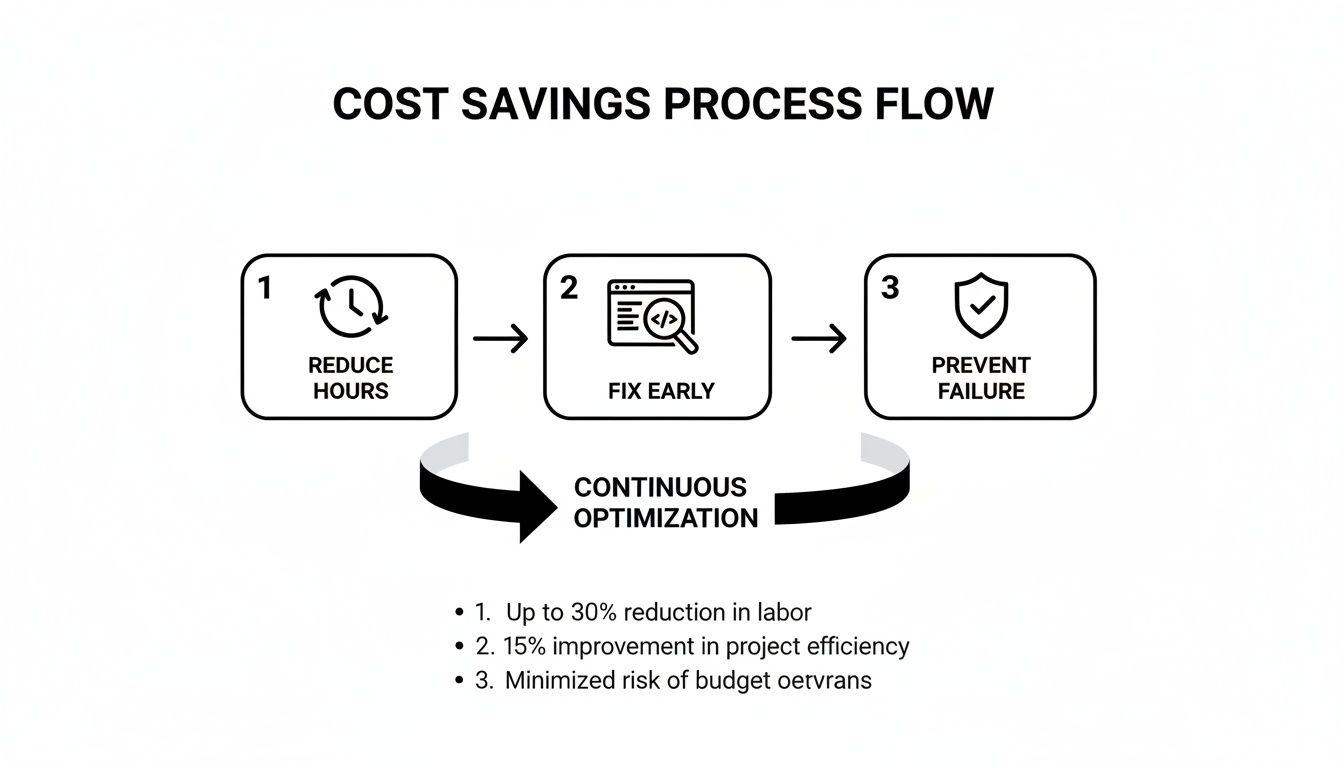
The strategy is focused on reducing manual labor, catching bugs when they are cheap to fix, and preventing costly production failures.
Choose Tools and Integrate into Your Workflow
The final steps involve selecting the right tools for your technology stack and integrating them into your existing development workflow. Your automation framework should plug directly into your CI/CD pipeline, triggering tests automatically with every code commit. This creates the continuous feedback loop essential for achieving both speed and quality.
To ensure your investment is delivering results, track the right metrics. The table below outlines key KPIs for measuring the real-world impact of your automation strategy.
Key Metrics for Measuring Automation Success
| KPI | What It Measures | Business Impact Example |
|---|---|---|
| Test Execution Time | The time required to run the entire automated test suite. | Reducing a 12-hour manual regression cycle to a 20-minute automated run enables multiple daily releases instead of weekly ones. |
| Defect Escape Rate | The percentage of bugs found in production that should have been caught by tests. | A lower rate means fewer customer-facing issues, reduced support workload, and higher user satisfaction. |
| Test Coverage (%) | The percentage of your application's code covered by automated tests. | Higher coverage provides greater confidence that new changes won't break existing functionality, thereby reducing release risk. |
| Cost Per Test Case | The total cost of automation (tools, infrastructure, engineers) divided by the number of test cases. | Demonstrates long-term cost-effectiveness compared to the recurring expense of manual testing for the same test cases. |
Monitoring these KPIs helps transform your automation initiative from a cost center into a clear driver of business value, justifying further investment and scaling.
A well-structured implementation plan is the bridge between understanding the benefits of test automation and actually realizing them. It ensures your investment delivers measurable improvements in efficiency, quality, and speed to market from day one.
A successful roadmap requires careful planning and expert execution. For a deeper look at structuring your testing, check out our guide on the essential quality assurance process steps. Partnering with an expert team like Group107 can accelerate your progress, helping you build a scalable framework aligned with your business goals.
Summary and Next Steps
The fundamental benefit of automated testing is confidence—the confidence to innovate faster, scale reliably, and build deep customer loyalty. By transitioning from tedious, error-prone manual checks to a robust automated framework, you are not just optimizing a process; you are fundamentally upgrading your entire software delivery engine. Your development lifecycle evolves from a series of bottlenecks into a smooth, predictable system for value creation. This empowers your team to shift from being gatekeepers to creators, focusing on building exceptional products backed by a reliable safety net of automated tests.
Your Actionable Next Steps
Begin your journey with an honest assessment of your current testing process. Identify the most repetitive, time-consuming, and high-risk areas—these are the prime opportunities where automation will deliver immediate and undeniable ROI.
- Analyze Your Regression Suite: Calculate the total engineering hours spent on manual regression testing for each release. This figure often provides a compelling business case for automation.
- Identify Critical User Journeys: Map out the "must-work" functionalities of your application, such as user login, checkout processes, or core data transactions. Automating these flows directly protects revenue and brand reputation.
- Evaluate Your Tooling and Skills: Assess whether your in-house team has the expertise and tools to build a scalable automation framework. Determine if partnering with specialists would accelerate your path to success.
This transformation is about adopting a new mindset where quality is integrated into every stage of development. At Group107, we specialize in guiding businesses through this journey, building custom automation strategies that deliver measurable business outcomes.
Answering Your Top Questions About Test Automation
Business leaders often have strategic questions when considering a shift to automated testing. Here are clear, straightforward answers to the most common concerns.
Isn't Automated Testing Expensive to Set Up?
While there is an upfront investment in tools and expertise, viewing automation solely as an expense overlooks its significant long-term ROI. By automating repetitive regression tests, you reclaim hundreds of engineering hours with every release cycle.
Furthermore, automated tests detect bugs early in the development process when they are up to 10 times cheaper to fix than those that reach production. The cost of a single critical production failure—including emergency hotfixes, customer support overload, and brand damage—far exceeds the initial investment in a robust automation framework.
Does Automation Mean We Don't Need Our Manual Testers Anymore?
No. In fact, automation elevates the role of your QA team from repetitive task execution to strategic problem-solving. It empowers them to focus on high-value activities that require human intuition and creativity.
Automation excels at handling repetitive tasks with perfect consistency, freeing up your skilled testers to focus on:
- Exploratory Testing: Creatively attempting to break the application in ways a script would not anticipate.
- Usability Testing: Assessing the user experience and providing nuanced, subjective feedback.
- Complex Scenarios: Validating intricate workflows that are impractical to automate.
By delegating rote tasks to machines, you empower your team to enhance the overall product quality and user experience.
How Do We Figure Out Which Tests to Automate First?
Prioritize based on business impact and frequency. The best starting point is nearly always your regression test suite. These are the critical checks performed before every release to ensure new code hasn't broken existing functionality. They are highly repetitive, and automating them provides immediate, measurable time savings.
After addressing regression tests, focus on:
- Critical User Journeys: Core application functions like user login, checkout processes, or key data submission forms that directly impact revenue.
- Data-Driven Tests: Scenarios requiring the same action to be tested with numerous data inputs, such as form validations.
Starting with these high-value areas delivers quick wins and builds a strong business case for expanding your automation efforts. For a deeper dive into structuring your approach, explore our guide on the essential quality assurance process steps.
Ready to build a resilient, high-velocity development process? Group107 builds custom automation strategies and provides dedicated offshore engineering teams to help you accelerate your time to market and deliver flawless digital products.