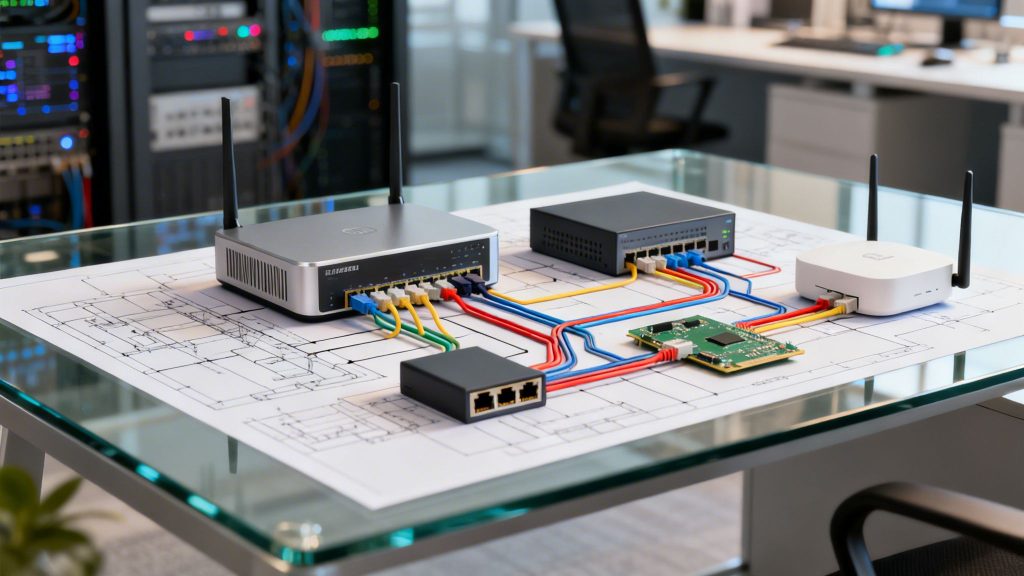
A computer network is built from two core types of components: physical hardware you can see and touch—like routers, switches, and cables—and the logical elements that make it all work, such as protocols and software. These parts interconnect to form the digital infrastructure that enables your devices to communicate, share data, and connect to the internet, powering virtually every modern business operation.
Understanding these foundational computer network elements is not just an IT task; it's a strategic business imperative for achieving scalability, security, and a competitive edge.
Why Your Network Is Your Most Critical Business Asset

Before diving into the technical specifics, it's critical to understand why a well-architected network is non-negotiable in today's digital economy. Your network is the central nervous system of your entire organization. It underpins every digital interaction, every data transfer, and every customer experience.
For a SaaS company, network performance directly translates to user experience and retention. In fintech, it's the bedrock for secure, instantaneous transactions. For an organization embracing DevOps, the network's design dictates the velocity of CI/CD pipelines and the speed of innovation.
Turning Infrastructure Into a Competitive Advantage
When you approach your network components strategically, your IT infrastructure transforms from a cost center into a significant competitive advantage. The right choices deliver tangible business outcomes.
- Enhanced Performance: High-quality components reduce latency, ensuring applications run flawlessly and data is instantly accessible. This is vital for everything from e-commerce checkouts to internal team productivity.
- Improved Reliability: A resilient network architecture is your best defense against downtime. For any public-facing company, this means consistent service delivery, which protects revenue and brand reputation.
- Robust Security: Integrating security components like firewalls and access controls directly into the network's design is the only effective way to protect sensitive data. Understanding modern threats is foundational, which is why it's crucial to be familiar with today's cloud computing security risks.
- Greater Scalability: A well-designed network is built to grow with your business. Whether you're a startup launching an MVP or an enterprise adding new services, your network must handle increased traffic and users without requiring a complete overhaul.
To simplify this, we can group all network parts into three fundamental pillars. Each has a distinct role, but they are completely interdependent—a weakness in one area undermines the others.
The Three Pillars of Network Infrastructure
| Component Category | Primary Role | Real-World Business Impact |
|---|---|---|
| Physical Hardware | Creates the physical pathways for data to travel. | Determines the raw speed and capacity of your operations. |
| Logical Elements | Sets the rules for how data moves and is interpreted. | Ensures data integrity, efficiency, and interoperability. |
| Services & Security | Provides essential functions and protects the entire system. | Enables automation, usability, and defense against threats. |
This framework clarifies how individual pieces contribute to the bigger picture. From a single cable to a complex firewall, every component has a job to do in driving business outcomes.
A network is no longer just about connectivity; it's about enabling business velocity. How you assemble its components directly determines your ability to innovate, scale securely, and outperform competitors.
Mastering these foundational pieces is the first step toward building an infrastructure that delivers a clear ROI. This guide provides a clear roadmap to understanding these parts and how they fit together to create a powerful digital foundation.
The Physical Foundation: Your Network Hardware
Before we can discuss software or services, we must start with the physical hardware. These are the tangible devices that form the real-world backbone of your digital operations, creating the pathways for all data to travel. A poor choice here can create bottlenecks that degrade the performance of your entire business.
Each piece of equipment has a specific job, and they work together like a tightly orchestrated logistics operation. This isn't just an IT decision—it’s a business decision that shapes performance, security, and your ability to grow.
Endpoints: The Origin and Destination of All Data
Every piece of data begins and ends its journey at an endpoint. These are the devices your team uses or the machines that house the applications your business depends on.
- Client Devices: This includes desktops, laptops, smartphones, and tablets. For an e-commerce site, your customer's phone is the endpoint initiating a purchase request.
- Servers: These are the powerful computers that store, process, and deliver your data and applications. For a SaaS company, your servers are the endpoints hosting the software and serving it to thousands of users simultaneously. Their performance is your customer's experience.
In short, endpoints are the source and destination of network traffic. Securing and optimizing them is the first step toward building a robust network.
Network Interface Cards (NICs): The On-Ramp to the Data Highway
An endpoint cannot send or receive a single byte of data without a Network Interface Card (NIC). Think of the NIC as the device's on-ramp to the information superhighway. It translates computer data into a signal that can be transmitted over the network and vice-versa.
Every server, PC, and network-connected device has one. The speed of this component—whether 1 Gbps or 10 Gbps—sets the maximum theoretical speed at which that device can communicate. For a fintech firm processing high-frequency trades, a 10 Gbps NIC is a baseline requirement to ensure data moves instantaneously.
Switches: The Local Traffic Director
Once data leaves an endpoint, it needs to reach other devices on the same local network. This is the job of a switch. If a router connects different cities, a switch directs traffic within a single city block.
A switch is intelligent; it forwards data packets only to the specific device that needs to receive them. This is a massive improvement over older hubs that broadcasted data to every connected device, creating unnecessary network congestion. For a growing application, upgrading to a high-throughput, managed switch can eliminate internal traffic jams and ensure your servers can communicate at full speed.
Routers: The Inter-Network Connector
While a switch connects devices within one network, a router connects different networks together. It’s the device that directs traffic between your local office network (LAN) and the public internet (WAN).
Routers examine the destination address on each data packet and determine the most efficient path to send it on its journey. This capability makes everything from sending an email to accessing a cloud application possible. A properly configured router also acts as a primary line of defense, using its firewall features to block unwanted traffic.
A router makes decisions about where to send traffic between networks, while a switch makes decisions about where to send traffic within a single network. Understanding this distinction is crucial for designing an efficient and secure network architecture.
Cabling and Wireless Access Points: The Physical Pathways
Finally, all this data needs a medium to travel through. This is where cables and wireless access points come in.
- Cabling: These are the physical roads of your network. Options range from standard Ethernet (Cat6) for most office setups to fiber optic cables for high-speed, long-distance data center connections. In a data center or on a financial trading floor, fiber is non-negotiable for its immense bandwidth and low latency. A solid physical foundation starts with quality infrastructure, and understanding the value of structured cabling highlights its importance.
- Wireless Access Points (WAPs): These devices create the "airways" for your data, broadcasting a Wi-Fi signal so devices can connect without physical tethers. In any modern office, strategically placing multiple WAPs is key to providing seamless connectivity and mobility for employees.
The choice between wired and wireless often boils down to a trade-off between performance and convenience. Critical systems like servers are almost always hardwired for stability and speed, while laptops and mobile devices rely on the flexibility of Wi-Fi.
The Rules of the Road: Network Software and Protocols
Physical hardware provides the network's foundation, but it's the software and protocols that bring it to life. These logical components act as a universal language for how data is formatted, addressed, transmitted, and received across every device on your network.
Think of it this way: cables and switches are the highways. Software and protocols are the traffic laws, GPS directions, and postal codes that prevent chaos. Without these rules, data packets would get lost, collide, or never reach their destination.
The Universal Framework: The OSI Model
To manage this complexity, network engineers use the Open Systems Interconnection (OSI) model. This is a practical framework that deconstructs network communication into seven distinct layers. Each layer performs a specific job and communicates only with the layers directly above and below it.
This layered approach is a cornerstone of modern networking. It allows different hardware and software vendors to build interoperable products. A network card from one company can communicate with a router from another because both adhere to the rules defined by the OSI model. For your business, this means you can mix and match best-of-breed components without vendor lock-in.
This map shows the basic flow of data from endpoints through your core hardware.

As you can see, endpoints don’t just connect randomly. They communicate through central hardware, and protocols govern every single step of that data’s journey.
Core Network Services: DNS and DHCP
While the OSI model provides the structure, two key services make networks automated and user-friendly: the Domain Name System (DNS) and the Dynamic Host Configuration Protocol (DHCP).
- DNS (Domain Name System): This is the internet's phone book. Humans remember names like
group107.com, but computers require numerical IP addresses to communicate. DNS is the service that translates human-friendly domain names into machine-readable IP addresses that routers and servers use. - DHCP (Dynamic Host Configuration Protocol): This service is a massive time-saver for any IT team. When a new device joins a network, DHCP automatically assigns it an IP address and other critical network settings. Without it, an administrator would have to manually configure every computer, phone, and printer—an impossible task in any modern organization.
For a SaaS platform, reliable DNS is paramount. If it fails, your customers cannot find your service, even if your servers are running perfectly. For a large enterprise, DHCP enables hundreds of employees to connect their devices seamlessly every day.
The Network’s Operating System and Security
Just as a computer needs an operating system like Windows or macOS, a network runs on a Network Operating System (NOS). This software typically runs on servers, routers, and firewalls, giving administrators the tools to manage users, control access, and monitor traffic. It's the central command center for the entire network.
Layered on top of this are security components, with the most critical being the firewall.
A firewall is the digital gatekeeper for your network. It inspects all incoming and outgoing traffic, deciding whether to block or allow it based on a pre-defined set of security rules. A next-generation firewall (NGFW) takes this further by using advanced inspection to identify and block sophisticated threats, not just simple attacks.
For a fintech company, a properly configured firewall isn't optional; it's the primary defense protecting sensitive customer data. For any public company subject to regulations like SOX, firewalls provide the auditable controls needed to prove compliance.
By integrating these rules into the network's software and protocol layers, you create a system that is secure and efficient by design. This is a core principle of modern DevOps and cloud infrastructure for a reason.
Designing for Growth with Network Architecture

Having the right hardware and software is one thing. Assembling them into a cohesive network architecture—a strategic blueprint built for performance and resilience—is where real value is created. Without a smart design, even the most powerful components will underperform, creating bottlenecks that stifle growth and increase security risks.
Your architecture transforms a collection of parts into a powerful business asset. It governs how data moves, how your system recovers from failure, and how quickly you can adapt to new demands. For any company with digital ambitions, architecture isn't just an IT decision; it's a core part of your business strategy.
Network Topologies: The Blueprints for Connectivity
The physical or logical layout of your network is its topology. These are proven design patterns, each with distinct trade-offs in cost, performance, and reliability. Choosing the right one means aligning it with your business priorities.
Two of the most common topologies are Star and Mesh.
- Star Topology: Every device connects to a central hub or switch. This design is straightforward and cost-effective, making it ideal for small offices and startups. Its primary vulnerability is the central switch—if it fails, that entire network segment goes down.
- Mesh Topology: Devices are interconnected, providing multiple paths for data to travel. A full mesh connects every device to every other device, offering exceptional redundancy. If one connection fails, data is simply rerouted. This resilience makes it perfect for mission-critical systems in finance or enterprise e-commerce, though the complexity and cost are significantly higher.
For a startup launching an MVP, a simple star topology is a smart, budget-friendly starting point. An enterprise running a global platform, however, would leverage a mesh or hybrid model in its data centers to guarantee uptime.
Architectural Models: Client-Server vs. Peer-to-Peer
Beyond the physical layout, the way your devices interact defines the network’s architectural model. The two main approaches, client-server and peer-to-peer (P2P), are designed for very different use cases.
| Model | Description | Business Use Case |
|---|---|---|
| Client-Server | A centralized server provides resources like data and applications to "client" devices. This model offers strong security, centralized management, and streamlined backups. | This is the foundation of nearly all business applications—including SaaS platforms, corporate portals, and e-commerce sites. |
| Peer-to-Peer (P2P) | All devices, or "peers," are equal and share resources directly with one another without a central server. This architecture is highly resilient and decentralized. | This is common in file-sharing applications like BitTorrent and some blockchain technologies where decentralization is a core goal. |
For most businesses, the client-server model is the standard. It provides the control and security necessary to manage company data and deliver reliable services. Getting this implementation right is foundational, and a good Network Setup and Optimization Guide can offer more practical, in-depth knowledge.
Network architecture isn’t a set-it-and-forget-it decision; it's a living framework. As cloud services and remote work become standard, hybrid architectures that mix on-premise control with cloud flexibility are now the norm for businesses built to scale.
Architecture as a DevOps Enabler
In a modern technology organization, network architecture is the unsung hero of DevOps. A fast, well-designed network is what enables a smooth Continuous Integration/Continuous Deployment (CI/CD) pipeline. It provides the low-latency, high-bandwidth connections needed for rapid code commits, automated testing, and seamless deployments.
A rigid or overloaded network becomes an immediate bottleneck, slowing the entire development lifecycle and crippling your team's ability to innovate.
For SaaS products that must scale on demand, a flexible architecture using virtualized network components and cloud services is non-negotiable. This is where smart network design directly translates into a faster time-to-market and a superior customer experience. Of course, keeping this dynamic environment running smoothly requires solid infrastructure monitoring best practices to ensure reliability and performance.
Selecting Network Components for Your Business Needs
Turning network theory into a real-world, high-performing setup means aligning your infrastructure with your business goals. The components a lean startup needs for a Minimum Viable Product (MVP) are vastly different from what a global enterprise or a high-security fintech platform requires. Making smart, ROI-driven decisions is about finding the right balance between performance, security, and cost—based on where your business is today and where it's going tomorrow.
This isn't about buying the most expensive hardware. It's about making strategic investments that directly support your operations. A misstep here can mean wasting budget on unneeded capacity or, worse, building a network that breaks the moment your business starts to scale.
Checklist: Lean Network for a Startup MVP
For any startup, the objective is to get to market quickly while conserving capital. The network must be agile, cost-effective, and scalable enough to handle the first wave of users without a large upfront investment. The key is to leverage virtual and cloud-native tools to minimize physical hardware.
The mantra for a startup network is simple: minimize upfront cost and complexity. Cloud services are the strategic core, offering a pay-as-you-go model that aligns perfectly with a startup's unpredictable growth.
- [ ] Virtual Private Cloud (VPC): Instead of physical routers and switches, use a VPC from a provider like AWS or Azure to create a logically isolated network in the cloud with its own subnets, route tables, and gateways.
- [ ] Managed Network Services: Use managed firewalls (e.g., AWS WAF) and load balancers to get enterprise-grade security and traffic management without purchasing or managing dedicated hardware.
- [ ] Virtual Machines and Containers: Host your application on virtual servers (like EC2 instances) or in containers (using Docker or Kubernetes) to scale resources up or down in minutes.
- [ ] Basic Office Setup: For the physical office, a simple prosumer-grade router and a few wireless access points are typically sufficient, as the heavy lifting is done in the cloud.
Checklist: Enterprise-Grade Scalable Infrastructure
As a business grows, priorities shift toward reliability, top-tier performance, and ironclad security. An enterprise network must support thousands of users, high transaction volumes, and critical applications with near-perfect uptime. Redundancy and capacity are paramount.
- [ ] Enterprise-Grade Routers and Switches: Standardize on high-capacity, modular hardware from vendors like Cisco or Juniper, which include features like redundant power supplies and advanced management tools.
- [ ] Fiber Optic Backbone: Implement a fiber optic backbone for high-speed links between data centers or major offices to handle large-scale data replication and backups.
- [ ] Redundant Internet Connections: Establish a "multi-homed" setup with connections from at least two different internet providers to ensure business continuity during an outage.
- [ ] Advanced Security Appliances: Deploy a suite of security hardware, including Intrusion Prevention Systems (IPS), dedicated Web Application Firewalls (WAFs), and advanced endpoint protection. Group 107 specializes in building these secure, large-scale systems through our end-to-end digital solutions.
Checklist: Fortified Network for a Fintech Platform
For a fintech platform, security is the non-negotiable foundation of the business. Every component choice must be evaluated through the lens of security and regulatory compliance. The network must be engineered from the ground up to protect sensitive financial data, prevent fraud, and provide a clear, auditable trail for every transaction.
- [ ] Next-Generation Firewalls (NGFWs): NGFWs are mandatory for their deep packet inspection and advanced threat prevention capabilities.
- [ ] Strict Network Segmentation: The network must be architected into multiple, isolated segments. For instance, payment processing servers must be on a completely separate network from the corporate marketing website to reduce the attack surface.
- [ ] Hardware Security Modules (HSMs): For cryptographic operations like key management and digital signing, use specialized HSM hardware to provide the highest level of security.
- [ ] End-to-End Encryption: Ensure all data is encrypted, both at rest (on a server) and in transit (moving across the network), using protocols and components designed for secure data handling.
The Future of Networking: Intelligent, Automated, and Virtualized

The landscape of network components is undergoing a massive transformation, driven by the demands of artificial intelligence, automation, and ubiquitous connectivity. Preparing for the future isn't just about buying faster hardware; it's about building an infrastructure that is intelligent, resilient, and can adapt on the fly. For any business aiming to compete, understanding these trends is critical for building a network that actively drives growth.
At the center of this shift is the modern data center. AI is no longer a niche workload. According to CRN.com, global spending on data center systems is projected to hit $653 billion in 2026—a massive 32% annual jump from 2025. This investment is fueling a new generation of high-performance network components.
The Rise of AI-Ready Components
This investment is funding a new breed of hardware engineered for AI workloads. We are seeing a complete overhaul at every layer, from server connectivity to the fabric connecting massive GPU clusters.
Key developments include:
- Faster Server Connectivity: To manage the data throughput from AI inference, frontend server connections are leaping from 100G/200G to 400G.
- Blazing-Fast Backbones: The backend interconnects that allow GPUs to communicate are already at 800G and rapidly moving toward 1.6T speeds to eliminate training bottlenecks.
- Advanced Topologies: Architectures like leaf-spine are becoming the gold standard, connecting servers through high-performance switches and optical links to deliver the low latency and massive scale modern applications demand.
The pace of innovation is relentless. Having an expert partner who understands this rapid lifecycle is crucial for making smart, future-proof investments.
AIOps and the Shift to Predictive Maintenance
As networks grow more complex, the traditional break-fix model is no longer viable. The future is AIOps (AI for IT Operations), which uses machine learning to manage the network itself. Instead of waiting for a component to fail, AIOps platforms analyze performance data to predict problems before they cause an outage.
AIOps transforms network management from a manual, reactive task into an automated, proactive strategy. By identifying anomalies and predicting failures, it delivers higher uptime and frees up engineering teams to focus on innovation instead of firefighting.
This predictive capability is non-negotiable for SaaS platforms, fintech services, or e-commerce sites where uptime directly impacts revenue.
The Move Toward Flexible Consumption Models
Businesses are increasingly moving away from owning and managing physical hardware. Network as a Service (NaaS) is leading this trend. It's a cloud model that allows you to consume network services on a subscription basis, enabling you to scale up or down without large capital expenditures.
When combined with virtualized components, this model becomes incredibly powerful. To see how this abstraction works in practice, explore our guide on the advantages of virtualization, which details the benefits. By embracing intelligent automation and flexible services, you can build a network that is ready for today and prepared for tomorrow.
From Theory to Action: Key Takeaways and Next Steps
We've covered the essential components of a computer network, from the physical hardware that forms the foundation to the software and architectural designs that bring it to life. Understanding these elements is the first step toward building an infrastructure that not only supports but actively accelerates your business goals.
Summary of Key Concepts
- Hardware is the Foundation: Devices like routers, switches, and NICs determine the raw speed and capacity of your network.
- Software Provides the Rules: Protocols (like TCP/IP) and services (like DNS and DHCP) ensure data moves efficiently and securely.
- Architecture is Strategy: The design of your network (its topology and model) dictates its performance, resilience, and scalability.
- Business Needs Drive Component Choice: A startup's network needs are vastly different from an enterprise's. Select components that align with your specific goals for performance, security, and budget.
- The Future is Automated: Trends like AIOps and NaaS are making networks more intelligent, predictive, and flexible.
Your Actionable Next Steps
- Assess Your Current Network: Identify your current network components and architecture. Are there clear bottlenecks or single points of failure that are holding your business back?
- Align with Business Goals: Define what you need from your network over the next 12-24 months. Are you planning to launch a new product, scale your user base, or improve your security posture?
- Identify Key Upgrades: Based on your assessment and goals, create a prioritized list of upgrades. This could range from upgrading a core switch to migrating key services to a Virtual Private Cloud (VPC).
- Develop a Strategic Roadmap: Don't make ad-hoc changes. Build a clear, phased roadmap for evolving your network to ensure your investments deliver maximum ROI.
Ready to build a network that drives business growth? At Group 107, we provide end-to-end digital solutions, from designing resilient infrastructure to deploying dedicated offshore engineering teams that can accelerate your roadmap. Learn how we turn vision into delivery at scale.