
Deciding to move to the cloud is no longer the question. The real challenge is how you get there. A solid enterprise cloud migration strategy is what separates a smooth, value-driven transition from a chaotic and expensive failure. It’s the essential blueprint that aligns your migration directly with business goals, mitigates risk, and ensures you realize tangible value from day one.
Why a Cloud Migration Strategy is Critical for Your Business
Jumping into a cloud migration without a clear strategy is like building a skyscraper without architectural plans. You’re inviting runaway costs, significant security vulnerabilities, and operational chaos. A well-architected strategy, however, elevates the migration from a simple IT project to a powerful business initiative that drives a real competitive advantage.
The primary reason to be strategic is to unlock genuine business agility. Instead of simply lifting and shifting servers, a planned migration allows you to modernize applications, streamline inefficient workflows, and respond faster to market shifts. This foundational work prepares you to leverage advanced technologies like AI and machine learning, transforming your infrastructure into an engine for innovation.
The Foundation for Scalability and Innovation
A formal strategy forces an honest, in-depth assessment of your current IT landscape. This deep dive uncovers hidden application dependencies, highlights technical debt, and helps you select the right migration path for each workload. Without this critical first step, enterprises often just "lift-and-shift" their existing problems into a new, more expensive cloud environment.
This proactive planning also sets the stage for modern DevOps practices. By integrating automation and CI/CD pipelines from the outset, you create a cloud environment that is resilient, efficient, and secure by design. For a refresher on the basics, review our guide on what the cloud is and why you need it.
A successful cloud migration strategy isn’t just about technology—it’s about re-architecting your business for the future. It provides the clarity needed to make intelligent decisions, control costs, and maximize the return on your cloud investment.
Aligning Technology with Business Outcomes
The need for a clear strategy is underscored by the data. By 2025, an incredible 94% of enterprise organizations will be using cloud computing, making it the undisputed foundation of modern IT. This trend is accelerating, with global public cloud spending projected to hit $723.4 billion in 2025—a 21.5% increase from 2024. Discover more insights about cloud migration statistics on pump.co.
Ultimately, a robust enterprise cloud migration strategy provides a clear roadmap to achieve tangible business results:
- Accelerated Agility: Rapidly deploy new features and services to enhance customer experiences.
- Enhanced Security: Implement robust, cloud-native security and achieve regulatory compliance from day one.
- Cost Optimization: Avoid budget overruns by right-sizing resources and establishing strong governance.
- Future-Proofing: Create a scalable foundation that supports long-term growth and future technological advancements.
Without this strategic direction, you don't just risk a failed migration. You risk being outpaced by competitors who are already leveraging the cloud to innovate and scale.
Choosing Your Migration Path with The 7 Rs Framework
Applying a one-size-fits-all approach to cloud migration is a surefire way to waste time and money. Not every application requires a ground-up rewrite, and not every legacy system can be dropped into a new environment and be expected to perform optimally. A smart migration strategy hinges on selecting the right path for each specific workload.
This is where the "7 Rs" framework provides a clear, strategic vocabulary for making these critical decisions.
Instead of a simplistic "cloud or no cloud" debate, this framework forces a more granular analysis of your entire application portfolio. By evaluating each component against these seven options, you can perfectly align the technical effort with its actual business value, ensuring every dollar spent on migration is an investment in your company's future.
This decision tree illustrates how a clear strategy leads to agility, while a reactive approach introduces unnecessary risk.
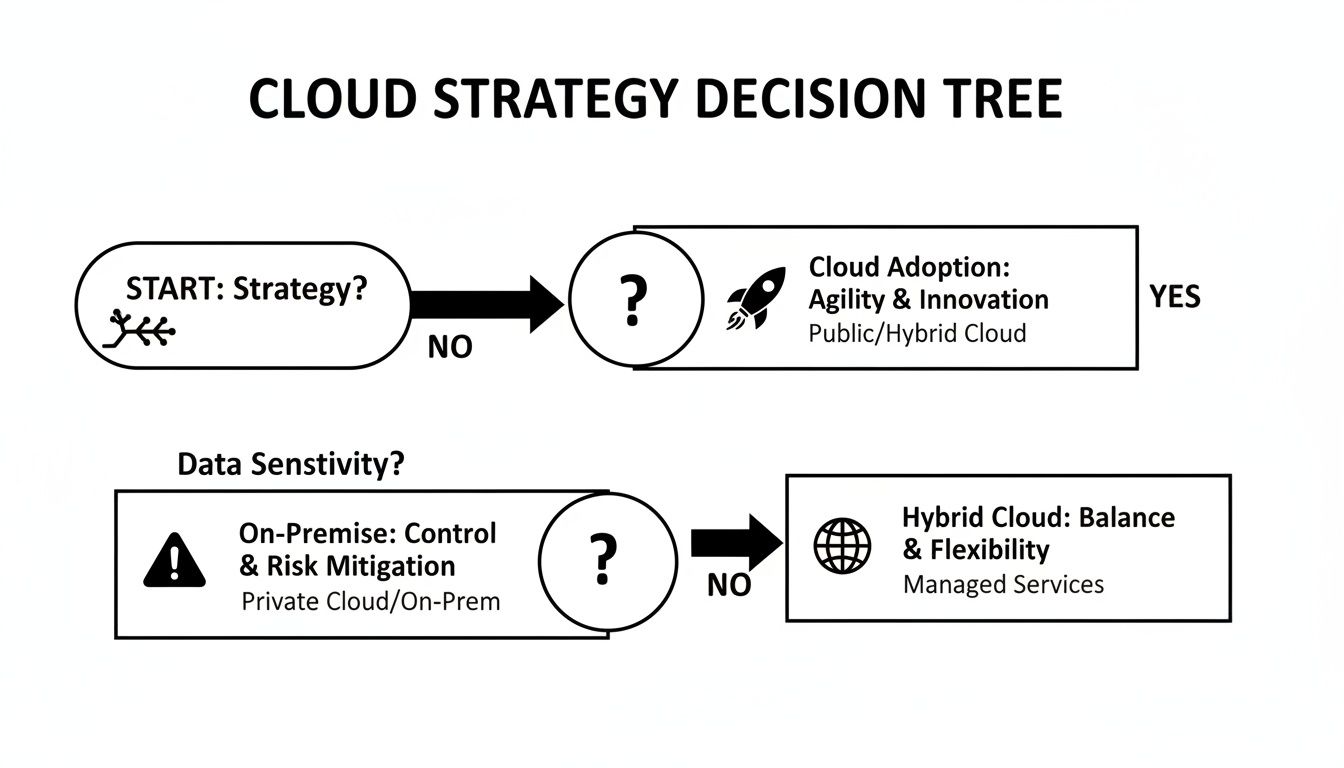
The key takeaway? Strategic alignment is the crucial fork in the road. It determines whether your cloud journey becomes a competitive advantage or just another operational burden.
To make sense of these options, let’s unpack the 7 Rs. It's helpful to group them into key categories: quick wins, strategic investments, and the deliberate decisions to leave things as they are.
Comparing the 7 Rs of Cloud Migration
Before diving deep, here’s a high-level comparison of the seven strategies. Think of this table as a cheat sheet for matching the right approach to the right application, helping you gauge effort versus reward.
| Migration Strategy | Description | Best For | Complexity & Cost |
|---|---|---|---|
| Rehost | Moving an application to the cloud with minimal changes. Often called "lift-and-shift." | Legacy systems where refactoring is too costly; quickly exiting a data center. | Low |
| Replatform | Making a few cloud optimizations during the migration. Sometimes called "lift-and-tinker." | Migrating to managed services (e.g., from a self-hosted DB to a cloud DB) to reduce admin overhead. | Low to Medium |
| Repurchase | Discarding a legacy application in favor of a SaaS product. Known as "drop-and-shop." | Replacing commodity software like CRM, HR, or finance systems with modern SaaS solutions. | Varies (Subscription Cost) |
| Refactor/Rearchitect | Fundamentally changing how an application is built to become cloud-native. | Core, business-critical applications that need high scalability, performance, and agility. | High |
| Relocate | Moving infrastructure between environments (e.g., from one cloud to another) without changing the app. | Data center consolidation or moving workloads to a different region for compliance or latency. | Low |
| Retain | Keeping an application on-premise because it's not a good fit for the cloud. | Systems with strict regulatory needs, complex dependencies, or extreme latency sensitivity. | None (Ongoing on-prem cost) |
| Retire | Decommissioning an application that is no longer needed. | Redundant, low-value, or obsolete systems discovered during the assessment phase. | Low (Cost Savings) |
Each of these "Rs" serves a purpose. The art of a successful strategy is knowing when to apply which one, creating a balanced approach that maximizes your return on investment.
The Foundational Strategies: Rehost, Replatform, and Repurchase
These first three strategies are the most common entry points for enterprises starting their cloud journey. They offer varying levels of change, from a simple move to a complete replacement.
-
Rehost (Lift-and-Shift): This is the fastest path to the cloud. You are essentially picking up an application from your on-premise server and dropping it onto a cloud-based virtual machine with minimal code changes. It’s ideal for legacy systems that are too costly to rework or when facing a hard deadline to exit a data center. The downside is that you gain few cloud-native benefits, which can lead to higher long-term costs.
-
Replatform (Lift-and-Tinker): This approach is a step up from a pure lift-and-shift. Here, you make small modifications to the application to better leverage cloud capabilities. For example, a financial services firm might move its on-premise database to a managed cloud service like Amazon RDS. This simple change significantly reduces administrative overhead. It's an excellent middle ground, balancing speed with tangible efficiency gains.
-
Repurchase (Drop-and-Shop): This strategy involves moving to a different product entirely, typically a Software-as-a-Service (SaaS) solution. Instead of migrating a cumbersome legacy CRM system, you switch to Salesforce or a similar modern platform. This is a highly effective way to offload legacy technology and adopt modern, managed solutions without the migration overhead.
Advanced and Strategic Options
The next set of "Rs" involves more significant architectural shifts and strategic decisions that can dramatically enhance your organization's technological capabilities and velocity. As you evaluate these options, consider how modern network models like Network as a Service (NaaS) can complement cloud-native principles.
-
Refactor/Rearchitect: This is often the most complex yet most rewarding path. It involves substantially changing—or completely rewriting—an application to be fully cloud-native, often by breaking a monolith into a microservices architecture. A SaaS company might refactor its core platform to achieve greater scalability, improve resilience, and deploy updates in minutes instead of months. It’s a significant investment, but it's how you unlock the full transformative power of the cloud.
-
Relocate: Think of this as a hypervisor-level migration. You are shifting infrastructure from one cloud environment to another without altering the application's core architecture. This is common during data center consolidations or when moving workloads to a different cloud region to reduce latency or comply with local data residency laws. The application itself remains unchanged.
Key Insight: The choice between Rehosting and Refactoring is a classic trade-off. Rehosting offers speed. Refactoring delivers long-term performance, scalability, and cost savings. The right decision depends entirely on the strategic importance of the application to your business.
The Non-Migration Paths: Retain and Retire
Finally, a comprehensive strategy acknowledges that not everything belongs in the cloud. You also need a plan for what stays behind or gets decommissioned entirely.
-
Retain: Some applications must remain on-premise due to stringent regulatory requirements, complex dependencies, or latency-sensitive functions that are not viable in the cloud. Recognizing this means accepting that a hybrid cloud model is often the most practical and realistic solution for large enterprises.
-
Retire: Your migration assessment is the perfect opportunity for portfolio rationalization. You will inevitably discover applications that are no longer used or have been superseded by better tools. Decommissioning these redundant or low-value systems is a clear win. It reduces complexity, slashes maintenance costs, and closes potential security vulnerabilities. This simple act of housekeeping can deliver immediate financial benefits.
Laying the Groundwork with Pre-Migration Planning
A successful enterprise cloud migration is won or lost long before the first server is provisioned in the cloud. Teams that rush into execution without a robust plan inevitably face scope creep, budget overruns, and unexpected operational disruptions. This initial planning phase is the foundation of your entire strategy.
Think of it as an architect surveying land before designing a building. You must meticulously map the terrain, understand the underlying conditions, and know where every existing utility line runs. The same principle applies to cloud migration. You need a complete, brutally honest inventory of your IT portfolio—every application, every server, and every hidden dependency. This upfront diligence prevents costly failures later.
Auditing Your IT Portfolio
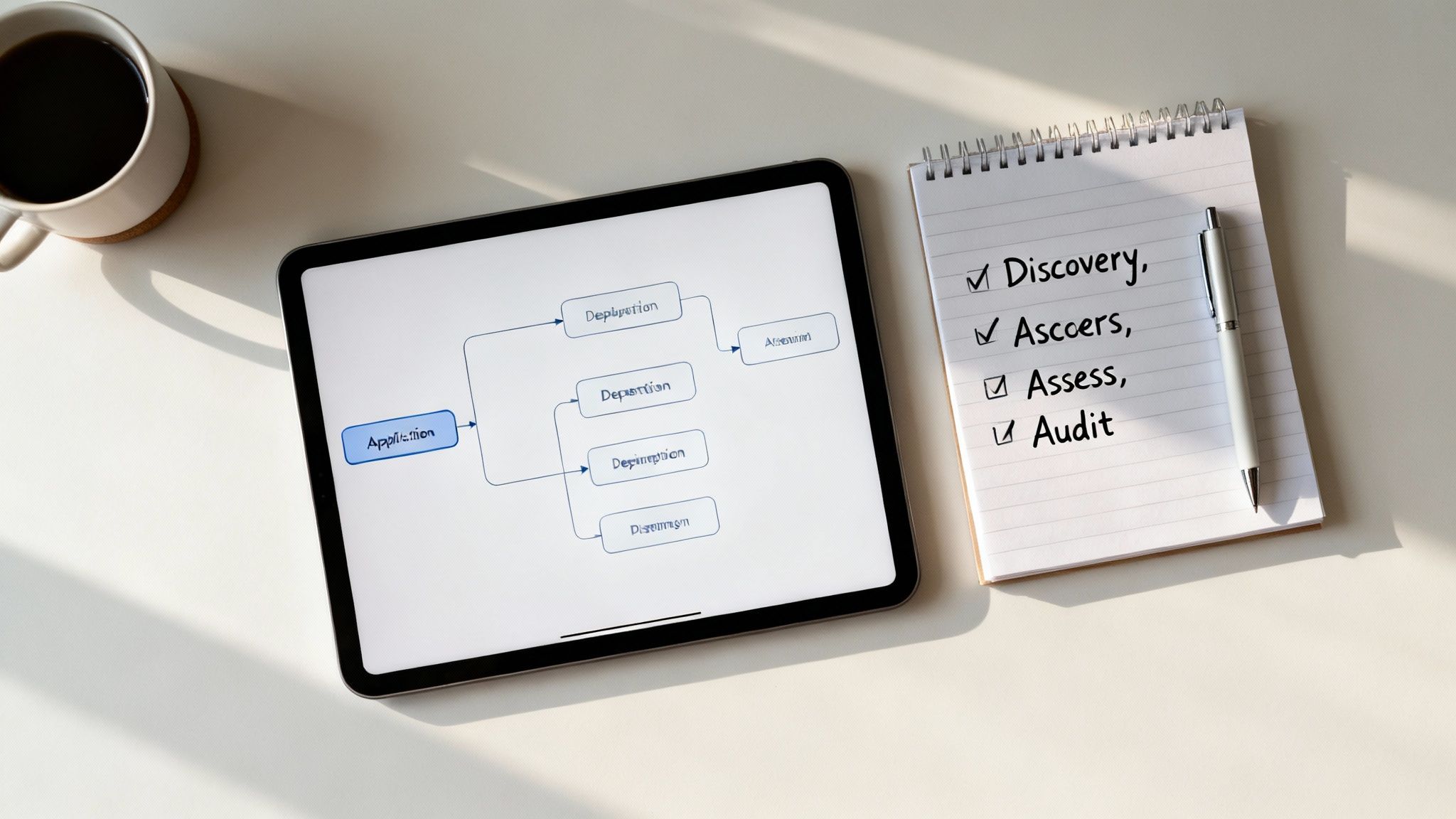
First, conduct a comprehensive audit of your existing infrastructure and applications. This is not just about creating lists; it's a deep-dive analysis to determine which migration paths are viable for each component of your tech stack. As you begin, it’s wise to apply proven data center migration best practices, as many core principles overlap.
Your audit must produce specific, actionable data:
- Application Dependency Mapping: Untangle the complex web of connections between your applications, databases, and third-party services. A seemingly simple application may be tied to a dozen other systems, and breaking one of those links could bring operations to a grinding halt.
- Performance Baselining: Collect hard data on current application performance, including CPU usage, memory consumption, and network latency. This baseline serves as your source of truth for validating success post-migration and for right-sizing cloud resources from day one.
- Identifying Technical Debt: Honestly document all outdated code, unsupported systems, and cumbersome architectures. The migration presents a golden opportunity to decide whether to pay down that debt by refactoring or to cut your losses and retire the application.
Establishing a Cloud Center of Excellence
As you plan, it is critical to establish a Cloud Center of Excellence (CCoE). This cross-functional team acts as the central governance body for your entire cloud journey, embedding best practices from the start. A CCoE is not a theoretical committee; it's a hands-on group that creates standards, manages security, and provides expert guidance to other teams.
A CCoE is typically responsible for:
- Setting Governance and Security Policies: They establish the rules for cloud usage, covering everything from identity and access management and data encryption to compliance requirements.
- Managing Costs (FinOps): This team creates budgets, implements resource tagging strategies for cost allocation, and continuously monitors spending to prevent budget overruns.
- Providing Tools and Automation: They select, approve, and provide standardized tools for infrastructure provisioning, monitoring, and building CI/CD pipelines.
By centralizing this expertise, a CCoE ensures consistent, secure, and cost-efficient cloud adoption across the organization. It prevents individual teams from making isolated decisions that could introduce risk or generate massive, unexpected costs.
Building a Compelling Business Case
Finally, you need a powerful business case to secure executive buy-in and sustain project momentum. This document must go beyond a simple cost comparison. While a Total Cost of Ownership (TCO) analysis is important, the true value of the cloud lies in its strategic impact on the business.
Your business case must paint a clear picture of how the cloud will fuel innovation and drive growth, not just reduce IT costs. The focus should be on the why—faster time-to-market, improved customer experiences, and enhanced business resilience.
Ensure your business case quantifies the expected benefits:
- Return on Investment (ROI): Project financial gains from new revenue streams, improved operational efficiency, and decommissioned legacy costs.
- Business Agility: Show precisely how the cloud will enable faster product launches, real-time responses to market changes, and more frequent feature deployments.
- Risk Mitigation: Clearly outline how moving to the cloud will strengthen security posture, improve disaster recovery capabilities, and ensure compliance with industry regulations.
This level of detailed planning transforms your migration from a reactive IT project into a proactive, strategic business initiative. It provides the clarity and data needed to make informed decisions, align stakeholders, and ensure your cloud journey delivers real, lasting value.
Executing Your Migration with Security and Precision
With a solid plan in place, it’s time to execute. This phase is about control, precision, and efficiency. It’s where your technical and operational teams collaborate to transform the blueprint into a secure, functional cloud environment. Success here depends on three pillars: intelligent automation, security by design, and robust governance.
The objective is to move beyond manual deployments, which are slow and error-prone. A modern migration leverages automation to manage complexity and reduce risk. By embracing DevOps and the right tooling, you can make your migration repeatable, predictable, and perfectly aligned with your business objectives.
Integrating DevOps and CI/CD Pipelines
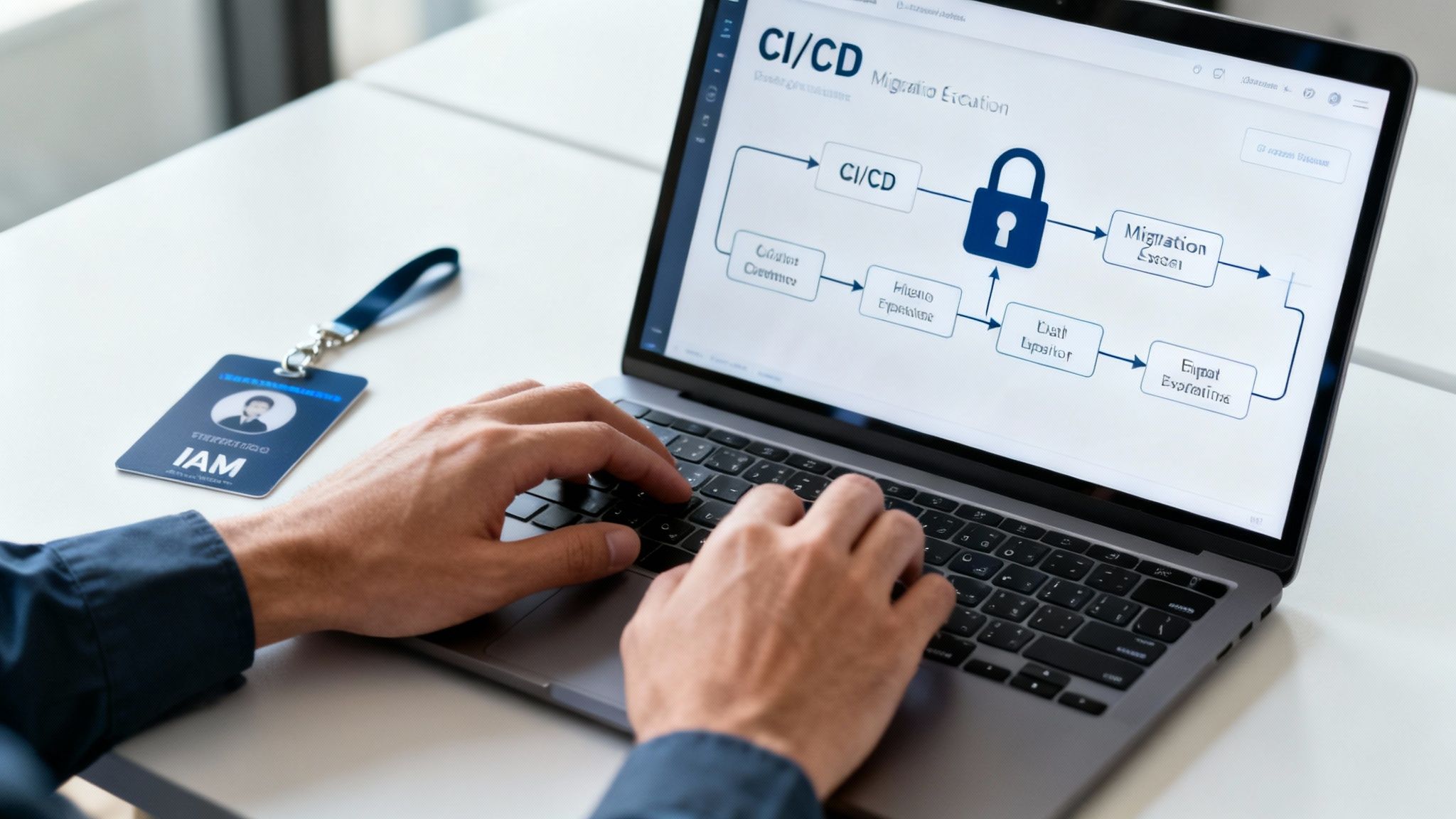
A modern migration is powered by Continuous Integration and Continuous Deployment (CI/CD) pipelines. These automated workflows are the engine driving your execution, handling everything from code compilation and testing to infrastructure provisioning and application deployment.
By integrating CI/CD, you dramatically reduce the risk of human error. Instead of manual checklists, the entire deployment process is defined as code. It runs automatically with every change, ensuring consistency and accelerating your migration timeline.
This is where Infrastructure as Code (IaC) becomes indispensable. With IaC, you define your entire cloud infrastructure—servers, databases, networks—in configuration files using tools like Terraform or AWS CloudFormation. This makes your infrastructure fully reproducible and far easier to manage. For practical applications, explore these Infrastructure as Code examples to see its power.
Adopting a DevSecOps Mindset
Security cannot be an afterthought; it must be integrated from the very beginning. This is the core principle of DevSecOps, which weaves security practices directly into your CI/CD pipelines. Instead of waiting for a final security review, you run automated security checks throughout the development and deployment lifecycle.
A DevSecOps approach shifts security "left," making it a shared responsibility of development, security, and operations teams from the outset. This proactive stance is essential for preventing vulnerabilities before they ever reach production.
Here are essential security practices to build into your execution:
- Identity and Access Management (IAM): Implement strict IAM policies from day one to enforce the principle of least privilege, ensuring users and services only have the access they absolutely require.
- Data Encryption: This is non-negotiable. All data must be encrypted, both at rest (while stored) and in transit (as it moves across networks).
- Continuous Compliance Monitoring: Use automated tools to continuously scan your environment for compliance with standards like SOC 2, HIPAA, or GDPR. These tools can detect misconfigurations in real-time, helping you maintain compliance without manual overhead.
Establishing Strong Governance for Cost and Policy
The cloud's flexibility is a double-edged sword. Without strong governance, it can quickly lead to "cloud sprawl" and uncontrolled spending. Establishing clear guardrails from the start is the only way to maintain control.
This typically involves a combination of automated policies and human oversight, managed by your Cloud Center of Excellence (CCoE).
Key components of effective governance include:
- Cost Management and FinOps: Proactively manage your spending by setting budgets, using resource tags to track costs by department, and configuring alerts to prevent overspending.
- Policy Enforcement: Use tools like AWS Organizations or Azure Policy to enforce rules across all accounts. For example, you can automatically prevent resources from being created in unapproved regions or mandate specific security settings on all new databases.
- Automated Guardrails: Implement preventative controls that stop actions violating your policies, such as automatically blocking the launch of an excessively expensive virtual machine.
By combining automated DevOps pipelines, an integrated DevSecOps culture, and strict governance, you ensure your migration is fast, efficient, secure, compliant, and cost-effective. This precision is what turns a good strategy into a great business outcome.
Maximizing Value with Post-Migration Optimization
Migrating your applications and data to the cloud is a major milestone, but it is not the finish line. In many ways, this is where the real work begins. A smart enterprise cloud migration strategy transitions from migration to continuous optimization. This is how you unlock the massive financial and operational potential of the cloud.
Without a dedicated post-migration plan, initial cost savings can erode, performance can degrade, and the promised agility can remain out of reach. The goal is to evolve your cloud environment from a static destination into a dynamic, high-performance ecosystem that adapts to your business needs.
Driving Continuous Cost Optimization
One of the first priorities post-migration is to gain tight control over cloud spending. The pay-as-you-go model is powerful, but it requires active management to prevent costs from spiraling. This is where a proactive FinOps culture becomes essential.
The first step is to right-size your resources. It's common for teams to overprovision instances during a migration "just in case," but this safety buffer quickly becomes a source of wasted spend.
- Analyze Usage Patterns: Use native cloud tools like AWS Cost Explorer or Azure Advisor to identify underutilized virtual machines and databases.
- Downsize or Shut Down: Systematically downsize oversized instances to a more appropriate tier. For completely idle resources, such as old development environments, decommission them permanently.
- Embrace Automation: A simple automated script that powers down non-production resources after business hours can reduce costs for development and test environments by over 50%.
When you treat cost management as an ongoing discipline rather than a one-time task, you build a culture of financial accountability. This ensures your cloud spend is always tied to real business value, preventing budget surprises and maximizing ROI.
For a deeper analysis, our guide outlines several powerful cloud cost optimization strategies you can implement immediately.
Enhancing Performance and Reliability
Beyond cost, you must ensure your cloud environment delivers the speed and stability your business depends on. This means moving from reactive troubleshooting to proactive performance management. The objective is to identify potential issues long before they impact customers.
Establishing intelligent monitoring and alerting is foundational. Modern observability platforms provide deep insights into application health, user experience, and infrastructure stability.
Key Performance Monitoring Practices:
- Establish Baselines: Define what "normal" performance looks like for your critical applications, using the data collected before the migration as a reference.
- Configure Smart Alerts: Set up alerts based on anomalies or deviations from your baseline, not just simple thresholds like "CPU at 90%." This reduces noise and allows your team to focus on meaningful events.
- Monitor the End-User Experience: Use tools that track real-world metrics like page load times and transaction success rates to understand what your customers are actually experiencing.
Fostering a Culture of Cloud Fluency
Ultimately, technology alone is not enough. The most critical component of post-migration success is your people. Upskilling your teams and fostering a culture of continuous improvement are what will truly maximize the long-term value of the cloud.
This cultural shift involves breaking down traditional silos and promoting collaboration between development, operations, security, and finance teams.
- Invest in Training: Provide ongoing training and certification opportunities to build deep cloud expertise within your organization.
- Encourage Experimentation: Create a safe environment for teams to experiment with new cloud services and architectures to discover more efficient solutions.
- Share Successes: When an optimization effort yields positive results, celebrate it. Highlighting these wins builds momentum and demonstrates the tangible benefits of a cloud-first mindset.
By weaving together disciplined cost management, proactive performance monitoring, and a commitment to upskilling your teams, you ensure your enterprise cloud migration delivers sustained, measurable business impact long after the initial move is complete.
Proving the Value: How to Measure Your Cloud Migration's Business Impact
You've completed the heavy lifting of your enterprise cloud migration. Now, you must prove its value. Simply stating "we're on the cloud" won't satisfy the C-suite; they demand a clear return on investment, backed by data.
A smart migration strategy includes a framework for measuring what matters. This means looking beyond technical metrics and tying every outcome back to tangible business value. You need to build a dashboard that tells a compelling story of how the migration made the company more efficient, agile, and profitable. Without clear Key Performance Indicators (KPIs), you're merely guessing at your success.
The Bottom-Line Metrics: Financial and Operational KPIs
The most direct way to demonstrate value is through financial and operational metrics. These KPIs speak the language of the boardroom: money and efficiency.
Financial KPIs track the dollars and cents:
- Total Cost of Ownership (TCO) Reduction: This is a direct comparison of your previous on-premise spending (hardware, data center leases, maintenance) against your new cloud bill. The goal is to show a clear and sustained cost reduction over time.
- FinOps Efficiency: This demonstrates intelligent spending. Track metrics like the percentage of idle or untagged resources you have eliminated to prove you are managing costs effectively.
Operational KPIs show that your new cloud environment is more resilient and reliable:
- Improved Uptime and Availability: Monitor the uptime percentage for critical applications. Every additional "nine" (e.g., from 99.9% to 99.99%) represents a direct improvement in business continuity and a powerful testament to the migration's success.
- Deployment Frequency and Lead Time: A core DevOps metric that measures how quickly you can ship new code. A significant increase in deployment frequency is proof that the cloud has accelerated your ability to innovate.
The Real Game-Changers: Performance and Agility KPIs
While cost savings are important, the true power of the cloud lies in its ability to accelerate the business and improve customer experiences. These KPIs measure speed, user satisfaction, and competitive advantage, demonstrating that the cloud is a business accelerator, not just an IT project.
Proving ROI is about more than just TCO. It's about showing that the cloud has fundamentally changed how you do business, enabling you to innovate faster and outpace the competition.
Here’s where to focus:
- Application Performance: Monitor metrics like application response times and page load speeds. A faster, more responsive user experience directly impacts customer satisfaction and can increase conversion rates, linking a technical improvement to a clear business win.
- Time-to-Market: This is a critical agility metric. How long does it take to move a new feature from concept to production? If you have significantly reduced that timeline, you have proven that your enterprise cloud migration strategy has delivered true business transformation.
By tracking these four areas—financial, operational, performance, and agility—you can create a comprehensive, data-driven narrative that clearly communicates the business impact of your cloud journey to all stakeholders.
Answering Your Enterprise Cloud Migration Questions
Even with the best strategy, questions and challenges will arise during implementation. Here are answers to some of the most common questions we encounter, designed to provide clarity and keep your migration on track.
What Is the Biggest Mistake in Cloud Migration?
The single biggest mistake is treating the migration as a simple IT project rather than a strategic business initiative.
When companies "lift and shift" their old infrastructure into the cloud without a real strategy, they almost always end up with higher operational costs, significant security gaps, and none of the transformative benefits they expected. It is a classic case of executing work without realizing value.
A successful enterprise cloud migration strategy begins with a thorough assessment and a compelling business case. It requires a plan that integrates security, governance, and optimization from the very beginning.
How Long Does an Enterprise Migration Take?
While this depends on several factors, we can provide realistic ranges. The timeline is primarily driven by the size and complexity of your current environment.
- Small-Scale Migrations: Moving a few non-critical applications can typically be completed in 3-6 months.
- Large-Scale Migrations: A full migration of an enterprise's core systems often takes 18-36 months, and sometimes longer.
The migration path you choose (e.g., Rehost vs. Refactor), the complexity of your application dependencies, and the maturity of your DevOps practices will all significantly influence the timeline.
How Do We Manage Security and Compliance?
You don't manage it as a separate, final step. Security must be integrated into the migration process from day one, not bolted on as an afterthought. This is the core principle of a DevSecOps approach.
Security isn't a phase; it's a foundational principle. Embed it into every step of your migration—from planning and coding to deployment and operations—to build a resilient and compliant cloud environment by design.
Here’s what that looks like in practice:
- Define cloud security policies before any workloads are migrated.
- Implement robust Identity and Access Management (IAM) controls to enforce least privilege.
- Encrypt all data, both in transit and at rest—without exception.
- Use Infrastructure as Code (IaC) to create repeatable, automated, and secure configurations.
- Deploy continuous monitoring to detect threats and maintain compliance with regulations like GDPR or HIPAA.
Summary and Next Steps
A successful enterprise cloud migration strategy is a business-led initiative, not just an IT project. By starting with a thorough assessment, choosing the right migration paths from the 7 Rs framework, and embedding security and governance from day one, you can transform your infrastructure into a true competitive advantage.
Post-migration, the focus must shift to continuous optimization of cost, performance, and reliability. This ongoing process, supported by a skilled team and a culture of cloud fluency, is what unlocks the full ROI of your investment.
Your Actionable Next Steps:
- Conduct a Portfolio Audit: Begin mapping your applications and their dependencies to understand your current state.
- Form a CCoE: Assemble a cross-functional team to lead governance, security, and best practices.
- Build Your Business Case: Define clear KPIs to measure the financial, operational, and agility gains you expect to achieve.
- Develop a Phased Roadmap: Start with low-risk, high-impact workloads to build momentum and demonstrate early wins.
Ready to build a cloud migration strategy that delivers real business results? The expert teams at Group107 Digital and Group107 provide end-to-end support, from planning and execution to post-migration optimization, ensuring your move to the cloud is secure, efficient, and cost-effective. Get in touch with us today.