
You have an idea for a SaaS product. That’s the starting line. Transforming that concept into a market-leading business, however, is a disciplined, strategic journey—not a single "eureka!" moment.
Building a successful SaaS product is a strategic execution playbook with three core stages: validating your idea to ensure it solves a real problem, building a Minimum Viable Product (MVP) to get your core solution into users' hands, and finally, engineering your tech and operations to scale as you grow.
This guide provides an actionable blueprint for navigating these critical stages, moving from concept to a scalable, revenue-generating reality.
Your SaaS Blueprint: From Idea to Launch and Scale
Developing a SaaS product doesn't start with writing code. That's one of the fastest ways to burn through capital. The real work begins with rigorous market research and validation, ensuring you're building a solution that customers will pay for.
Once you’ve confirmed you are solving a painful, urgent problem, then you can begin the build. This process is not a straight line; it's a continuous loop of building, measuring, and learning driven by data.
This flowchart provides a high-level overview of the path from a raw idea to a market-ready, scalable solution.
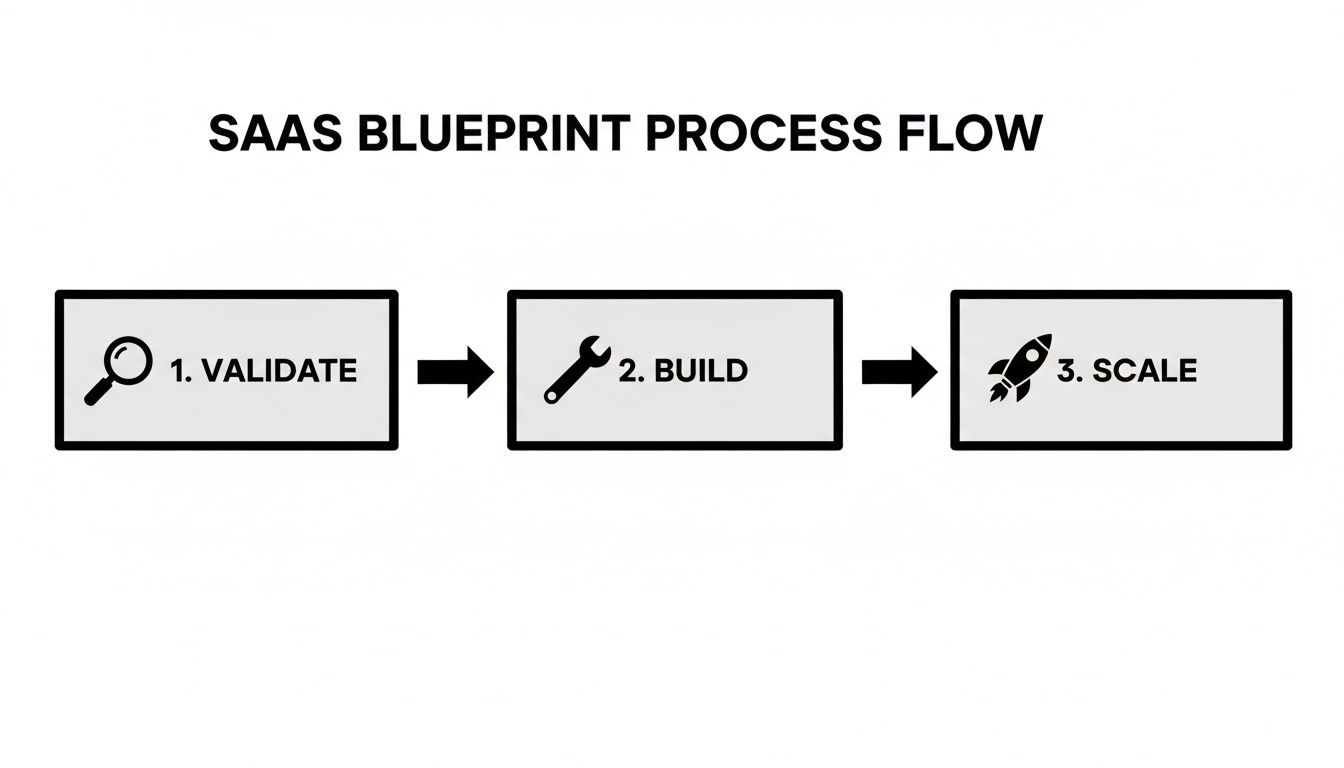
Each phase feeds into the next, creating a cycle of continuous improvement driven by hard data and real user feedback. This iterative process is the engine of sustainable growth.
This table breaks down the entire lifecycle, outlining the main goal and key outcome for each stage.
SaaS Development Lifecycle Overview
| Phase | Primary Objective | Key Outcome |
|---|---|---|
| Discovery & Validation | Confirm a real market need for your idea. | A validated problem, a clear user persona, and a list of core features for an MVP. |
| MVP Build & Launch | Build the simplest version of the product to solve the core problem. | A functional MVP in the hands of early adopters, gathering initial user feedback. |
| Iterate & Scale | Refine the product based on feedback and prepare for growth. | A product with proven market fit, a scalable tech stack, and a repeatable customer acquisition model. |
Each of these phases is a non-negotiable building block. Skipping one is like building a house without a foundation—it's destined to collapse.
Laying a Data-First Foundation
To build a successful SaaS business, you must be obsessed with data from day one. Many founders get distracted by vanity metrics. A 2026 study from Gartner revealed that less than 30% of SaaS companies track meaningful product metrics like user activation or feature adoption.
Instead, they chase top-line numbers like total sign-ups or monthly recurring revenue (MRR). While important, these figures don't tell you why users stick around or what makes them churn. For a deeper dive, check out this research on effective SaaS product analytics from Kissmetrics.
The smartest strategic move is to build a solid analytics framework before development begins. This transforms raw data into a competitive advantage, providing the insights needed to guide every decision, from feature prioritization to your go-to-market strategy.
Step 1: Validate Your Idea and Define Your Strategy
Before a single line of code is written, you must tackle the most critical phase of building a SaaS product: validation. This process de-risks the entire venture. A great idea is a start, but a solution to a problem a real market will pay for is a business. This requires methodical research to prove you're solving a painful problem people will gladly pay to fix.
The goal is to replace assumptions with evidence. This means digging deeper than surface-level trends. It requires direct conversations with potential customers to understand their daily frustrations and identify gaps that existing tools fail to address.
Define Your Ideal Customer and Unique Value
You cannot build a product for everyone. The first step in your strategy is defining your Ideal Customer Profile (ICP). This is a detailed portrait of the exact company and user who will gain the most value from your product—and, in turn, provide the most value back to you.
Go beyond basic demographics. Pinpoint their specific job titles, daily challenges, the software they currently use, and the business outcomes they are responsible for. Once you know exactly who you're building for, you can craft a Unique Value Proposition (UVP) that resonates deeply.
Your UVP must answer one simple question for your ICP: "Why should I choose you over every other option, including doing nothing?"
- Be Specific: "Improves productivity" is fluff. "Cuts meeting report generation time by 50% for project managers" is a value proposition.
- Focus on Outcomes: Don't list features. Articulate the tangible results and business impact your users will achieve.
- Differentiate Clearly: What makes you fundamentally different? Is it a superior user experience, a disruptive pricing model, or a niche feature that larger competitors ignore?
Find Your North Star Metric
To keep your strategy aligned, you need a single, guiding metric. This is your North Star Metric (NSM), and it represents the core value your product delivers. It is not a vanity metric like sign-ups or site visits; it's a direct measure of your users' success with your product.
The NSM becomes the focal point for your entire company, aligning product, engineering, and marketing on a shared goal. This simplifies feature prioritization and focuses the team on what truly matters. A good NSM is a leading indicator of sustainable growth.
For example, for collaboration tools like Slack or Asana, the NSM is often tied to engagement, such as messages sent or tasks completed, as this directly reflects active use and value delivery.
Your North Star Metric is the truest reflection of customer value. When that number increases, it means your users are getting more value from your product, which is the strongest predictor of future revenue and retention.
Create a Powerful Product Charter
With your ICP, UVP, and NSM defined, it's time to consolidate them into a Product Charter. This concise document serves as the source of truth for your team and any partners.
A well-crafted Product Charter ensures complete alignment and includes:
- Vision: The long-term change you aim to create.
- Mission: The core purpose of your product.
- Target Audience: A summary of your ICP.
- Problem Statement: The primary pain point you are solving.
- Success Metrics: Your North Star Metric and other key performance indicators (KPIs).
- Scope: High-level boundaries for your initial product or MVP.
This is a living document that anchors your team as you move into the dynamic phases of building, testing, and iterating. It transforms a validated idea into an actionable, outcome-driven strategy.
Step 2: Build Your MVP with the Right Team and Tech
Once your strategy is validated, it's time to build a tangible product. The temptation is to build a comprehensive solution, but the strategic move is to start small and focused.
This is where your Minimum Viable Product (MVP) comes in. An MVP is not a half-baked product; it is the simplest, most streamlined version that solves the single most critical problem for your target customer. It is the fastest way to get your product into the hands of real users and start the learning cycle.
Building an MVP is a balancing act. You must move quickly to gather feedback while making sound technical decisions that enable future scalability. This requires ruthless feature scoping, selecting the right architecture, and assembling a team that can execute efficiently.
How to Ruthlessly Scope Your MVP
Countless founders get bogged down over-engineering their first release. Your MVP should do one thing exceptionally well: address the primary pain point for your ideal user. Anything else is noise.
To keep your scope in check, map out the essential steps a user must take to reach the "aha!" moment. If a feature does not directly support this core journey, it belongs in the backlog.
- Focus on “Must-Haves”: Prioritize only the features essential for delivering core value.
- Solve One Problem: Your MVP should be a scalpel, designed for a specific purpose and sharper than any other tool for that job.
- Embrace Manual Processes: It is acceptable for some backend operations to be handled manually at first. If you can perform a task for your initial users behind the scenes, you can postpone building complex automation.
The goal of an MVP is not to launch a half-finished product. It's to launch a finished, focused product that solves a small, critical part of a larger problem. This approach maximizes learning while minimizing wasted engineering effort.
For a deeper dive into this crucial first step, learn how to build a Minimum Viable Product that resonates with early adopters.
Choosing the Right Architecture and Tech Stack
The technical decisions you make for your MVP have long-term consequences. A common debate is whether to start with a monolithic architecture or jump straight into microservices.
For the vast majority of MVPs, a well-structured monolithic architecture is the most practical choice. It is faster to develop, easier to deploy, and more straightforward to manage with a small team. This approach gets your product into users' hands sooner.
Microservices, which break an application into smaller, independent services, offer incredible scalability but come with significant operational complexity. It is an architecture you evolve into as you scale, not one to start with.
When selecting your tech stack—languages, frameworks, and databases—prioritize technologies that:
- Promote Rapid Development: Use frameworks with large communities and extensive libraries.
- Are Cost-Effective: Choose open-source technologies to minimize your initial burn rate.
- Have Available Talent: Select a stack where you can easily find skilled developers.
Assembling a High-Performing Development Team
The success of your MVP depends on the people building it. You need talented engineers who can deliver quality at speed—a major hurdle for many startups.
This is where a dedicated offshore team becomes a powerful strategic advantage. Partnering with a company like Group107 gives you access to an elite global engineering talent pool at a more efficient cost structure. We provide fully dedicated engineers who integrate seamlessly into your team.
This model delivers more than just cost savings. By working with a dedicated offshore team, you can:
- Accelerate Time-to-Market: Scale your development capacity to build and iterate faster.
- Reduce Development Costs: Achieve savings of up to 60% on talent compared to local markets.
- Access Specialized Skills: Onboard experts in AI, DevOps, or specific tech stacks without a lengthy hiring process.
- Maintain Full Control: Your dedicated team works exclusively on your project with complete transparency and robust IP protection.
Building a successful SaaS product is a marathon. By focusing on a lean MVP, making smart technology choices, and assembling the right team from the start, you lay the foundation for sustainable success.
Step 3: Engineer for Scale, Security, and Accessibility
Once your SaaS product gains traction, its technical foundation will be tested. Building an MVP is about speed; scaling is about strength. This phase shifts your focus from finding users to supporting them reliably and securely. Engineering for growth is a deliberate strategy that protects your users, reputation, and future revenue.
This means fostering a culture and adopting tools that prioritize automation, security, and inclusivity from day one. Neglecting these areas creates technical debt that can halt a fast-growing SaaS.
Implement a DevOps Culture and CI/CD Pipelines
To move fast without breaking things, you must automate. A DevOps culture breaks down silos between development (Dev) and operations (Ops) teams, creating a more efficient, collaborative workflow. This is a mindset focused on shared ownership and continuous improvement.
The engine behind DevOps is the CI/CD pipeline (Continuous Integration/Continuous Deployment).
- Continuous Integration (CI): Developers merge code changes into a central repository multiple times a day. Each merge triggers an automated build and test sequence, catching bugs early.
- Continuous Deployment (CD): Once code passes all automated tests, it is automatically deployed to the production environment. This reduces manual effort, minimizes human error, and accelerates the delivery of new features and fixes.
A solid CI/CD pipeline is one of the highest-impact investments you can make, transforming your development process into a predictable, automated flow. These principles are critical for all modern development, especially when evolving architectures, as explored in these 10 essential microservices architecture best practices.
Navigating Security and Compliance
For any SaaS product, security is non-negotiable. In regulated industries like finance, healthcare, or government, it's the price of admission. Building security in from the beginning is far more effective than trying to add it after a breach.
Start with these fundamentals:
- Data Encryption: Encrypt all data at rest (in your database) and in transit (between your servers and the user).
- Access Control: Implement role-based access control (RBAC) to ensure users can only access what their permissions allow.
- Regular Audits: Conduct periodic security audits and penetration testing to proactively find and patch vulnerabilities.
To target enterprise customers or regulated sectors, prepare for certifications like SOC 2 or ISO 27001. These are rigorous frameworks that prove your commitment to security and data privacy, opening doors to larger contracts.
Prioritize Web Accessibility from Day One
Web accessibility is not a niche feature; it's a core component of a high-quality product. Building an inclusive product that follows the Web Content Accessibility Guidelines (WCAG) is not only the right thing to do—it's smart business.
An accessible product expands your total addressable market by ensuring that people with disabilities can use your SaaS effectively. It also significantly mitigates the legal risk of accessibility lawsuits, which are increasingly common.
Incorporating accessibility means designing for keyboard navigation, screen reader compatibility, proper color contrast, and a clear content structure. To ensure your SaaS product adheres to global accessibility standards, refer to an ultimate WCAG compliance checklist.
Building for scale means building a resilient, secure, and inclusive platform. By embedding DevOps, security, and accessibility into your engineering DNA from the start, you create a SaaS product engineered for long-term success.
Step 4: Launch, Measure, and Iterate for Growth
Launching your product is the starting line, not the finish. The moment you go live, the focus must shift from building features to driving measurable growth. This is where your product's potential transforms into business momentum.
Your Go-to-Market (GTM) strategy is the playbook for acquiring your first customers. It is more than a marketing plan; it aligns product, sales, and marketing toward a single goal: attracting users who stick around because they derive real value from your solution.
Defining Your Go-to-Market Approach
In the early stages, keep your GTM strategy simple and focused. The goal is to gain initial traction, gather user feedback, and identify effective acquisition channels.
A well-run beta program is an ideal bridge between final development and a public launch. This is a strategic move to:
- Build a core community: These are your first evangelists.
- Perfect your onboarding: Observe where new users struggle and refine the experience.
- Gather powerful testimonials: Social proof from real users is invaluable marketing collateral.
For a SaaS business with growth ambitions, leveraging the right technology is non-negotiable. Mastering the best SaaS marketing automation tools early on provides a significant advantage in executing campaigns efficiently.
Building Your Product Analytics Framework
You cannot improve what you cannot measure. A solid product analytics framework is essential for this growth phase. It transforms raw user behavior into actionable insights for building a product that customers can't live without.
Your analytics must go deeper than sign-ups or page views. You must track metrics that signal engagement and value.
Product usage analytics are a powerful driver of SaaS success. Development teams use key metrics like daily active users (DAU), feature adoption rates, and session lengths to identify user journey blockers. This analytical approach shapes the product roadmap, ensuring new features are based on actual user needs, not internal assumptions. To see how this applies to both B2B and B2C models, learn more about the impact of product usage analytics for SaaS teams.
Using Data to Fuel Your Iteration Cycle
With analytics in place, you can establish a rhythm of continuous improvement. The "build-measure-learn" loop becomes your daily operational model. Treat every change, from a small button tweak to a major feature release, as an experiment.
Cohort analysis is your most effective tool here. Group users by their sign-up date (e.g., the "May 2026" cohort) and track their behavior over time to measure the true impact of your product changes. For instance, did a new onboarding flow improve retention for new users compared to those who signed up before the change? This is how you move from guessing to knowing.
By analyzing your user journey funnels and key metrics, you can answer critical questions:
- Activation Rate: What percentage of users are completing the key steps that lead to their "aha!" moment?
- Feature Adoption: Are customers using the new feature you spent three months building?
- User Segmentation: What do your best customers have in common? How can you guide new users to adopt those same behaviors?
This continuous cycle of launching, measuring, and iterating is the engine of sustainable growth. It ensures every decision is rooted in data, moving you closer to a product that not only wins customers but retains them.
Summary & Next Steps: Your Path Forward
Building a successful SaaS product is a marathon, not a sprint. It demands a disciplined, multi-stage approach:
- Validate Your Idea: Prove a real market need before you build. Define your Ideal Customer Profile, Unique Value Proposition, and North Star Metric.
- Build a Lean MVP: Focus ruthlessly on solving one core problem. Choose a practical tech stack and assemble a high-performing team to accelerate time-to-market.
- Engineer for Scale: Implement DevOps, robust security, and accessibility from the start to build a resilient and inclusive platform.
- Launch, Measure, Iterate: Use a data-driven GTM strategy and a robust analytics framework to fuel a continuous cycle of improvement based on real user behavior.
This framework transforms an idea into a scalable, market-leading SaaS business.
At Group107, we don’t just build software; we build businesses. Our dedicated offshore teams and end-to-end digital solutions provide the strategic partnership you need to turn your vision into a scalable, market-leading SaaS product. Get in touch to learn how we can accelerate your journey.