
In a competitive market, simply using Kubernetes isn't enough. The real advantage comes from how you deploy applications within it. Selecting the right Kubernetes deployment strategy is the critical factor separating seamless, zero-downtime releases that delight users from catastrophic failures that erode trust and revenue. For businesses in high-stakes sectors like SaaS, finance, and e-commerce, a robust deployment methodology is the foundation of innovation, enabling rapid feature delivery, A/B testing, and unshakable operational resilience. An ineffective strategy, in contrast, leads directly to slow release cycles, production instability, and wasted engineering resources.
This guide moves beyond theory to provide a deep, actionable roundup of the most critical Kubernetes deployment strategies. We will explore each method in detail, from the default Rolling update to advanced techniques like Canary, Blue-Green, and Shadowing, all with a sharp focus on real-world business impact. You'll gain practical insights and decision frameworks to select and implement the perfect strategy for your specific needs, whether you are a startup launching an MVP or an enterprise managing mission-critical systems.
At Group107, our expert teams leverage these exact strategies to help clients achieve unparalleled release velocity and system stability. This mastery turns complex deployments from a liability into a strategic advantage. To truly master business agility, leveraging powerful modern DevOps solutions is as crucial as understanding Kubernetes deployment strategies. Let's dive into the methodologies that will empower your team to ship better software, faster and safer.
1. Blue-Green Deployment
The Blue-Green deployment is one of the most reliable Kubernetes deployment strategies for achieving zero-downtime releases. The core concept involves running two identical, parallel production environments, conventionally named "Blue" and "Green." At any given moment, only one environment (e.g., Blue) is live and serving all user traffic, while the other (Green) is idle or contains the previous stable version.
When a new version of the application is ready, it's deployed to the idle Green environment. Here, it can be thoroughly tested in a production-like setting without impacting any users. Once the new version is validated, the load balancer or router is reconfigured to switch all incoming traffic from the Blue environment to the Green one. This switch is instantaneous. The Blue environment is now idle and can be kept on standby for an immediate rollback if issues arise, or it can be updated to become the staging ground for the next release.
When to Use This Strategy
Blue-Green deployments are ideal for mission-critical applications where availability is non-negotiable and downtime is unacceptable. Fintech platforms processing secure transactions and large-scale SaaS applications like Netflix leverage this strategy to ensure seamless updates without disrupting the user experience. It's particularly effective when you need to test a new version with the full production infrastructure and data dependencies before going live.
Implementation and Best Practices
In Kubernetes, this is typically achieved by manipulating Service selectors. The Service points to the active deployment (e.g., version: blue). To switch, you update the Service's selector to point to the new deployment (version: green).
Key tips for successful implementation include:
- Automate Everything: The traffic switch must be a single, automated action to eliminate manual error. Integrating this into a CI/CD pipeline is essential for reliability.
- Comprehensive Health Checks: Before flipping the switch, run a battery of automated tests and health checks against the Green environment to ensure it's fully operational.
- Database Compatibility: Ensure your database schema changes are backward-compatible. The old application version must function correctly with the new schema if you need to roll back.
- Keep Environments Warm: The idle environment should be "warmed up" and ready to handle production load instantly to avoid performance degradation post-switch.
This strategy is a cornerstone of modern release management, directly supporting the principles discussed in advanced DevOps methodologies by reducing risk and improving deployment frequency.
2. Canary Deployment
The Canary deployment is one of the most risk-averse Kubernetes deployment strategies, designed to gradually introduce a new version of an application to a small subset of users before a full rollout. Named after the "canary in a coal mine" analogy, this method allows teams to detect issues with a new release in a live production environment with minimal user impact. The new version (the "canary") runs alongside the stable version, and traffic is incrementally shifted based on real-time performance metrics like error rates and latency.

This incremental exposure is the key difference from Blue-Green. Instead of an all-or-nothing switch, it provides a safety net, allowing developers to observe the new code under real-world load. If the canary version performs well, traffic is gradually increased until 100% of users are on the new version. If problems arise, traffic is quickly routed back to the stable version, and only a small user group is affected.
When to Use This Strategy
Canary deployments are perfect for large-scale applications where even minor issues can have a significant business impact. Tech giants like Amazon and Uber use this strategy to test changes in specific regions or with a subset of drivers before a global launch. It is also extremely valuable for startups testing a Minimum Viable Product (MVP) or new features with real users, allowing them to gather feedback and performance data without risking the entire user base. Fintech clients often use canaries to roll out new payment features, ensuring stability and security are maintained.
Implementation and Best Practices
In Kubernetes, this can be managed using service mesh tools like Istio or Linkerd to precisely control traffic splitting. Alternatively, tools like Argo Rollouts or Flagger can automate the entire canary analysis and promotion process. The basic idea involves running two Deployments with different version labels and a Service that targets pods from both.
Key tips for successful implementation include:
- Define Success Metrics: Before deploying, establish clear, measurable Key Performance Indicators (KPIs) such as acceptable error rates, latency thresholds, and CPU/memory usage.
- Start Small: Begin by shifting a very small percentage of traffic (e.g., 2-5%) to the canary. Monitor it closely before increasing the percentage.
- Automate Rollbacks: Configure automated checks against your KPIs. If a threshold is breached, the system should automatically roll back traffic to the stable version without human intervention.
- Comprehensive Monitoring: Use robust logging and monitoring to compare the performance of the canary against the stable version. This detailed analysis is crucial for identifying subtle bugs.
This strategy enhances release safety and is a core component of a mature delivery process, building upon the principles of a well-structured CI/CD pipeline to deliver value more frequently and with greater confidence.
3. Rolling Deployment
The Rolling Deployment is the default and most widely used of all Kubernetes deployment strategies. This approach updates applications with zero downtime by incrementally replacing instances of the old version with instances of the new version. Unlike an "all-or-nothing" switch, a rolling update ensures that the application remains available throughout the entire process, as new pods are started before old ones are terminated.
The process is sequential. Kubernetes gradually introduces the new application version, typically one pod or a small batch at a time, while slowly scaling down the old version. This controlled transition allows for continuous service availability and provides a window to monitor the new version's performance under partial load. If an issue is detected early, the process can be halted and rolled back before the entire user base is affected.
When to Use This Strategy
This strategy is the standard for most stateless applications and microservices running in production. It offers an excellent balance between safety, resource efficiency, and simplicity. SaaS platforms rely on it for routine updates, and it’s the go-to pattern for any cloud-native web application that requires frequent, seamless releases without the infrastructure overhead of a full Blue-Green setup. It is particularly well-suited for applications designed to handle having mixed versions running simultaneously.
Implementation and Best Practices
In a Kubernetes Deployment manifest, you can fine-tune the rolling update behavior using the strategy field with maxSurge and maxUnavailable parameters. These control how many pods can be created above the desired count and how many can be unavailable during the update, respectively.
Key tips for successful implementation include:
- Configure Probes Correctly: Implement comprehensive readiness and liveness probes. A readiness probe is crucial as it tells Kubernetes when a new pod is truly ready to accept traffic, preventing premature traffic routing.
- Set Graceful Termination: Use an appropriate
terminationGracePeriodSecondsto allow old pods to finish in-flight requests and shut down cleanly, preventing abrupt connection drops for users. - Zero-Downtime Settings: For maximum availability, configure
maxSurgeto25%andmaxUnavailableto25%(or similar values) to ensure a buffer of both new and old pods remains available during the update. - Monitor the Transition: Actively monitor both the new and old application versions during the rollout. Keep an eye on error rates, latency, and resource consumption to catch anomalies early.
This foundational strategy is a key part of building a scalable and resilient system, forming the basis for many advanced cloud and DevOps practices that prioritize stability and speed.
4. Recreate Deployment
The Recreate deployment is the simplest of all Kubernetes deployment strategies. Its process is direct: the existing version of the application is completely terminated before the new version is created and rolled out. All old Pods are shut down simultaneously, and only then are the new Pods spun up. This approach guarantees that only one version of the application is running at any given time.
This simultaneous shutdown and startup process results in a period of complete application downtime. The duration of this outage depends on how long it takes to shut down the old Pods and for the new ones to become fully operational. While this downtime makes it unsuitable for most production scenarios, its simplicity offers distinct advantages in specific contexts where availability is not a primary concern.
When to Use This Strategy
The Recreate strategy is an excellent choice for non-production environments where simplicity and speed of iteration are more important than uptime. It's commonly used in development and staging environments for rapid testing of new features. This strategy is also practical for internal tools or batch processing jobs where you can schedule deployments during planned maintenance windows, ensuring no active users are affected.
Implementation and Best Practices
In Kubernetes, you can explicitly define this strategy in your YAML configuration by setting strategy.type to Recreate.
apiVersion: apps/v1
kind: Deployment
metadata:
  name: my-app-recreate
spec:
  replicas: 3
  strategy:
    type: Recreate # Explicitly defining the strategy
  template:
    # ... Pod template details ...
Key tips for successful implementation include:
- Non-Production Only: Reserve this strategy strictly for development, testing, or internal applications where downtime is acceptable.
- Schedule Downtime: If used for internal systems, always schedule the deployment during low-traffic periods and communicate the planned maintenance window to all users.
- Rapid Development Cycles: Leverage its speed to quickly iterate and test changes in a development environment without the complexity of managing multiple versions.
- Stateful Applications: Be cautious when using this with stateful applications, as the abrupt termination can lead to data corruption if not handled gracefully.
This basic strategy serves as a foundational concept, highlighting the trade-offs between simplicity and availability that are central to more advanced DevOps methodologies.
5. Shadow/Traffic Mirroring Deployment
Shadow deployment, also known as traffic mirroring, is one of the most advanced Kubernetes deployment strategies for validating a new release with zero production impact. The core idea is to duplicate live user traffic and send it to a new, "shadow" version of the application running in parallel with the stable production version. The shadow version processes these mirrored requests, but its responses are discarded and never sent back to the user. This allows developers to see exactly how the new version behaves under real-world load and with actual production data.
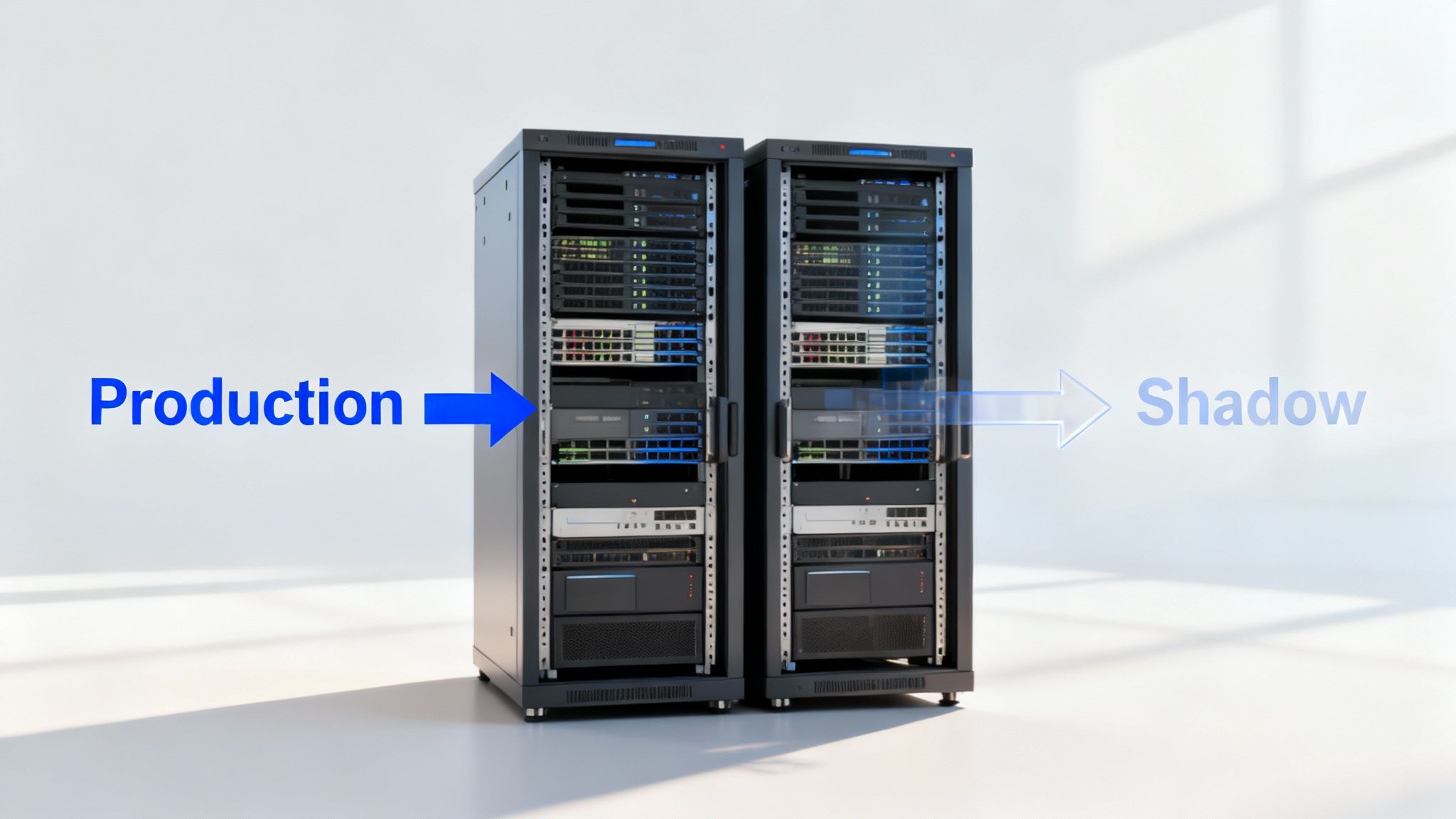
By comparing the performance, errors, and output logs of the shadow version against the production version, teams can gain immense confidence in the new code's stability and correctness before it handles any live traffic. It's the ultimate non-disruptive, real-world stress test, effectively de-risking complex releases.
When to Use This Strategy
Shadow deployments are invaluable for systems where predicting real-world traffic patterns is difficult or impossible. Payment processors use mirroring to validate new transaction logic, and fintech platforms can shadow new compliance rule engines to ensure accuracy without risking financial data. It's a go-to strategy for critical backend services, like those at Google and LinkedIn, where even minor bugs in a new release can have significant consequences. This approach is ideal for testing performance regressions, validating complex logic changes, and ensuring fault tolerance under actual production conditions.
Implementation and Best Practices
Implementing traffic mirroring in Kubernetes almost always requires a service mesh like Istio or Linkerd. These tools can be configured to duplicate traffic at the network level and route it to the shadow deployment.
Key tips for successful implementation include:
- Utilize a Service Mesh: Tools like Istio provide built-in traffic mirroring capabilities, which greatly simplifies the setup. This is the recommended approach.
- Isolate Side Effects: Ensure the shadow service does not perform any write operations or trigger external actions (like sending emails or processing payments). This is critical to prevent unintended consequences.
- Monitor Performance Overhead: Mirroring traffic will increase resource consumption on your cluster. Monitor CPU, memory, and network I/O carefully to ensure the shadow deployment does not degrade the performance of the production environment.
- Systematic Comparison: Use correlation IDs to trace requests across both production and shadow versions. Set up robust logging and metric comparison tools to automatically analyze discrepancies and performance differences.
- Gradual Mirroring: Start by mirroring a small percentage of traffic (e.g., 10%) before scaling up to 100%. This helps manage the initial resource impact and validate the setup.
This strategy empowers teams with data-driven confidence, which is a core component of the high-velocity CI/CD pipelines that modern enterprises depend on for competitive advantage.
6. Feature Flag / Feature Toggle Deployment
A Feature Flag deployment, also known as a Feature Toggle, is a modern software development technique that decouples code deployment from feature release. This strategy allows new code containing incomplete or experimental features to be deployed into the production environment but kept hidden or "toggled off" from users by default. The features are activated or deactivated at runtime via a configuration flag without requiring a new code deployment.
This approach gives development teams fine-grained control over who sees a new feature. Flags can be enabled for specific user segments, internal testers, geographical regions, or a certain percentage of the user base. This method fundamentally changes release dynamics, allowing teams to deploy code frequently and safely while managing the release of features as a separate business or testing decision. Tech giants like Facebook and Slack rely heavily on feature flags to continuously deploy code while carefully managing feature rollouts and A/B testing.

When to Use This Strategy
Feature flags are invaluable for agile teams focused on rapid iteration, A/B testing, and risk mitigation. They are perfect for SaaS platforms wanting to test new functionalities with a subset of users before a full launch, or for fintech applications needing to roll out new payment methods or compliance rules to specific markets gradually. For any organization aiming to implement trunk-based development and reduce the complexity of long-lived feature branches, this is one of the most effective Kubernetes deployment strategies.
Implementation and Best Practices
In a Kubernetes environment, feature flags are managed by an external configuration service or an in-application SDK (e.g., LaunchDarkly, Optimizely, or an open-source tool like Flagsmith). The application running inside a pod queries this service at runtime to determine whether a feature should be enabled for a given user or request.
Key tips for successful implementation include:
- Centralize Flag Management: Use a dedicated feature flag management system to provide a single source of truth and an easy-to-use interface for non-technical team members.
- Establish a Flag Lifecycle: Define clear naming conventions and policies for creating, managing, and, most importantly, removing flags once a feature is fully rolled out. This prevents "flag debt."
- Test Flag Combinations: Systematically test how different feature flag combinations interact to avoid unexpected behavior in production.
- Monitor Performance: Keep a close watch on any performance overhead introduced by flag evaluations, especially for high-traffic endpoints.
This strategy empowers teams to move faster and with greater confidence, embodying the core principles of modern CI/CD pipelines by separating deployment risk from release risk.
7. Helm Chart-Based GitOps Deployment
Helm Chart-Based GitOps is a modern, declarative approach that combines Helm's powerful package management with the core principles of GitOps. This strategy establishes a Git repository as the single source of truth for all Kubernetes configurations. Instead of manually applying changes, you commit Helm chart updates to Git, which automatically triggers a GitOps operator like ArgoCD or Flux to synchronize the cluster state with the repository.
The process is straightforward: a change to an application's Helm chart (e.g., updating an image tag in values.yaml) is committed to a Git branch. The GitOps tool, continuously monitoring the repository, detects this change. It then runs a helm upgrade command, applying the resulting manifests to the target Kubernetes cluster. This creates a fully auditable, version-controlled, and automated deployment workflow that is becoming the standard for enterprise Kubernetes management.
When to Use This Strategy
This strategy is exceptionally well-suited for organizations managing complex applications across multiple environments, such as startups scaling their infrastructure, fintech companies requiring strict audit trails, and large enterprises standardizing their deployment processes. Companies like Shopify and Datadog use this model to manage countless services reliably. It excels where compliance, version control, and operational transparency are critical, as every change to the production environment is a trackable Git commit.
Implementation and Best Practices
Implementing this strategy involves setting up a GitOps operator in your cluster and pointing it to a repository containing your Helm charts. The operator handles the rest, ensuring the live state matches the desired state defined in Git.
Key tips for successful implementation include:
- Structure Your Repositories: Use a clear Git branching strategy, like GitFlow, to manage environments (e.g.,
develop,staging,main). This isolates changes and creates a clear path to production. - Automate Chart Validation: Integrate automated testing for your Helm charts directly into your CI pipeline. Use tools like
helm lintandKubeconformto catch errors before they are committed. - Manage Secrets Securely: Never commit plain-text secrets to Git. Use tools like Sealed Secrets or integrate with an external secret manager like HashiCorp Vault to handle sensitive data securely.
- Version Everything: Maintain a strict versioning alignment between your application code, Docker images, and Helm charts. This ensures that a rollback to a previous Git commit accurately restores the entire application stack.
This approach transforms your infrastructure into a version-controlled, auditable system, a core concept of modern Infrastructure as Code practices that drives both efficiency and reliability.
8. A/B Testing Deployment (Weighted Traffic Splitting)
A/B Testing Deployment is a data-driven strategy where user traffic is split between two or more application versions to compare their performance based on specific business metrics. Unlike canary deployments that primarily validate stability, A/B testing is a business experiment focused on optimizing user experience and outcomes. For instance, an e-commerce site might split traffic 50/50 between a version with a green "Buy Now" button (Version A) and one with a red button (Version B) to see which one converts better.
This method leverages sophisticated traffic management, often through a service mesh like Istio or Linkerd, to route specific percentages of users to different versions. The goal is to collect empirical data on user behavior, engagement, and conversion rates, allowing product teams to make informed decisions backed by statistical evidence rather than intuition. This is a powerful technique for validating hypotheses and refining features before a full rollout.
When to Use This Strategy
A/B testing is essential for product-led organizations that prioritize continuous improvement and data-driven decision-making. It is the go-to strategy for validating changes to user interfaces, recommendation algorithms, or critical business flows. For example, fintech platforms A/B test different checkout processes to reduce cart abandonment, while SaaS companies like Netflix test UI changes to improve user engagement. It is invaluable for any scenario where the impact of a change on user behavior needs to be precisely measured.
Implementation and Best Practices
In Kubernetes, this is implemented using weighted traffic rules within a service mesh or an Ingress controller. A tool like Argo Rollouts can manage the traffic split between different ReplicaSets, sending, for example, 50% of traffic to version A and 50% to version B while collecting metrics from a monitoring tool like Prometheus.
Key tips for successful implementation include:
- Define Clear Metrics: Before launching, clearly define your hypothesis and the key performance indicators (KPIs) you will use to measure success (e.g., conversion rate, click-through rate).
- Ensure Statistical Significance: Run the test long enough to gather sufficient data for a statistically significant conclusion.
- Use Sticky Sessions: Ensure users are consistently routed to the same version throughout their session to avoid a confusing or inconsistent experience.
- Establish a Control Group: Always maintain a control group (the original version) to provide a reliable baseline for comparing performance.
- Combine with Feature Flags: Use feature flags alongside A/B testing to quickly disable a poorly performing variant without needing a full rollback, minimizing negative impact.
This strategy transforms deployments from simple technical releases into valuable business experiments, driving product evolution and aligning engineering efforts with strategic goals.
Kubernetes Deployment Strategies: A Comparison
| Strategy | Key Advantage | Implementation Complexity | Ideal Use Case | Business Impact |
|---|---|---|---|---|
| Blue-Green Deployment | Zero-downtime, instant rollback | Medium | Mission-critical systems | Ensures 100% availability during updates, minimizing revenue loss. |
| Canary Deployment | Minimized blast radius, early issue detection | Medium-High | Feature validation, performance-sensitive apps | Reduces risk of widespread outages, protecting user trust and brand reputation. |
| Rolling Deployment | Simple, efficient, Kubernetes-native | Low | Stateless microservices, routine updates | Provides a reliable, low-overhead method for continuous, zero-downtime updates. |
| Recreate Deployment | Simplest approach, fast execution | Very Low | Development, staging, batch jobs | Accelerates development cycles by enabling rapid, easy deployments in non-prod. |
| Shadow Deployment | Real-traffic validation with zero user impact | High | Critical backend services, payment processors | De-risks complex releases by validating performance and logic with live data. |
| Feature Flag Deployment | Decouples deploy from release, targeted rollouts | Medium | A/B testing, rapid iteration | Enables data-driven product decisions and accelerates time-to-market for new features. |
| GitOps Deployment | Auditable, declarative, automated workflow | Medium-High | Enterprise Kubernetes, compliance environments | Increases operational efficiency, enhances security, and provides a clear audit trail. |
| A/B Testing | Data-driven optimization, direct business impact | High | UI/UX changes, conversion funnels | Directly ties deployments to business outcomes like increased revenue or engagement. |
Your Next Move: Choosing the Right Deployment Strategy
We've navigated the diverse landscape of Kubernetes deployment strategies, from foundational updates to sophisticated patterns. Each method offers a unique balance of risk, speed, cost, and user impact. The key takeaway is that there is no universal "best" strategy; the optimal choice is deeply contextual, hinging on your application's architecture, your team's operational maturity, and your specific business objectives.
For a mission-critical fintech platform, the zero-downtime, instant rollback capability of a Blue-Green deployment might be non-negotiable. Conversely, a rapidly evolving SaaS product team may lean on Canary deployments and A/B Testing to validate new features with a subset of users, gathering real-world performance data before a full rollout. For teams focused on backend services or internal APIs, Shadowing offers an invaluable, risk-free way to test a new version with live production traffic without impacting a single user.
The power of modern Kubernetes deployment strategies lies not just in their individual strengths but in how they can be combined. A truly advanced CI/CD pipeline might orchestrate a Canary release that is further controlled by Feature Flags, allowing for granular, business-logic-driven rollouts. This entire process can be managed declaratively through a Helm Chart-based GitOps workflow, ensuring every change is version-controlled, auditable, and automated.
From Theory to Actionable Implementation
Mastering these deployment models transforms your release process from a high-stress, error-prone event into a strategic, reliable, and data-driven component of your product lifecycle. Instead of fearing deployments, your engineering teams can embrace them as routine opportunities to deliver value faster and more safely. This shift is fundamental to achieving elite DevOps performance and creating a sustainable competitive advantage.
Your actionable next steps should involve a candid assessment of your current processes. Convene your engineering, product, and operations teams to discuss the following:
- Risk vs. Speed: Does our current deployment method align with our application's service level objectives (SLOs) and our business's tolerance for risk?
- Validation & Feedback: How do we validate new releases? Do we have mechanisms to test with real users and production traffic before a full commitment?
- Rollback Automation: What does our rollback plan look like? Is it a manual, panicked procedure, or a fully automated, one-click process triggered by monitoring alerts?
- Observability: Do our monitoring and alerting systems provide the necessary insights to confidently execute a progressive delivery strategy like Canary or A/B Testing?
Answering these questions will illuminate the gaps in your current approach and point directly to the Kubernetes deployment strategies that will deliver the most significant impact. By methodically adopting these advanced patterns, you elevate your infrastructure from a simple container orchestrator to a sophisticated value delivery platform, enabling your organization to innovate securely and at scale.
Ready to move beyond basic deployments and build a robust, automated release pipeline that accelerates innovation? The DevOps experts at Group107 specialize in designing and implementing advanced Kubernetes deployment strategies for enterprises, fintech, and product companies. Contact us today to build a deployment system that provides a true competitive edge.