
Nearshore software development is the strategic sweet spot between paying top dollar for local talent and navigating the communication hurdles of an offshore team. It’s a proven model for building a high-performance extension of your in-house team by partnering with experts in a nearby country, giving you the cost-effectiveness of a global workforce with the collaborative advantage of a shared time zone.
This approach is designed to scale your tech team without sacrificing project velocity or your budget. For businesses in the SaaS, finance, and enterprise sectors, it offers a direct path to faster innovation and a stronger market position.
Understanding the Nearshore Model
So, what does "nearshore" mean in practice? It's an outsourcing strategy where you partner with a tech company in a neighboring country. If you're based in the U.S., this typically means tapping into the deep talent pools in Latin America. For European businesses, it often points to the tech hubs of Eastern Europe.
The key differentiator is proximity—not just geographically, but in work hours and cultural alignment.
The nearshore model is built to feel like a natural extension of your own office. The time zone difference is minimal—often just one to three hours—which eliminates the frustrating delays common with offshore teams. Instead of sending an email and waiting a full day for a response, your teams can collaborate in real-time to solve problems and keep projects moving forward. This is a game-changer for any organization running on agile principles.
This map helps visualize how the different outsourcing models stack up based on distance.
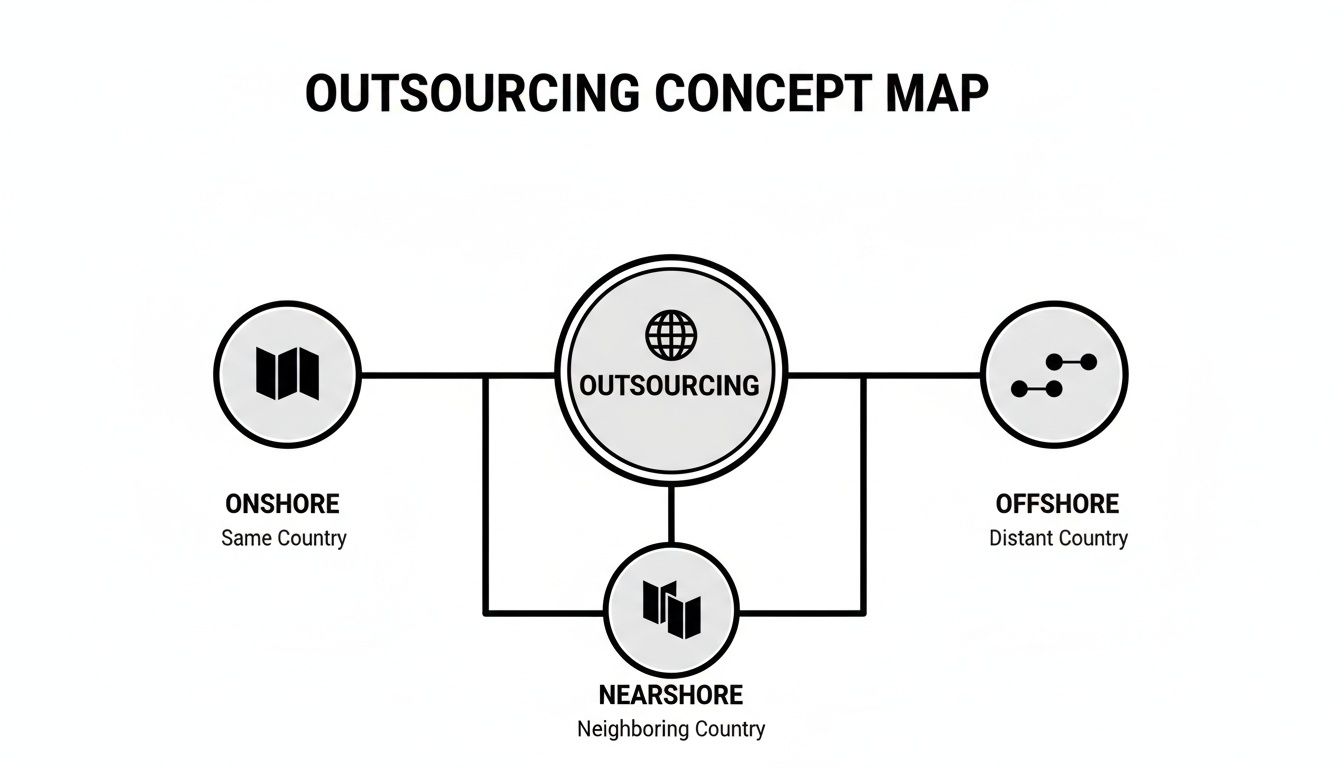
As you can see, nearshoring hits a strategic middle ground, delivering the accessibility of an onshore team with the significant cost benefits of going offshore.
Who Benefits from Nearshore Services?
The practical advantages of nearshore software development services appeal to a wide range of companies. For a SaaS startup, it's an actionable way to assemble a world-class team to build an MVP without the prohibitive costs of hiring locally.
For a larger enterprise, a nearshore partner can be the ideal solution for modernizing legacy systems or scaling engineering capacity to meet new market demands without getting bogged down in lengthy recruitment cycles.
The data confirms the trend. The nearshore market has grown to an estimated $25 billion with a steady 12% CAGR over the last five years. Companies leveraging this model are cutting development timelines by up to 30% and achieving cost savings of 20-40% compared to domestic hires.
The core value of nearshoring lies in achieving operational synergy. It provides access to world-class talent that works when you work, understands your business context, and integrates directly into your existing workflows and culture.
Comparing Onshore vs. Nearshore vs. Offshore
To fully appreciate the power of nearshoring, it's helpful to compare it side-by-side with the alternatives. Each model presents a unique trade-off between cost, control, and collaboration.
The table below breaks down the key differences between the three main outsourcing models.
Onshore vs Nearshore vs Offshore Development: A Comparison
| Factor | Onshore Development | Nearshore Development | Offshore Development |
|---|---|---|---|
| Cost | Highest | Moderate (significant savings) | Lowest |
| Time Zone Overlap | Full | High (0-3 hours difference) | Low (8-12+ hours difference) |
| Communication | Seamless, real-time | Easy, real-time collaboration | Challenging, often delayed |
| Cultural Alignment | High | High, strong similarities | Low, potential for friction |
| Travel & Visits | Easy, low cost | Relatively easy and affordable | Difficult and expensive |
| Talent Pool Access | Limited to local market | Access to entire region's talent | Access to global talent |
| Project Control | Maximum | High | Moderate to low |
Onshore offers maximum control but at a premium price. Offshore provides the largest cost savings but often at the expense of seamless communication and strategic alignment.
Nearshoring strikes a powerful balance. It mitigates the major pain points of the other models, creating a solution that is both financially intelligent and operationally sound. This makes it an excellent fit for any business that relies on agile methodologies and frequent collaboration but still needs to maintain strict budget discipline. For a different perspective, you can also check out our guide on building offshore software development teams.
The Real Business Impact of Nearshoring
Understanding the definition of nearshore software development is one thing; seeing its impact on your bottom line and team velocity is another. The benefits of this model extend far beyond cost reduction. We're talking about tangible advantages that strengthen your market position, accelerate your roadmap, and deliver a healthier return on investment.

When you partner with a nearshore team, you’re not just delegating tasks—you’re building a genuine extension of your organization. This deep integration unlocks strategic business advantages that drive efficiency, scalability, and ROI.
Accelerating Your Time to Market
In competitive industries like SaaS or e-commerce, speed is a critical advantage. Launching a new feature or product even slightly faster than the competition can be the difference between leading the market and playing catch-up. Nearshore partnerships are designed to accelerate your timeline by eliminating the communication lag inherent in offshore models.
The key is real-time collaboration. With teams operating in the same or similar time zones, daily stand-ups, ad-hoc problem-solving sessions, and code reviews happen fluidly. You escape the 24-hour feedback loop that brings progress to a halt.
This synchronized workflow gets your product from concept to launch significantly faster. For a startup, that could mean securing the next funding round. For an enterprise, it means capitalizing on market opportunities before they disappear.
Driving Financial Efficiency and Reinvestment
Cost savings are a major driver for businesses considering nearshore software development services. The real strategic value, however, comes from how you reinvest those savings. The model often delivers 20-40% lower rates than onshore developers, with talent in Latin America or Eastern Europe commanding hourly rates between $25-49—a significant value compared to the $100+ rates in the US for developers with equivalent 4.9+ Clutch ratings.
The financial benefits of nearshoring are not just about reducing expenses. They are about creating new opportunities for growth by reallocating capital to core business drivers like product innovation, customer acquisition, and strategic marketing.
Consider these real-world business scenarios:
- Product Innovation: A fintech company saves 35% on its development budget. It reinvests that capital into building a cutting-edge, AI-powered fraud detection module, creating a significant competitive advantage.
- Marketing & Sales: A B2B SaaS business uses the savings to double its digital marketing spend, resulting in a 50% increase in qualified leads and a measurable boost in revenue.
- Scaling Infrastructure: An e-commerce brand channels its savings into upgrading its cloud infrastructure, enabling it to handle massive traffic spikes during peak seasons without performance degradation.
This principle of leveraging external partners to fuel growth is not unique to development. To see how it applies in other business functions, explore the transformative impact of outsourced marketing, which shares many of the same strategic parallels.
Seamlessly Scaling Your Engineering Capacity
Market demands are unpredictable. A sudden user surge, a new compliance requirement, or a competitor's strategic move can create an immediate need for more engineering resources. A nearshore partner provides the flexibility to scale your team up or down as needed.
Instead of getting mired in a lengthy and expensive domestic hiring process, you can onboard specialized talent—like a DevOps engineer or a mobile developer—in a fraction of the time. This agility allows you to respond to market shifts instantly, keeping your business resilient and prepared for any opportunity or challenge.
Finding Your Ideal Engagement Model
Choosing how to structure your partnership with a nearshore software development provider is more than a contractual detail—it's the foundation of your collaboration. The engagement model you select dictates everything from project control and flexibility to how deeply the team integrates with your own.
Getting this right is crucial for success. The correct model ensures your nearshore team functions as a natural extension of your business, fully aligned with your goals and operational cadence. Think of it like choosing a vehicle: you wouldn't take a sports car on a cross-country camping trip. The model must match the mission, whether you're building a long-term product, need a temporary skill injection, or are tackling a single, well-defined project.
The Dedicated Team Model
For long-term, complex initiatives, the Dedicated Team model is the industry gold standard. In this arrangement, your nearshore partner assembles a full-time team of developers, QA engineers, and other specialists who work 100% on your project. They become an integrated part of your organization, adopting your culture, tools, and processes.
This model is a perfect fit for:
- Long-Term Product Development: Ideal for building a core product like a SaaS platform or a fintech application that requires continuous development and innovation.
- Complex Projects with Evolving Scopes: When requirements are likely to change, a dedicated team provides the agility to pivot without the friction of renegotiating a fixed-price contract.
- Businesses Needing Full Control: You direct the team's priorities and workflow, giving you maximum command over the project's direction and outcomes.
This approach is about building an asset, not just renting a service. Your dedicated team accumulates invaluable institutional knowledge over time, becoming more efficient and innovative as they grow with your product.
For a deeper analysis, review our complete guide on how to build and scale with the dedicated development team model. It offers the tightest integration and often proves to be the most cost-effective path for sustained development efforts.
The Team Augmentation Model
Team Augmentation, also known as staff augmentation, is a surgical approach to filling specific skill gaps within your in-house team. You aren’t outsourcing an entire project; you’re strategically adding one or more experts from your nearshore partner to work directly under your management.
This model is your best option when:
- You Have a Specific Skill Shortage: Your team is strong but lacks a critical capability, such as a DevOps engineer for a cloud migration or a mobile developer with expertise in a specific framework.
- You Need to Scale Quickly for a Specific Phase: Facing a tight deadline or a sudden increase in workload, this model allows you to add engineering power precisely when you need it.
- You Want to Retain Full Project Ownership: The augmented engineers report directly to your managers, blending seamlessly into your existing team structure and workflows.
For example, a public company preparing for a major platform launch could bring in two senior QA automation engineers for three months to ensure a flawless release. They get the targeted expertise they need, exactly when they need it, without the long-term overhead of permanent hires.
The Project-Based Model
The Project-Based model is the most straightforward engagement structure. It is designed for projects with a clearly defined scope, fixed requirements, and an established timeline and budget. You provide the project specifications, and the nearshore partner takes full responsibility for managing the development process and delivering the final product.
Choose this model if:
- Your Project Scope is Well-Defined: You have a crystal-clear vision and detailed specifications for a specific deliverable, such as building an MVP, creating a standalone mobile app, or redesigning a corporate website.
- You Prefer a Hands-Off Approach: You want to delegate day-to-day project management so your internal team can remain focused on core business activities.
- Your Budget is Fixed: The price is agreed upon upfront, providing cost predictability and minimizing financial risk.
Selecting the right model is a strategic decision. A startup building its core product will gain the most value from a Dedicated Team. An enterprise needing a short-term skill infusion will find Team Augmentation to be the perfect fit. By accurately assessing your business needs, you can choose the model that transforms your nearshore partnership into a powerful engine for growth.
How to Select the Right Nearshore Partner
Choosing your nearshore software development services partner is a critical business decision. The right partner becomes a genuine extension of your team, driving innovation and growth. A poor fit, however, can lead to missed deadlines, budget overruns, and significant frustration.
To mitigate this risk, you need a structured evaluation process that goes beyond a surface-level portfolio review. It's essential to rigorously assess their technical capabilities, communication protocols, business stability, and security posture to find a partner that not only delivers high-quality code but also aligns with your company's strategic goals.
Vetting Technical Expertise and Industry Acumen
First and foremost: does the potential partner possess the specific technical skills your project requires? A generalist firm is rarely the right choice. You need to see proven, hands-on experience in your technology stack and, equally important, your industry. A fintech company requires a team that understands the nuances of financial compliance, not just one that knows how to build a mobile app.
When evaluating their technical skills, ask targeted questions:
- Review Case Studies: Look for projects that mirror yours in complexity, scale, and industry. Have they built scalable platforms? Integrated complex AI? Managed highly sensitive data?
- Inquire About Their Team: Find out about the seniority and specific expertise of the developers who would be assigned to your project. How many years have they worked with your preferred frameworks?
- Assess Their Commitment to Innovation: How do they maintain their technical edge? Do they contribute to open-source projects or invest in continuous training for their engineers?
A great nearshore partner doesn’t just execute tasks; they provide strategic technical guidance. They should be able to challenge your assumptions and recommend better approaches based on their deep expertise, ensuring your product is not only built correctly but is engineered for the future.
Scrutinizing Communication and Collaboration Protocols
Exceptional communication is the bedrock of any successful nearshore relationship. Since you won't be in the same office, their collaboration processes must be transparent and efficient. Vague answers about communication are a major red flag and often signal future misalignment and delays.
During initial conversations, ask direct questions about their operational cadence:
- What project management tools are central to their workflow (e.g., Jira, Asana)?
- What does a typical week look like? Do they conduct daily stand-ups? Weekly demos?
- How do they handle urgent bugs or unexpected roadblocks?
- What is their process for documentation and knowledge sharing?
The objective is to find a partner whose workflow can integrate seamlessly with yours. For a more detailed framework, our complete software development outsourcing guide offers additional best practices for setting your partnership up for success.
Evaluating Security, IP Protection, and Stability
Finally, you must be rigorous in assessing a partner’s security posture and business stability. This is non-negotiable, particularly for enterprise clients or companies in regulated sectors like finance and healthcare. Your intellectual property and customer data must be protected by robust legal and technical safeguards.
Your due diligence checklist should include:
- Intellectual Property Protection: Ensure they have strong NDAs and clear contract language stipulating that all IP developed for you belongs 100% to you.
- Data Security and Compliance: Inquire about security certifications like SOC 2 or ISO 27001 and their experience with regulations such as GDPR. How do they enforce data encryption and access controls?
- Talent Retention Strategy: High employee turnover can kill a project's momentum. Ask about their attrition rates and the strategies they use to retain top talent. A stable team ensures continuity and protects institutional knowledge.
By thoroughly vetting these three core areas—technical skill, communication, and security—you can select a nearshore software development partner that minimizes risk and establishes a foundation for a successful, long-term collaboration.
Integrating Your Nearshore Team for Success
Signing the contract is just the beginning. The real work starts now: transforming a group of skilled developers into a seamless extension of your in-house team. Successful integration doesn’t happen by accident; it’s the result of a deliberate, well-executed plan for onboarding, communication, and performance management.
A robust integration plan acts as the bridge between your contractual agreement and your expected business outcomes. It ensures your nearshore developers understand not just the "what" but the "why" behind every task. This strategic alignment fosters a sense of shared ownership, which is critical for long-term productivity and innovation.

Establishing a Robust Onboarding and Communication Framework
A comprehensive onboarding process is your most critical first step. Go beyond providing system access and introductions. Immerse your new team in your company's mission, product vision, and customer profiles. The goal is to provide the business context they need to make smarter, more strategic contributions from day one.
With that foundation established, define crystal-clear communication channels. This framework should be unambiguous:
- Primary Tools: Standardize on core platforms. This might be Slack for daily communication, Jira for task management, and Confluence for documentation.
- Meeting Cadence: Establish a predictable rhythm with scheduled ceremonies—daily stand-ups, weekly sprint planning, and bi-weekly retrospectives are a solid starting point.
- Role Clarity: Ensure everyone knows who is responsible for what. A simple document outlining roles and responsibilities on both your internal and nearshore teams can prevent significant confusion.
The best nearshore partnerships feel less like a client-vendor dynamic and more like one distributed team pursuing a shared goal. This level of synergy is only achievable through intentional onboarding and transparent communication.
Defining and Tracking Key Performance Indicators (KPIs)
You can't improve what you don't measure. To ensure your partnership is delivering tangible value, you must track the right Key Performance Indicators (KPIs). Relying on anecdotal feedback is a recipe for misalignment. A data-driven approach provides an objective view of performance, helps identify bottlenecks, and enables you to make informed decisions to keep the project on track.
Demand for these services is growing, especially for complex projects. Projections show nearshore software development is expanding at 23% YoY, fueled by needs in AI and cybersecurity. For instance, banks building secure fintech platforms find that real-time collaboration with nearshore partners can reduce iteration cycles by 40% compared to offshore models. You can discover more about these nearshore trends and see how they drive efficiency. Tracking your KPIs is how you ensure you capitalize on this advantage.
Your KPIs should offer a balanced view across productivity, quality, and business impact. The exact metrics will vary by project, but a holistic set of indicators is essential for understanding the full picture.
To get started, here’s a breakdown of essential metrics that provide a clear view into your team's effectiveness, quality, and overall impact.
Key KPIs to Measure Nearshore Team Performance
| KPI Category | Metric Example | What It Measures |
|---|---|---|
| Productivity & Velocity | Sprint Velocity | The amount of work (e.g., story points) a team completes during a sprint, indicating its predictable output over time. |
| Efficiency & Flow | Cycle Time | The time it takes from when work begins on a task until it is delivered, highlighting process bottlenecks. |
| Code Quality | Code Churn | The frequency with which code is rewritten or deleted, which can indicate instability or unclear requirements. |
| Quality Assurance | Bug Rate / Defect Density | The number of bugs found after a feature is released, measuring the effectiveness of QA processes. |
| Business Alignment | Feature Adoption Rate | The percentage of users actively using a new feature, tying development efforts directly to customer value. |
By tracking these KPIs consistently, you gain objective insights into what’s working and where adjustments are needed.
Ultimately, by implementing a rigorous plan for integration, communication, and measurement, you are setting your partnership up for success. This isn't just about managing resources; it’s about building a strategic asset that actively drives your business forward.
Common Questions About Nearshore Development
Exploring any outsourcing model will naturally raise questions. When it comes to nearshore software development services, businesses often focus on three key areas: security, team structure, and intellectual property ownership. Getting clear answers on these topics is essential for building the trust required for a successful partnership.
This section provides direct, actionable answers to the most common questions we hear from companies in SaaS, finance, and e-commerce, helping you make an informed decision with confidence.
How Is Intellectual Property Protected in a Nearshore Model
Let's address the most critical concern first: safeguarding your intellectual property (IP). A premier nearshore partner treats IP protection as a core pillar of the relationship, integrating it into both legal agreements and daily operations. Your source code, proprietary processes, and business logic are your most valuable assets, and they must be protected as such.
Here’s how a robust framework creates a fortress around your IP:
- Ironclad Legal Agreements: Every partnership begins with a detailed Master Services Agreement (MSA) and a strict Non-Disclosure Agreement (NDA). These documents explicitly state that 100% of the intellectual property created for you belongs to you, leaving no room for ambiguity.
- Secure Infrastructure: Access is granted on a need-to-know basis. Strict access controls ensure only your dedicated team members can access your codebase and environments, backed by secure network configurations and regular security audits.
- Employee Confidentiality: Every engineer signs a comprehensive confidentiality clause as a condition of employment. This legally binds them to protect your proprietary information, an obligation that persists even if they leave the company.
Your IP is your competitive advantage. A trustworthy partner doesn’t just promise to protect it; they build their entire legal and operational framework around that commitment, providing you with complete peace of mind.
This multi-layered approach ensures your IP is as secure with your nearshore team as it would be with your own in-house staff.
What Is the Typical Team Structure for Building an MVP
For any startup or enterprise launching a new product, speed to market is paramount. The Minimum Viable Product (MVP) is the critical first step, and the team assembled to build it must be lean, agile, and focused on shipping core, functional features. While the exact composition varies, a high-performance nearshore MVP team is structured for velocity.
A typical MVP team structure includes:
- 1 Project Manager / Scrum Master: This individual serves as the team lead, responsible for removing roadblocks, facilitating agile ceremonies (stand-ups, sprint planning), and ensuring the project remains on track.
- 2-3 Software Engineers: The core of the team, this usually includes a mix of front-end and back-end specialists (or versatile full-stack developers) to build everything from the user interface to the database.
- 1 QA Engineer: Even for an MVP, a dedicated quality assurance engineer is non-negotiable. They are responsible for both manual and automated testing to identify and resolve critical bugs before the first users engage with the product.
- 1 UI/UX Designer (Part-Time or Full-Time): A skilled designer ensures the product is not just functional but also intuitive and user-friendly. They may work full-time during the initial design phase and then transition to a part-time advisory role.
This small, focused unit possesses all the necessary skills to transform an idea into a viable, market-ready product. It is a balanced team designed to build, test, and iterate quickly—exactly what is needed for a successful launch.
How Is Security and Compliance Handled Especially for Fintech
For businesses in highly regulated sectors like finance or healthcare, security and compliance are foundational requirements. Any nearshore partner operating in these industries must have a deeply ingrained security culture and a proven track record of navigating complex regulatory landscapes. This is an area where there is no room for compromise.
For our fintech clients, we embed security and compliance into every stage of the development lifecycle:
- Adherence to Global Standards: We design systems with major international standards like GDPR in mind and follow frameworks that align with SOC 2 principles for secure data management and operations.
- Data Encryption at Rest and in Transit: All sensitive data is encrypted by default. We use industry-standard protocols like TLS for data in transit and AES-256 for data at rest, securing data at every potential point of vulnerability.
- Regular Security Audits and Penetration Testing: We proactively identify and remediate vulnerabilities through routine security scans and third-party penetration testing, ensuring systems are hardened against potential threats.
By making these security measures a non-negotiable part of every project, we ensure the platforms we build for regulated industries are not only innovative and user-centric but also fundamentally secure and compliant.
At Group 107, we build dedicated, high-performance software development teams that integrate seamlessly with your organization. Whether you're a startup building an MVP or an enterprise modernizing its systems, we provide the expertise and governance to turn your vision into a secure, scalable reality.
Learn how our dedicated teams can accelerate your product roadmap.