
Launching a software project without a cost estimate is like greenlighting a major construction project without a blueprint. You have a vision, but no clear understanding of the resources, time, or capital required. A software development cost calculator serves as your initial architectural plan—translating a high-level concept into a tangible financial roadmap.
This preliminary estimate is critical for validating your concept, securing stakeholder buy-in, and aligning your internal team. It transforms an idea into a data-driven plan.
What a Software Development Cost Calculator Really Is
A software development cost calculator is not a crystal ball that predicts the final price with absolute certainty. It is a strategic estimation tool that forces you to define what you intend to build before development begins. This structured approach helps manage financial risk from day one and establishes a realistic, data-driven project framework. The process is about converting abstract ideas into concrete numbers to generate a preliminary budget.
The logic is similar to commissioning a custom-built home. You wouldn't ask a builder, "How much for a house?" without providing detailed specifications. The same principle applies to building software.
The Key Inputs That Drive the Numbers
An effective calculator requires specific inputs to generate a meaningful estimate. Using our home-building analogy, here are the core components of the calculation:
- Project Scope (The Rooms): This defines the number and complexity of features. A simple three-bedroom house is fundamentally different from a mansion with a home theater and an indoor pool. Similarly, an application with a basic user login and dashboard is far less complex than a fintech platform requiring real-time transaction processing.
- Technology Stack (The Materials): The choice of technology—from programming languages like Python or Java to cloud infrastructure on AWS or Azure—directly impacts cost, scalability, and long-term maintenance. Are you building with standard frameworks or specialized, high-performance materials?
- Team Composition (The Labor): A software project requires a skilled team. This may include a project manager (the general contractor), backend developers (skilled electricians), and UI/UX experts (interior designers). The right mix of junior, mid-level, and senior talent significantly affects your budget and timeline.
This table breaks down these crucial inputs for a clearer overview.
Key Software Cost Estimation Inputs at a Glance
This table summarizes the primary factors that influence the final cost of a software project, providing a quick reference for understanding what drives your budget.
| Factor | Description | Impact on Cost |
|---|---|---|
| Project Scope | The total number and complexity of features, screens, and user stories. | High: The single biggest driver. More features and greater complexity directly increase development hours. |
| Technology Stack | The programming languages, frameworks, and platforms used to build the software. | Medium: Niche technologies or specialized skills can increase hourly rates and development time. |
| Team Composition | The size, seniority level (junior, mid, senior), and roles (dev, QA, PM) on the team. | High: Senior talent costs more per hour but delivers greater efficiency. Larger teams increase the monthly burn rate. |
| Integrations | Connecting the software to third-party systems like payment gateways, CRMs, or APIs. | Medium: Each integration adds complexity and requires dedicated development and testing time. |
| Compliance & Security | Meeting industry standards like HIPAA, GDPR, or PCI-DSS. | High: Requires specialized expertise, rigorous testing, and often more robust infrastructure. |
Understanding what drives the estimate is as important as the final number. It gives you control over the budget.
By quantifying these core components, a software development cost calculator provides the financial clarity needed to secure funding, allocate resources, and make informed strategic decisions from the outset.
Mastering these variables is the first step toward a successful project. For a closer look at all the factors that can influence your project's bottom line, you can explore detailed software development cost guides.
Ultimately, this initial estimation phase ensures your project is built on solid financial ground, preventing costly surprises down the line. It’s how you align your vision with a practical budget and turn a great idea into a viable business.
Understanding the Key Software Cost Drivers
A precise estimate from a software development cost calculator requires specific, detailed inputs, not vague ideas. A realistic budget depends on accurately defining the variables that feed into the final calculation.
The most significant factor is the project scope, which extends beyond a simple feature list to encompass the depth and complexity of each function. For example, a "user profile" can range from a basic page with a name and email to a complex system with multi-factor authentication, social media integration, and personalized dashboards. Each layer of complexity adds development hours, directly increasing the cost.
This diagram shows how basic inputs like your features, tech stack, and team structure all flow into the final budget.
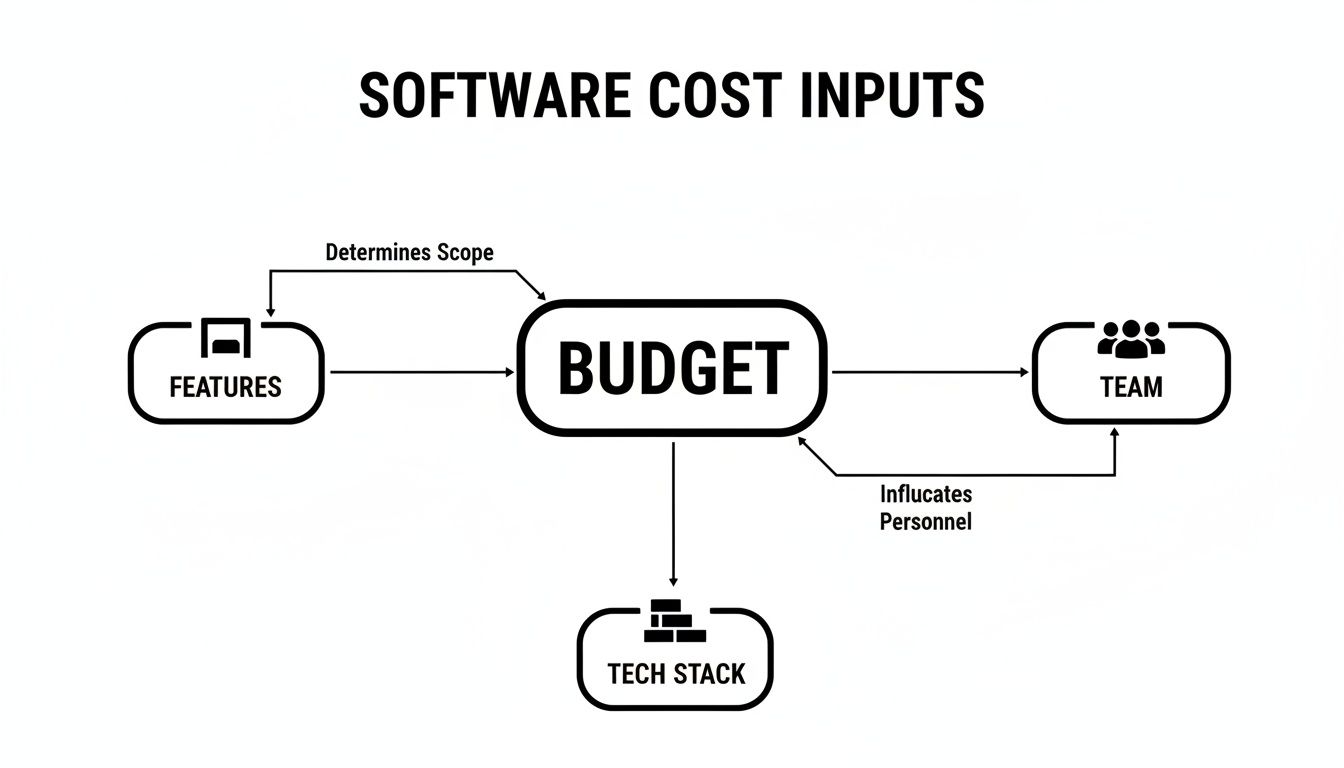
These components are interconnected. A decision in one area, such as adding a complex feature, has a ripple effect on team and technology needs—and, ultimately, your bottom line.
Deconstructing the Primary Cost Factors
To build a reliable estimate, you must break down the project into its core components.
-
Team Composition and Expertise: The experience level of your development team is a key variable. A team of senior architects and engineers will have a higher hourly rate than junior developers. However, their experience often translates to greater efficiency, faster problem-solving, and higher-quality code, which can reduce long-term maintenance costs and accelerate time-to-market. The key is to find the right blend of seniority for your project's specific needs.
-
Pricing Models (Fixed vs. Hourly): The engagement structure also shapes the budget. A fixed-price model is ideal for projects with a well-defined scope, such as a Minimum Viable Product (MVP), as it provides cost predictability. An hourly (Time & Materials) model offers the flexibility needed for complex projects where requirements are likely to evolve. The right choice depends on your project's clarity and your comfort with potential budget adjustments.
Project complexity is a fundamental driver. Basic MVPs designed for market validation typically range from $20,000 to $100,000. Mid-sized custom applications with more advanced features generally fall between $100,000 and $500,000. For large-scale enterprise solutions requiring extensive compliance or AI integrations, the starting point is often $500,000 and can increase significantly. For a more detailed view, explore detailed software development cost guides.
Uncovering the Hidden and Indirect Costs
A common mistake is focusing solely on direct development costs while overlooking other essential project expenses. A truly realistic budget must account for these often-overlooked items to avoid financial strain later.
A budget that only covers coding is incomplete. True cost estimation accounts for the entire ecosystem supporting the software, from third-party services and security audits to regulatory compliance and ongoing maintenance.
Failing to budget for these will create significant financial stress. Ensure your estimate includes:
- Third-Party API Licensing: Modern applications often rely on external services for functions like payment processing (Stripe), maps (Google Maps), or communications (Twilio). These services typically have subscription fees that scale with usage.
- Security Audits and Penetration Testing: For applications handling sensitive data, particularly in finance or healthcare, independent security audits are mandatory. These tests identify vulnerabilities and are crucial for earning user trust and preventing breaches.
- Regulatory Compliance: Adhering to regulations like HIPAA (for healthcare data) or GDPR (for EU user data) is a legal requirement. Achieving compliance involves specialized development, legal consultation, and meticulous documentation, all of which have associated costs. To understand more, see our guide on how to ensure your digital presence is accessible and compliant.
By carefully considering both direct and indirect cost drivers, your software development cost calculator will produce a more accurate and dependable estimate, setting your project up for financial success from the start.
How Offshore Development Reduces Your Total Cost
One of the most powerful levers for managing your software budget is strategic team placement. While a software development cost calculator focuses on project complexity, where your team is located can dramatically lower your Total Cost of Ownership (TCO) without sacrificing quality.
Partnering with premium offshore talent is a strategic business decision, not merely a cost-cutting tactic. This approach provides access to a global pool of highly skilled engineers, designers, and project managers in regions with different economic structures. The result is a significant reduction in labor costs—typically the largest line item in any software project.

The Economics of Global Talent Pools
The global software development landscape reveals a significant disparity in regional hourly rates. North America, with its mature tech ecosystem and high operational costs, typically commands the highest rates at $80-$150 per hour.
In contrast, Central and Eastern Europe offers an exceptional balance of quality and cost, with senior developers available for $40-$80 per hour. This has positioned the region as a strategic hub for companies that refuse to compromise on quality.
This is not about finding the "cheapest" option; it's about optimizing for value. High-value hubs in Eastern Europe, particularly Ukraine, are known for their strong technical education systems, robust IT infrastructure, and a deep pool of experienced engineers.
By partnering with a premium offshore team, businesses can achieve up to 60% savings on direct labor costs. This isn't just a budget adjustment; it's a strategic advantage that redefines what you can build.
These savings can be reinvested directly into the product, making it financially viable to build out an extra feature set or accelerate your time-to-market.
Turning Savings into a Superior Product
The financial benefits of an offshore model extend beyond lower hourly rates. The cost savings enable the assembly of a more comprehensive and specialized team—one that might be unattainable in a purely onshore model.
With the savings from an offshore model, you can afford to build a more robust team by reallocating your budget to roles that are often cut due to cost pressures:
- Dedicated QA Engineers: Instead of developers testing their own work, you can bring on a dedicated quality assurance team focused entirely on identifying bugs, resulting in a more stable and reliable product at launch.
- Specialized DevOps Experts: A dedicated DevOps engineer can build and manage a CI/CD pipeline, automating deployments and reducing the risk of human error. This accelerates the development cycle and enhances system resilience. You can learn more about the benefits of offshore software development in our detailed guide.
- Senior UI/UX Designers: An intuitive and engaging user interface is critical for adoption. Budget flexibility allows you to onboard senior design talent to craft an exceptional user experience.
This strategic team expansion means you are not just building software for less; you are building a fundamentally better product. A lower TCO allows for greater investment in quality, security, and user experience, ultimately delivering a higher ROI and a stronger competitive edge.
The Budget Impact of Your Technology Choices
Your technology stack is one of the most critical financial decisions you will make. It impacts your entire budget, from initial development to long-term maintenance. While a software development cost calculator provides a solid starting point, the specific technologies you choose will ultimately shape your product's financial reality.
Selecting a modern, widely supported framework is like building on a solid foundation—it accelerates development and simplifies talent acquisition. Conversely, relying on obscure or outdated systems is like building on sand—it often leads to expensive problems and a difficult search for specialized (and costly) developers. The right technology is a strategic investment in your product's future.

DevOps And CI/CD For Cost Control
A strong DevOps culture supported by a robust Continuous Integration/Continuous Deployment (CI/CD) pipeline is one of the most effective ways to control costs. This approach replaces slow, manual, and error-prone processes with automated, predictable quality control.
By automating the build, test, and deployment processes, CI/CD pipelines significantly reduce the time your team spends on repetitive tasks. They also catch bugs early in the development cycle when they are exponentially cheaper to fix. This automation not only accelerates time-to-market but also establishes a rhythm of consistency that minimizes the risk of costly post-launch failures.
The Financial Impact of AI Integration
Integrating Artificial Intelligence into your project requires an upfront investment in specialized talent and tools, but the long-term ROI can transform your business. AI can unlock significant cost savings and create new revenue streams.
Here are a few ways AI integration delivers value:
- Process Automation: AI can automate routine tasks like customer support chats or data entry, freeing up your team to focus on high-impact, strategic work.
- Predictive Analytics: By analyzing user data, AI can identify customers at risk of churn, uncover hidden sales opportunities, and optimize marketing spend for maximum impact.
- Personalized Experiences: AI algorithms can deliver customized content and product recommendations that boost user engagement and drive conversions, creating an experience that feels tailored to each individual.
Comparing Open-Source, Serverless, and Licensed Tech
Your architectural decisions have a direct impact on your budget, affecting both initial build costs and ongoing operational expenses.
Technology choices are budget choices. Opting for serverless architecture or open-source libraries isn't just a technical decision; it's a financial strategy that impacts everything from initial outlay to ongoing operational costs.
- Open-Source vs. Licensed Software: Open-source technologies like Linux or Python eliminate licensing fees, but you are responsible for setup, maintenance, and security. Licensed products from companies like Microsoft or Oracle come with a price tag but typically include dedicated support, which can reduce internal overhead.
- Serverless vs. Traditional Cloud Infrastructure: With traditional cloud setups (e.g., AWS EC2), you pay for servers 24/7, even when they are idle. Serverless computing (e.g., AWS Lambda) is a pay-as-you-go model where you are billed only when your code is running. It can significantly reduce costs for applications with unpredictable traffic but requires a different architectural approach.
Making these decisions requires a clear understanding of their financial implications.
Cost Impact of Modern Tech Choices
The table below breaks down how different technology and methodology choices can influence both the upfront and long-term costs of a software project.
| Technology/Methodology | Initial Cost Impact | Long-Term Cost Impact | Best For |
|---|---|---|---|
| CI/CD Pipeline | Medium (setup, tools) | Low (fewer bugs, faster releases) | All modern software projects |
| AI Integration | High (specialized talent) | Low to High (major ROI potential) | Data-rich apps needing automation or personalization |
| Open-Source | Low (no license fees) | Medium (internal maintenance costs) | Startups and teams with strong in-house tech skills |
| Serverless | Low (no server provisioning) | Low (pay-per-use model) | Apps with unpredictable or event-driven traffic |
Choosing the right stack is about balancing short-term expenses with long-term value.
When navigating cloud options, the best AI cloud cost optimization tools can help keep monthly bills under control. For a comprehensive guide on managing cloud spending, see our expert analysis of cloud cost optimization strategies.
Common Cost Estimation Mistakes to Avoid
An inaccurate budget can jeopardize your project before development even begins. Even the most sophisticated software development cost calculator is ineffective if fed poor information, and several common mistakes can derail your financial planning.
One of the most significant errors is underestimating the project's true scope. This occurs when a high-level idea lacks detailed feature specifications. What seems like a simple "user login" can quickly expand to include social sign-on, two-factor authentication, and password recovery—each adding complexity and cost.
Another classic pitfall is focusing exclusively on developer salaries while overlooking other essential roles that are critical to a project's success.
Forgetting the Full Team and Lifecycle Costs
Your budget must cover the entire team, not just the developers writing code. Neglecting to account for these critical support roles is a recipe for quality issues and costly delays.
- Project Management: A skilled project manager ensures tasks remain on schedule, facilitates communication, and aligns the team with project goals.
- Quality Assurance (QA): Without dedicated QA engineers, developers are left to test their own work—a practice that often leads to a buggy and frustrating user experience.
- UI/UX Design: A superior user experience requires professional designers to create a product that is intuitive, engaging, and enjoyable to use.
Beyond the team, many budgets have a fatal flaw: they end at launch. Software is a dynamic asset that requires continuous investment to remain secure, functional, and relevant.
A project budget that stops at deployment is fundamentally incomplete. Post-launch costs for maintenance, server hosting, bug fixes, and future updates typically account for 15-25% of the initial development cost annually.
Failing to plan for the entire product lifecycle will lead to surprise expenses that drain resources and threaten your application's long-term viability.
The Dangers of Scope Creep and No Contingency
Scope creep is the silent budget killer. It occurs when new features and minor changes are added during development without formally updating the budget or timeline. While each request may seem reasonable in isolation, they accumulate rapidly, leading to significant cost overruns.
The best defense is a well-defined project roadmap and a strict change control process. For a deeper look at managing project timelines, check out our guide on how to estimate software development time.
Finally, even with a meticulous plan, unforeseen challenges arise. A third-party API may change, or a technical issue may require more time to resolve than anticipated. That is why a contingency buffer is essential. Allocating 15-20% of your budget to a contingency fund provides the flexibility to handle these surprises without derailing the project. It is the financial safety net that distinguishes a well-managed project from a crisis.
Taking the Next Step: From Estimate to Accurate Budget
Transitioning from a rough estimate to a reliable project budget requires careful preparation and the right technology partner. An online software development cost calculator provides a valuable starting point, but transforming that figure into a dependable financial plan is the next critical step.
The goal is to be fully prepared to execute your vision. This means understanding the primary cost drivers—scope, technology, and team—and recognizing the strategic advantages of leveraging expert offshore teams and modern practices like CI/CD to maximize your investment.
Your Pre-Estimation Checklist
Before engaging a development agency, complete your due diligence. A clear, well-defined brief is the single most effective tool for obtaining an accurate estimate.
- Define Your Core Problem: Clearly articulate the business problem you are solving. Be specific about your target users and the pain points your software will address.
- List Must-Have Features (MVP Scope): Document the essential features for your initial launch. Frame them as user stories, such as, "As a new user, I need to create an account with my email."
- Identify Technical Constraints: List any non-negotiable technical requirements, such as integrations with a CRM or payment gateway, or compliance with regulations like HIPAA or GDPR.
- Outline Your Business Goals: Define what success looks like in the first year. Is it achieving a specific number of users, reaching a revenue target, or improving an internal process?
Partnering for Success
Once your requirements are clear, the next step is to find a partner who can translate your vision into a functional product. An estimate is just a number; the right partner provides the strategy, experience, and transparency to deliver on that number.
An accurate budget isn’t just about the math. It’s the outcome of a collaborative discovery process with a team you trust. It connects your business goals to a realistic technical plan, so there are no surprises later on.
At Group107, we don’t just provide a calculation; we initiate a strategic dialogue. Our experts will collaborate with you to refine your scope, select the optimal technology, and assemble a dedicated offshore team that delivers top-tier quality while respecting your budget.
Ready to get a detailed, no-obligation estimate for your project? Contact Group107 today to start building your software with a team you can trust.
Frequently Asked Questions
Navigating the complexities of software project budgeting can be challenging. Here are straightforward answers to the most common questions about software costs and estimation.
How Accurate Is a Software Development Cost Calculator?
A calculator provides a directional estimate—a ballpark figure that is invaluable for early-stage planning, validating a business case, or initiating discussions with investors. Its accuracy depends on the level of detail you provide. A well-defined feature list will yield a much more precise estimate than a high-level concept. The final, definitive budget will always emerge from a detailed discovery phase with your development partner.
Why Do Estimates Vary So Much Between Agencies?
Significant variations in quotes for the same project are common and typically stem from one of three factors:
- Team Location: An agency in a high-cost region like San Francisco has a different cost structure than a top-tier offshore team in Eastern Europe. Labor costs are the primary driver of this difference.
- Team Composition: Some agencies may quote a lower rate based on junior developers, while others will price for senior engineers who, despite a higher hourly rate, often work more efficiently and produce higher-quality code, saving money in the long run.
- Scope Interpretation: A vague project brief can lead to different interpretations. One team might assume a simple, bare-bones build, while another might price for a complex, scalable architecture. The more detailed your brief, the more accurate and comparable the estimates will be.
How Can I Lower My Software Development Costs?
You can reduce costs without sacrificing core features by optimizing your team structure and development process.
The real secret to reducing costs isn't about cutting corners on features. It's about optimizing your team and development strategy. Getting this right can cut your budget by up to 60%.
- Engage an Offshore Team: Partnering with a skilled offshore development team provides access to world-class talent at a more competitive price point.
- Start with an MVP: Focus on the essential features that solve your users' most critical problem. Launching a Minimum Viable Product accelerates time-to-market, minimizes initial investment, and allows real user feedback to guide future development.
- Embrace DevOps and CI/CD: Automating your testing and deployment pipeline reduces manual errors and speeds up release cycles. Faster development translates to lower costs.
What Is a Typical Contingency Budget?
Even the most meticulously planned projects encounter unforeseen challenges. A contingency fund is not optional; it is essential. The industry standard is to set aside 15-20% of the total estimated budget as a buffer. This safety net ensures that minor surprises do not derail your timeline or force you to make difficult compromises.
Ready to move from a ballpark estimate to a detailed, transparent budget for your software project? Group107 provides expert offshore teams and the strategic guidance to bring your vision to life—on time and on budget.