
Choosing your software development team structure is a high-stakes decision. It’s not just about drawing an org chart; it’s a strategic move that dictates project velocity, product quality, and budget efficiency. Get it right, and you build a foundation for innovation and scalable growth. Get it wrong, and you introduce friction, bottlenecks, and wasted resources that stall progress.
Why Your Team Structure Defines Your Success

Think of your team structure as the architectural blueprint for your engineering organization. A solid blueprint acts as a force multiplier, enabling teams to build exceptional software with minimal friction. A flawed one creates communication silos, process bottlenecks, and wasted resources that bring momentum to a grinding halt.
This guide moves beyond textbook definitions to provide a practical framework for building a high-performing team. We'll break down why a startup's lean structure won’t work for a large enterprise and how the right model can unlock your team’s true potential and drive measurable business outcomes.
The Impact on Business Outcomes
The ultimate goal is to align your team structure with your business objectives. When this alignment is achieved, the results are tangible and impactful.
The right structure directly influences:
- Speed and Agility: How quickly can you pivot, ship new features, and respond to market demands?
- Product Quality: Does your setup foster ownership, accountability, and rigorous testing?
- Scalability: Can your team and processes grow without collapsing under their own weight?
- Innovation: Does the environment encourage creative problem-solving and cross-functional collaboration?
This isn’t just about rearranging an org chart; it's about cultivating a culture of operational excellence. Understanding the core principles of building high performance teams is critical, especially when navigating the complexities of SaaS, fintech, or enterprise-grade software.
Small, Focused Teams Dominate the Industry
The global software development landscape is vast, with approximately 4.3 million developers in the United States and 25.6 million worldwide. Despite this scale, a clear trend has emerged: small, agile teams are the industry standard.
Data shows that half of all developers work in teams of just two to seven people. This confirms that lean, focused groups are highly effective at building and shipping software. This principle holds true whether your team is in-house or you’re leveraging a dedicated offshore model. A well-designed team structure is the mechanism that turns a strategic vision into a market-ready product, regardless of scale.
Understanding Core Software Team Models
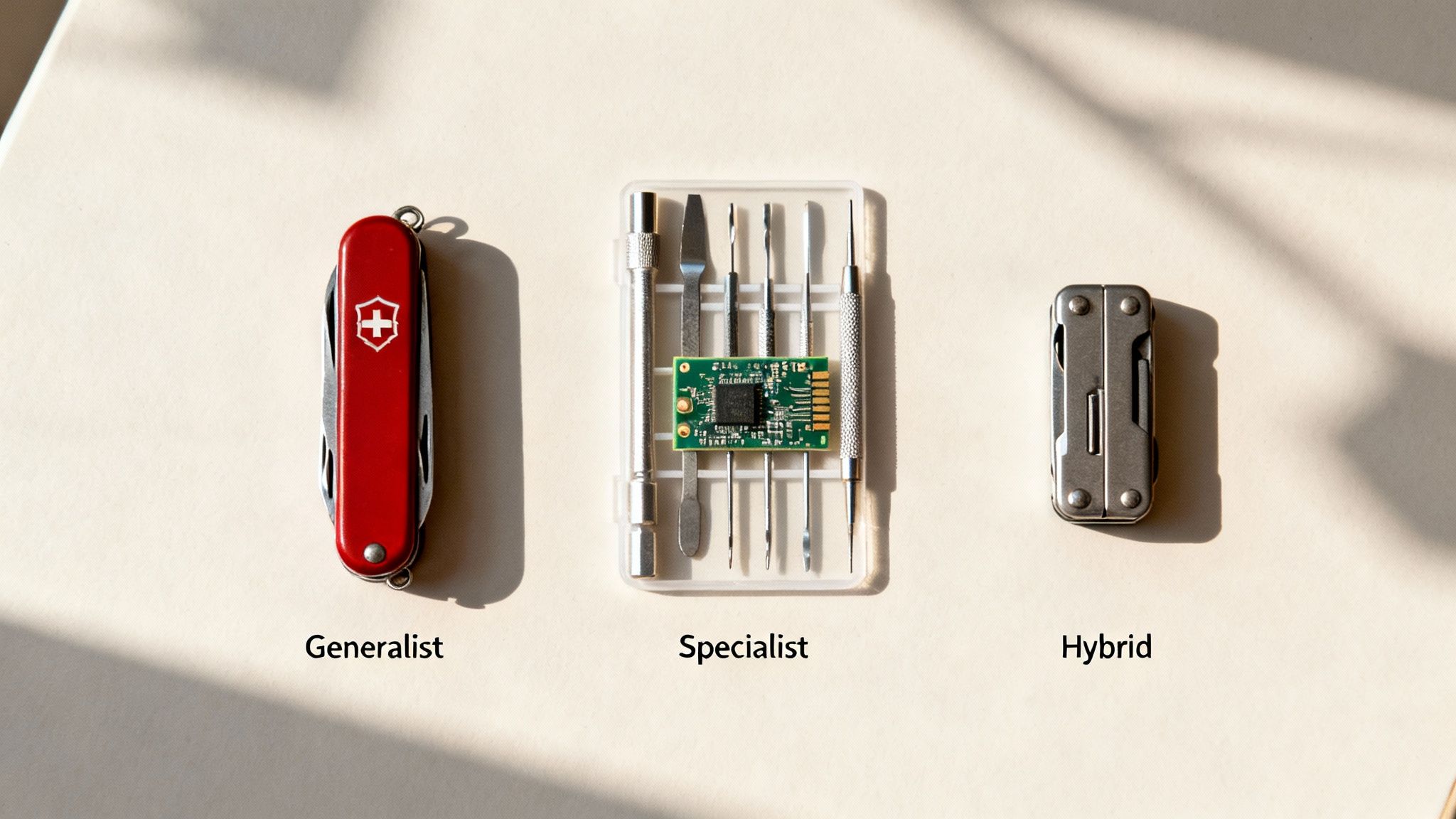
Before you assemble a high-performing engineering team, you must understand the fundamental blueprints. Every effective software development team structure is a variation of three core models: Generalist, Specialist, or Hybrid. Each serves a distinct strategic purpose, and selecting the right one depends entirely on what you're building, your timeline, and your overarching business goals.
Think of it as selecting the right tool for a job. A sledgehammer is ineffective for watch repair, and a tiny screwdriver won’t demolish a wall. Similarly, your team structure must be fit-for-purpose. This foundational decision dictates collaboration patterns, problem-solving approaches, and ultimately, value delivery.
Comparison of Core Software Team Models
| Team Model | Primary Strength | Best For | Potential Challenge |
|---|---|---|---|
| Generalist | Adaptability & Speed | Early-stage startups, MVPs, projects with fluid requirements. | Lacks deep, specialized knowledge for complex domains. |
| Specialist | Depth & Precision | Complex, enterprise-grade systems, fintech, high-security apps. | Prone to bottlenecks and slower cross-functional handoffs. |
| Hybrid | Balance & Scalability | Established product companies, scaling businesses. | Requires strong coordination and intentional communication. |
Each model offers distinct advantages. The key is identifying which one provides a competitive edge for your specific context.
The Generalist Model: The Versatile Multi-Tool
A Generalist team is composed of developers with broad, overlapping skill sets—typically full-stack engineers comfortable working across the entire technology stack. This model is the software equivalent of a Swiss Army knife: adaptable, flexible, and capable of handling a wide range of tasks without requiring personnel changes.
This structure excels when speed and agility are paramount. An early-stage SaaS startup building its Minimum Viable Product (MVP) is a perfect use case. The team can pivot quickly, tackle different application components as needed, and maintain extremely short development cycles.
- Ideal Use Case: Startups, MVP development, rapid prototyping, and projects with evolving requirements.
- Operational Dynamics: Highly collaborative, with fluid roles. Team members share responsibilities and contribute wherever they are needed most.
- Typical Composition: A small group of full-stack developers, a product owner, and a UI/UX designer with some front-end coding skills.
The primary trade-off is that a "jack-of-all-trades" can be a master of none. When a project demands deep expertise in a niche area—like advanced cybersecurity for a fintech application—a Generalist team may lack the specialized knowledge to deliver a truly robust solution.
The Specialist Model: The Set of Precision Instruments
Conversely, a Specialist team is comprised of individuals with deep, focused expertise in a single domain. This is your set of precision instruments, where each member has a specific and critical function. Here, you'll find dedicated front-end developers, back-end engineers, database administrators, and QA specialists working within their areas of mastery.
This model is designed for complex, large-scale projects where quality, security, and performance are non-negotiable. Think of enterprise-level financial platforms, government systems handling sensitive data, or high-compliance e-commerce solutions. The depth of knowledge ensures each component is engineered to the highest possible standard.
This focused approach minimizes risks associated with complex technologies. When building secure, scalable systems, having dedicated experts for each layer of the technology stack is not just a best practice—it's a necessity for long-term success.
The main challenge is the risk of creating bottlenecks. If the back-end team encounters a delay, the front-end team may be blocked, killing momentum. Exceptional project management is essential to coordinate all moving parts effectively. For guidance on structuring and scaling your engineering efforts, explore our guide on the dedicated development team model.
The Hybrid Model: The Best of Both Worlds
The Hybrid model is a strategic blend of Generalists and Specialists, creating a balanced and high-impact team. It offers the flexibility of a Generalist structure while providing access to deep expertise when it matters most. This is akin to having a well-stocked toolbox containing both a reliable multi-tool and a full set of specialized instruments.
This approach is becoming the standard for modern software development. Balancing broad adaptability with deep knowledge is key to team effectiveness. With 85% of development teams now utilizing multiple programming languages, the need for diverse, T-shaped skills is clear.
For example, a SaaS company might have a core team of full-stack developers (Generalists) handling day-to-day feature development. When preparing for a major release, they bring in a cybersecurity specialist to conduct a thorough security audit. This is a smart, cost-effective way to cover all bases, making the model ideal for established companies and enterprises that must maintain existing systems while innovating with new technologies.
How Modern Engineering Teams Are Actually Structured
As a company scales, the simple team models of its early days become insufficient. The structure must evolve. Modern software development relies on organizational designs—or topologies—built for speed, clear ownership, and the ability to scale without collapsing under complexity.
These aren't just trendy buzzwords; they are the engines powering today's most successful tech companies, enabling them to ship features rapidly while maintaining a clean, manageable codebase.
The most significant shift has been moving away from organizing teams around technical functions (e.g., "the database team"). Instead, high-performing structures are organized around delivering business value. This shift aligns engineering efforts directly with customer needs, dismantling the silos that create friction and impede progress.
Feature Teams: The End-to-End Value Drivers
A Feature Team is a self-contained, cross-functional unit that owns a customer-facing feature from concept to deployment. This team includes all necessary roles—front-end, back-end, QA, design, and product management—to build, test, and ship independently.
Consider an e-commerce company. A dedicated "Checkout Feature Team" would own the entire checkout experience, from the user clicking the cart icon to payment gateway integration and the final confirmation page. This end-to-end ownership fosters a powerful sense of responsibility and deep product expertise.
- Pros: Extremely fast delivery cycles, clear ownership, and a laser focus on user value.
- Cons: Without strong cross-team communication, you risk duplicated code or conflicting technical decisions.
This structure is ideal for product-led companies where rapid shipping and iteration based on user feedback are the primary drivers of success.
Component Teams: The Masters of the Stack
A Component Team is focused on specialization. This team of experts owns a specific, foundational piece of the technology stack—such as a billing API, a user authentication service, or a complex data processing engine. Other teams become "customers" of the services this team provides.
For example, a large SaaS company might have a "User Authentication Component Team." This group is responsible for everything related to logins, password resets, multi-factor authentication, and security. Any other feature team needing to verify a user's identity integrates with the service this specialized group builds and maintains.
- Pros: Unmatched technical depth, high-quality reusable components, and clean architectural boundaries.
- Cons: Can easily become a bottleneck if multiple feature teams depend on them for critical updates.
Component Teams are essential in complex systems where consistency and reliability are non-negotiable. They ensure that shared, critical parts of your platform are built by experts, preventing other teams from reinventing the wheel. To optimize this model, check out our guide to agile development best practices.
The Spotify Model: Squads, Tribes, Chapters, and Guilds
Popularized by the music streaming giant, the "Spotify Model" is less a rigid blueprint and more a philosophy for scaling agile principles. It focuses on creating teams that are loosely coupled but highly aligned.
The core principle is to grant small, mission-focused teams the autonomy to move fast while ensuring knowledge and standards are shared across the organization. It's a framework for scaling without being crushed by bureaucracy.
Here’s the breakdown:
- Squads: The basic unit, similar to a Feature Team. A Squad is a small, self-organizing team with a long-term mission, such as "improving music discovery."
- Tribes: A collection of Squads working in the same general area, like "the music player experience."
- Chapters: These cut across Squads within a Tribe. A Chapter is a group of people with the same skills (e.g., all iOS engineers in the Music Player Tribe) who meet to share best practices and maintain high engineering standards.
- Guilds: An informal, company-wide community for anyone interested in a specific topic, from "API design" to "accessibility," enabling knowledge sharing across the entire organization.
This model provides a powerful balance between team autonomy and organizational alignment, making it popular with fast-growing tech companies.
Platform Teams: Your Internal Force Multipliers
At scale, it becomes inefficient for every feature team to manage its own infrastructure, CI/CD pipelines, and core services. This is where a Platform Team adds value. Its mission is to build and maintain the shared tools and infrastructure that all other development teams use to do their jobs effectively.
Their "product" is the internal developer platform, and their "customers" are the company's engineers. A "Data Platform Team" at a data-intensive company, for instance, provides a centralized platform for logging, storing, and analyzing data. This empowers other teams to build data-driven features without needing to become data engineering experts themselves.
Platform Teams reduce cognitive load on other teams, standardizing processes and accelerating the entire development lifecycle.
Defining the Key Roles on Your Development Team
An effective software development team structure is more than a diagram; it's a living system powered by skilled individuals with clear responsibilities. While models provide the blueprint, it's the people in these roles who bring the vision to life. Understanding who does what—and how they connect—is the secret to building a cohesive, high-performing team.
This diagram illustrates how different Agile team topologies, from foundational Platform teams to customer-facing Feature teams, interoperate.
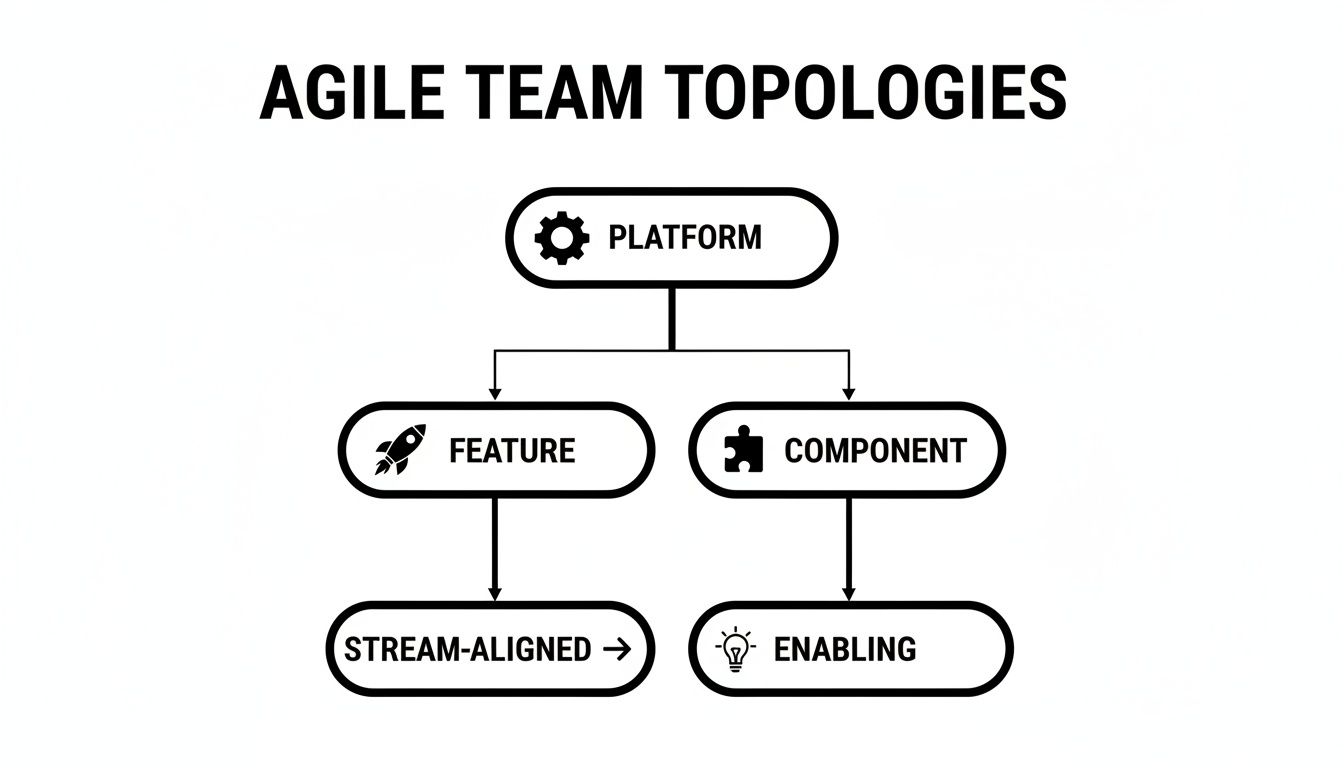
Each layer supports the one above it, creating a system designed to deliver business value quickly and reliably. Now, let’s meet the key players.
Strategic and Leadership Roles
At the helm of any project are the leaders focused on the big picture: vision, strategy, and process. They ensure the team is building the right thing, the right way.
- Product Manager (or Product Owner): As the voice of the customer, the Product Manager owns the product vision, manages the backlog, and prioritizes work based on user needs and business goals. They constantly answer the "what" and the "why."
- Scrum Master/Agile Coach: A facilitator and process guardian. Their role is to remove impediments, improve collaboration, and ensure the team adheres to agile principles. They are servant leaders focused on optimizing team workflow and health.
Without this strategic direction, even a team of elite engineers can build a technically brilliant product that fails to meet market needs.
The Core Engineering and Design Engine
This group translates ideas into a functional product. They are the builders, architects, and craftspeople of the software world.
Software Engineers
Engineers write, test, and maintain the code that powers the application. They often specialize in key areas:
- Frontend Engineers: Build everything the user sees and interacts with in a browser or mobile app.
- Backend Engineers: Develop the server-side logic, databases, and APIs that form the application's engine.
- Full-Stack Engineers: Versatile professionals comfortable working on both the frontend and backend, able to contribute across the entire application.
UI/UX Designers
Designers are advocates for the user. They work to create a product that is not only visually appealing (UI – User Interface) but also intuitive, efficient, and enjoyable to use (UX – User Experience). They conduct user research, create wireframes, and collaborate closely with engineers to bring the vision to life.
Quality and Operational Excellence Roles
Building features is only half the battle. You also need to ensure the software is reliable, secure, and easily deployable. These roles form the backbone of a mature development process.
A team without dedicated quality and operations roles is like a race car without a pit crew. You might be fast for a few laps, but you're destined to break down when it matters most.
These specialists fortify the entire process:
- QA Engineers (Quality Assurance): The guardians of quality. QA engineers are dedicated to identifying and resolving bugs before they reach users. They create and execute everything from manual tests to sophisticated automated test suites.
- DevOps Engineers: The critical bridge between development (Dev) and IT operations (Ops). DevOps engineers build and manage the CI/CD pipeline, automate infrastructure, and monitor application health in production, enabling teams to ship better code, faster.
A well-rounded team integrates all these roles. In a small startup, individuals may wear multiple hats, but as you scale, the value of each specialized function becomes increasingly apparent for creating a robust and scalable software development team structure.
How to Choose the Right Team Structure for Your Business
Translating organizational theory into practice requires a pragmatic approach. Selecting the right software development team structure is not a one-size-fits-all exercise. It demands an honest assessment of your company's stage, project goals, and market pressures. When aligned correctly, your engineering team becomes a direct extension of your business strategy.
A structure that helps a startup race to an MVP will almost certainly hamstring an enterprise managing legacy systems. The key is to match your team’s design to your specific operational reality.
Tailoring Structure to Company Stage
Your company's maturity is the most significant factor in determining the optimal team model. Each stage presents unique challenges that require a different structural solution.
- Startups: The priority is speed and concept validation. A small, agile Generalist or Feature Team of four to six people is ideal. This lean setup enables rapid prototyping and MVP iteration without the communication overhead of larger, more specialized teams.
- Scale-ups: Growth introduces complexity. You must ship new features while managing accumulating technical debt. A Hybrid model, often incorporating elements like Squads and Chapters from the Spotify model, is a strong fit. It helps maintain velocity while building deep expertise in critical areas like security or data infrastructure.
- Enterprises: At this scale, you're managing complex, interconnected systems, often with significant legacy code. A combination of Component Teams for core services, Platform Teams for infrastructure, and Feature Teams for new product initiatives is a proven approach. This layered structure ensures stability while creating space for innovation.
Aligning Structure with Project Type
Beyond company size, the nature of the work itself should guide your decision. Building a new product from scratch is fundamentally different from modernizing a legacy platform.
A new product development project benefits immensely from an autonomous Feature Team. This structure provides the end-to-end ownership needed to take an idea from concept to launch. In contrast, a platform modernization project is better suited for a Component or Platform Team. They can focus on rebuilding foundational services without disrupting other teams' workflows.
Choosing your team structure is a strategic decision about resource allocation. You're deciding where to place your bets—on speed, technical depth, or long-term scalability. The right answer depends entirely on the game you're playing.
Project complexity and timeline also influence the ideal structure. Research shows that Agile teams are most effective when sized between four and ten members. While a startup building an MVP can succeed with a lean team, redesigning a complex application will require a larger, more specialized group. You can discover more insights on structuring teams for different project scopes.
Integrating Scalable Talent with Offshore Teams
As your needs evolve, integrating a dedicated offshore team can be a powerful strategic move. It allows you to scale your engineering capacity quickly and cost-effectively without compromising on quality. The key is to treat your offshore partners as integrated members of your organization, not temporary contractors. To make the right decision for your business, you must understand the different engagement models. Exploring the pros and cons of staff augmentation vs. outsourcing provides the clarity needed to choose the approach that best fits your long-term goals and delivers maximum ROI.
Putting Your Team Structure into Action
Selecting the right software development team structure is a critical strategic decision, but it's only the first step. Effective execution is what transforms a good plan into a high-impact engineering organization that drives business results.
This begins with establishing crystal-clear communication channels and processes. Non-negotiable agile ceremonies are the bedrock for keeping teams aligned and removing roadblocks before they escalate.
- Daily Stand-ups: A brief, daily huddle where the team syncs on progress, plans, and impediments. It’s a commitment to transparency and mutual support, not a status report for management.
- Sprint Retrospectives: Dedicated time after each sprint for the team to reflect on what worked, what didn’t, and how to improve. This ritual is where a culture of continuous improvement is forged.
Defining Success with the Right Metrics
You can't improve what you don't measure. Vague goals lead to vague outcomes. Focus on a handful of Key Performance Indicators (KPIs) that provide a true picture of your team's health, throughput, and impact.
Meaningful metrics go beyond tracking activity; they should tell a story about your team's flow, quality, and business impact. Great KPIs help you identify real bottlenecks, not just celebrate being busy.
Essential metrics include:
- Velocity: Measures the amount of work a team can complete in a single sprint, enabling more accurate future planning.
- Cycle Time: Tracks the time from when work begins on a task to when it is completed. Shorter cycle times mean faster value delivery to customers.
- Deployment Frequency: How often you push code to production. High frequency is a strong indicator of a mature and healthy DevOps culture.
A well-defined structure also provides the clarity needed for managing critical workflows, like mastering the software bug life cycle from discovery to resolution.
Avoiding Common Implementation Pitfalls
Even the best-laid plans can fail if you fall into common traps. Be vigilant against anything that erodes team trust, autonomy, and focus.
The two most common anti-patterns are micromanagement, which stifles morale and innovation, and unclear role definitions, which lead to confusion, duplicated effort, and interpersonal friction. Grant your teams clear ownership and the autonomy to execute, and they will build a structure that not only works but thrives.
Frequently Asked Questions
As you design your team structure, several common questions inevitably arise. Here are practical answers to the challenges leaders frequently encounter when optimizing their software development team structure.
What Is the Ideal Team Size?
The "two-pizza rule," popularized by Amazon, is a surprisingly effective guideline: if you can’t feed the team with two large pizzas, it’s likely too big. In practical terms, this translates to a team of four to ten people.
This size is the sweet spot. It's small enough to maintain agility and simple communication but large enough to encompass the diverse skills required to deliver complete work. A team of this size can move quickly without getting bogged down in bureaucratic overhead.
How Do You Integrate Remote and Offshore Developers?
Successfully integrating remote or offshore developers is not about geography; it's about inclusion and process alignment. They must be treated as core team members, not peripheral contractors. This requires deliberate effort.
- Standardize Your Tools: Ensure everyone uses the same platforms for communication (Slack), project management (Jira), and version control (Git). Consistency is key.
- Establish Core Hours: Identify a few hours of timezone overlap for synchronous collaboration. Use this window for daily stand-ups, brainstorming sessions, and critical meetings.
- Build a Unified Culture: Proactively combat distance-based silos. Include remote members in virtual social events, provide public recognition for their contributions, and ensure they have equal access to information and opportunities.
A seamless integration is less about location and more about shared processes and a sense of shared purpose. When everyone is aligned on goals and communication, geography becomes irrelevant.
When Should a Company Change Its Team Structure?
Your team structure is not static; it must evolve with your business. Re-evaluating your structure is critical during key transition points:
- Rapid Scaling: When hiring accelerates, the structure that worked for a small team can begin to crack under the strain of increased complexity and communication overhead.
- Product Maturity: The scrappy, generalist team that built your MVP may not be the right fit for maintaining and enhancing a mature, complex platform. A shift toward a more specialized, hybrid model is often necessary.
- Persistent Bottlenecks: If teams are consistently waiting on each other and development velocity grinds to a halt, it’s a clear sign that your current structure is creating friction instead of flow.
Summary and Next Steps
Choosing the right software development team structure is a foundational business decision that directly impacts your ability to innovate, scale, and compete. By moving from simple Generalist or Specialist models to more advanced topologies like Feature, Component, or Platform teams, you can align your engineering organization directly with your strategic goals.
The key is to match your structure to your company's stage, project type, and long-term vision. Remember that the ideal structure is not static; it must evolve as your business grows and market conditions change.
Your Actionable Next Steps:
- Assess Your Current State: Evaluate your company stage (Startup, Scale-up, Enterprise) and primary business objectives. Is your current structure a performance enabler or a source of friction?
- Identify Bottlenecks: Analyze your development lifecycle. Where are the delays? Are teams waiting on each other? Use metrics like Cycle Time to pinpoint problem areas.
- Design a Future-State Structure: Based on your analysis, map out a team structure that better supports your goals. Consider a Hybrid model or adopting elements of topologies like Feature or Platform teams.
- Implement and Iterate: Roll out changes incrementally. Clearly define roles, establish communication protocols, and use retrospectives to continuously refine the new structure.
Ready to build a high-performing engineering team that drives real business results? Group 107 provides premium offshore software development teams that integrate seamlessly with your organization, helping you scale efficiently and accelerate your time to market. Contact us today to build your ideal team.