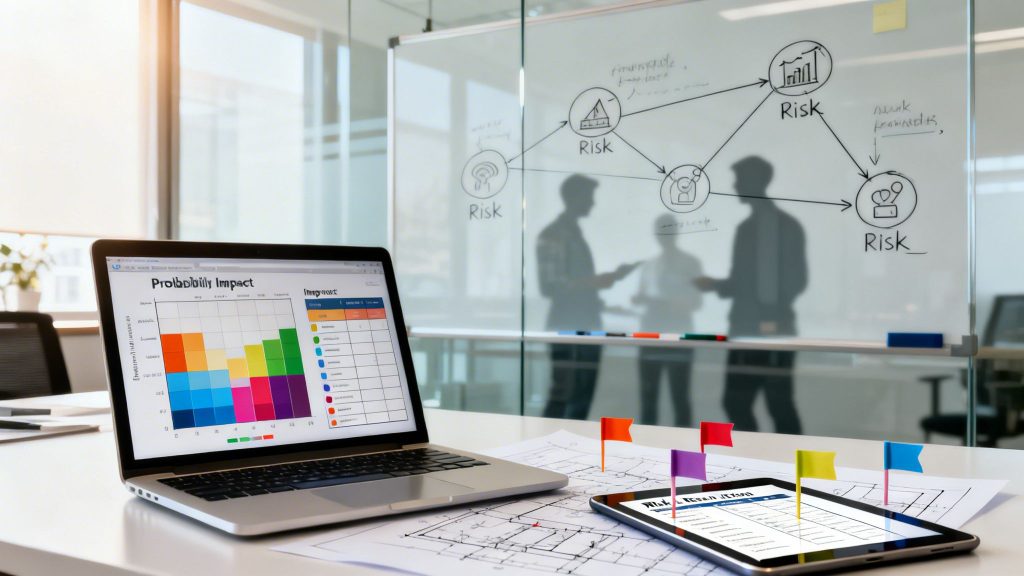
Software project risk management is the structured, proactive process of identifying, analyzing, and neutralizing potential threats before they derail your project's budget, timeline, or core objectives. It’s the strategic discipline that prevents minor hiccups from escalating into full-blown catastrophes, ensuring your investment delivers its intended business value.
Why Software Project Risk Management is Non-Negotiable

In high-stakes software development, "hope for the best" isn't a strategy; it's a recipe for failure. Launching a new SaaS platform, a complex fintech application, or a major e-commerce overhaul without a robust risk management plan is like navigating a storm without a compass. You know your destination—a successful launch—but the journey is filled with unknowns that can sink the entire initiative.
Unchecked risks are a primary driver of project failure, manifesting as budget overruns, missed deadlines, and products that miss the mark. The data is stark: a 2023 software project failure report found that 52.7% of projects exceeded their budget, while 31.1% were canceled outright. For any business, from a fast-moving SaaS startup to an established enterprise, ignoring risk is synonymous with planning to fail.
The Core Risk Management Lifecycle
Effective software project risk management isn't a one-off task performed at kickoff; it's a continuous, cyclical process. This lifecycle provides the structure to navigate uncertainty, make informed decisions, and transform potential disasters into manageable challenges. At Group107, we integrate this lifecycle directly into our web development and product delivery processes to safeguard our clients' investments and ensure predictable, high-quality outcomes.
This isn’t just theory; it's a practical roadmap that keeps your project on track. The entire process is built on four key pillars that we'll explore in detail.
The table below breaks down these foundational stages, providing a clear, high-level view of the framework.
The Four Pillars of Software Project Risk Management
| Pillar | Objective | Key Actions |
|---|---|---|
| Identification | Create a comprehensive list of all potential threats that could impact the project. | Conduct brainstorming sessions, analyze post-mortems from previous projects, interview key stakeholders, and perform a SWOT analysis. |
| Assessment | Quantify and prioritize risks to distinguish critical threats from minor issues. | Utilize a probability and impact matrix to score and rank each identified risk based on its potential damage and likelihood. |
| Mitigation | Develop concrete, actionable plans to address the most significant threats before they materialize. | Formulate strategies to avoid, transfer, reduce, or consciously accept each high-priority risk. |
| Monitoring | Continuously track identified risks, evaluate the effectiveness of mitigation plans, and scan for new threats. | Maintain a dynamic risk register, conduct regular review meetings, and monitor key risk indicators (KRIs). |
By embedding these pillars into your project workflow, you aren’t just reacting to problems—you're building a more resilient, predictable, and successful project from the ground up.
Identifying Common Software Project Risks
To manage risk effectively, you must first know what you're looking for. Think of risks as the latent vulnerabilities that can haunt a project from inception to launch. Before you can address them, you must bring them into the open. Categorizing risks helps focus your team's expertise and facilitates early detection.
Risks in software development rarely announce their arrival; they quietly fester. A minor, overlooked technical detail can easily snowball into a project-derailing disaster. Data shows that 62% of organizations were impacted by a critical risk event in the last three years, yet fewer than 40% have a formal risk management program. For tech startups and SMBs, where poor planning is a leading cause of failure, this oversight is particularly dangerous. You can explore further software development risk statistics to grasp the full scale of the challenge.
By sorting potential threats into key categories, you can build a more structured and thorough identification process.
Technical Risks
Technical risks arise directly from the technology stack, architecture, and development processes. While often most visible to engineering teams, they carry significant business consequences if unmanaged. Identifying them requires a deep understanding of the technology and how specific choices align with the project's strategic goals.
Common examples include:
- Technology Stack Obsolescence: Choosing a new, unproven framework can lead to a lack of community support, undiscovered security vulnerabilities, and a shallow talent pool. Imagine building a core fintech platform on a niche JavaScript library—future maintenance could become a costly nightmare.
- Integration Complexities: Modern software rarely exists in a vacuum. A new SaaS product might need to integrate with legacy enterprise systems, third-party payment APIs, and internal data warehouses. Each integration point is a potential point of failure that can cause data corruption, performance degradation, or complete service outages.
- Unforeseen Performance Bottlenecks: A system that performs flawlessly with 100 test users can collapse under the load of 100,000 real customers. Performance risks often hide in inefficient database queries, poor memory management, or an architecture not designed for scale.
Business Risks
Business risks stem from the gap between commercial objectives and project execution. These threats typically originate outside the development team and require close collaboration with business stakeholders to mitigate effectively.
A project can be a technical masterpiece and still fail if it doesn't solve a real market problem or align with strategic business goals. Business risks are about ensuring you’re building the right product, not just building the product right.
Key business risks to monitor include:
- Scope Creep: The classic project killer, where uncontrolled changes and "minor" feature requests accumulate, blowing past the original timeline and budget. A small tweak requested by one department can derail the entire roadmap and lead to team burnout.
- Changing Market Demands: The market moves fast. A competitor could release a disruptive feature, or customer preferences could pivot, rendering your product obsolete before it even launches.
- Stakeholder Misalignment: When key decision-makers disagree on the project's vision or priorities, the result is indecision, churn, and costly rework. This is a common challenge in enterprise environments where marketing, sales, and operations may have conflicting goals.
Operational Risks
Operational risks are rooted in the people, processes, and resources that drive the project. A brilliant strategy and a perfect tech stack are useless without effective execution. This is particularly critical for companies leveraging distributed or offshore development teams, where clear communication and process alignment are paramount.
Be prepared to manage these operational challenges:
- Resource Constraints: Projects can be starved of essential resources—skilled personnel, adequate funding, or the right tooling. This risk becomes acute when a key team member departs mid-project, creating a knowledge vacuum that is difficult to fill.
- Communication Breakdowns: With distributed teams across different time zones and cultures, simple misunderstandings can escalate. This is how features are built to the wrong specifications, wasting valuable time and resources.
- Third-Party Vendor Dependencies: Relying on an external vendor for a critical component places your project's timeline in their hands. If they go out of business, deprecate an API, or fail to deliver, your project suffers the consequences.
Frameworks for Effective Risk Assessment and Prioritization
Identifying risks is only the first step. The true value comes from understanding which threats warrant your immediate attention. A raw, unsorted list of what could go wrong is overwhelming and leads to "analysis paralysis." You need a structured framework to cut through the noise.
This is where risk assessment frameworks provide immense value. They offer a repeatable methodology for evaluating and ranking each risk, focusing your team’s energy where it will have the greatest impact. To do this effectively, teams often rely on established risk management frameworks to convert vague concerns into a clear, prioritized action plan.
Before assessment, you must categorize. Is it a technical challenge, a business misalignment, or an operational bottleneck?

Starting with the correct category ensures you evaluate each threat through the appropriate lens, whether it’s a security vulnerability or a budget shortfall.
The Central Role of the Risk Register
The risk register is your project’s single source of truth for all risk-related information. It is not a static document created at the project's outset and then forgotten; it's a dynamic tool that tracks every potential issue from identification through resolution.
A well-maintained risk register fosters clear communication and accountability. For each logged risk, you should capture these key details:
- Risk ID: A unique identifier for tracking.
- Description: A concise, clear summary of the potential problem and its cause.
- Category: Technical, Business, or Operational.
- Probability Score: The likelihood of the risk occurring (e.g., on a 1-5 scale).
- Impact Score: The severity of the consequences if it occurs (also 1-5).
- Risk Owner: The individual accountable for monitoring the risk and executing the response plan.
- Mitigation Plan: The specific actions to be taken to address the risk.
- Status: The current state (e.g., Open, In Progress, Monitored, Closed).
This structured approach transforms abstract anxieties into concrete, actionable data. It's a discipline that integrates seamlessly with various development methodologies, as detailed in our guide comparing https://group107.com/blog/agile-vs-waterfall-vs-scrum/.
Prioritizing Risks with a Probability and Impact Matrix
With probability and impact scores assigned, you can prioritize effectively using a Probability and Impact Matrix. This simple visual tool helps you plot where each risk falls, making it instantly clear which threats demand immediate attention.
The purpose of the matrix is to separate the critical, high-impact threats from the minor distractions. It prevents you from wasting resources on low-probability, low-impact issues and forces the most significant risks to the top of your action list.
Here’s how to put it into practice:
- Define Your Scales: Establish clear, objective criteria for what a "1" (low) and a "5" (high) mean for both probability and impact.
- Score Each Risk: Systematically review your risk register and assign probability and impact scores to each item.
- Plot the Risks: Place each risk on the matrix according to its two scores, with probability on one axis and impact on the other.
- Define Priority Zones: Color-code the grid into zones. Red signifies high-priority risks requiring immediate mitigation, Yellow for medium-priority risks to be monitored, and Green for low-priority risks that may be accepted.
To make scoring objective, use a clear rubric.
Sample Probability and Impact Scoring System
| Score | Probability Level | Impact Level (on project goals, budget, or timeline) |
|---|---|---|
| 1 | Very Unlikely (<10%) | Insignificant |
| 2 | Unlikely (10-30%) | Minor |
| 3 | Possible (30-60%) | Moderate |
| 4 | Likely (60-90%) | Significant |
| 5 | Very Likely (>90%) | Catastrophic |
Using a well-defined system like this removes subjectivity and ensures consistent risk evaluation across the team.
Ultimately, any risks that land in the top-right quadrant of your matrix—high-probability, high-impact—are your top priority. They demand an immediate and robust mitigation plan before they can jeopardize project success.
Actionable Strategies for Risk Mitigation and Control
You've identified and prioritized your risks. Now comes the most critical phase: taking action. This is where your software project risk management plan moves from theory to execution. A well-defined mitigation strategy for each major risk provides your team with a clear playbook, turning potential chaos into a series of manageable, proactive tasks.
Fundamentally, there are four ways to respond to a risk. Choosing the right one is a strategic decision based on the nature of the threat, its potential impact, and your project's constraints.
The Four Core Risk Response Strategies
Every risk response is a calculated trade-off. You can eliminate it, transfer it, reduce it, or accept it.
- Avoid: The most definitive strategy. If a risk is too significant or unpredictable, you can alter the project plan to eliminate the threat entirely. For example, if a planned integration with a new, unstable third-party API poses a major threat to your launch timeline, you might avoid the risk by removing the feature from the MVP and developing a simpler, in-house alternative for a future release. This isn't surrender; it's a strategic pivot to protect core objectives.
- Transfer: This strategy involves shifting the consequence of a risk, typically the financial impact, to a third party. The classic example is purchasing insurance, but in software development, it often means outsourcing. If your project requires specialized cybersecurity expertise that your in-house team lacks, you can transfer that risk by hiring an expert firm like Group107 to manage that component. The burden of managing that specific risk is now on their specialized shoulders.
- Mitigate: This is the most common risk management strategy. Mitigation involves taking proactive steps to either reduce the probability of a risk occurring or lessen its impact if it does. This is where best-in-class development and quality assurance practices deliver immense value. Implementing a comprehensive automated testing suite, for instance, directly mitigates the risk of critical bugs reaching production. For a deeper dive, explore our guide on software testing best practices.
- Accept: Sometimes, the cost and effort required to address a potential problem outweigh the risk itself. Acceptance is a conscious, documented decision to live with a risk without taking immediate action. This approach is best suited for low-probability, low-impact risks. A minor UI inconsistency on a seldom-used admin page might be accepted so the team can maintain focus on critical, customer-facing features. The key is that acceptance must be an informed decision, not an oversight.
Creating a Contingency Plan
Even the best mitigation plans can fail. That’s why you need a contingency plan—your "Plan B" for high-impact risks.
A mitigation plan is what you do to prevent a risk from happening. A contingency plan is what you do after it happens to control the damage and recover.
For example, your mitigation plan for a key developer resigning might include improving team morale and offering retention incentives. The contingency plan would be to have another developer cross-trained on their responsibilities, ready to step in with minimal disruption.
Here’s how to build an effective contingency plan:
- Define Triggers: What specific event activates the plan? Be explicit (e.g., "If the lead backend developer gives notice…").
- Outline Response Actions: Create a clear, step-by-step checklist of what to do immediately.
- Assign Ownership: Designate a single person who is responsible for executing the plan when triggered.
By defining these responses in advance, you empower your team to act swiftly and decisively under pressure, minimizing panic and protecting your project's budget and timeline.
Risk Management in Specialized Contexts

Effective software project risk management is never one-size-fits-all. While the core principles remain constant, the specific threats and mitigation strategies vary dramatically by industry and technical context. Applying a generic risk template to specialized domains like DevOps, offshore development, or fintech is insufficient. You must adapt your approach to the unique terrain.
Navigating DevOps and CI/CD Risks
In a DevOps culture, velocity is paramount. However, this speed introduces unique risks. The CI/CD (Continuous Integration/Continuous Delivery) pipeline is the lifeblood of modern software delivery, and any disruption can have immediate, widespread consequences. Proactive risk management is essential to protect this pipeline.
Common DevOps risks include:
- Deployment Failures: An automated pipeline can push defective code to production in minutes. To mitigate this, we implement automated testing gates, canary releases, and blue-green deployment strategies to isolate and validate changes before they affect all users.
- Infrastructure Vulnerabilities: With Infrastructure as Code (IaC), a single misconfiguration in a script can expose your entire system. This risk is managed through automated security scanning of code, mandatory peer reviews for all infrastructure changes, and principle-of-least-privilege access controls.
- Pipeline Bottlenecks: A slow or unreliable pipeline negates the velocity advantage of DevOps. Mitigation involves optimizing build times, parallelizing test execution, and continuously monitoring pipeline performance to identify and resolve bottlenecks.
Managing Offshore Development Teams
Leveraging offshore teams provides access to a global talent pool and can improve cost-efficiency, but it also introduces distinct operational risks. Without proactive management, challenges like communication gaps, cultural differences, and security concerns can stall a project. These issues are magnified on large-scale projects, as illustrated in this high-stakes risk management exercise in energy sector migration.
Our embedded team model at Group107 is specifically designed to mitigate these risks through tight integration and transparent communication.
- Communication Gaps: Time zones and language nuances can lead to misunderstandings. We mitigate this by assigning dedicated project managers, establishing overlapping work hours for real-time collaboration, and enforcing rigorous communication protocols.
- Cultural Differences: Varying approaches to problem-solving and feedback can create friction. Our model focuses on building a single, unified team culture with shared goals and processes from day one.
- IP and Data Security: Protecting client intellectual property is non-negotiable. We enforce strict security protocols, NDAs, and secure, role-based access to development environments to ensure all assets remain confidential and secure.
Addressing High-Stakes Fintech Risks
The fintech industry operates under intense scrutiny. Here, risks extend far beyond budget and schedule—they encompass regulatory compliance, financial data security, and public trust. Research shows that IT projects with budgets over $1 million are 50% more likely to fail, with one in six overrunning their budget by 200%.
For fintech platforms, risk management isn't a best practice; it's a core business function. A single compliance failure or security breach can result in massive fines, loss of licensing, and irreparable brand damage.
Key risks we proactively manage in fintech include:
- Regulatory Compliance: Navigating the complex web of regulations like GDPR, PCI-DSS, and Anti-Money Laundering (AML) is mandatory. This requires dedicated compliance expertise, regular audits, and embedding compliance checks directly into the CI/CD pipeline.
- Cybersecurity Threats: As high-value targets, fintech companies face constant cyberattacks. We mitigate this with a multi-layered security architecture, including regular penetration testing, threat modeling, and continuous security monitoring to protect sensitive financial data.
Tools and Technologies for Modern Risk Management
Attempting to manage complex software project risks in a spreadsheet is a recipe for failure. Information becomes outdated, updates are missed, and a manageable risk can escalate into a crisis before anyone notices.
Modern risk management is powered by specialized tools that centralize information, automate monitoring, and provide clear visibility for all stakeholders—from engineers to executives. The right technology transforms risk management from a static, administrative task into a dynamic, strategic advantage.
Many teams are already using project management platforms with powerful risk management capabilities. Tools like Jira, Asana, and monday.com can handle risk tracking natively or through integrations, weaving it seamlessly into your daily workflow.
Integrated Project Management Tools
For teams embedded in the Atlassian ecosystem, Jira is a natural choice. With add-ons like Risk Register, you can create a centralized log of all potential threats directly within your project boards. This co-locates the conversation about risks alongside the epics and user stories they impact, ensuring they remain visible.
Below is a typical Jira dashboard used for tracking project progress.
When risk management is integrated here, threats become as visible and actionable as new features, preventing them from being overlooked.
For teams that prioritize visual workflows and cross-departmental collaboration, Asana and monday.com are excellent choices. Their automation capabilities allow you to set up rules that trigger alerts when a risk's status changes or a mitigation task becomes overdue, ensuring nothing falls through the cracks. For a broader view, our DevOps tools comparison provides additional context.
Specialized Enterprise Risk Management Software
While integrated tools are effective for project-level risks, larger organizations face complexity at a different scale. This is the domain of specialized Enterprise Risk Management (ERM) platforms. These systems are designed for large-scale governance, compliance, and aggregating risk data across an entire portfolio of projects. They excel at handling complex reporting for regulators and auditors.
The right tool depends on your context. A lean SaaS startup can manage effectively with a Jira plugin. In contrast, a global financial institution navigating complex regulations needs a dedicated ERM solution to maintain control over hundreds of concurrent projects.
Here’s a quick comparison:
- Jira, Asana, monday.com: Ideal for startups, SMBs, and individual project teams. They excel at tracking operational and technical risks tied to daily development activities. Their per-user pricing model is highly accessible.
- Specialized ERM Platforms (e.g., Predict!, LogicManager): Built for enterprise, public companies, and highly regulated industries like finance and healthcare. Their strength lies in aggregating strategic risks, managing compliance, and generating audit-ready reports. They represent a more significant investment.
Ultimately, the best tool is the one your team will consistently use. It must integrate into your existing tech stack and provide clear, actionable insights that help you protect your project's success.
Your Top Risk Management Questions Answered
To conclude, let's address the most common questions we hear from teams implementing a formal software project risk management process.
How often should we conduct risk assessment meetings?
For teams using an Agile methodology, the ideal cadence is to review and update the risk register as part of your regular sprint planning and retrospective ceremonies. This integrates risk management into the natural rhythm of development.
At a minimum, a formal risk review should occur at each major project milestone. The goal is continuous risk assessment, not a one-time event at kickoff. As projects evolve, so do their risks.
What is the difference between a risk and an issue?
This distinction is simple but critical.
- A risk is a potential future event that could negatively impact your project. It’s a "what if."
- An issue is a risk that has already occurred. It’s a problem that exists right now and requires immediate resolution.
Effective risk management is the process of preventing risks from becoming issues.
Who is ultimately responsible for risk management?
While the project manager typically owns the risk management process, accountability is distributed across the entire team. It is a collective responsibility.
- Developers identify technical risks in code, architecture, and integrations.
- QA Engineers flag potential quality, performance, and security vulnerabilities.
- Business Analysts monitor for scope creep and requirement-related risks.
- Senior Stakeholders are responsible for making final decisions on strategic, high-impact business risks.
Can risk management be fully automated?
No. While you can and should automate parts of the process—such as using DevOps tools to monitor system health or running automated security scans—these are monitoring tools. The core activities of identifying, assessing, and planning for risks require human expertise, critical thinking, and collaborative discussion. Technology supports the process; it doesn't replace it.
Summary and Next Steps
Effective software project risk management is a strategic imperative, not an administrative burden. By systematically identifying, assessing, mitigating, and monitoring risks, you transform uncertainty into a competitive advantage. This disciplined approach is the foundation for delivering complex software projects on time, within budget, and to the highest quality standards.
Your actionable next steps are:
- Establish a Risk Register: Create a centralized document or use a tool like Jira to begin logging all potential risks immediately.
- Schedule Your First Risk Workshop: Bring your cross-functional team together to brainstorm and identify an initial list of technical, business, and operational risks.
- Define Your Risk Matrix: Agree on a clear scoring system for probability and impact to ensure consistent assessment.
At Group107, we build resilience into every project. Our integrated approach to development, including our expert offshore teams and end-to-end digital solutions, is designed to minimize risk and accelerate your path to market.
Ready to build your next project on a foundation of certainty? Partner with us today.