
Deciding between staff augmentation and outsourcing isn't just a resourcing choice—it's a strategic decision that shapes your project's outcome, budget, and timeline. The core difference is simple: staff augmentation adds skilled specialists to your existing team, giving you direct control over talent. Outsourcing delegates a specific outcome to an external partner, offering hands-off execution.
Understanding this distinction is critical. For any CTO, product leader, or engineering manager, this choice directly impacts project velocity, final quality, and your ability to innovate.
Choosing Your Tech Scaling Model
Getting this choice right is crucial for sustainable growth. Whether you're accelerating an MVP launch, modernizing a legacy system, or scaling your DevOps capabilities, the model you select determines how efficiently you can achieve your goals.
Think of staff augmentation as bringing in a surgical specialist. You need a senior DevOps engineer to optimize your CI/CD pipeline or a Python expert for a new AI feature, so you integrate them directly into your team. They report to your managers, adopt your processes, and collaborate daily with your full-time employees. This model is ideal when your project management is solid, but a specific skill gap is creating a bottleneck. A key advantage is its impact on your time to hire metrics; you onboard critical expertise in days, not months.
Outsourcing, on the other hand, is about handing over the keys to a finished product. You define a project—like building a new mobile app, managing the entire QA process, or running your cloud infrastructure—and delegate it to an external partner. They assemble their own team, implement their own project management framework, and are accountable for the final deliverable. This approach shines when a project is important but not a core business function, or when you lack the internal bandwidth to manage it directly.
It's also worth noting that hybrid models exist. For instance, a dedicated development team can blend the focused delivery of outsourcing with the deep integration of an in-house team. You can learn more about building and scaling with that approach here: https://group107.com/blog/dedicated-development-team-model-build-and-scale-teams/
Quick Comparison: Staff Augmentation vs. Outsourcing
To clarify the trade-offs, here's a high-level breakdown of how each model impacts control, cost, and team integration. Use this as a quick reference to guide your initial decision-making.
| Factor | Staff Augmentation | Outsourcing |
|---|---|---|
| Control | High—you directly manage the talent and day-to-day tasks. | Low—the vendor manages the project, team, and execution. |
| Integration | High—experts become a seamless part of your team and culture. | Low—the team operates as a separate, external unit. |
| Speed to Hire | Fast—fill critical skill gaps in days or weeks. | Slower—requires detailed scoping, vendor selection, and negotiation. |
| Cost Structure | Variable—typically a monthly or hourly rate per person. | Predictable—often a fixed price for the entire project scope. |
| Management Overhead | High—your leaders must onboard, manage, and guide the talent. | Low—the vendor handles all project and people management. |
Ultimately, the right choice depends on your priorities. If maintaining direct control and embedding knowledge within your team is paramount, staff augmentation is your best bet. If you need to offload a project completely to focus on core business objectives, outsourcing is the more strategic path.
A Deep Dive into the Core Differences
To move beyond definitions and make a truly informed decision in the staff augmentation vs. outsourcing debate, you must analyze the operational impact. The right choice ripples across your budget, project velocity, and ability to innovate. Let's break down the five critical areas that determine success.

Management Control and Integration
The fundamental difference between these two models comes down to a single word: control.
With staff augmentation, you maintain high, direct control. You manage these specialists just like your own employees. They participate in your daily stand-ups, use your Jira boards, and report directly to your team leads. This tight integration is perfect for agile environments where you need to pivot quickly based on market feedback. They become part of your team's DNA, absorbing your culture and contributing to a seamless workflow.
Conversely, outsourcing is defined by delegated control. You hand off a project or an entire function to a vendor who manages execution. They handle the team, the process, and final delivery. Your role becomes more strategic—you define the vision and review outcomes, but you aren't involved in daily task management.
The bottom line is this: with outsourcing, you're buying a result. With staff augmentation, you're buying dedicated expertise that you direct. This is a crucial distinction for projects where how you build is as important as what you build.
Cost Models and Budget Predictability
Your finance team will view these models through entirely different lenses. Staff augmentation almost always operates on a time-and-materials contract. You pay a set rate—hourly or monthly—for each person you bring on. This provides the flexibility to scale your team dynamically but can lead to less predictable monthly costs if the project scope expands.
Outsourcing, especially for well-defined projects, often uses a fixed-price model. You and the vendor agree on a total cost for a specific scope of work, detailed in a Statement of Work (SOW). This predictability is a major advantage for corporate budgeting. The catch? Any changes or new requirements will trigger change orders and additional costs, which can quickly erode the appeal of a fixed price.
Market trends reflect these financial differences. The global IT outsourcing market continues to expand as enterprises seek budget certainty, while staff augmentation sees rapid growth in tech-driven sectors where agility is key. You can discover more insights on these market dynamics to understand how different industries weigh control against cost.
Onboarding Speed and Time to Productivity
When speed is a priority, staff augmentation almost always wins. You're integrating an expert into an existing team and process, so onboarding is fast and focused. The goal is to get them productive within your workflow, which can often happen in days.
The process is direct and actionable:
- Technical Setup: Grant access to your code repositories, Slack, and development environments.
- Team Integration: Introduce them to the team, clarify project goals, and outline communication protocols.
- First Task: Assign a ticket to get them contributing to the codebase almost immediately.
Outsourcing requires a much longer runway. The process involves finding a vendor, negotiating a contract, scoping the project in minute detail, and then conducting a significant knowledge transfer. The vendor's team must learn your business logic and technical architecture from scratch, which can easily add weeks or months to the timeline before work begins.
Intellectual Property Protection
Protecting your IP is non-negotiable, and each model presents a different risk profile. With staff augmentation, the process is straightforward. Your augmented developers work directly for you, on your systems, and under your policies. They are typically bound by the same employment contracts and NDAs as your full-time staff, ensuring your code and trade secrets remain secure.
Outsourcing demands a more robust legal framework. Since an external team is building your product on their infrastructure, your contract must be airtight regarding IP ownership.
For any outsourcing engagement, ensure your contract includes:
- Clear IP Ownership Clauses: The agreement must state unambiguously that all intellectual property created belongs to you.
- Comprehensive Confidentiality Agreements: Strong NDAs must bind the vendor and every individual who touches your project.
- Strict Data Security Protocols: The vendor must comply with your security standards to prevent data breaches.
This makes outsourcing a higher-risk option for projects involving proprietary algorithms or sensitive data, particularly in regulated industries like SaaS, finance, and healthcare.
Talent Quality and Expertise Access
Both models provide access to a global talent pool, but the approach is different.
Staff augmentation allows you to hand-pick individuals with the precise, niche skills you need. Need a machine learning expert specializing in a specific Python library for your SaaS platform? You can find and interview that exact person. You maintain complete control over the vetting process, ensuring a perfect match for both your tech stack and your team culture.
Outsourcing gives you access to a pre-assembled, cross-functional team managed by the vendor. This is a significant advantage when you need a full squad—developers, QA engineers, a project manager, and a designer—without the overhead of hiring them individually. The trade-off is less control over who is on your project. The quality of work ultimately depends on the vendor's hiring standards, which can be a black box.
When Staff Augmentation Makes Perfect Sense
Choosing staff augmentation is a strategic play for when you must maintain absolute control, ensure tight integration, and accelerate project velocity. This model is most effective when your core team is strong but lacks one or two key skills needed to cross the finish line. It's a precision tool, not a blunt instrument.
For example, your development team has a clear roadmap and solid project management, but a new AI integration requires deep expertise in natural language processing. Or perhaps your CI/CD pipeline is hitting scalability limits, and you need a senior DevOps engineer now. Staff augmentation allows you to surgically insert that specific expertise directly into your workflow without disrupting team dynamics or project ownership.
Filling Critical Skill Gaps—Fast
The primary use case for staff augmentation is solving an urgent talent shortage. It is designed for situations where you need a highly specialized professional to start contributing immediately, allowing you to bypass the lengthy traditional hiring process.
This approach is a game-changer for scenarios like:
- Accelerating a project deadline by adding senior developers to clear a backlog.
- Integrating a new technology like AI or machine learning, where an expert can guide your team.
- Executing a product redesign by bringing in a seasoned UI/UX specialist for a few months.
- Modernizing a legacy system with an engineer who has deep experience in older architectures.
In these cases, you aren't handing off the project; you are empowering your team with the expertise needed to execute flawlessly. The new team member becomes a true extension of your organization, adopting your culture and processes from day one.
Keeping Full Control Over Your Product and IP
For many businesses, especially tech startups and companies in regulated sectors, maintaining total control over the product and intellectual property is non-negotiable. Staff augmentation is the only scalable model that guarantees this level of direct oversight. Your augmented team members work under your management, on your secure systems, and are bound by your NDAs.
This is absolutely critical for:
- Tech startups building an MVP: When the core product vision is evolving, direct control over every developer is key to iterating quickly and protecting your codebase.
- Fintech and healthcare companies: Direct management is often a compliance requirement, making it essential to have every person building your platform under your direct supervision.
While the global outsourcing market hit $731 billion in 2023, staff augmentation's focused growth underscores its value for filling expertise gaps in fast-paced industries like fintech and SaaS. It provides superior team control and flexibility for scaling in days versus weeks. You can read more analysis on this growing trend.
Scaling Your Team Up or Down with Ease
Business needs are never static. You might need to ramp up development for a major product launch, then scale back down once the feature is stable. Staff augmentation gives you the elasticity to adjust your team size on demand, without the administrative and financial burdens of hiring and laying off permanent employees.
This flexibility allows for more effective cost management. Instead of carrying a large, fixed payroll, you can tie your talent spend directly to revenue-generating projects. This approach turns talent acquisition into a nimble operational expense rather than a rigid, long-term commitment. For a detailed breakdown of how to budget for this model, see our guide on offshore team cost calculation.
When Does Outsourcing Make the Most Sense?
Outsourcing evolves from a simple resourcing tactic into a powerful strategic advantage when you need to delegate an entire project or non-core business function. It's designed for situations where the primary goal is to offload responsibility, access a full team of specialists, and achieve a predictable outcome without getting mired in day-to-day management. You are buying a result, not just renting talent.
The core principle behind smart outsourcing is focus. By handing off a well-defined project—like building a new application, managing your IT infrastructure, or handling 24/7 customer support—you free your in-house team to concentrate on what truly drives business growth. This is a fundamentally different mindset from staff augmentation, where the goal is to seamlessly integrate talent into your existing team.
When a Project is Well-Defined and Can Stand on Its Own
Outsourcing thrives on clarity. If you can draw a clear boundary around a project with a defined start and finish, a fixed scope, and measurable deliverables, it is an ideal candidate. The vendor takes your requirements and manages everything from team assembly and project planning to QA and final delivery.
This model is highly effective for projects like:
- Building a non-core application: An e-commerce company might hire an agency to build its new mobile shopping app. The business provides the vision, and the vendor executes the entire development lifecycle.
- Developing a specific software module: A SaaS company could outsource the creation of a new billing and subscription management system. It’s a distinct piece of work that can be developed independently and integrated later.
- Legacy system maintenance: A large enterprise can delegate the ongoing support for an older, stable system to a specialized firm, freeing up its top engineers for innovation.
Outsourcing is the optimal choice when you need a finished product, not another team member to manage. You are transferring the execution risk to a partner who specializes in delivering that specific outcome on time and within budget.
When You Need a Broad Range of Skills Under One Roof
Some projects require a diverse mix of skills that would be a significant challenge to hire for individually. Imagine needing front-end and back-end developers, a QA specialist, a UI/UX designer, and a project manager simultaneously. Assembling that team through direct hires or even staff augmentation is a massive undertaking.
Outsourcing eliminates this complexity by providing a pre-vetted, cross-functional team under a single contract. The vendor has already done the hard work of recruiting these professionals and understands how they collaborate effectively, drastically reducing your coordination overhead. It is a major benefit when you lack the internal capacity to manage different disciplines or simply need a complete, turnkey solution. To explore the various outsourcing models, check out our comprehensive software development outsourcing guide.
When Reducing Management Overhead is a Top Priority
A critical factor in the staff augmentation vs outsourcing decision is your management team's bandwidth. If your project managers and tech leads are already at capacity, adding more direct reports—even temporary ones—can lead to burnout and decreased quality.
Outsourcing is designed to minimize your management burden. The vendor handles day-to-day team management, removes roadblocks, and ensures the project stays on track. Your role shifts from daily oversight to strategic reviews and milestone approvals. This frees up your leadership to focus on product strategy and core business goals, making it an ideal choice for any organization looking to scale without expanding its management structure.
A Strategic Framework for Making the Right Choice
Choosing between staff augmentation and outsourcing is a strategic decision, not just a tactical one. The right call depends on a clear-eyed analysis of your project, your team's capacity, and your business objectives. This framework will help you move beyond gut feelings and into a structured evaluation that aligns your resourcing model with your growth strategy.
By systematically breaking down the key variables, you can confidently decide which path—hands-on control or delegated execution—will deliver the results you need, minimize risk, and maximize ROI.
Project Scope and Flexibility
First, analyze the nature of the work. Is the scope fixed, or is it an agile project that will evolve based on user feedback and market dynamics?
- For projects with a fixed scope—like a one-off database migration or a self-contained marketing website—outsourcing is a natural fit. You provide a detailed Statement of Work (SOW), and a vendor can execute it efficiently within a predictable budget.
- For projects with a dynamic scope, such as building a new SaaS product or an MVP, staff augmentation is the clear winner. Direct, day-to-day control over your augmented developers allows you to pivot quickly and build iteratively without constantly renegotiating contracts.
If your project's path is a winding road rather than a straight highway, you need the direct control that staff augmentation provides. Constant scope changes are a recipe for budget overruns in a fixed-price outsourcing model.
Internal Management Capacity
Be honest about your team’s ability to manage more people. Onboarding augmented staff adds to your management overhead. They need daily guidance, performance feedback, and integration into your team's culture, just like any other employee.
If you have experienced project managers and tech leads with the bandwidth to guide new talent, staff augmentation can be seamless. However, if your leadership is already stretched thin, adding more people can create a significant bottleneck. In that case, outsourcing becomes the more strategic option, as the vendor assumes all management responsibility for their team.
The flowchart below provides a quick visual guide for when outsourcing is the clear choice based on these key project attributes.
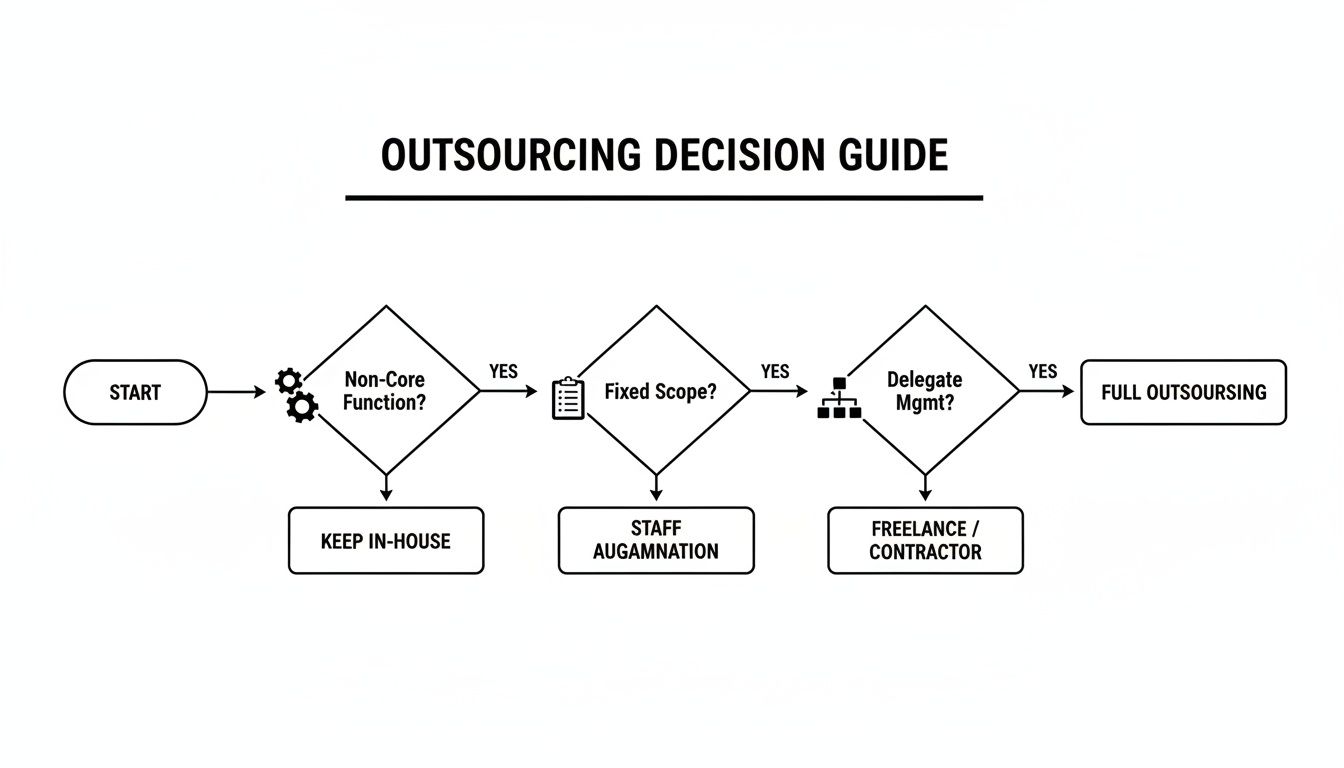
As the chart illustrates, outsourcing shines when a project is a non-core function, the scope is well-defined, and you prefer to delegate management completely.
Decision-Making Checklist
Use this checklist to systematically walk through the key criteria and determine which model best aligns with your specific situation.
| Evaluation Criteria | Questions to Ask Yourself | Favors Augmentation | Favors Outsourcing |
|---|---|---|---|
| Project Scope | Is the scope likely to change? Do you need to pivot quickly? | Yes | No |
| Control Level | Do you need direct, daily control over the development process? | Yes | No |
| Management Overhead | Do your managers have the time to guide new team members? | Yes | No |
| Core Function | Is this project a core part of your business's value proposition? | Yes | No |
| Speed to Start | How quickly do you need developers to start contributing? | Very Quickly (Days) | Slower (Weeks/Months) |
| Budget Model | Do you need cost flexibility or a fixed, predictable price? | Flexibility (Time & Materials) | Predictability (Fixed Price) |
| IP Sensitivity | Is the intellectual property highly sensitive or proprietary? | Yes | No |
| Team Integration | Is it critical for the new talent to feel like part of your team? | Yes | No |
Running through these questions provides an objective lens, ensuring your final decision is based on a comprehensive understanding of your needs.
Budget Structure and Speed to Market
Your financial constraints and timeline are often the deciding factors in the staff augmentation vs outsourcing debate. Each model is structured for different fiscal realities and operational tempos.
Ask yourself two critical questions:
- Is your priority budget predictability or flexibility? Outsourcing typically offers a fixed price, providing clear cost certainty from the outset. Staff augmentation uses a time-and-materials model, which offers flexibility but requires diligent budget management.
- How fast do you need to see results? With staff augmentation, specialists can be writing code and contributing to your project within days. Outsourcing has a longer ramp-up period involving vendor selection, contract negotiations, and detailed knowledge transfer, which can take weeks or months.
Intellectual Property Sensitivity
Finally, consider the sensitivity of the intellectual property involved. While strong contracts can protect your IP in an outsourcing agreement, nothing matches the security of keeping development under your direct control.
For any project involving proprietary algorithms, core business logic, or sensitive customer data—especially in regulated industries like finance or healthcare—staff augmentation is the safer choice. Your augmented developers work within your secure systems and follow your security protocols, dramatically minimizing the risk of IP leakage. When your competitive advantage is on the line, direct oversight is non-negotiable.
Finding a Partner to Fuel Your Growth

Ultimately, success with either staff augmentation or outsourcing depends on one factor: the quality of your technology partner. The right partner is more than a vendor; they are a strategic asset invested in your business goals and operating as a natural extension of your team. The wrong one leads to blown budgets, missed deadlines, and subpar results.
At Group107, we've engineered a hybrid model that delivers the best of both worlds. You get the direct control and seamless integration of staff augmentation combined with the strategic oversight and accountability of a dedicated technology partner. This model is designed for businesses that refuse to compromise on quality or control.
The Group107 Dedicated Team Model
We specialize in building premium, dedicated offshore software development teams that integrate directly into your company's workflow. Unlike typical vendors who may shuffle engineers between clients, our teams are 100% dedicated to your project.
What this dedicated model means for your business:
- Total Transparency: You have a direct line to every team member. You participate in daily stand-ups and have a real-time view of all project progress. No black boxes.
- Airtight IP Protection: All work is performed within your secure environment, under your direct supervision. Your intellectual property is never at risk.
- True Goal Alignment: Our teams don't just complete tasks; they adopt your mission. They are focused on delivering the same business outcomes you are.
Choosing a partner is about more than filling a skills gap. It's about building a relationship that creates sustainable growth. A true partner invests the time to understand your long-term vision and proactively shapes their engineering efforts to help you achieve it.
Solutions Built for Your Growth Stage
We understand that every business has unique needs. For clients requiring the speed and agility of staff augmentation, we provide top-tier, pre-vetted talent to reduce your time-to-market and fill critical expertise gaps.
For companies seeking a more comprehensive solution, we offer end-to-end services grounded in deep technical expertise. Our core strengths include:
- AI Integration: We design and implement AI solutions that drive relevant traffic, automate key processes, and unlock new revenue streams.
- DevOps as a Service: Our experts streamline your CI/CD pipelines and cloud operations to boost efficiency and reliability. Learn more about our DevOps services.
- Secure Fintech Platform Development: We build secure, intuitive platforms that transform complex financial processes into engaging user experiences. To compare different provider models, you can explore BPO solutions and services.
By becoming a genuine extension of your team, we align our strategy and engineering with yours to deliver measurable business outcomes.
Frequently Asked Questions
When deciding between staff augmentation and outsourcing, the right choice depends on your project's specifics and long-term business goals. Here are answers to the most common questions we hear from leaders making this decision.
Which Model Is Better For Long-Term Projects?
For long-term projects that are likely to evolve, staff augmentation is almost always the better choice. When you integrate an augmented team member, they become a true part of your organization. They learn your culture, systems, and long-term vision, which is invaluable for knowledge retention and maintaining alignment as the project grows.
Outsourcing can work for ongoing but clearly defined functions like IT maintenance or support. However, for core product development that will adapt over months or years, the direct control and flexibility of augmentation are superior.
How Should I Manage An Augmented Team Member In A Different Time Zone?
Managing remote team members across time zones requires a systematic approach, not just constant online availability. Success hinges on a few key practices:
- Establish Overlap Hours: Ensure a few hours of overlapping work time for daily stand-ups, real-time collaboration, and quick syncs.
- Standardize on Tools: Use a robust project management tool like Jira for a single source of truth on tasks and progress. Use communication platforms like Slack for daily interaction.
- Set Clear Communication Protocols: From day one, define expectations for response times, progress reporting, and meeting schedules.
A quality partner will provide engineers who are already experienced in working effectively across time zones, minimizing potential friction.
What Are The Hidden Costs Of Outsourcing?
While the fixed-price contracts of outsourcing seem appealing, you must account for hidden costs that don't appear on the invoice. Common hidden costs include:
- Vendor Management Overhead: The time your team spends managing the outsourcing partner can be significant.
- Knowledge Transfer: There's a real cost to onboarding the vendor's team initially and every time there's a change or new requirement.
- Rework and Revisions: If requirements are not perfectly clear, you will pay for the time it takes to fix misunderstandings.
- Scope Creep Charges: Any work that falls even slightly outside the original Statement of Work (SOW) will incur additional fees.
Your best defense against these costs is an incredibly detailed SOW that leaves no room for interpretation.
Can I Switch Between Models With The Same Partner?
Yes, and a strong technology partner should be structured to support this flexibility. A common path is to start with an outsourced project to launch an MVP quickly. Once the product is stable and you have built up your internal team, you can transition to a staff augmentation model to take more direct control over future development.
This hybrid approach allows your engagement model to evolve with your business. It is essential to discuss this possibility with potential partners upfront to ensure they can support your changing needs.