The scramble for top engineering talent is more intense than ever. What used to be a temporary fix—software development team augmentation—is now a core business strategy for scaling growth and gaining an immediate competitive advantage. It's about embedding expert engineers directly into your projects to accelerate your roadmap and access specialized skills on demand.
Why Team Augmentation Is a Strategic Imperative
Traditional hiring is too slow and expensive for today's market. It can stall critical projects for months, forcing you to shelve innovation while you search for the right candidate. This friction is a direct threat to your ability to compete and innovate.
Agile organizations understand that speed is everything. Team augmentation provides the flexibility to stay ahead of the curve. Instead of spending six months recruiting for a niche skill, you can have a seasoned professional integrated with your team in weeks, not quarters.
This model directly addresses the biggest challenges modern businesses face: the crippling developer shortage and the burnout of overstretched in-house teams. It's not about filling seats; it's a practical, results-driven solution for gaining a tangible competitive edge.
The Widening Global Talent Gap
The global shortage of software developers has become a significant bottleneck for technology-driven companies. The numbers are staggering—the worldwide shortage is expected to balloon from 1.4 million in 2021 to a projected 4.0 million by 2025.
Some critical talent shortage findings even predict a global shortfall of 85.2 million skilled workers by 2030, which could cost the economy trillions in lost innovation.
Team augmentation is no longer a stopgap measure. It is a fundamental component of building a resilient and scalable workforce, enabling companies to build, iterate, and innovate without being constrained by local talent pools.
Tapping Into Specialized, On-Demand Skills
The core value of team augmentation is immediate access to highly specialized skills that are either impossible or cost-prohibitive to hire full-time. Whether you need an expert in AI, cloud infrastructure, or cybersecurity, you can inject that talent directly into your team precisely when you need it.
This approach delivers critical business outcomes:
- Accelerated Time-to-Market: Add the precise engineering firepower required to meet deadlines and launch new products and features faster.
- Enhanced Innovation: Bring in fresh perspectives and advanced technical knowledge to solve complex problems and build next-generation solutions.
- Strategic Agility: Scale your development capacity up or down as project demands change, ensuring you only pay for the resources you actively use.
By building a dedicated, embedded team from a top talent hub, you gain more than just extra capacity. You secure a competitive advantage, accelerate your product roadmap, and establish a foundation for sustainable, scalable growth. For a deeper dive, see our guide on managing offshore software development teams at Group107.
Team Augmentation vs. Outsourcing And Other Models
Choosing the right model to scale your engineering team can be complex. You'll encounter terms like outsourcing, managed services, and team augmentation, often used interchangeably. However, they represent fundamentally different approaches. Software development team augmentation is distinct from traditional outsourcing, and understanding the difference is key to making a sound strategic decision.
The primary distinction lies in two factors: control and integration.
With team augmentation, you are not simply delegating a project and hoping for a positive outcome. You are embedding skilled, senior-level engineers directly into your team. They operate under your leadership, adopt your processes, and become an integrated part of your company culture. This model is designed to enhance your team's existing capabilities, not replace them.
Traditional outsourcing is about delegation. You hand over an entire project to a vendor who manages it from start to finish, with your involvement limited to high-level check-ins. While it can be effective for non-core tasks, it creates a rigid boundary between your core team and the individuals doing the work.
Breaking Down The Key Differences
To make the right choice, you must evaluate each model based on your project's specific needs. For most technology leaders, the critical factors are direct control over the development process, seamless team integration, and long-term knowledge retention. Each model offers a different balance of these attributes.
For example, when building a complex SaaS product, deep domain knowledge is essential. Losing that expertise when a contract ends is a significant business risk. A formal make or buy analysis provides a useful framework for navigating these strategic decisions.
Let's compare the main engagement models to clarify their differences.
Team Augmentation vs. Outsourcing vs. Managed Services
This table provides a side-by-side comparison of how these models perform against key business criteria.
| Attribute | Team Augmentation (Dedicated Team) | Project Outsourcing | Managed Services |
|---|---|---|---|
| Control | You retain full control over the project, roadmap, and day-to-day tasks. | You delegate project control to the vendor, focusing on the final deliverable. | The provider manages a specific IT function based on a Service Level Agreement (SLA). |
| Integration | High. Augmented members integrate into your team, tools, and culture. | Low. The vendor's team works separately with its own processes and culture. | Medium. Integration is focused on service delivery, not deep cultural alignment. |
| Knowledge Transfer | Excellent. Knowledge is retained in-house as the augmented team works alongside your staff. | Poor. Institutional knowledge is typically lost when the vendor's contract ends. | Moderate. The provider holds the expertise, but it is not embedded within your team. |
| Flexibility | High. You can easily scale the team up or down as project needs evolve. | Low. The scope is typically fixed in a contract, making changes slow and costly. | Moderate. Scaling is possible but governed by the strict terms of the SLA. |
| Best For | Core product development, filling specific skill gaps, and accelerating aggressive roadmap goals. | Non-core projects and one-off tasks with clearly defined requirements. | Ongoing operational support, such as IT helpdesks, cloud management, or security monitoring. |
The differences are stark. One model provides a surgical instrument for precise team additions, while another is better suited for executing self-contained tasks.
Which Model Is Right For You?
There is no single "best" answer—the optimal choice depends entirely on your specific business objectives. However, clear indicators can point you toward the model with the highest probability of success.
This flowchart illustrates common pain points—from slow hiring and budget constraints to team burnout—that drive companies to seek external support.
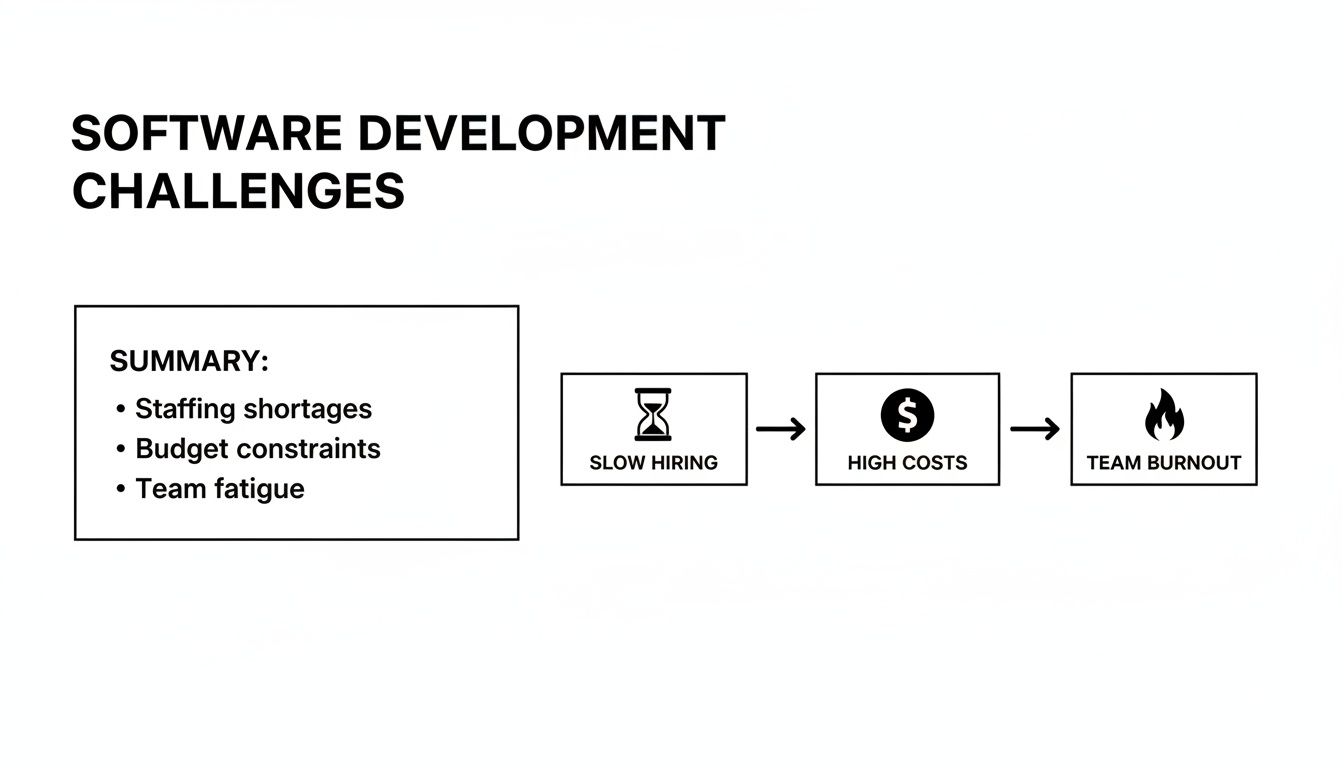
While any model can address one of these issues, team augmentation is uniquely equipped to solve several simultaneously.
Use this simple guide to inform your decision:
- Choose Team Augmentation if: You need to accelerate core product development, fill a critical skill gap, and maintain complete control over quality and direction. This is the preferred model for SaaS companies, fintech firms, and enterprises building proprietary technology.
- Choose Project Outsourcing if: You have a well-defined, non-critical project that can be managed at a distance, such as building a simple marketing website or an internal tool that doesn't affect your main product.
- Choose Managed Services if: You need to offload a specific, ongoing operational function like network monitoring or database administration. The goal is reliability and cost savings for a predictable service, not innovation.
To explore this topic further, our comprehensive guide on staff augmentation vs. outsourcing provides additional detail.
Ultimately, software development team augmentation offers a superior blend of flexibility, expert talent, and direct integration that strategic, long-term projects require.
The Real-World Business Impact of Team Augmentation
Let's move beyond theory to the tangible business outcomes. The true test of software development team augmentation is its impact on your balance sheet and product roadmap. This is not just a staffing solution; it's a strategic lever that directly affects your bottom line, speed to market, and ability to outmaneuver competitors. When executed correctly, it fundamentally transforms how you build and scale your engineering capabilities.
The most immediate benefit is speed. By gaining instant access to specialized, pre-vetted engineers, you can shrink your time-to-market from months to weeks. Instead of a critical project languishing in a six-month hiring queue, you can launch features and release products while your competitors are still conducting interviews.
Ship Faster and Innovate More
In hyper-competitive industries like SaaS and fintech, a few months' delay can mean the difference between market leadership and obsolescence. Team augmentation eliminates the hiring bottleneck, allowing you to assemble a dedicated project team in weeks, not quarters.
This rapid scaling enables you to:
- Seize Market Opportunities: Quickly mobilize the talent to build an MVP or a new feature set in response to emerging trends.
- Eliminate Technical Debt: Bring in specialists to refactor legacy code or modernize systems without diverting your core team from its roadmap.
- Execute Parallel Projects: Run multiple development streams simultaneously, dramatically increasing your overall product velocity.
By embedding experts directly into your workflow, you create a high-velocity environment where innovation is a constant, measurable output. This model provides the confidence to pursue more opportunities, knowing you have the engineering capacity to deliver.
Cut Costs, Not Corners
A powerful advantage of team augmentation is the significant reduction in overhead costs. Tapping into global talent pools provides access to world-class engineers at a fraction of the cost of hiring in expensive local markets.
These savings extend beyond salary to include hidden costs that inflate your budget:
- Recruitment: Eliminate hefty agency fees and the internal time consumed by hiring campaigns.
- Benefits and Payroll: Avoid the costs of health insurance, retirement plans, and other employee benefits.
- Infrastructure: Reduce the pressure to expand office space and purchase additional equipment.
The data supports this trend. The IT staff augmentation market is projected to reach $12.7 billion by 2026, driven by an insatiable demand for specialized skills. In the financial sector, 45% of US companies already use this model to build their platforms and enhance IT security. You can explore the factors driving IT staff augmentation for US companies to understand the momentum behind this shift.
Build a More Flexible, Resilient Organization
Markets pivot, priorities shift, and economic conditions are unpredictable. Team augmentation provides the operational elasticity to adapt to these changes. It allows you to ramp up your team for a major product launch and then scale back down to your core crew once the intensive work is complete.
This on-demand talent model creates a more resilient business. You avoid painful layoffs during downturns and prevent burnout from understaffing when opportunities arise. Your organization becomes more agile, ready to pivot to new challenges without being locked into a rigid, high-cost workforce. In any industry, that strategic flexibility is a powerful competitive advantage.
A Step-by-Step Implementation Framework
Successfully implementing software development team augmentation requires more than just finding a developer; it demands a structured, deliberate process. A robust framework ensures new team members integrate quickly, deliver value from day one, and function as a true extension of your core team. This practical playbook outlines a four-phase roadmap, from planning to full integration.

This guide will help you weave augmented engineers into your existing workflows, tools, and culture to build a single, high-performing engineering organization.
Phase 1: Define Your Objectives and Skill Gaps
Before initiating a search for a partner, you must achieve absolute clarity on your objectives. The success of the engagement hinges on precisely defining your goals and the specific skills required to achieve them. Vague requirements lead to suboptimal outcomes.
Start by asking these critical questions:
- What is the business goal? Are you trying to accelerate a product launch, eliminate technical debt, or build a proof-of-concept for a new AI feature?
- What specific technical skills are missing? Go beyond job titles. Do you need a backend engineer with deep experience in microservices architecture using Go? Or a DevOps professional proficient in Kubernetes and Terraform within an AWS environment?
- What seniority level is required? Be precise. Does the project require a senior architect to lead the strategy, or will a mid-level developer provide the necessary velocity for your sprint team?
This initial discovery phase is non-negotiable. A detailed brief becomes the foundation of your partner search, ensuring you only engage with candidates who are a perfect technical and strategic fit.
Phase 2: Select the Right Augmentation Partner
Choosing a partner is the most critical decision in this process. A great partner is not just a resume provider; they are a strategic ally who understands your industry, has a rigorous vetting process, and operates with complete transparency. To ensure a smooth process, look for partners offering dedicated implementation support.
When evaluating potential partners, focus on these criteria:
- A Proven Vetting Process: Ask detailed questions about their technical screening, coding challenges, and assessment of soft skills.
- Strong IP Protection and Security Policies: Ensure they have robust NDAs and clear contract language that protects your intellectual property.
- Cultural Alignment: A partner who understands your work culture—whether it's a fast-paced agile environment or a more structured enterprise—will find individuals who integrate seamlessly with your team.
A top-tier augmentation partner doesn't just find developers; they build dedicated teams. They invest time in understanding your product, roadmap, and culture to ensure a long-term, successful engagement.
Phase 3: Onboard and Integrate Your New Team Members
This is where your strategy becomes operational. The way you welcome augmented members sets the tone for the entire relationship. Treat them exactly as you would a new full-time hire, providing the tools, context, and support they need to be productive immediately.
Your onboarding plan should include:
- System and Tool Access: Provide access to code repositories, project management tools (like Jira), and communication channels (Slack or Teams) before their first day.
- Comprehensive Documentation: Share project briefs, architectural diagrams, coding standards, and other essential process documentation.
- A Designated "Buddy" or Mentor: Pair the new team member with an in-house engineer who can guide them, answer questions, and facilitate introductions.
Phase 4: Establish Clear Communication and Performance Metrics
Once new members are onboarded, consistent alignment is crucial. With distributed teams, proactive communication is essential. Establish a clear rhythm for meetings, feedback, and reporting to ensure everyone remains on the same page. Our guide on the 10 ways of managing offshore teams to boost performance offers more valuable tips.
Build a framework for success:
- Daily Stand-Ups: Use video to build human connection and identify blockers more effectively.
- Regular One-on-Ones: Schedule weekly or bi-weekly check-ins between augmented members and their direct manager to discuss progress and provide feedback.
- Define Success Metrics: Be explicit about KPIs from the start, such as story points completed, code quality scores, or adherence to project deadlines.
By following this four-phase framework, you can transform team augmentation from a simple staffing solution into a powerful strategic asset.
How to Choose the Right Augmentation Partner
Your choice of partner is the single most important factor determining the success of your software development team augmentation strategy. A great partner is a strategic asset; the wrong one introduces risk, friction, and subpar talent. This guide focuses on looking beyond the price tag to identify the critical qualities that define a world-class augmentation firm.

Making the right decision requires a structured evaluation. You are not just sourcing contractors; you are seeking a partner who builds dedicated, long-term teams invested in your success.
Scrutinize The Technical Vetting Process
A partner's value is directly tied to the quality of their engineers, which is a product of their screening process. Do not take their marketing claims at face value—dig into the how. A superficial review process is a significant red flag.
Ask specific, probing questions:
- What does your technical screening actually involve? Look for evidence of a multi-stage process, including live coding challenges, system design deep dives, and thorough reviews of past projects.
- How do you evaluate soft skills? Technical brilliance is ineffective without strong communication, problem-solving abilities, and a collaborative spirit.
- Can you validate expertise in our specific tech stack? They must prove they can vet for proficiency in your exact frameworks, languages, and cloud architecture.
A top-tier partner will have a rigorous, multi-layered process designed to identify the top 3-5% of talent. They should be able to walk you through this process in detail and provide anonymized examples of their screening criteria.
Prioritize Security, Compliance, and IP Protection
When granting a partner access to your codebase, security and intellectual property protection are non-negotiable. A casual approach to these issues exposes your business to significant risk. Your partner must have a robust, demonstrable framework for protecting your most valuable assets.
Your intellectual property is your competitive advantage. The partner you choose must have airtight legal and operational controls in place to protect it, ensuring that all code and knowledge developed remains exclusively yours.
Before signing a contract, ensure these requirements are met:
- Ironclad NDAs and Contracts: Their standard agreements must include strong confidentiality clauses and explicitly state that all IP developed is 100% your property. There should be no ambiguity.
- Compliance Certifications: If you operate in a regulated industry like finance or healthcare, inquire about their experience with standards such as SOC 2, ISO 27001, GDPR, or HIPAA.
- Secure Development Practices: Ask about their policies on secure coding standards and data handling protocols to ensure their engineers follow security best practices.
This due diligence is essential for protecting your business and maintaining regulatory compliance. Our guide to working with offshore software development teams offers additional insights on this topic.
Evaluate Operational Transparency And Cultural Fit
The best augmentation partnerships feel like a natural extension of your own team, not a transactional relationship. This requires two key elements: complete operational transparency and a strong cultural fit. You need clear visibility into their processes, and their engineers must align with your team's dynamics.
This is particularly important in fast-moving environments. While a traditional hire can take 60-120 days, a good partner can place vetted developers in weeks. Some can even deliver cloud engineers in 3-5 days or QA specialists in 24-48 hours. This speed is a game-changer, but it is only effective if the new team members can integrate seamlessly from day one.
Look for a partner who:
- Offers Flexible Engagement Models: They should adapt to your needs rather than forcing you into a rigid, one-size-fits-all contract.
- Facilitates Direct Communication: You must have a direct line to your augmented team members, free from unnecessary intermediaries.
- Understands Your Work Culture: Whether you are an agile startup or a structured enterprise, the partner must understand your environment and provide engineers who will thrive in it.
By thoroughly vetting potential partners on these core pillars—technical excellence, security, and cultural alignment—you can confidently select a firm that will become a true strategic ally.
Summary and Next Steps
The key takeaway from this guide is that software development team augmentation is more than a temporary staffing solution; it is a strategic lever for growth, innovation, and agility. We've explored why it's essential in today's competitive talent market, how it compares to other models, and the framework for successful implementation.
With the right partner and a clear strategy, you can build a high-performance engineering organization that consistently delivers on your business goals.
This model directly impacts what matters most: it accelerates your product roadmap, provides access to specialized skills on demand, and ensures you retain full control over your development process—all while managing costs effectively. It equips your company with the capacity to respond to market shifts with speed and confidence.
Your Action Plan
The first step is to conduct a candid assessment of your current team to identify the friction points that are impeding progress.
Ask these focused questions:
- What are our primary development bottlenecks? Are release cycles too long? Is technical debt accumulating? Or are we missing a specific area of expertise?
- Which skill gaps are hindering our roadmap? Do we need a senior DevOps engineer to optimize our CI/CD pipeline? Or an AI expert to develop a new feature?
- Where can additional resources deliver the greatest return on investment? Identify a high-value project that could be unlocked with the right talent.
By clearly defining your most pressing needs, you move from a general interest in team augmentation to a focused, actionable strategy. This clarity is crucial for finding a partner who can deliver tangible results.
Once you have identified these critical gaps, your path forward becomes clear. The final step is to translate this internal analysis into a conversation with an expert partner.
A partner like Group107 can provide the targeted software development, AI, or DevOps expertise needed to turn your vision into reality. Schedule a consultation to discuss how a dedicated team of specialists can help you achieve your goals faster and more efficiently.
Frequently Asked Questions
When considering augmenting your team, practical questions about logistics, security, and integration inevitably arise. Here are straightforward answers to the most common questions from founders and technology leaders.
How Does Team Augmentation Handle Time Zone Differences?
Time zone differences are a common concern but can be managed effectively with a structured approach. A skilled partner will establish a reliable overlap in working hours to facilitate seamless collaboration.
The optimal solution is a 4-6 hour overlap between your in-house and augmented teams. This window is dedicated to critical collaborative activities:
- Daily Stand-ups: To keep everyone aligned on progress and blockers.
- Sprint Planning & Retrospectives: To ensure the entire team contributes to the agile process.
- Real-time Collaboration: For pair programming, code reviews, and ad-hoc problem-solving.
Outside of this overlap, augmented engineers have uninterrupted time for deep, focused work, which often leads to a significant productivity boost.
How Is My Intellectual Property Protected?
Protecting your intellectual property is paramount. A reputable augmentation partner will have ironclad measures in place, combining legal safeguards with strict operational security protocols.
The legal framework must be unambiguous:
- Non-Disclosure Agreements (NDAs): Every engineer signs an NDA before gaining access to any project information.
- Master Service Agreements (MSAs): These contracts explicitly state that 100% of the intellectual property created by the augmented team belongs to you.
Operationally, your partner should enforce secure development practices, including tightly controlled access to code repositories and encrypted communication channels.
A top-tier partner ensures there is zero ambiguity in their contracts. All code, documentation, and project-related knowledge are unequivocally your property from day one.
What Does The Onboarding Process Typically Look Like?
A disorganized onboarding process can kill momentum. The best practice is to treat your augmented team members exactly as you would new full-time hires, focusing on rapid and effective integration.
The process typically includes these steps:
- Pre-Onboarding: Your partner works with you to arrange all necessary access in advance, including code repositories (Jira), and communication tools (Slack or Microsoft Teams).
- Day One Immersion: The new developer meets the team, receives an overview of the product architecture, and is briefed on the current sprint goals.
- Buddy System: Pairing the new member with an existing team member is highly effective. This mentor can answer questions about company culture, coding standards, and internal workflows.
A structured onboarding process makes the engineer feel like a valued part of the team from the start and significantly shortens their time-to-contribution. For more on this, consult our guide on managing offshore teams at Group107.
Ready to fill your talent gaps and accelerate your roadmap? Group107 provides senior-level software development teams that integrate seamlessly with your existing crew. Let's discuss how our experts can help you scale intelligently and achieve your goals faster.