The Software Development Life Cycle (SDLC) is a structured roadmap for building and deploying high-quality software. It’s a methodical process that transforms a conceptual idea into a market-ready product, breaking down the complex task of software creation into distinct, manageable phases—from initial planning and design to coding, testing, and ongoing maintenance.
Adopting a formal SDLC is not just a technical formality; it’s a strategic business imperative that ensures projects are delivered on time, within budget, and aligned with stakeholder expectations.
Why a Structured SDLC is Critical for Business Success
Imagine constructing a commercial building without a detailed architectural blueprint. The result would be chaos, wasted resources, and a structure that fails to meet safety and functional standards. The SDLC is that essential blueprint for your software. Without it, development projects risk spiraling out of control, leading to missed deadlines, budget overruns, and a final product that fails to deliver business value.
A well-defined life cycle aligns development teams, product managers, and business stakeholders around a common goal. It provides the framework needed to turn an innovative idea into a successful, predictable, and profitable software solution.
The Business Case for a Formal SDLC
Implementing a formal SDLC provides tangible benefits that directly impact your bottom line and competitive edge.
Here’s the business value it delivers:
- Predictability and Control: The SDLC establishes clear deliverables, timelines, and budgets for each phase. This gives project managers and investors transparent visibility into progress and resource allocation.
- Proactive Risk Mitigation: By identifying potential technical and business risks during the early planning and design phases, you can prevent costly rework and delays later in the project.
- Enhanced Product Quality: Dedicated testing and quality assurance phases ensure bugs are identified and resolved before reaching your users, resulting in a more stable, reliable, and secure product.
- Strategic Alignment: The SDLC framework ensures that every development activity is directly tied to the initial business requirements, preventing scope creep and guaranteeing the final product solves the intended problem.
A formal SDLC moves development from an unpredictable art to a manageable science. It provides the visibility and control needed to turn ambitious software ideas into market-ready products that perform.
Modern software development has decisively shifted toward iterative, continuous methodologies. Models like Agile and DevOps are now the industry standard, with Agile adoption reported above 70% among software teams. Businesses can no longer afford to wait months for a single release. These models, with their focus on continuous delivery, can slash development cycles from months down to hours for high-performing teams.
This velocity is critical, especially when considering that maintenance and ongoing support can consume 60–90% of a system’s total life-cycle cost. An efficient SDLC helps manage these long-term costs from day one. To understand how the SDLC fits into the broader product journey, it’s also valuable to explore the related product management life cycle.
The 7 Phases of the Software Development Life Cycle
The Software Development Life Cycle (SDLC) is a flexible framework, not a rigid set of rules. It guides a project through a series of logical stages, ensuring a systematic approach from concept to launch. Each phase builds upon the previous one, creating a clear path to delivering a high-quality product.
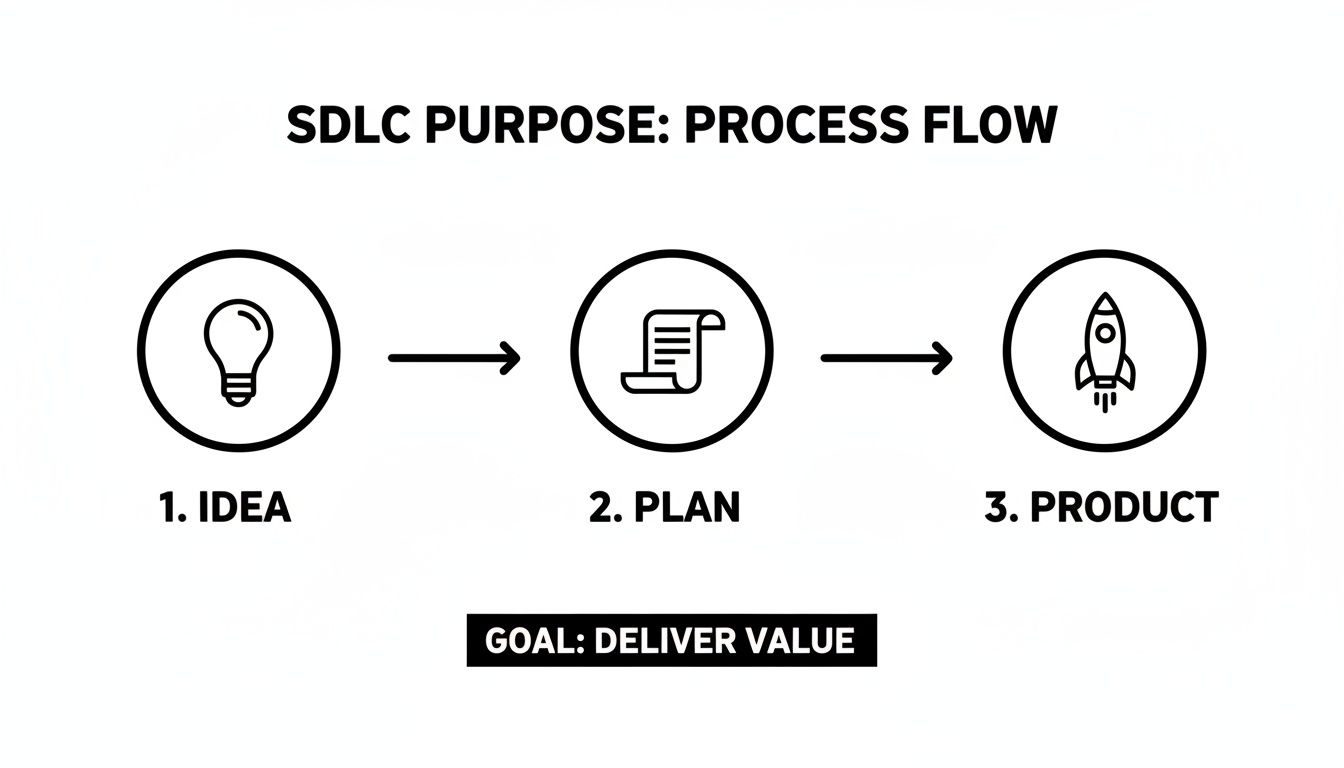
This process flow simplifies the SDLC’s core purpose: to channel an initial idea through a structured plan to deliver tangible business value.
Successful software is the result of a deliberate, methodical process. Let’s break down the actionable steps within each of these seven development phases.
Phase 1: Planning
Before writing a single line of code, you must establish a solid strategic foundation. In the planning phase, senior team members, project managers, and key stakeholders collaborate to define the project’s scope, goals, and feasibility. This is where the strategic “why” behind the software is solidified.
Key questions addressed at this stage include:
- What specific business problem are we solving for the end-user?
- What are the available resources (budget, personnel, timeline)?
- What are the primary risks and how can we mitigate them?
The output is a project plan that outlines the business case, resource allocation, and high-level timeline, securing stakeholder buy-in to move forward.
Phase 2: Requirements Analysis
With a high-level plan approved, the focus shifts to defining exactly what the software must do. Business analysts and product managers work closely with stakeholders to elicit and document detailed functional and non-functional requirements. This is arguably the most critical phase, as errors here have a cascading effect, leading to expensive rework later.
This stage translates broad business needs into specific, measurable, and testable requirements. These are formalized in a Software Requirement Specification (SRS) document, which serves as the definitive agreement between the development team and business stakeholders.
Phase 3: Design
The design phase is where the architectural blueprint for the software is created. Guided by the SRS, software architects and lead developers map out the system architecture, data models, user interfaces (UI), and user experiences (UX). They make crucial technical decisions that will shape the product’s scalability, performance, and maintainability.
The team produces a Design Document Specification (DDS) detailing:
- System Architecture: The high-level structure and how components will interact.
- Database Design: How data will be structured, stored, and accessed.
- UI/UX Wireframes: Visual mockups illustrating the user flow and interface.
For a new fintech application, this phase would involve designing secure authentication flows and mapping out how transaction data is processed and displayed, providing a clear guide for the development team.
Phase 4: Development
This is where the design blueprints are transformed into functional software. The development team writes the code, building the features and functionality defined in the previous phases. The project is typically broken down into smaller, manageable modules or tasks.
Adherence to established coding standards is crucial for maintaining code quality, consistency, and readability. Developers also perform unit tests on their code to verify that each individual component functions correctly before it is integrated into the larger system.
Phase 5: Testing
Once development is complete, the software is handed over to the Quality Assurance (QA) team. QA engineers conduct rigorous testing to identify and document bugs, defects, and performance issues. This process validates that the application is stable, secure, and meets all specified requirements.
The goal of the testing phase is not just to find bugs—it is to validate that the software meets all business requirements and delivers a seamless user experience before it reaches the customer.
Common testing types include:
- Integration Testing: Verifying that different software modules work together as expected.
- Performance Testing: Assessing speed, responsiveness, and stability under heavy load.
- Security Testing: Identifying and mitigating vulnerabilities to protect against cyber threats.
- User Acceptance Testing (UAT): Allowing end-users or stakeholders to validate the software against their real-world needs.
Phase 6: Deployment
After the software has successfully passed all testing stages, it is ready for deployment. This is the process of releasing the application to a live production environment where users can access it. Modern teams leverage automated CI/CD (Continuous Integration/Continuous Deployment) pipelines to make this process faster, safer, and more reliable.
Deployment can be a phased rollout to a limited user group or a full launch to all users. For an e-commerce platform, this is the “go-live” moment when the site becomes accessible to customers.
Phase 7: Maintenance
The software life cycle doesn’t end at launch. The maintenance phase is an ongoing process of monitoring the application’s performance, fixing bugs as they are discovered, and rolling out updates and new features. This crucial phase ensures the software remains functional, secure, and relevant over its entire lifespan. Ongoing support often accounts for up to 90% of a software’s total lifetime cost, highlighting the importance of building a high-quality, maintainable product from the outset.
Choosing Your SDLC Model: Waterfall vs. Agile vs. DevOps
Selecting the right SDLC model is a strategic decision that dictates how your team collaborates, responds to change, and delivers value. It’s not a one-size-fits-all choice; the optimal model depends on your project’s complexity, the stability of its requirements, and your overarching business objectives. The three predominant models today are Waterfall, Agile, and DevOps.
Understanding their core differences is essential for aligning your development process with your project goals, ensuring a smooth and efficient path from concept to delivery.
Waterfall: The Traditional, Sequential Approach
The Waterfall model is the classic, linear methodology for software development. It treats each phase of the SDLC as a distinct step that must be fully completed before the next one begins. Think of it as an assembly line: requirements are defined and locked in, then design is completed, followed by coding, and finally, testing.
This highly structured approach provides predictability and control, making it a good fit for projects where requirements are well-understood and unlikely to change.
Waterfall is best suited for:
- Highly Regulated Industries: Projects in finance or government where strict compliance and comprehensive upfront documentation are mandatory.
- Projects with Fixed Requirements: When scope, budget, and timelines are non-negotiable from the start.
- Simple, Well-Defined Projects: When the problem and solution are clear and have been successfully implemented before.
Agile: The Flexible, Iterative Framework
In contrast to Waterfall’s rigidity, Agile embraces change and flexibility. It breaks down development into short, iterative cycles called “sprints,” typically lasting one to four weeks. At the end of each sprint, the team delivers a small, functional piece of the software. This allows for continuous feedback from stakeholders, which is then used to adapt and refine the plan for the next sprint.
This iterative feedback loop enables teams to respond quickly to evolving market demands or user needs. Instead of a single “big bang” launch, value is delivered incrementally, ensuring the final product truly meets customer expectations. This adaptability has made Agile the dominant model for modern software development, particularly for SaaS products and mobile applications. To learn more, explore the core principles of the Agile methodology in the SDLC.
DevOps: A Culture of Speed and Automation
DevOps represents an evolution of Agile, combining cultural philosophies, practices, and tools to increase an organization’s ability to deliver applications at high velocity. It breaks down the traditional silos between development (Dev) and IT operations (Ops) teams, fostering a culture of collaboration and shared responsibility. The primary goal is to automate and streamline the entire software delivery pipeline.
DevOps relies heavily on automation, particularly through Continuous Integration and Continuous Delivery (CI/CD) pipelines. These automated workflows manage everything from code integration and testing to deployment, reducing manual errors and enabling teams to release updates frequently and reliably.
DevOps transforms the SDLC from a series of sequential handoffs into a seamless, automated flow. It prioritizes speed, reliability, and collaboration to meet the demands of a fast-paced market.
By integrating operations from the beginning, DevOps ensures that software is not only well-built but also runs efficiently and reliably in production. This end-to-end approach is ideal for large-scale enterprise applications and companies that require maximum development velocity.
SDLC Model Comparison: Waterfall vs. Agile vs. DevOps
This table clarifies the fundamental differences between the three primary SDLC models, helping you select the best approach for your specific project needs.
| Characteristic | Waterfall | Agile | DevOps (CI/CD) |
|---|---|---|---|
| Philosophy | Sequential, linear phases | Iterative and incremental | Continuous, automated flow |
| Requirements | Fixed and defined upfront | Evolve and adapt throughout the project | Evolve based on constant feedback and monitoring |
| Change Management | Rigid; changes are difficult and costly | Flexible; change is expected and welcomed | Proactive; changes are managed via automation |
| Delivery Cycle | Long; one final delivery | Short (1-4 weeks per “sprint”) | Extremely short (daily or even hourly releases) |
| Feedback Loop | At the end of the project | At the end of each sprint | Continuous and immediate |
| Team Structure | Siloed teams (dev, test, ops) | Cross-functional, self-organizing teams | A single, integrated Dev + Ops team |
| Best For | Projects with stable, unchanging requirements | Complex projects with evolving needs | Large-scale applications needing high velocity |
Choosing the right framework is the first step toward building a high-performing development process that aligns with your business goals.
Integrating Security and Accessibility into Your SDLC
In the past, security and accessibility were often treated as afterthoughts—features to be tacked on at the end of the development cycle. This approach is no longer viable. Today, integrating security and accessibility from the very beginning of the SDLC is a non-negotiable requirement for building successful, compliant, and user-centric products.
This proactive strategy is known as “shifting left.” It involves moving security and accessibility considerations as early as possible into the development process. Instead of being a final checklist item, they become core components of the project’s DNA, embedded in every phase.

From DevSecOps to Inclusive Design
In practice, shifting left means embedding these principles into your team’s daily workflows:
- Design: Architects and designers incorporate security threat modeling and accessibility standards (like WCAG) directly into wireframes and system architecture before any code is written.
- Development: Developers use Static Application Security Testing (SAST) tools to scan their code for vulnerabilities in real-time, catching and fixing issues as they code.
- Testing: QA teams use Dynamic Application Security Testing (DAST) to simulate real-world attacks and test with assistive technologies like screen readers to ensure the product is both secure and accessible.
When security becomes a shared responsibility across development, security, and operations teams, the result is DevSecOps—a culture that automates and integrates security into the entire CI/CD pipeline.
The business case for shifting left is clear. Building secure, inclusive software from day one reduces the risk of costly data breaches, ensures legal compliance (e.g., ADA), and expands your market by making your product accessible to a wider audience.
The Financial Impact of Early Detection
The cost of fixing a bug or vulnerability increases exponentially the later it is discovered in the SDLC. A defect found after release can cost up to 100 times more to fix than if it were caught during the initial design phase. This staggering cost differential is why modern SDLCs emphasize early and continuous testing.
By making security and accessibility integral to your SDLC, you are not just building a better product—you are making a sound financial decision that protects your bottom line. Following established web accessibility best practices from day one is the most effective way to build software that is robust, inclusive, and built to last.
How Group107 Elevates Your Development Lifecycle
A well-defined SDLC framework is essential, but achieving real business impact requires expert execution. At Group107, we act as a strategic partner, integrating seamlessly into your workflow to optimize every phase of the development lifecycle. We don’t just build software; we engineer scalable, secure, and high-performance solutions designed for growth.
Our methodology is focused on delivering tangible business outcomes. From the initial planning phase, we work with you to refine requirements, ensuring that every feature is directly aligned with a core business objective. This strategic alignment prevents scope creep and guarantees the final product solves the right problems for your users.
Accelerating Delivery with Deep Expertise
We help you accelerate your time-to-market by injecting specialized expertise precisely where it’s needed most. Our teams are masters of modern methodologies, balancing speed with uncompromising quality to drive your project forward efficiently.
We achieve this by focusing on three key pillars:
- DevOps and Automation: We design and implement robust CI/CD pipelines to automate testing and deployment. Our guide on what a CI/CD pipeline is explains how this streamlines releases and enhances reliability.
- Scalable Architecture: Our architects design systems built for future growth, ensuring your platform can handle increased demand without performance degradation—a critical requirement for ambitious SaaS and enterprise applications.
- Integrated Security (DevSecOps): We embed security best practices throughout the entire SDLC, from secure coding standards and threat modeling to automated vulnerability scanning, protecting your product from inception.
Partnering with Group107 transforms your SDLC from a procedural checklist into a strategic competitive advantage. We provide the technical depth and operational discipline to build better products, faster.
By leveraging modern AI automation tools, we can further enhance efficiency by automating repetitive tasks. Our deep expertise in AI, enterprise-grade security, and accessibility helps clients in demanding sectors like SaaS, finance, and e-commerce build solutions that are robust, compliant, and deliver an exceptional user experience. We turn your development lifecycle into a predictable, high-performance engine for business growth.
Common SDLC Questions Answered
Even with a well-defined process, practical questions often arise when implementing the software development life cycle. Here are expert answers to some of the most frequently asked questions.
What’s the most important phase of the SDLC?
While every phase is integral, Requirements Analysis is arguably the most critical. Errors or ambiguities at this stage have a compounding effect, leading to costly rework, missed deadlines, and a product that fails to meet user needs.
Investing extra time to meticulously define and validate requirements is the single most effective way to mitigate project risk. A clear and comprehensive SRS acts as the project’s north star, ensuring alignment across all teams and throughout the entire lifecycle.
How long does a typical SDLC take?
The duration of an SDLC is entirely dependent on the methodology you choose and the scope of the project.
- Waterfall: These projects are typically long-term, lasting from several months to over a year. The sequential nature means the entire product is delivered in a single release at the end of the cycle.
- Agile: Development is organized into short cycles (“sprints”) that last one to four weeks. A minimum viable product (MVP) can be delivered quickly, with additional features added in subsequent sprints.
- DevOps (CI/CD): In a mature DevOps culture, the release cycle is nearly continuous. Teams can deploy updates multiple times per day, allowing for rapid iteration and immediate response to user feedback.
Who are the key players involved in the SDLC?
Successful software development is a collaborative effort involving several key roles:
- Product Manager: Acts as the voice of the customer and the business. They define the product vision, prioritize features, and ensure the final product delivers market value.
- Software Architect: Designs the high-level technical structure of the system. They make critical decisions about technology stacks, scalability, and security to ensure a robust and maintainable foundation.
- Developers/Engineers: The builders who write, test, and maintain the code that brings the product vision to life.
- QA Engineers: The quality champions. They are responsible for identifying and documenting defects, ensuring the software meets all functional and non-functional requirements before release.
Summary and Next Steps
The Software Development Life Cycle provides an essential framework for building high-quality software efficiently and predictably. By understanding its phases, choosing the right model for your project, and integrating security and accessibility from the start, you can transform your development process into a powerful engine for business growth.
Actionable Next Steps:
- Assess Your Current Process: Evaluate your existing development lifecycle. Are there clear phases? Is your chosen model (e.g., Agile, Waterfall) a good fit for your projects?
- Identify Bottlenecks: Pinpoint areas where delays or quality issues frequently occur. This could be in requirements gathering, testing, or deployment.
- “Shift Left” on Security and Accessibility: Begin incorporating security and accessibility checks earlier in your process. Start with a basic checklist during the design and development phases.
- Explore Automation: Investigate how a CI/CD pipeline could automate your testing and deployment processes to increase speed and reliability.
Ready to transform your development process from a cost center into a strategic growth engine? The expert offshore teams at Group107 embed directly into your workflow to accelerate delivery, enhance security, and build products that win.