Digital transformation is a top priority for nearly every executive, yet successful implementation remains a significant hurdle for most organizations. The real challenges of digital transformation are rarely about technology alone. They are rooted in the more complex, human-centric elements: strategy, culture, and day-to-day execution. This gap between ambition and reality is precisely why so many expensive projects fail to deliver a meaningful return on investment.
Why Most Digital Transformations Fail

Let's be clear: digital transformation is not about installing new software. It is a fundamental reinvention of how a company operates, creates value, and competes. True success requires aligning people, processes, and technology under a single, coherent vision. When leaders treat transformation as just another IT project, they set the stage for failure from the outset.
The cost of getting this wrong is substantial, leading to wasted budgets, diminished team morale, and a loss of competitive advantage. The problem is so pervasive that despite trillions being invested in these initiatives, the results are often disappointing.
The Staggering Cost of Misalignment
The statistics paint a grim picture. Despite a global spend of $2.3 trillion on digital transformation, a staggering 84% of these projects flop. Digging into the reasons behind these transformation failures, the root cause is rarely the technology itself but rather fundamental strategic blind spots.
Too many companies attempt to layer a new AI tool or cloud service over decades-old systems without first addressing whether their underlying workflows are efficient or even relevant. The result? Productivity declines, employees become frustrated, and the entire initiative stalls. This proves a critical point: without a holistic strategy, even the best technology creates more chaos than it resolves. To succeed, leaders must begin by diagnosing the weak points in their own approach.
A successful digital transformation is built on a unified strategy that addresses technology, processes, and culture simultaneously. Ignoring any one of these pillars virtually guarantees failure, turning a strategic investment into a costly mistake.
Understanding the most significant roadblocks is the first step toward building a strategy that can withstand real-world pressures. A high-level view of where initiatives typically fail is a valuable starting point.
Core Challenges of Digital Transformation at a Glance
The table below breaks down the primary obstacles, providing a quick framework for identifying potential blind spots within your organization.
| Challenge Category | Primary Obstacle | Business Impact |
|---|---|---|
| People | Cultural resistance and skill gaps | Low adoption rates, decreased employee morale, and project delays. |
| Process | Outdated and inefficient workflows | Operational bottlenecks, poor customer experiences, and wasted resources. |
| Technology | Complex legacy systems and data silos | Limited agility, integration difficulties, and increased security risks. |
| Data | Poor data governance and quality | Flawed insights, unreliable decision-making, and compliance failures. |
Think of these categories as the four legs of a table—if any one is weak, the entire structure becomes unstable. Now, let’s explore each of these challenges in greater detail.
Navigating Cultural Resistance and Skill Gaps

Technology is just a tool; your people are the engine behind any successful transformation. The most significant—and most frequently underestimated—hurdle is the human element. You can implement the most advanced tech stack available, but it is useless if your teams do not understand it, trust it, or know how to leverage it effectively.
This is where many ambitious projects unravel. A sobering 70% of digital transformation projects are torpedoed by employee resistance. Why? Organizations often neglect the psychology of change. As 2040digital.com explains, this isn't mere stubbornness; it's rooted in genuine concerns about job security, the stress of learning new processes, and a lack of clear communication from leadership.
The Psychology Behind Resistance
Pushback is a natural human reaction to uncertainty. People cling to familiar workflows because they are comfortable and predictable. When new systems are introduced without context, it can trigger deep-seated fears.
The core reasons for employee resistance typically include:
- Fear of Obsolescence: Employees worry that new AI tools or automation will render their skills—and potentially their jobs—redundant.
- Discomfort with the Unknown: Learning a new system requires effort and often involves a temporary dip in productivity, which can be stressful.
- Lack of Perceived Benefit: If the "why" behind a change is not clearly communicated, your team will view it as an unnecessary disruption.
- Past Initiative Failures: A history of poorly managed projects creates cynicism, leading to a "this too shall pass" attitude.
Ignoring these psychological barriers is one of the biggest challenges of digital transformation and a direct path to low adoption rates, disengaged employees, and project failure.
Building a Change-Ready Culture
Overcoming resistance requires a deliberate, strategic approach. You must shift the narrative from a top-down mandate to a collaborative evolution, creating an environment where employees feel like active participants.
Consider a fintech company introducing a new AI-powered loan platform. The legacy process was manual but familiar, and the team resisted the change. Instead of forcing adoption, the company created cross-functional "champion" teams, pairing experienced loan officers with data scientists to co-design the new workflow. As a result, the most skeptical employees became the system's biggest advocates.
To build this kind of culture, focus on three key areas:
- Transparent and Continuous Communication: Establish clear, two-way channels. Explain why the change matters for the company and for individual roles, not just what is changing. Regular town halls, honest Q&A sessions, and genuine feedback loops are non-negotiable.
- Strategic Upskilling and Reskilling: Invest in targeted training. Move beyond generic software tutorials and provide role-specific programs that demonstrate how new tools will make jobs more valuable, not more complex.
- Empowerment Through Involvement: Involve your people in the design and testing phases. When employees help build the new process, they develop a sense of ownership that drives genuine buy-in.
True transformation happens when you stop pushing technology onto people and start empowering people with technology. The goal isn't just adoption, but advocacy.
Turning Roadblocks into Assets
Ultimately, your people are your greatest asset. By addressing cultural and skill-based challenges head-on, you can turn potential roadblocks into drivers of success. For example, a SaaS provider can implement a continuous learning program that not only teaches new coding languages but also cultivates a mindset of adaptability and innovation.
This approach requires more than a project plan; it demands empathy and expert change management. For organizations looking to scale engineering capacity or integrate advanced AI, partnering with a firm like Group107 provides more than technical expertise. It offers the strategic guidance needed to manage the human side of change. Find out how our offshore engineering teams can help you bridge both skill and cultural gaps.
Modernizing Legacy Systems and Processes

For any established company, technological debt is a major obstacle. Many digital transformation projects fail because new tools are layered on top of outdated, siloed legacy systems. This is like putting a Formula 1 engine in a car with a rusted frame—the foundation cannot support the power.
These old systems are often monolithic, built as a single, indivisible unit. Over decades, they become a tangled web of custom code, departmental workarounds, and fragile dependencies, making them extremely difficult to update or integrate with modern applications. A simple "lift-and-shift" to the cloud rarely solves the problem; it just moves the same issues to a more expensive environment without delivering real agility.
Why Integration Is the Real Technical Hurdle
The real work is not just replacement; it's about untangling complexity. True modernization means rethinking how technology supports your business by breaking down departmental silos and enabling the free flow of information across the organization.
Effective integration is critical. Without it, you are left with disconnected data, a disjointed customer experience, and operational friction that stifles innovation. As experts note when Cracking the Challenges of Data Integration, a solid strategy to unify systems and data formats is non-negotiable. This requires a new way of thinking about software architecture.
The goal is not just to acquire new tech. It is to build an agile, resilient, and scalable foundation that enables your business to adapt and innovate quickly. This means moving from rigid, monolithic structures to more flexible, interconnected architectures.
Adopting a DevOps and Microservices Mindset
To break free from legacy constraints, you need new ways of working. A DevOps mindset is essential. It involves dismantling the traditional walls between software development (Dev) and IT operations (Ops) teams. By fostering collaboration, automation, and continuous improvement, DevOps accelerates software delivery and enhances system reliability.
This cultural shift goes hand-in-hand with a technical one: transitioning from a monolithic architecture to microservices. Instead of one massive application, a microservices architecture comprises a collection of small, independent services. Each can be developed, deployed, and scaled autonomously, giving teams the freedom to innovate faster.
Modernization Approaches: Monolith vs. Microservices
| Attribute | Monolithic Architecture | Microservices Architecture |
|---|---|---|
| Development | Single codebase; changes require redeploying the entire application. | Independent services; teams can develop and deploy their service without impacting others. |
| Scalability | Must scale the entire application, even if only one component is a bottleneck. | Can scale individual services based on specific demand, optimizing resource use. |
| Resilience | A failure in one part of the application can bring down the entire system. | Failure in one service is isolated and does not affect the rest of the application. |
| Technology | Locked into a single technology stack for the entire application. | Each service can use the best technology for its specific job, enabling flexibility. |
As the table shows, microservices offer significant advantages in flexibility and resilience—crucial for today's fast-paced markets. This architectural shift is a major undertaking that requires careful planning. For a deeper analysis, see our guide on building an enterprise cloud migration strategy.
A Fintech Case Study: DevOps-as-a-Service in Action
Consider an enterprise fintech company constrained by its legacy core banking platform. Releasing new features took months due to complex code and manual testing, causing them to lose ground to more agile competitors.
They partnered with Group107 for DevOps-as-a-Service. We implemented a CI/CD (Continuous Integration/Continuous Deployment) pipeline, automating their build, test, and deployment process. Simultaneously, they began a gradual migration to microservices, starting with non-critical functions like customer notifications.
The impact was immediate. The automated pipeline reduced deployment times from months to days. The microservices approach allowed them to update features without risking the entire platform's stability. This was more than a tech upgrade; it fundamentally improved their ability to respond to the market, providing a significant competitive advantage.
Managing Data Security and Compliance Risks
Digital transformation exponentially increases the volume of data an organization handles. While this data is a valuable asset for generating insights and enhancing customer experiences, it also significantly expands your attack surface. Every new cloud service, API, and connected device represents a potential vulnerability.
This makes data security one of the most critical challenges of any transformation initiative. A breach is not just a technical issue; it is a business catastrophe that can shatter customer trust, result in severe fines, and cause long-term brand damage. The average cost of a data breach has now reached $4.45 million, a figure that demands executive attention.
Navigating the Regulatory Minefield
Beyond fending off attackers, organizations must navigate a dense web of regulations as data moves globally. Keeping up with compliance is a monumental task.
Different jurisdictions have their own non-negotiable rules, and non-compliance is costly. Key regulations include:
- GDPR (General Data Protection Regulation): The EU’s standard for data privacy, with fines up to 4% of global annual revenue.
- CCPA/CPRA (California Consumer Privacy Act/Privacy Rights Act): Grants California residents significant control over their personal data.
- HIPAA (Health Insurance Portability and Accountability Act): Essential for any organization handling protected health information in the U.S.
- WCAG (Web Content Accessibility Guidelines): While not a privacy law, non-compliance can lead to litigation and exclude users with disabilities.
A proactive approach is essential. Privacy and security must be integrated into your digital systems from the very beginning.
From Data Silos to a Cohesive Security Strategy
Many companies struggle with security because their data is scattered across legacy systems and disconnected cloud applications. These data silos create massive blind spots, making it impossible to enforce a consistent security policy. A true digital transformation breaks down these silos, but it must be done with a robust data management and security plan.
A proactive approach to security and compliance is not just a defensive measure—it's a competitive advantage. Demonstrating a commitment to protecting customer data and ensuring inclusive access builds the trust necessary to succeed in the digital economy.
To build true resilience, you must embed security throughout the development lifecycle—a practice known as DevSecOps. This makes security a continuous, automated part of the process, not a final checklist item. Building this resilience requires the right technology and processes. For a detailed look at the tools involved, review our guide on the best data security technologies to avert cyber threats.
A Practical Checklist for Security and Compliance
Here is a checklist to keep your security and compliance efforts on track during a digital transformation:
- Conduct a Comprehensive Risk Assessment: Identify where your sensitive data resides, who has access to it, and which regulations apply. Map vulnerabilities in both new and legacy systems.
- Implement a "Privacy by Design" Framework: Build data protection into the core architecture of your digital products from the initial concept.
- Automate Security and Compliance Checks: Integrate automated security tests and compliance scans into your CI/CD pipeline to catch issues early.
- Establish Robust Identity and Access Management (IAM): Adhere to the principle of least privilege, ensuring employees only have access to the data and systems necessary for their roles.
- Prioritize Accessibility Compliance: Ensure all new digital platforms and applications are built to WCAG standards to avoid legal risks and ensure usability for everyone.
Getting Leadership on Board and Nailing Down the Budget
Even the most brilliant digital transformation strategy will fail without two critical components: a champion in the C-suite and a realistic, protected budget. These are not just line items; they are the engine and steering for the entire initiative.
Securing them is often one of the biggest political challenges. It requires shifting the conversation from "How much will this cost?" to "What business value will this investment generate?"
From Cost Center to Growth Engine
To secure buy-in, you must speak the language of business leaders, not IT. Avoid technical jargon and connect every initiative to a tangible business outcome, such as increased revenue, improved customer lifetime value, or reduced operational costs. You must articulate how this transformation will build a stronger, more profitable company.
A powerful tactic is to calculate the cost of inaction. What market share will be lost? How much more will be spent on inefficient processes over the next two years? This creates a sense of urgency. For instance, a bank launching a new fintech app should not just present development costs but also project a 15% lift in user engagement and a 10% drop in customer service calls within the first year.
Leadership buy-in isn't a signature on a form. It's an active, ongoing partnership. It demands constant communication, honest reporting on progress, and a shared understanding that this is a journey, not a one-and-done project.
Show, Don't Just Tell: The Power of Early Wins
Large, multi-year projects make executives nervous due to the perceived risk of a distant payoff. The solution is to break down the initiative and deliver value in stages. An MVP (Minimum Viable Product) approach is ideal for this.
Instead of trying to achieve everything at once, focus on launching a small, high-impact feature quickly. This strategy:
- Delivers a quick win, building momentum and trust.
- Validates your approach by testing core assumptions with real users before the full budget is spent.
- Creates a feedback loop, allowing you to refine the plan based on user input.
This phased approach maintains engagement and provides the flexibility to pivot as needed without jeopardizing the entire initiative.
Why Sustained Support is Everything
Initial budget approval is just the first step. The real challenge is maintaining leadership engagement when obstacles arise. Statistics show that by 2025, 70% of projects are expected to fail to achieve employee adoption, primarily due to poor buy-in. Some research suggests up to 88% of transformations fall short of their goals, with human factors being the main culprit. You can explore the findings on transformation statistics to understand the criticality of this support.
This is why you need more than just developers. Dedicated UI/UX designers and data specialists are crucial for creating experiences users will adopt. However, without a leader consistently championing the cause, even the best-designed plan will eventually fail.
A Practical Framework for Making Transformation Stick
Theory is insufficient for navigating the complex reality of digital transformation. You need a repeatable framework that translates big ideas into tangible business results. Our model is built on four core pillars designed to move you beyond one-off projects and create lasting, sustainable change.
It begins with an honest assessment of your current state and a clear, shared vision of your destination.
Start by Assessing and Aligning Your Goals
Before writing a single line of code, define what success looks like. This means moving beyond vague goals like "going digital" to establish specific, measurable outcomes that align with business priorities.
- Audit Your Current Reality: Gain a clear understanding of your existing technology, processes, and people. Identify bottlenecks and legacy systems that hinder progress.
- Set Clear KPIs: Tie every initiative to a core business metric. A goal to "improve customer experience" should translate into a tangible KPI, like a 15% increase in Net Promoter Score (NPS) or a 20% reduction in support ticket volume.
- Get Leadership on Board: Use this data to build a compelling business case focused on ROI. Ensure your executive team understands the strategic value and champions the vision.
This first step grounds your entire effort in business reality. Securing buy-in is critical.
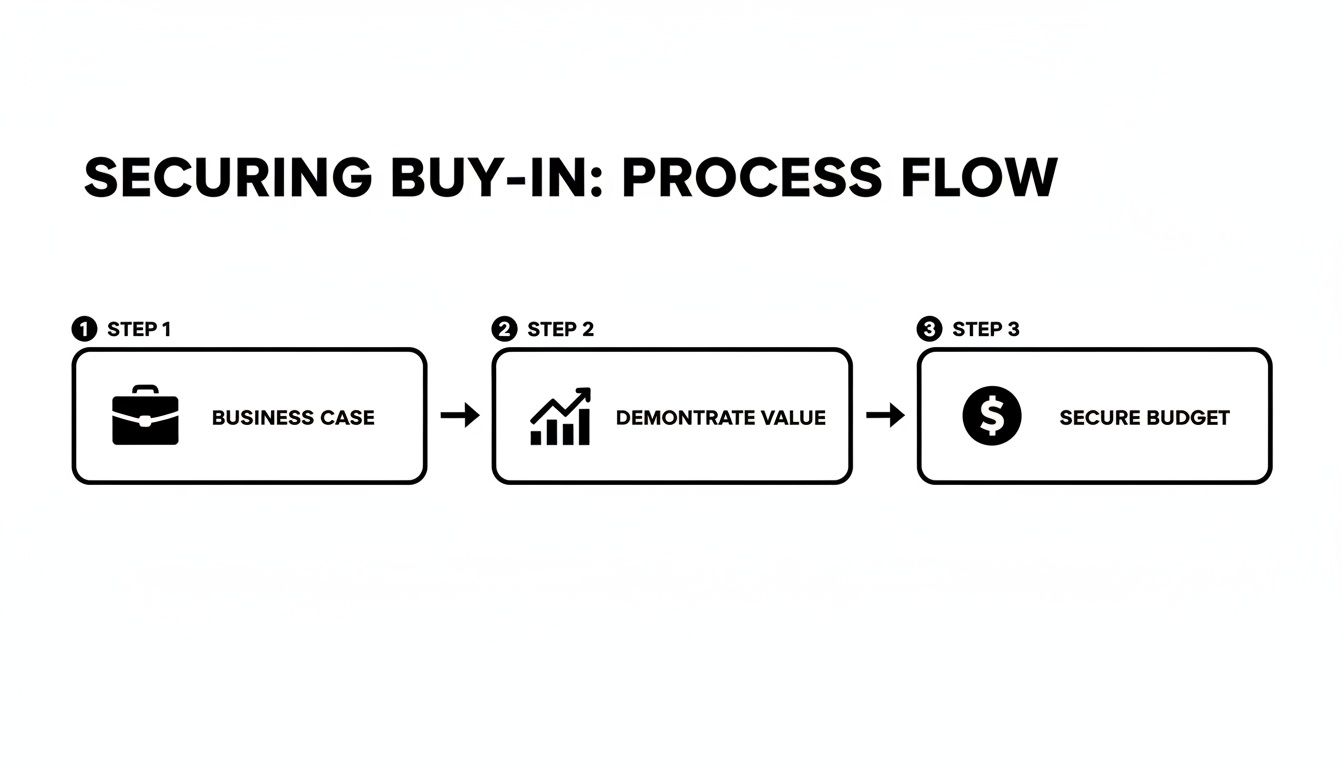
As shown, a strong business case that demonstrates value is the most direct path to securing the necessary budget.
Empower Your People
Technology is an enabler; your people make it work. Overcoming cultural resistance requires a deliberate investment in communication, training, and change management. Your teams must feel like they are part of the journey, not that changes are being imposed upon them.
Modernize Your Technology Stack
With clear goals and an engaged team, you can address the technology. This is about building a flexible, scalable foundation, not chasing trends. Adopt agile architectures like microservices and a DevOps culture to increase velocity and resilience. Every modernization effort should directly support your business goals and enable faster innovation.
Measure, Learn, and Iterate Constantly
Transformation is not a project with an end date; it is a continuous cycle of improvement. Establish feedback loops to monitor KPIs, gather user feedback, and track adoption rates. Use these insights to refine your strategy, address issues, and adapt to market changes. This iterative mindset mitigates risk and ensures you deliver sustained value.
This four-part framework provides a structured, repeatable process for driving real change. For a closer look at proven methods, exploring Digital Transformation Best Practices and Strategies can offer valuable guidance. To see our full methodology, review our complete guide to digital transformation best practices.
Summary and Next Steps
Overcoming the challenges of digital transformation requires a holistic, business-first approach. Success hinges not just on implementing new technology, but on navigating cultural resistance, modernizing legacy systems, ensuring robust security, and securing sustained leadership buy-in. By focusing on clear, measurable outcomes and empowering your people, you can turn these obstacles into strategic advantages.
Your next steps should be:
- Conduct a Reality Audit: Honestly assess your current state across people, processes, and technology to identify your biggest transformation roadblocks.
- Build a Value-Driven Business Case: Frame your initiative around clear KPIs and ROI, moving the conversation from cost to strategic investment.
- Prioritize an Early Win: Identify a small, high-impact project to deliver an MVP, build momentum, and demonstrate value to stakeholders.
Ready to turn transformation hurdles into your biggest competitive edge? The experts at Group107 have the strategic insight and engineering talent to align your people, processes, and technology. Get in touch with us today and let’s build a resilient, future-ready organization.