
Choosing a software development pricing model is more than an accounting decision—it's a strategic move that defines the entire trajectory of your project. It establishes the relationship with your development partner, allocates risk, and dictates your ability to adapt to market changes. The right model creates a win-win partnership, aligning your project goals with a financial structure that ensures transparency and maximizes your return on investment.
Why Your Pricing Model Is a Core Business Decision
Before a single line of code is written, selecting a pricing model is one of the most critical decisions you'll make. This choice directly impacts budget predictability, your agility in responding to market feedback, and the fundamental dynamic between you and your development team.
Think of it as setting the rules of engagement for success. A Fixed Price model, for instance, requires a perfectly defined scope from day one, offering predictability. In contrast, a Time & Materials (T&M) model is engineered for agility, allowing the project to evolve. Understanding these core differences is your best defense against scope creep, budget overruns, and misaligned expectations. For a deeper dive into managing these partnerships, our software development outsourcing guide offers practical insights.
A Framework for Strategic Selection
Viewing pricing models purely through a cost lens is a common pitfall. The true value lies in selecting a model that actively supports your business objectives.
- Risk Allocation: Who assumes responsibility for unexpected challenges? In a Fixed Price project, the vendor shoulders most of the risk. With T&M, it becomes a shared responsibility, fostering collaboration.
- Flexibility & Innovation: Does your project require the freedom to pivot or explore new opportunities? Models like T&M or a Dedicated Team are designed for this flexibility, whereas a rigid Fixed Price contract can stifle creative problem-solving and market responsiveness.
- Partnership Dynamics: Your chosen model shapes the working relationship. A value-based approach fosters a true partnership focused on shared business outcomes, while a transactional T&M contract centers on task execution.
The era of one-size-fits-all contracts is over. The software industry has shifted dramatically from legacy perpetual licenses toward flexible subscription and outcome-based agreements. Today, the average software company offers multiple pricing tiers to meet diverse customer needs, underscoring the importance of making a deliberate, strategic choice.
Key Pricing Models at a Glance
This table provides a high-level comparison to help you identify the best-fit model for your project’s unique characteristics.
| Model | Best For | Flexibility | Budget Control |
|---|---|---|---|
| Fixed Price | Small, well-defined projects (like MVPs) with static, crystal-clear requirements. | Low | High (Upfront) |
| Time & Materials | Long-term projects with an evolving scope, complex features, or R&D needs. | High | Medium |
| Dedicated Team | Scaling an in-house team for long-term, ongoing development with a dynamic product roadmap. | Very High | High (Predictable monthly cost) |
| Value-Based | Projects where the business impact (e.g., revenue uplift, cost savings) is clearly measurable. | Medium | Varies (Tied to ROI) |
Use this table as a starting point to align your project’s DNA with the right financial structure.
The Fixed Price Model: Predictability with Trade-offs
For many organizations, budget certainty is non-negotiable. The Fixed Price model addresses this need directly. It operates like commissioning a custom-built home: you agree on the blueprints, materials, and final price before construction begins.
The appeal is clear: you know exactly what will be delivered, when, and for how much. This predictability simplifies financial planning and eliminates the risk of unexpected invoices. The development partner assumes the responsibility of delivering the agreed-upon scope within the set budget.
When to Use a Fixed Price Model
A fixed-price contract excels when a project's requirements are meticulously defined and unlikely to change.
- Minimum Viable Products (MVPs): Startups require tight cost control to launch their core feature set without budget overruns.
- Small, Well-Defined Projects: Building a simple website, a specific API integration, or a small-scale application with a limited and clear scope is a perfect fit.
- Government and Public Sector Contracts: These initiatives often operate with strict budgets and demand comprehensive upfront planning, making the fixed-price approach a natural choice.
Success with this model hinges on exhaustive preparation. A comprehensive requirements document is non-negotiable. To master this critical planning stage, our guide on how to estimate software development time breaks down the inputs required for an accurate quote.
A Fixed Price contract shifts financial risk to the vendor. However, this means the vendor must build a contingency buffer into the price to cover potential unknowns, which can inflate the total cost.
The Inflexibility Challenge
While predictability is its main advantage, the Fixed Price model's greatest weakness is its rigidity. In a fast-moving digital landscape, what seems like a brilliant idea today could be obsolete in six months. This model struggles to accommodate change.
Any deviation from the original plan requires a formal change request, initiating a new round of negotiations on cost and timelines. This rigidity can stifle innovation. If your team discovers a breakthrough or receives critical user feedback mid-development, acting on it becomes a contractual hurdle rather than a strategic advantage.
Real-World Example: An e-commerce company signs a fixed-price contract to build a new checkout flow. Midway through, a key competitor launches a one-click purchase feature that customers love. To incorporate this now-essential feature, the company must initiate a scope change, delaying the launch and increasing the cost—a significant competitive disadvantage.
The Fixed Price model provides security for projects with an unchangeable scope. But for dynamic initiatives that require adaptation and evolution, its constraints can become a serious impediment to success.
The Time and Materials Model: Agility for Evolving Projects
When building an innovative product or when the path forward is not fully defined, the Time and Materials (T&M) model provides essential agility. Unlike a rigid fixed-price contract, T&M operates on a straightforward principle: you pay for the actual time your development team invests, plus the cost of any materials like software licenses or third-party services.
This model is the industry standard for complex, long-term projects with evolving requirements. It's ideal for modernizing enterprise platforms, developing AI-driven products, or any initiative where market feedback will actively shape the final outcome. The core benefit is adaptability.

Why T&M Drives Innovation and Speed to Market
The greatest advantage of the Time and Materials model is its unparalleled flexibility. Development can begin almost immediately, without a protracted discovery phase to finalize every detail, resulting in a much faster project kickoff.
Crucially, this model empowers your team to be responsive. When a new business opportunity arises or user testing reveals a better solution, you can pivot without cumbersome contract renegotiations. This iterative process leads to a higher-quality product that truly meets user needs.
- Adaptive Scope: Easily adjust priorities, add features, and modify functionality based on real-world feedback.
- Faster Time-to-Market: Begin development sooner and release features incrementally, creating a significant competitive advantage.
- Superior Product Quality: The continuous feedback loop enables constant refinement and improvement throughout the development lifecycle.
Transparent billing is essential for T&M success. Reliable developer time tracking software is critical for maintaining clarity and control over costs.
Managing Financial Risk in a Flexible Framework
The primary concern with T&M is the potential for an unpredictable budget. Without a fixed price, costs can escalate if the project lacks strong governance. However, this risk is entirely manageable with the right partner and robust controls.
The T&M model is not a blank check. It is a collaborative framework that demands clear communication, active client involvement, and rigorous project management to ensure costs remain aligned with value delivery.
The objective is to leverage flexibility without sacrificing budgetary control. By implementing specific risk-mitigation strategies, you can transform potential ambiguity into predictable, controlled expenditure.
Actionable Steps for T&M Success
A successful T&M engagement is built on trust and transparency. The key is to establish clear ground rules from the outset.
- Establish Budget Caps and Estimates: The absence of a fixed total cost does not mean an absence of financial planning. Set "soft" or "hard" caps for different sprints or project phases. Your development partner must provide detailed, rolling estimates to forecast upcoming costs and prevent surprises.
- Demand Transparent Reporting: Insist on regular, detailed reports that clearly outline hours worked, tasks completed, and any impediments. This visibility allows you to track progress against the budget and make informed decisions about future priorities.
- Maintain Open Communication: Schedule regular ceremonies—such as daily stand-ups or weekly reviews—to ensure constant alignment. Your active participation is crucial for guiding the development team and ensuring their work directly contributes to your business goals.
With these controls in place, the Time and Materials model becomes a powerful tool for building exceptional software that evolves with your business, turning flexibility into your greatest asset.
The Dedicated Team Model: A Strategic Partnership for Growth
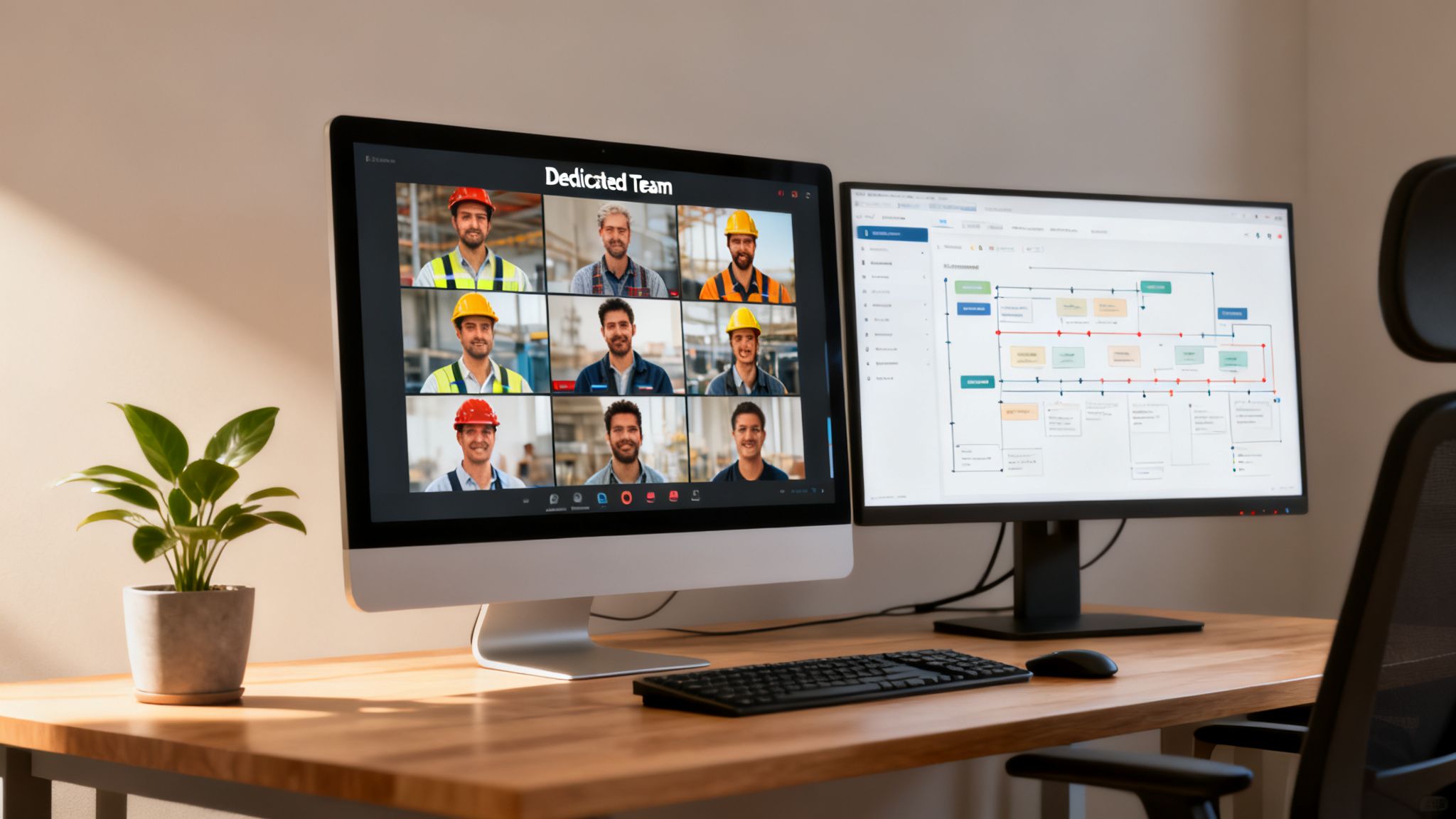
When your needs extend beyond a single project, it’s time to rethink your development resources. The Dedicated Team model is not just another pricing structure; it’s a strategic decision to build a long-term extension of your in-house staff with full-time, dedicated offshore or nearshore talent.
This model moves beyond task-based outsourcing to focus on building institutional knowledge. The team becomes fully immersed in your company culture, product roadmap, and long-term business objectives. This fosters a level of ownership and commitment that is impossible to achieve with short-term, project-based contracts.
Unlocking Scalability and Control
The core power of a dedicated team is its ability to scale development capacity rapidly and cost-effectively, without the overhead and administrative burden of direct hiring. You retain complete control over the team’s priorities and daily work, directing them just as you would an internal team. This direct command ensures your intellectual property remains secure and the team's expertise compounds over time, directly benefiting your business.
This model is a game-changer for several business types:
- Product Companies: For dynamic roadmaps requiring continuous feature development, updates, and maintenance, a dedicated team provides the engine for sustained delivery.
- Enterprises: Large organizations use dedicated teams to acquire specialized skills for major, long-term initiatives like digital transformation or legacy system modernization.
- High-Growth Startups: After securing a new funding round, a dedicated team helps accelerate development and drastically shorten time-to-market.
By choosing a dedicated team, you are not just hiring developers; you are investing in a stable, predictable engine for growth. Our guide on the dedicated development team model provides a deeper look at structuring these teams for maximum impact.
Favorable Economics in a Stable Market
While a dedicated team represents a recurring monthly investment, it offers significant cost advantages over hiring locally, especially in competitive tech hubs. You gain access to a global talent pool at a predictable rate, simplifying budgeting and financial forecasting.
The global market for development talent has matured, bringing stability. Recent analysis reveals that a remarkable 58.5% of companies plan to maintain their rates for 2025. The most notable growth occurred in the $20-$29 per hour bracket, driven by startups and SMBs seeking high-value, affordable talent. This trend underscores the strategic advantage of leveraging global teams to scale cost-effectively.
A dedicated team is a strategic asset, not just a cost-saving tactic. The team’s accumulated domain knowledge becomes a powerful competitive advantage, accelerating development cycles and enhancing product quality.
The Clear Choice for Long-Term Vision
When comparing software development pricing models, the dedicated team stands out for its focus on long-term value. Unlike project-based outsourcing where developers may juggle multiple clients, your dedicated team is 100% focused on your success. This undivided attention translates to faster progress, seamless communication, and an unwavering commitment to quality.
Consider a fintech company building a complex trading platform. A fixed-price project could deliver the initial version, but a dedicated team can evolve that platform for years—adapting to new regulations, integrating advanced features, and providing robust support. This transforms a development expense into a strategic investment that drives sustained business growth.
Innovative Pricing Models for Modern Business Challenges
Traditional software development procurement methods don't always align with today's complex business goals. Forward-thinking companies are now seeking pricing models that transcend billing for time and instead foster true partnerships.
These innovative approaches directly link the development firm’s success to the client's business outcomes. The focus shifts from merely shipping features to achieving measurable business results, creating a more collaborative and aligned engagement.
The Value-Based Pricing Model
This is the ultimate "shared-risk, shared-reward" model. With Value-Based pricing, you aren't paying for hours logged or tasks completed. Instead, the cost is tied directly to the business value the software delivers. This could be a percentage of new revenue generated, a share of cost savings realized, or achieving specific key performance indicators (KPIs).
This model requires a deep, mutual understanding of the client's business. Both parties must agree on how to define and measure success upfront. It is ideal for projects where the software's impact is unambiguous and can be tracked with concrete data.
A Value-Based model is a strategic alliance, not just a contract. When financial outcomes are directly linked, both parties are fully invested in achieving exceptional results.
Real-World Example: A financial services firm wants to build an AI-powered platform to automate loan processing. Their goals are to reduce manual processing time by 50% and increase loan approval rates by 15%. Under a value-based agreement, the development partner could receive a percentage of the operational cost savings in the first year, directly rewarding them for exceeding business targets.
The Subscription Model
Familiar to anyone who uses SaaS products, the Subscription model provides ongoing access to development, maintenance, and support for a predictable, recurring fee. This model is not for one-off projects but for businesses requiring continuous improvement and stable operational expenditure.
A subscription model is highly effective for:
- Ongoing Platform Enhancement: Continuously roll out new features and improvements to your core software product.
- Managed Services: Outsource DevOps, cloud infrastructure management, or cybersecurity to a trusted partner.
- Long-Term Support: Ensure a business-critical application remains secure, stable, and up-to-date.
The primary benefit is budget stability. A fixed monthly or annual cost simplifies long-term financial planning while ensuring your technology remains a competitive asset.
Navigating Challenges in the AI Era
While powerful, these modern models face new challenges with the rise of artificial intelligence. Traditional software pricing struggles to account for the unique costs and complexities of AI. As one analysis notes, the infrastructure required to run AI applications is significantly more expensive than for standard software. For a deeper look at how AI is disrupting pricing, see Stigg's insights on their blog.
The price volatility of GPU resources and foundational AI models makes it difficult to establish stable, long-term pricing. This is a particular challenge for the Value-Based model. How do you isolate the value created solely by an AI feature when numerous other market forces and business activities are at play? Success requires robust, data-driven attribution methods and a mutual commitment to adapt the agreement as the technology landscape evolves.
How to Choose the Right Software Development Pricing Model
Selecting the right software development pricing model is a strategic decision that shapes your entire project. There is no single "best" option; the optimal choice depends entirely on your project's specific requirements, budget constraints, and long-term objectives. Making the right decision upfront is the most effective way to prevent misunderstandings and ensure the financial structure supports your goals.
The decision comes down to answering a few core questions about your project's DNA. By evaluating scope clarity, budget flexibility, timeline pressures, and your desired level of involvement, you can quickly identify the model that offers the best fit.
A Practical Decision-Making Checklist
Use these questions to pinpoint the ideal pricing structure for your initiative. Each answer will guide you toward a model designed to handle your specific conditions.
- How clear is your project scope?
If you have a detailed blueprint with every requirement finalized and minimal chance of change, a Fixed Price model provides complete predictability. If your scope is expected to evolve based on user feedback, a Time & Materials approach offers necessary agility. - What is your budget structure?
For projects with a strict, non-negotiable budget, Fixed Price is the safest option. If you need a predictable monthly cost for continuous development, the Dedicated Team model offers excellent financial control. - How firm is your timeline?
When a specific launch date is critical, the comprehensive upfront planning of a Fixed Price project helps keep everyone on track. For long-term initiatives where continuous improvement is more important than a single deadline, Time & Materials or a Dedicated Team allows for a more natural, milestone-driven cadence. - How involved will you be?
If you plan to be deeply involved in guiding the project and providing constant feedback, both Time & Materials and Dedicated Team models are built for close collaboration. If you prefer to define the scope, delegate execution, and await the final product, Fixed Price is a better fit.
While we've focused on the most common models, innovative approaches like Value-Based and Subscription models are gaining traction for long-term, strategic partnerships.
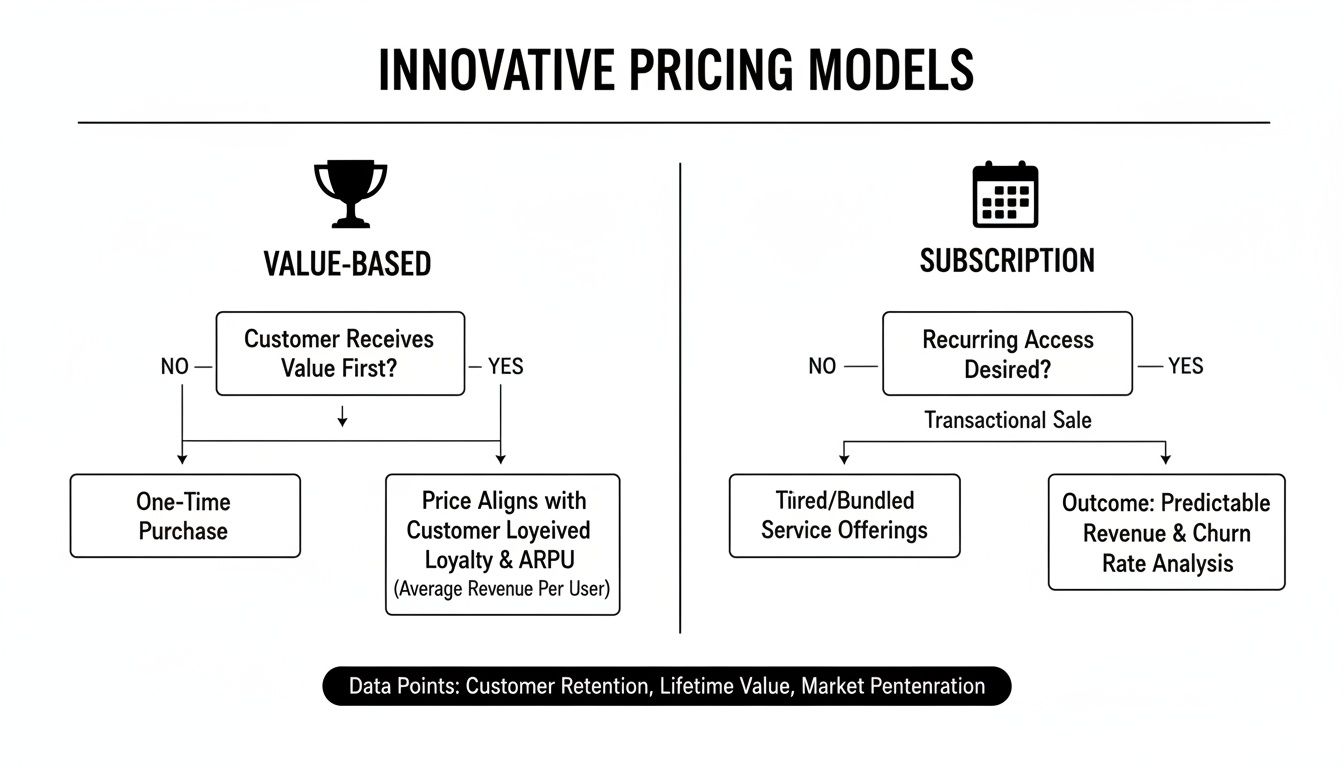
This visual clarifies the distinction: Value-Based pricing is outcome-driven (the trophy), while Subscription models focus on continuous service delivery over time (the calendar).
To simplify this further, use the decision framework below.
A Decision Framework for Pricing Model Selection
This checklist will help you select the optimal software development pricing model by aligning project factors with model strengths. Identify which column best matches your project's profile.
| Project Factor | Fixed Price | Time & Materials | Dedicated Team | Value-Based |
|---|---|---|---|---|
| Scope Definition | Clearly defined & stable | Evolving & flexible | Dynamic & long-term | Outcome-focused |
| Budget Style | Strict, upfront budget | Flexible, pay-as-you-go | Predictable monthly cost | Tied to business results |
| Timeline | Fixed deadline is critical | Flexible, iterative | Ongoing, continuous | Milestone-driven |
| Your Involvement | Low (after initial spec) | High (daily/weekly) | High (part of the team) | Strategic (defining goals) |
| Project Complexity | Low to medium | Medium to high | High, long-term | High, strategic |
| Best For | MVPs, small projects | Agile projects, unclear scope | Long-term products | Business transformation |
This framework provides a solid foundation for your decision. The model that aligns most closely with your project's profile is your best path to a successful engagement.
Real-World Scenarios
Let's apply this framework to common business situations:
- A Tech Startup Building an MVP: With limited funding and a precise feature list, the Fixed Price model is ideal. It ensures the MVP is delivered on a tight budget, enabling market entry and validation without financial surprises.
- A Financial Institution Modernizing its Core Platform: This is a massive, complex project with evolving regulatory requirements. A Time & Materials model, supported by a Dedicated Team of fintech experts from a partner like Group 107, provides the flexibility to adapt while ensuring deep domain knowledge and a relentless focus on security.
- An Enterprise Executing a Cloud Migration: This is a long-term, multi-phase initiative where predicting every dependency upfront is impossible. A Dedicated Team is the optimal solution, providing consistent expertise for a seamless transition while offering the control of an in-house team with the cost benefits of an offshore partner.
Summary and Next Steps
Choosing the right software development pricing model is a critical business decision that directly impacts your project's success. There is no universally "best" option—only the one that best aligns with your project's scope, budget, and strategic goals.
- Fixed Price: Best for small, well-defined projects with static requirements and a strict budget.
- Time & Materials: Ideal for complex, long-term projects with evolving scopes that require flexibility and agility.
- Dedicated Team: The optimal choice for long-term product development, scaling your in-house capabilities, and building institutional knowledge.
- Innovative Models (Value-Based, Subscription): Suited for strategic partnerships where success is tied to measurable business outcomes or continuous service delivery.
Your Actionable Next Steps
- Assess Your Project's DNA: Use the decision framework in this guide to analyze your project's scope clarity, budget flexibility, and timeline.
- Define Your Involvement Level: Determine how hands-on you plan to be, as this will heavily influence the best model for collaboration.
- Consult with an Expert: Discuss your project with a potential development partner to explore which model they recommend and why. A transparent partner will help you weigh the pros and cons of each.
Ready to build a development team that aligns perfectly with your financial and strategic goals? Group 107 provides premium offshore teams and end-to-end digital solutions that scale with your business. Let's discuss the right model for you. Visit us at https://group107.com to get started.