
Before any new software, app, or digital product is released to the public, it must pass two critical quality gates: alpha testing and beta testing. Think of them as the final dress rehearsal and the exclusive opening-night preview for your launch. Alpha testing is the internal, behind-the-scenes bug hunt, while beta testing is when you invite a select group of real users to validate the product’s value in the real world.
Why Alpha Beta Testing Is Non-Negotiable for Business Success

Launching a new product without rigorous testing is a significant business risk. You’re not just gambling with post-launch bug fixes; you’re putting your brand’s reputation, user adoption, and future revenue on the line. A flawed launch can lead to negative reviews, high customer churn, and costly emergency development cycles.
A well-structured alpha beta testing strategy isn’t an expense—it’s an investment in your product’s long-term success and market viability. It provides the critical data needed to ensure you’re launching a product that is not only stable but also solves a real-world problem for your target audience.
Alpha Testing: The Internal Dress Rehearsal
Alpha testing is the first line of defense. This is a strictly internal, controlled process where your own team—QA engineers, developers, and product managers—systematically attempts to break the product. The primary goal is to identify and resolve every show-stopping bug and stability issue before a single external user is exposed to it.
This phase validates core functionality, feature completeness, and technical integrity. For a new SaaS platform or fintech application where a single crash can erode user trust, skipping this step is a critical error. Alpha testing ensures your product works as designed in a controlled lab environment.
Beta Testing: The Real-World Preview
Once your product is stable, you proceed to beta testing. Here, you release the product to a limited, hand-picked audience of real users who experience it in their own environment. Their role extends beyond bug hunting; they are there to validate if the product truly delivers on its promise.
Does it solve their problem effectively? Is the user experience intuitive? Is it a solution they would be willing to pay for?
The feedback gathered during this phase is invaluable. It provides raw, honest insights essential for achieving true product-market fit. This is your opportunity to refine features, polish the user experience, and prioritize your development roadmap based on direct customer input. The global beta testing software market is projected to grow from USD 9.3 billion in 2025 to USD 33.8 billion by 2035, a clear indicator of its strategic importance. You can explore the research behind this market growth.
To clarify the distinct roles of these two testing phases, refer to this side-by-side comparison.
Alpha vs. Beta Testing: At a Glance
This table provides a high-level comparison of the key characteristics of alpha and beta testing, helping you quickly grasp the fundamental differences between the two phases.
| Attribute | Alpha Testing | Beta Testing |
|---|---|---|
| Testers | Internal team (QA, developers, employees) | External, real-world users (customers, prospects) |
| Environment | Controlled, lab-like setting | Real-world, uncontrolled environment |
| Primary Goal | Find and fix critical bugs, ensure stability | Validate product value, usability, and market fit |
| Product Stage | Unstable, often feature-incomplete | Mostly stable, feature-complete |
| Duration | Short (1-2 weeks) | Longer (4-8 weeks or more) |
| Feedback Focus | Technical issues, crashes, bugs | User experience, value proposition, feature suggestions |
While both phases focus on quality assurance, they approach it from different angles to ensure your final product is both technically sound and genuinely valuable to your target market.
Executing a Successful Alpha Test

A successful alpha test is more than an internal bug hunt; it is a methodical process designed to validate your product’s core functionality and stability against its technical specifications. This phase serves as a non-negotiable quality gate in any professional software development lifecycle, providing the last opportunity to catch major architectural or functional flaws before external exposure.
The core objective is validation. You are not merely chasing bugs; you are systematically confirming that every feature performs as designed and the system remains stable under expected operational loads. The central question to answer is: “Did we build the product we designed?” A well-defined plan with clear goals, scope, and exit criteria is essential to prevent the process from becoming unstructured and ineffective.
Defining Your Alpha Testing Goals and Scope
Before initiating any testing, product managers and QA leads must establish clear, measurable objectives. Vague goals like “find bugs” are insufficient. You need specific, actionable targets that align with business outcomes.
Effective alpha testing goals include:
- Feature Completeness Validation: Systematically verify that every feature specified in the product requirements document (PRD) has been implemented and functions correctly.
- Workflow Integrity: Test complete, end-to-end user journeys to ensure they are logical and free of critical errors. For an e-commerce platform, this would involve testing the entire flow from product discovery to successful checkout.
- Stability and Performance Benchmarking: Confirm the application operates without crashing under normal usage and meets predefined performance metrics for speed and responsiveness.
- Identification of Blocker Bugs: Proactively hunt for critical defects that would render the product unusable for beta testers or end-users.
With clear goals established, defining the scope becomes straightforward. Specify whether you are testing the entire application or a new, high-risk module. This focus ensures your team’s efforts are concentrated where they will have the most significant impact.
Key Metrics for Alpha Test Success
To objectively measure the effectiveness of your alpha phase, you must track the right metrics. These data points provide quantitative evidence of product quality and readiness for the next stage.
The purpose of alpha test metrics is to replace subjective assessments like “it feels stable” with hard data. This quantitative evidence is crucial for making a confident go/no-go decision for beta testing.
Essential metrics to monitor include:
- Bug Severity and Density: Track the number and severity (e.g., critical, major, minor) of identified bugs. A high density of critical bugs indicates a lack of stability.
- Task Completion Rate: Measure the percentage of core user tasks that testers can complete successfully without encountering a blocker. A low rate signals significant functional or usability issues.
- Crash Rate: Monitor the frequency of application crashes or freezes during testing. This is a direct indicator of software stability.
- Test Case Pass/Fail Ratio: Document the percentage of predefined test cases that pass versus those that fail. A high failure rate suggests deep-rooted issues in the codebase.
The market for alpha testing solutions, valued at $5 billion in 2025, is projected to exceed $15 billion by 2033, reflecting a strong industry trend toward data-driven quality assurance. You can explore more about this market’s growth. Focusing on these metrics provides an objective measure of product health, enabling your team to pinpoint weaknesses and verify fixes before advancing in the alpha beta testing process.
Mastering Your Beta Testing Program
With alpha testing complete, your product is stable enough for its first encounter with the outside world. This is beta testing, where the focus shifts from “Does it work?” to “Do people value and love it?”
A strategic beta program is not just another bug hunt. It is your first real opportunity to gather user insights that validate product-market fit before a full-scale public launch.
Choosing the Right Beta Program Type
Selecting the right beta test strategy is critical and depends on your product, audience, and learning objectives. The wrong choice can result in irrelevant feedback or premature exposure of sensitive features.
There are two primary types of beta programs:
- Closed Beta: An exclusive, invite-only test with a hand-picked group of users. This is ideal for testing new features in an enterprise SaaS platform, validating complex workflows in a fintech application, or gathering in-depth feedback from a specific customer profile. The controlled environment yields high-quality, focused feedback.
- Open Beta: A publicly accessible test where anyone can sign up. This approach is effective for consumer apps or platforms that need to assess scalability and server performance under load. It generates a large volume of data from a diverse user base, but the feedback can be less structured and more difficult to analyze.
The choice between open and closed beta depends on your priorities. If you need deep, qualitative insights from your ideal customer persona, a closed beta is appropriate. If you need to stress-test infrastructure and gauge broad market appeal, an open beta is the better option.
Recruiting and Engaging Your Beta Testers
The success of your beta program depends entirely on the quality of your testers. Recruiting the right participants starts with a clear definition of your ideal user profile.
Go beyond demographics. Consider their technical proficiency, the specific problems they need to solve, and the other tools they use. This information helps you create a screener survey that identifies participants who can provide the most relevant insights. To learn more, it’s beneficial to understand how to get customer feedback effectively.
A common mistake is recruiting testers who are too technical or too close to the company. You need unbiased users who represent your target market—not internal staff or friends who may be reluctant to provide critical feedback.
Once recruited, keeping testers engaged is paramount. A clear communication plan is essential to maintain momentum.
- Regular Updates: Keep testers informed about new builds, known issues, and upcoming features.
- Clear Feedback Channels: Provide an effortless way to report bugs or suggest improvements using tools like Jira or Instabug.
- Incentives and Recognition: While monetary compensation isn’t always necessary, recognition like gift cards, free subscriptions, or public acknowledgement can significantly boost participation.
Engaged testers become valuable partners in your product’s success, a core principle of modern software testing best practices.
Beta Tester Recruitment Channel Comparison
A comparative analysis of different channels for recruiting beta testers, highlighting the pros, cons, and best-fit scenarios for each to help product managers build an effective testing pool.
| Recruitment Channel | Pros | Cons | Best For |
|---|---|---|---|
| Existing User Base | Highly relevant feedback; already familiar with your product. | Can be biased; may not represent new user segments. | Incremental updates and feature validation for a mature product. |
| Social Media / Ads | Great for reaching a broad, diverse audience quickly. | Can be expensive; feedback quality can be low and noisy. | Consumer apps needing to test scalability and wide appeal. |
| Beta Testing Platforms | Access to experienced, professional testers. | Can be costly; testers may not perfectly match your ICP. | Teams that need structured, detailed feedback on a tight deadline. |
| Industry Communities | Highly targeted and passionate users; great for niche products. | Can be hard to get permission; requires genuine participation. | B2B SaaS, developer tools, or specialized fintech products. |
| Personal Networks | Fast and free to get started; high initial engagement. | Prone to bias; not scalable for large-scale testing. | Very early-stage startups testing initial concepts and prototypes. |
A multi-channel approach often yields the most balanced and diverse group of beta testers.
Triaging Feedback for Actionable Insights
Collecting feedback is only the first step. The real value is extracted by systematically processing the incoming bug reports, feature requests, and general comments.
The goal is to transform this raw data into a prioritized development backlog. Begin by categorizing all feedback:
- Bug Reports: The product is not functioning as intended.
- Feature Requests: New functionality suggested by users.
- Usability Issues: Points of friction or confusion in the user experience.
- General Comments: Praise, criticism, and other qualitative observations.
After categorization, prioritize the feedback. A critical bug affecting 10% of users takes precedence over a minor typo. This structured triage process ensures your development team focuses on the most impactful improvements, driving the product toward a successful launch based on real user data.
Integrating Testing into Your Development Workflow
High-performing teams integrate alpha and beta testing directly into their development pipeline rather than treating it as a final, isolated phase. This shift transforms testing from a last-minute bug hunt into a continuous quality-building process.
When feedback loops are an integral part of your workflow, you proactively build quality, catch issues early when they are less costly to fix, and ensure each sprint delivers tangible value.
Aligning Testing with Agile and DevOps
In an Agile environment, alpha and beta testing must be iterative. Instead of a single, monolithic testing phase, conduct smaller, targeted tests aligned with your release schedule. For example, a brief internal alpha test can be run at the end of a sprint to validate new features before they are merged.
This approach aligns perfectly with DevOps, which aims for a continuous flow of value from development to users. Embedding testing into this workflow shortens the feedback loop from code commit to real-world validation. To learn more, read our guide on the Agile methodology in the SDLC.
A successful testing program requires a clear, structured process.
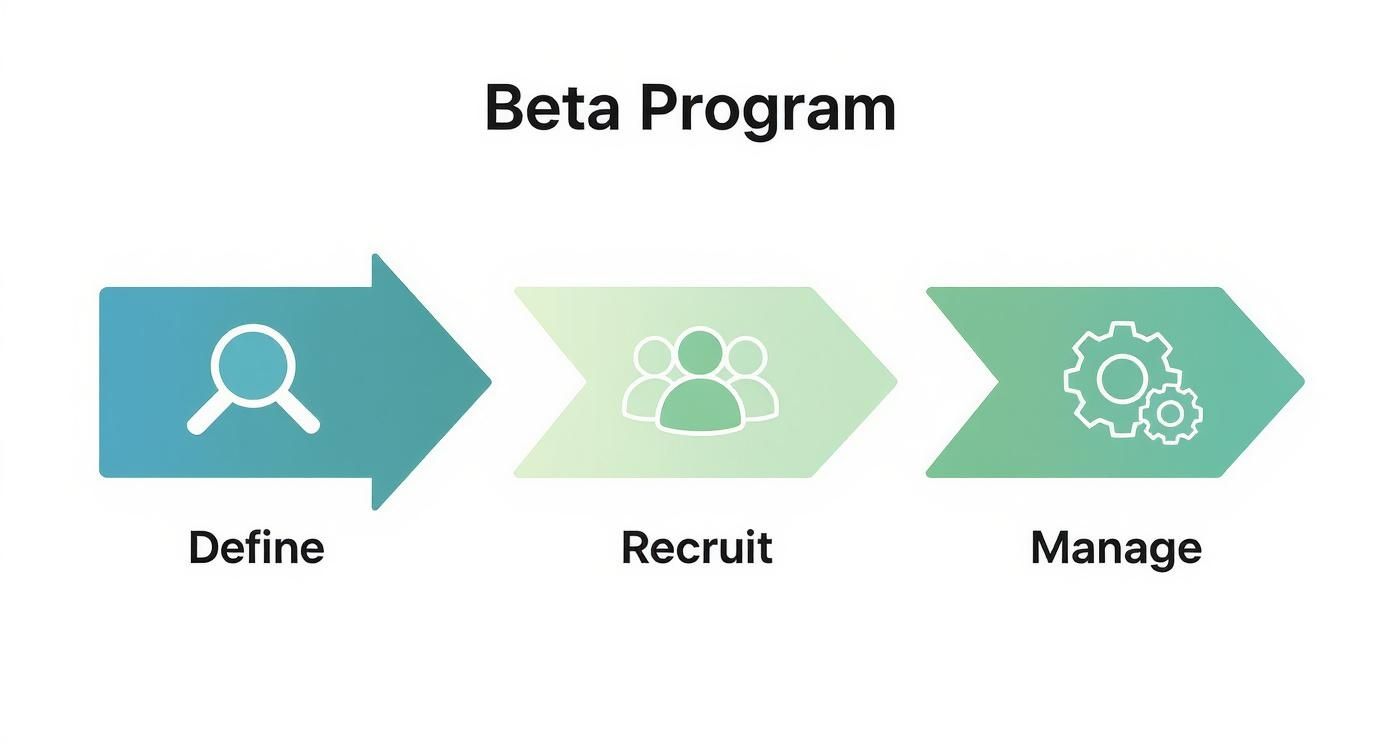
The process begins with defining goals, followed by recruiting the right testers and actively managing the program to extract the necessary insights.
A Practical Testing Framework and Timeline
A successful testing program requires a clear plan. This framework outlines the essential steps to ensure a methodical approach.
- Planning and Goal Setting: Before testing begins, define what success looks like. Set concrete goals (e.g., “95% of users complete the new checkout flow without help”) and firm exit criteria (“fewer than 5 critical bugs remain”). This should be done in conjunction with sprint planning.
- Execution and Feedback Collection: Once a stable build is ready, engage your testers. For an alpha test, this may involve deploying to a staging server for your internal team. For a beta test, it means sending invitations and clear instructions to your external group. The goal is to make providing feedback as frictionless as possible.
- Analysis and Prioritization: A product manager or QA lead must triage all incoming feedback, categorizing it into bugs, feature requests, and usability issues. This prioritized feedback is then converted into actionable tickets for the development backlog.
This structured process is part of the broader shift toward data-driven product development.
Essential Tools for a Scalable Process
Managing a testing program with spreadsheets and email is inefficient and prone to error. A dedicated toolstack is essential for building a scalable and repeatable process.
Your tool stack should serve as the single source of truth for all testing activities. Integrated systems ensure that every piece of feedback is tracked from submission to resolution.
Key tools to consider include:
- Bug Tracking and Project Management: Tools like Jira are essential for converting feedback into structured development tickets, assigning them to engineers, and tracking their progress.
- In-App Feedback Collection: Platforms like Instabug allow users to submit feedback, screenshots, and device logs directly from within your application, streamlining the reporting process.
- Tester Management: For larger beta programs, dedicated systems like Centercode or BetaTesting manage everything from recruitment and onboarding to communication and reward distribution, keeping your testers engaged.
Common Testing Pitfalls and How to Avoid Them
Even with a solid plan, alpha and beta testing efforts can be derailed by common pitfalls. These mistakes can corrupt your data, create a false sense of security, and lead to a problematic product launch. Knowing these traps is the first step toward building a testing program that delivers reliable, actionable insights.
Recruiting the Wrong Testers
One of the most critical errors is recruiting the wrong participants, especially for beta testing. Using internal staff, friends, or family is a common mistake. These groups are inherently biased; they either know the product too well to spot usability flaws or are too hesitant to provide the brutally honest feedback required for improvement.
A beta test with the wrong participants is worse than no test at all. It provides misleading data that can steer your product in the wrong direction, leading to a launch that misses the mark with your true customer base.
Solution: Develop a detailed ideal tester persona before sending any invitations. This profile should include technical skill level, current pain points, and existing tools they use. Use screener surveys to filter applicants and ensure you are gathering feedback from people who genuinely represent your target market.
Collecting Vague and Unactionable Feedback
Receiving feedback that is too generic, such as “it’s confusing” or “I don’t like it,” is another major challenge. This type of feedback provides no actionable information for your development team and often results from a lack of clear guidance or proper feedback tools.
Solution: Structure your feedback channels to elicit specific details. Instead of an open-ended comment box, use guided forms that ask targeted questions:
- What were you trying to accomplish?
- What did you expect to happen?
- What actually happened?
- Can you provide a screenshot or screen recording?
This structured approach ensures you receive the context needed to reproduce bugs and understand user friction points.
Ignoring Negative Feedback Due to Confirmation Bias
Confirmation bias—the tendency to favor information that confirms pre-existing beliefs—is a silent killer of product innovation. Teams can unconsciously amplify positive feedback while dismissing critical comments that challenge their assumptions.
This is a dangerous trap, as negative feedback often contains the most valuable insights. It highlights your product’s most significant weaknesses—the very issues that must be addressed before a public release.
Solution: Implement a formal, data-driven feedback review process. Mandate that all feedback, regardless of sentiment, is logged, categorized, and discussed by the product team. Appoint a “devil’s advocate” in meetings to ensure critical perspectives are heard and considered objectively.
Lacking Clear Exit Criteria
How do you know when testing is complete? Without predefined exit criteria, a test can either continue indefinitely or end prematurely. A test without a clear finish line lacks purpose and direction. This ambiguity can lead to “scope creep,” delaying your launch, or a premature conclusion that leaves critical flaws undiscovered.
Solution: Before the test begins, define specific, measurable goals that signal its completion.
- Alpha Test Exit Criteria: “The test is complete when there are zero blocker bugs and fewer than five critical bugs in the backlog.”
- Beta Test Exit Criteria: “The test concludes when the task completion rate for user onboarding reaches 90% and the user satisfaction score is at least 8/10.”
Setting these objective targets removes guesswork and aligns the entire team on a clear definition of “done.”
Summary and Next Steps
Alpha and beta testing are not mere QA checklist items; they are strategic business imperatives. Alpha testing ensures internal quality and stability, while beta testing validates real-world value and product-market fit. Mastering this process is the difference between launching with data-backed confidence and launching on a prayer.
To turn this knowledge into action, follow these practical next steps.
Your Actionable Pre-Launch Plan
- Formalize Your Testing Plan: Document your process. Create a pre-launch checklist that covers everything from defining alpha exit criteria to your beta tester communication plan.
- Select Your Toolstack: Evaluate tools like Jira for project management and Instabug for in-app feedback. Choose solutions that integrate with your existing workflows to create a seamless, scalable process.
- Build a Culture of Quality: Advocate for rigorous testing as a strategic investment. Frame it in business terms: reducing risk, protecting brand reputation, and increasing customer lifetime value.
After a successful launch, continuous monitoring is key. Resources on AI brand tracking for SaaS companies can provide post-launch insights to inform your ongoing strategy.
Frequently Asked Questions
Here are answers to common questions that product teams face when implementing alpha and beta testing.
How Long Should Alpha and Beta Testing Phases Last?
The duration depends on your product’s complexity, team size, and testing goals. An alpha test for a minor feature might last one to two weeks. A comprehensive beta test for a new platform could run from a few weeks to several months.
The key is to define exit criteria upfront. These metrics—such as “fewer than five critical bugs remaining” or a target user satisfaction score—determine when the test is complete. The phase ends when you achieve your goals, not when a calendar date arrives.
Can a Product Have Multiple Beta Stages?
Yes, and this is often a smart strategy for complex launches. Many teams start with a small, closed beta to gather high-quality initial feedback from trusted customers. After iterating on that feedback, they may proceed to a larger open beta to test scalability and gather insights from a broader audience. It is common to see phased releases labeled “Beta 1,” “Beta 2,” and so on, as part of a modern alpha beta testing strategy.
What Is the Difference Between Beta Testing and a Soft Launch?
While they may seem similar, their objectives are fundamentally different. Beta testing is a pre-release phase focused on finding bugs and validating product quality and usability with a select group of users.
A soft launch is the release of the final, market-ready product to a limited geographic area or demographic. Its purpose is not to test the product itself but to validate marketing strategies, operational readiness, and server infrastructure before a full-scale rollout.
In short: beta testing validates the product; a soft launch validates the market and operations.
At Group 107, we build rigorous testing directly into every stage of development, ensuring the digital products we deliver are not just working, but are truly ready for the market. Partner with us to build and launch with total confidence.
Find out more about our end-to-end digital solutions at https://group107.com.