
Understanding the difference between a web server and an application server isn't just a technical detail—it's a critical architectural decision that directly impacts your application's performance, scalability, and security. A web server is a specialist in serving static content—think HTML, CSS, and images. An application server is engineered to execute dynamic business logic and generate personalized content based on user interactions.
Think of it as the difference between a library and a custom manufacturing plant. The web server is the librarian, efficiently retrieving and delivering pre-existing documents. The application server is the factory floor, taking your specific requirements and building a dynamic, custom product just for you. Getting this distinction right is the first step toward building a robust and resilient digital platform.
Web Server vs. Application Server: The Core Distinction
Architecting a high-performance system requires a clear understanding of the distinct roles web and application servers play. While their capabilities can overlap, their core functions are different yet highly complementary. A web server's primary mission is to handle HTTP/S requests from a browser and deliver static files—HTML pages, stylesheets, JavaScript, and images—with maximum speed and efficiency.
In contrast, an application server provides the runtime environment for your business logic. It's the engine that processes dynamic requests, interacts with databases, calls third-party services, and connects to other backend systems to generate personalized content. This is the technology that powers everything from e-commerce checkouts and user authentication to real-time financial dashboards.

Why This Matters for Your Business
This separation of concerns directly impacts your application's architecture, performance, security, and scalability. Web servers are the internet's battle-tested workhorses. Market data confirms their dominance: Nginx holds 39% of the market, with Apache HTTP Server following closely at 36%, according to a recent web server market share report.
Application servers like Apache Tomcat (0.1%) or Oracle WebLogic (0.06%) have a smaller direct web-facing footprint. This isn't a sign of lower importance; it reflects their specialized role as powerful engines running securely behind the scenes. This is precisely why modern, scalable systems almost always use both in a hybrid architecture.
For a quick breakdown, here’s how they compare.
Web Server vs. Application Server At a Glance
This table offers a clear snapshot of the fundamental differences, highlighting their primary roles, the type of content they handle, and well-known examples.
| Attribute | Web Server | Application Server |
|---|---|---|
| Primary Role | Serves static content via HTTP/S | Executes dynamic business logic |
| Content Type | HTML, CSS, JavaScript, Images, Files | Dynamically generated content from code |
| Common Protocols | HTTP, HTTPS | HTTP, HTTPS, RPC, RMI, IIOP |
| Key Function | Request-response handling for files | Transaction management, connection pooling |
| Common Examples | Nginx, Apache HTTP Server, MS IIS | Tomcat, JBoss, WebLogic, GlassFish |
This high-level comparison frames the discussion. The real business value comes from understanding how these components work together to create a robust, secure, and scalable architecture.
Comparing Key Technical Differences
Beyond their high-level roles, the architectural distinctions between web and application servers define their operational capabilities. Designing an efficient and scalable system requires a deep understanding of these differences. Let's analyze four critical areas that highlight the technical divide in the application server vs web server comparison.

Request Handling Architecture
How a server manages incoming connections is the foundation of its performance under load. This is one of the most significant differentiators.
- Web Servers: Modern web servers like Nginx have perfected an event-driven, asynchronous architecture. This non-blocking model allows a single process to handle thousands of concurrent connections with minimal memory overhead, making it exceptionally efficient for I/O-bound tasks like serving static files.
- Application Servers: In contrast, many application servers, particularly in the Java ecosystem (e.g., Tomcat, JBoss), often employ a multi-threaded model. A new thread is created for each request. While effective for CPU-intensive, stateful operations, this model can consume significant resources and struggle to scale against a massive volume of simple, concurrent connections.
Supported Communication Protocols
While both servers speak the web's native language (HTTP/S), application servers are multilingual—a necessity for managing complex backend communication.
- Web Servers specialize in HTTP and HTTPS. Their job is to serve content over these protocols with maximum speed and security.
- Application Servers support a broader spectrum of protocols to enable communication between distributed components, including:
- Remote Procedure Call (RPC) for direct function calls between different services.
- Messaging protocols like JMS (Java Message Service) for asynchronous communication and queuing.
- IIOP (Internet Inter-ORB Protocol) for object-oriented communication in distributed systems.
This expanded protocol support is essential for enterprise-grade applications where microservices, legacy systems, and various backend components must communicate seamlessly.
Content Generation and Business Logic
The core operational difference lies in how each server generates a response. A web server retrieves what already exists; an application server creates something new.
- A web server is a content delivery specialist. It locates a pre-built file—an HTML document, a CSS stylesheet, or an image—on the file system and delivers it directly to the client. No on-the-fly computation or content assembly is involved.
- An application server is a dynamic content factory. It executes code to generate a response, which is the exclusive domain of business logic.
An application server is the runtime environment for your core business features. It connects to databases, processes transactions, and applies business rules to build a custom response for each user request—a capability web servers inherently lack.
Performance and Resource Management
These architectural differences lead to distinct performance profiles and resource requirements. Web servers are optimized for lightning-fast delivery of static assets, achieving massive throughput with minimal resource consumption. Nginx, for example, can handle millions of requests per second on modest hardware.
Application servers are the resource-intensive powerhouses built for dynamic workloads like executing business logic, managing database connection pools, and ensuring transactional integrity. For our clients at Group107, from SaaS startups to financial institutions, this typically translates to a hybrid stack: Nginx fronting application servers like WebLogic to guarantee 99.99% uptime. The growing application server market shows how enterprises are leveraging this model to scale.
This distinction is mission-critical for architects planning for growth. Our DevOps as a Service expertise helps ensure your infrastructure is engineered for resilience and success from day one.
Common Deployment Architectures and Use Cases
Understanding the technical specifications is one thing; seeing how these servers collaborate in real-world scenarios is where the strategic insights emerge. Let's shift from theory to practice and examine how web and application servers are deployed. The architectural pattern you choose will directly influence your application's performance, security, and scalability.
We will explore the three most common deployment models, each tailored for different business needs, from simple static sites to complex enterprise platforms.
Architecture 1: Web Server Only
The most straightforward architecture involves using a web server, like Nginx or Apache, to handle all requests. This model is designed for one specific purpose: serving static content as rapidly as possible.
- Best For: Static websites, single-page applications (SPAs) managing their own state on the client side, and serving assets for a content delivery network (CDN). Examples include marketing sites, product documentation, or a design portfolio.
- Business Impact: This is the most cost-effective and low-maintenance option for content that requires no server-side processing. It delivers exceptional load times with minimal server overhead, directly improving user experience and SEO rankings.
However, this architecture cannot process user data, interact with a database, or display personalized content. The moment dynamic functionality is required, this model is no longer sufficient.
Architecture 2: Application Server Only
Alternatively, an application server can operate alone, handling HTTP requests directly from the internet. Many modern application servers—such as Tomcat or those built with frameworks like Node.js's Express—can function as their own simple web servers.
- Best For: Internal tools, APIs not exposed to public traffic, or backend microservices within a trusted network.
- Business Impact: Simplifies the technology stack for internal-facing applications, reducing complexity and maintenance for systems like an admin dashboard or a data processing service.
Warning: Exposing an application server directly to the public internet in a production environment is strongly discouraged. It forces the server to handle raw network traffic and static file serving, detracting from its primary role of executing business logic and creating performance bottlenecks and security vulnerabilities.
This approach forfeits the significant benefits of a dedicated web server, such as efficient SSL/TLS termination, request routing, and static asset caching.
Architecture 3: The Hybrid Model
This is the gold standard for virtually every modern, scalable web application. The hybrid model leverages the specialized strengths of both a web server and one or more application servers to create a powerful, multi-tiered architecture.
In this configuration, the web server (typically Nginx) functions as a reverse proxy. It sits at the network edge, serving as the gatekeeper for all incoming traffic. This strategic placement allows it to perform several crucial functions:
- Static Content Caching: The web server instantly serves static files (images, CSS, JavaScript), freeing the application server to focus exclusively on dynamic, logic-intensive requests.
- Load Balancing: It intelligently distributes incoming traffic across multiple application servers, preventing any single server from becoming overwhelmed and ensuring high availability.
- SSL/TLS Termination: The web server handles the computationally expensive process of encrypting and decrypting HTTPS traffic, offloading this burden from the application servers.
- Security Gateway: It acts as a protective buffer, shielding application servers from direct internet exposure and mitigating a wide range of common cyberattacks.
This separation of concerns is fundamental to building systems that can scale gracefully and withstand failure. For any serious SaaS, e-commerce, or FinTech platform, the hybrid model is not just a best practice—it's an operational necessity. It provides the performance to handle traffic surges, the security to protect sensitive data, and the flexibility to scale system components independently. This model is also a prerequisite for advanced patterns, as detailed in our guide to microservices architecture best practices.
Architecture Decision Matrix
Choosing the right deployment model is a foundational decision. This matrix is a practical guide to help you select the optimal architecture based on your project's specific requirements.
| Requirement | Web Server Only | Application Server Only | Hybrid Architecture |
|---|---|---|---|
| Content Type | Exclusively Static | Primarily Dynamic | Both Static & Dynamic |
| Project Complexity | Low (e.g., brochure site) | Low to Medium (e.g., internal API) | High (e.g., SaaS platform) |
| Traffic Volume | Low to High | Low to Medium | Medium to Very High |
| Security Needs | Basic | Moderate | High / Enterprise-Grade |
| Scalability | Limited to static assets | Limited by a single server | High (horizontal scaling) |
Ultimately, the hybrid model provides the most robust and flexible foundation for growth, while the other models serve specific, well-defined use cases effectively.
How to Choose the Right Server for Your Project
Selecting the right server architecture is a strategic decision that shapes your project's performance, scalability, and total cost of ownership. The choice between a web server, an application server, or a hybrid model depends on a clear evaluation of your business objectives and technical requirements. Let's walk through the key criteria to guide your decision.
First, assess your project's complexity. A simple marketing landing page has fundamentally different needs than a multi-layered financial application requiring transactional integrity and robust security. One must serve static files quickly; the other must execute complex, state-dependent business logic.
This decision tree visualizes the architectural path based on your core needs for content type, dynamic logic, and traffic volume.
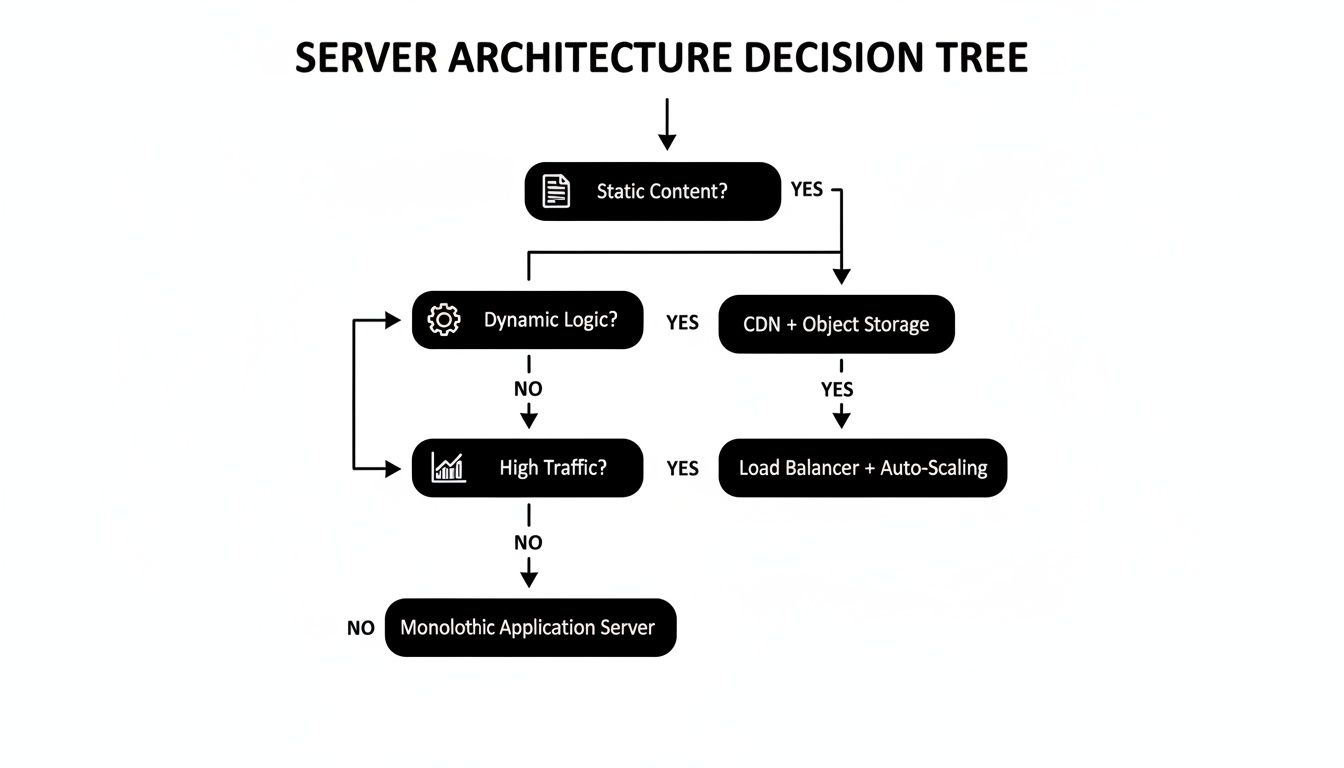
As the diagram illustrates, when dynamic logic and high traffic are introduced, the architecture must evolve from a simple web server to a more resilient and scalable hybrid model.
Evaluate Your Scalability and Performance Needs
Consider how your system will handle sudden traffic spikes. A stateless web server is relatively easy to scale horizontally, as each request is independent. In contrast, scaling a stateful application server that manages user session data is more complex, requiring advanced strategies like session clustering or sticky sessions.
- For high-volume static content: A web server like Nginx is unmatched. Its event-driven architecture handles thousands of concurrent connections with minimal resources, making it ideal for serving images, CSS, or client-side applications.
- For complex, stateful operations: An application server is essential. It provides the framework for managing user sessions, database connection pools, and transactional integrity, ensuring data consistency across complex workflows.
An e-commerce platform is a perfect example. It requires an application server to manage stateful shopping carts, but all of its static product images are best served by a high-performance web server.
Align with Your Technology Stack
Your choice of programming language and framework often guides your server environment selection. While flexible, certain pairings are highly optimized and benefit from extensive community support.
The technology stack is a major factor in the application server vs web server decision. Languages like Java have a rich ecosystem of application servers (e.g., Tomcat, JBoss, WebLogic), while Python applications commonly use servers like Gunicorn or uWSGI, often placed behind a web server.
Adhering to these natural pairings allows you to leverage your framework’s full capabilities without fighting the underlying infrastructure. It also simplifies hiring and onboarding for your development teams. Making the right technology choice early is crucial, much like comparing cloud platforms. Learn more in our guide on Azure vs AWS, which explores how such platform decisions impact your entire architecture.
Assess Security and Business Logic Protection
Finally, evaluate your security requirements. A primary advantage of the hybrid model is its ability to isolate and protect your core business logic. By configuring a web server as a reverse proxy, you create a buffer that shields your application server from direct internet exposure.
Market trends underscore the importance of this choice. While the web server market is mature—with Nginx at 39% and Apache at 36%—the application server market is expanding rapidly. Valued at USD 25.6B in 2024, it is projected to reach USD 56.34B by 2030, driven by digital transformation in sectors like retail and FinTech. For our clients, this data highlights a clear industry shift toward more dynamic, logic-driven applications that demand robust, secure architectures.
Optimizing Your Server Architecture for Performance and Security
A well-designed architecture is the foundation of any high-performing, secure application. By combining a web server and an application server in a hybrid model, you can implement powerful strategies to enhance speed and fortify your defenses. Let's explore expert best practices for optimizing this powerful combination.
The core principle is intelligent layering, allowing each component to perform its specialized function. This involves offloading tasks from your application server, enabling it to focus exclusively on executing business logic.
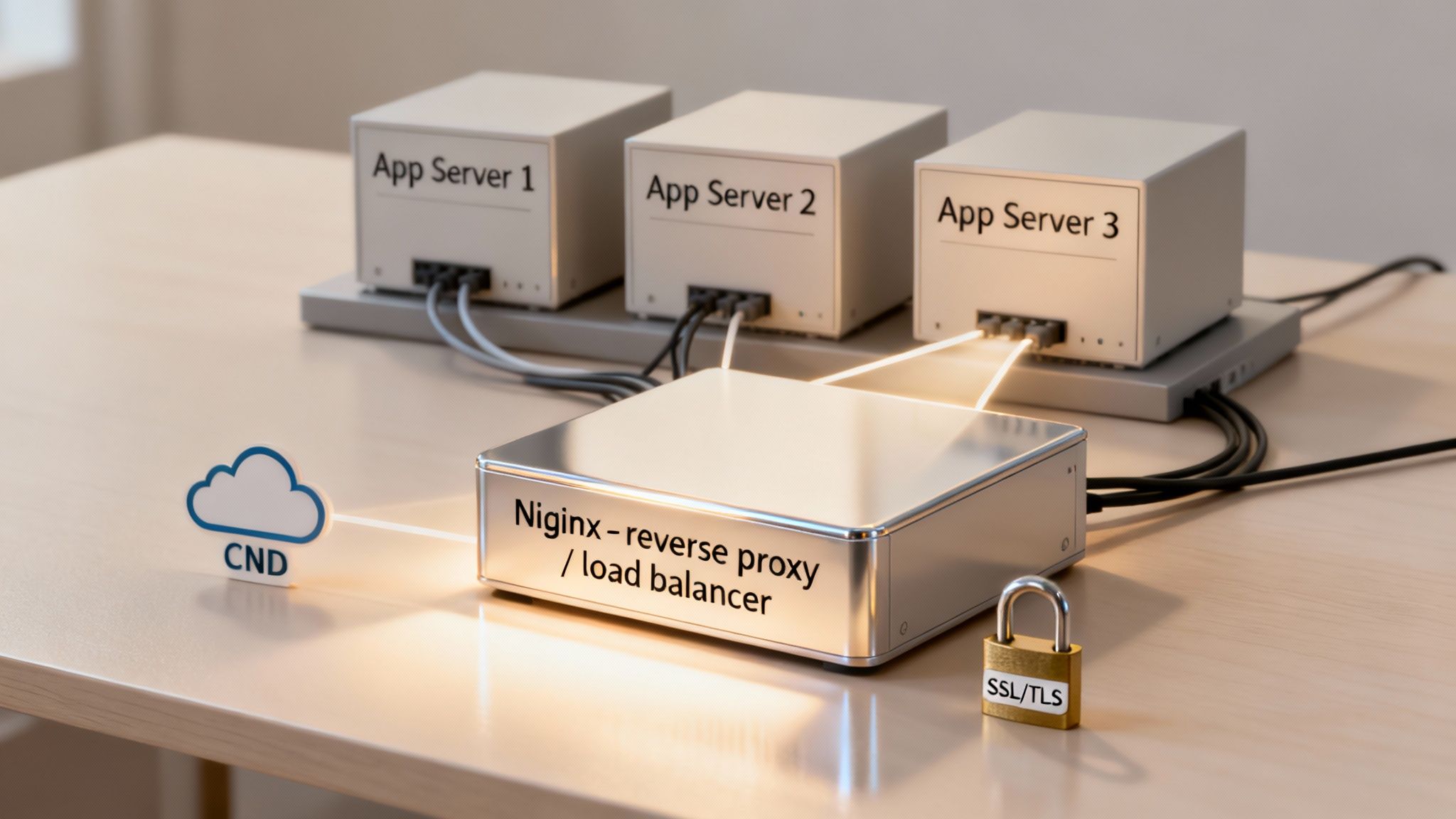
A properly configured hybrid setup ensures that every user request is handled with maximum efficiency and security, from the moment it enters your network until a response is delivered.
Implement Multi-Level Caching Strategies
Latency is the enemy of a positive user experience. A multi-level caching strategy is your most effective weapon, dramatically reducing content delivery times by storing frequently accessed data closer to the user.
In a hybrid architecture, caching can be implemented at several layers:
- Browser and CDN Caching: Your first line of defense. By setting appropriate HTTP headers (like
Cache-Control), you instruct browsers and Content Delivery Networks (CDNs) to store static assets. This allows subsequent requests to be served instantly without contacting your servers. - Web Server Caching: Your web server (e.g., Nginx) is perfectly positioned to cache static content like images, CSS, and JavaScript. This significantly reduces the load on the application server, which should never waste resources serving unchanging files.
- Application Server Caching: The application server can also cache data. It can store the results of complex database queries or frequently generated content fragments in memory using tools like Redis or Memcached, avoiding redundant processing for common dynamic requests.
This layered approach ensures requests are intercepted and served at the earliest, most efficient point in the architecture.
Use the Web Server for Intelligent Load Balancing
A single server cannot handle enterprise-scale traffic. A web server configured as a load balancer is essential for distributing incoming requests across multiple application server instances, ensuring high availability and preventing any single server from becoming a bottleneck.
A load balancer acts as a traffic director for your network, intelligently routing requests using algorithms like round-robin or least connections. This not only improves performance but also builds resilience. If one application server fails, the load balancer automatically redirects traffic to healthy instances, ensuring zero downtime for your users.
This is the foundation of horizontal scaling. As traffic grows, you can simply add more application servers to the pool, and the load balancer will seamlessly integrate them into the workflow.
Harden Security with a Reverse Proxy
In the application server vs web server debate, security is paramount. Placing a web server as a reverse proxy in front of your application server is one of the most effective security measures you can take. It acts as a shield, hiding your application server's identity and blocking a wide range of common attacks.
This setup establishes a critical security perimeter. The web server becomes the single point of entry, allowing you to enforce security policies centrally. For a deeper dive into securing your backend, read our guide on REST API security best practices.
Another significant security benefit is SSL/TLS termination. The web server handles the resource-intensive process of encrypting and decrypting HTTPS traffic. This offloads cryptographic computations from your application servers, freeing up their CPU cycles to execute business logic. The result is a more resilient, efficient, and secure system.
Frequently Asked Questions About Server Architectures
When discussing the practical implications of the application server vs web server choice, several key questions consistently arise. For architects and engineering leaders, the answers to these questions are crucial for designing a successful system. Here are clear, experience-based answers to the most common queries.
Can a Web Server Function as an Application Server?
Technically, yes, but this is an anti-pattern for any serious production application. Web servers like Apache can be extended with modules (e.g., mod_php, mod_python) to process server-side logic and generate dynamic content. However, this approach merely patches a capability gap rather than leveraging a purpose-built strength.
This configuration lacks the robust features of a true application server, forcing you to forgo mission-critical capabilities that complex systems depend on, including:
- Transaction Management: Ensuring data consistency and reliability across operations.
- Connection Pooling: Efficiently managing database connections to maintain high performance.
- Messaging Queues: Enabling asynchronous communication and background task processing.
- Dependency Injection: Simplifying component management and promoting clean, modular code.
Forcing a web server into this role is like using a screwdriver as a hammer. It may work for a small task, but it is the wrong tool for any substantial job. The trade-offs in performance, security, and long-term maintainability are not worth it.
Do I Always Need Both a Web Server and an Application Server?
The answer depends entirely on your project's functional requirements. For a straightforward static website—a portfolio, a simple blog, or a marketing landing page—a web server is all you need. It is the best tool for the job, designed to serve files quickly and efficiently.
However, the moment your application requires dynamic, interactive features, the hybrid two-server model becomes the professional standard. You will need both servers if your project involves:
- User authentication and session management.
- Database reads or writes.
- On-the-fly content personalization.
- Integration with third-party APIs or other backend services.
In these scenarios, a hybrid architecture allows each server to excel at its specialized role. The web server handles high-volume static asset delivery, while the application server executes complex business logic. This separation of concerns is fundamental to building scalable, secure, and maintainable applications.
How Does Containerization Impact This Choice?
Containerization tools like Docker and orchestration platforms like Kubernetes do not eliminate the need for both server types; they enhance the architecture. These technologies supercharge the hybrid model by making the separation of concerns cleaner, more resilient, and far easier to manage at scale.
A modern Kubernetes deployment perfectly illustrates this synergy.
A common cloud-native pattern involves deploying Nginx containers as an Ingress Controller. This Ingress acts as a smart reverse proxy and load balancer, routing external traffic to the appropriate backend services. These backend services are typically pods running your application server containers—such as Tomcat for a Java application or Gunicorn for a Python service.
This container-first approach provides incredible agility. You can scale your web-facing layer and your application logic independently and automatically in response to traffic fluctuations. This powerful combination is a cornerstone of modern DevOps. Explore our DevOps as a Service to see how we implement these advanced architectures to give our clients a competitive advantage.
Summary and Next Steps
Choosing between a web server, an application server, or a hybrid model is a foundational architectural decision.
- Web Server: The ideal choice for serving static content efficiently and cost-effectively.
- Application Server: Essential for executing dynamic business logic but not suited for direct internet exposure.
- Hybrid Architecture: The industry-standard for modern, scalable, and secure applications, leveraging the strengths of both.
By strategically layering your architecture with caching, load balancing, and a reverse proxy, you can build a system that is not only high-performing but also resilient and secure.
At Group 107, we specialize in architecting and building high-performance, secure, and scalable digital solutions. Whether you need to modernize your infrastructure or scale your product with a dedicated offshore team, we deliver results. Learn more about how we can turn your vision into a reality.