
The synergy between big data and cloud computing is not just a trend; it's the core engine powering modern digital transformation. On its own, big data is the massive, complex flood of information your business generates daily. Cloud computing provides the on-demand, scalable infrastructure required to process, analyze, and extract value from that data.
Without the cloud's elastic power, a big data strategy is often financially and logistically impossible. It would be like trying to build a data center for peak capacity that sits idle 90% of the time—an inefficient and costly approach that stifles innovation.
Why This Partnership Is a Business Imperative
Think of big data as a vast, raw resource, like crude oil. An on-premise data center is your own personal refinery—expensive to build, rigid in capacity, and complex to maintain. This model simply can't keep pace with the exponential growth of data from user interactions, IoT devices, and digital transactions.
Cloud computing provides a global network of refineries on demand. You don't own the infrastructure; you simply pay for the processing and storage you consume. This pay-as-you-go model converts a massive capital expenditure (CapEx) into a predictable operational expense (OpEx), democratizing access to enterprise-grade analytics.
To clarify the distinct roles these two technologies play, here’s a practical breakdown:
Big Data vs. Cloud Computing at a Glance
| Concept | Role in Your Business | Key Challenge It Solves | How They Work Together |
|---|---|---|---|
| Big Data | The asset—vast information streams from customer behavior, financial transactions, and operational logs. | Capturing and storing massive volumes of diverse data that overwhelm traditional databases. | Provides the raw material (data) that cloud services are built to process, store, and analyze for business intelligence. |
| Cloud Computing | The platform—a network of servers, storage, and software delivering compute services over the internet. | Accessing immense computing power and storage without the cost and complexity of owning physical infrastructure. | Offers the scalable, cost-effective environment needed to make big data analytics feasible, accessible, and ROI-positive. |
The cloud provides the "where" and "how" for big data's "what," transforming an inert asset into actionable insights.
The Business Impact of Synergy
This partnership empowers companies to shift from slow-moving infrastructure management to agile, data-driven decision-making. The market reflects this value—the global cloud computing market is projected to reach $947.3 billion by 2026.
The core benefits of uniting big data and the cloud are tangible and immediate:
- Scalability on Demand: Instantly scale compute resources to handle a Black Friday sales surge or process a massive dataset for an AI model, then scale back down to zero. This elasticity is crucial for SaaS platforms and e-commerce businesses.
- Cost-Effectiveness (ROI): Eliminate the capital expenditure of purchasing and maintaining servers. The cloud's pay-for-what-you-use model drastically improves your return on investment (ROI) for data initiatives.
- Accelerated Innovation: Gain immediate access to a rich ecosystem of managed services for analytics, machine learning, and AI. This allows DevOps and engineering teams to prototype and deploy new features in days, not months. For a deeper look, see our guide on what big data is and why it matters.
This synergy has democratized data analytics, giving businesses of all sizes—from fintech startups to global enterprises—the power to uncover insights once reserved for corporations with the deepest pockets. The focus shifts from managing hardware to driving business value.
Choosing the Right Cloud Architecture for Your Data
Selecting the right data architecture is a foundational business decision, not just a technical one. This blueprint dictates how your organization stores, processes, and accesses information, directly impacting your ability to innovate and respond to market changes. An ill-fitting architecture leads to performance bottlenecks, bloated costs, and missed opportunities.
The relationship between big data and the cloud is a dynamic workflow where raw data is refined into business intelligence, all powered by the cloud’s scalable infrastructure.
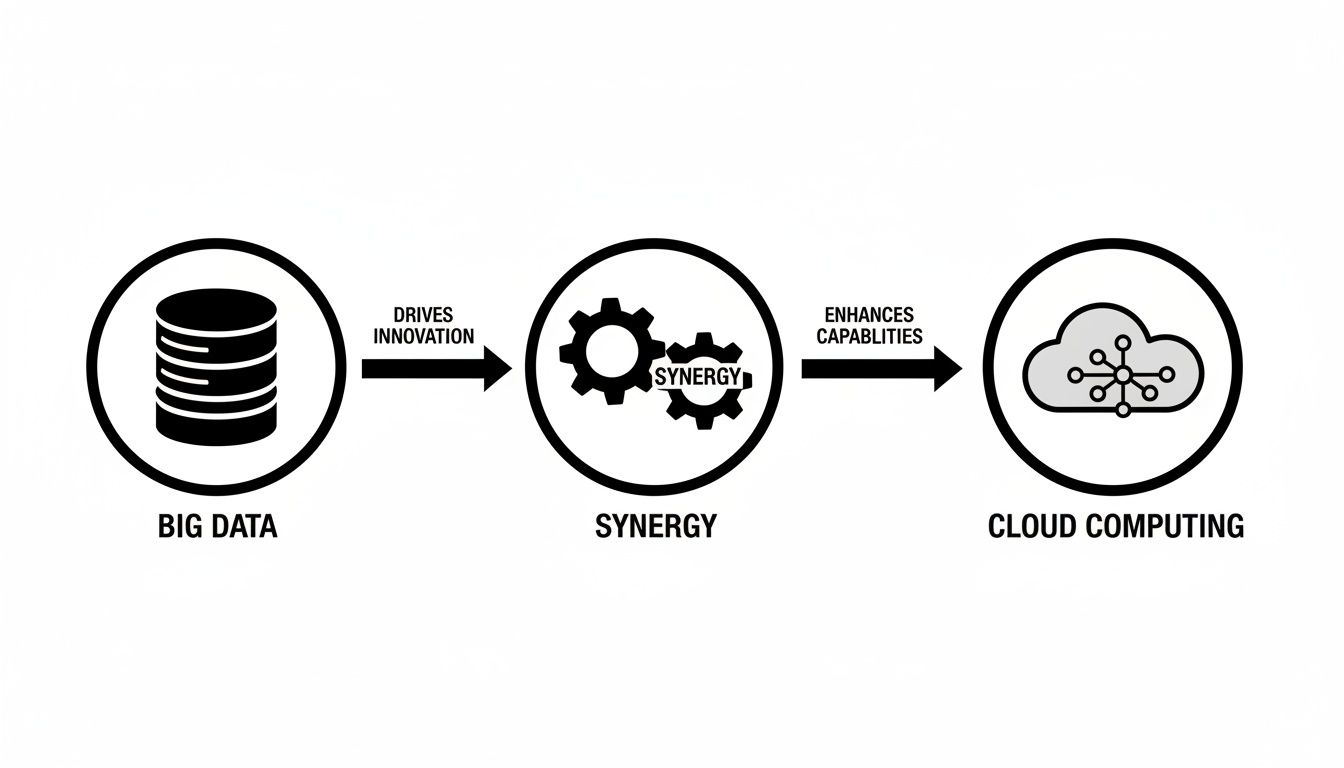
Big data is the fuel; the cloud is the engine. They are two sides of the same coin in any modern data operation.
Comparing Core Data Architectures
To build a high-performance system, it’s critical to understand the three primary architectural patterns: the Data Warehouse, the Data Lake, and the modern hybrid, the Data Lakehouse. Each is designed to solve different business problems.
- Data Warehouse: A Data Warehouse is like a meticulously organized research library. It stores structured, pre-processed data optimized for business intelligence (BI) and reporting. It excels at answering known questions, such as generating quarterly sales reports or tracking daily KPIs.
- Data Lake: A Data Lake is a vast, flexible reservoir. It stores massive volumes of raw data in its native format—structured, semi-structured, and unstructured. This is the ideal environment for data scientists to explore and discover new patterns without the constraints of a predefined schema.
In simple terms: a data warehouse provides answers to questions you already know to ask, while a data lake helps you discover the questions you should be asking.
The right choice depends on your use case. A financial services firm might use a data warehouse for regulatory reporting but leverage a data lake to feed raw transaction data into a machine learning model for fraud detection.
The Rise of the Lakehouse
The Lakehouse architecture emerged to provide the best of both worlds. It combines the low-cost, flexible storage of a data lake with the robust data management and performance features of a data warehouse.
This unified model simplifies the tech stack, reduces data redundancy, and enables both standard BI reporting and advanced AI workloads on the same data repository. For a fast-growing SaaS company, a Lakehouse offers a future-proof solution that supports today’s reporting needs and tomorrow’s AI-driven features without requiring a complete architectural overhaul.
Batch vs. Stream Processing: A Critical Choice
Once you’ve selected a storage architecture, you must decide how to process the data. This choice hinges on how quickly you need insights.
Batch Processing:
This method processes large volumes of data on a scheduled basis (e.g., hourly or nightly). It is highly efficient for tasks where real-time results are not required.
- Real-World Example: A SaaS company processes all of the previous day's user activity logs overnight to generate daily product engagement dashboards for its product managers.
- Best For: Financial reporting, payroll processing, and large-scale data transformations where some latency is acceptable.
Stream Processing:
This method analyzes data in real time, as it is generated. It’s used for applications that require an immediate response.
- Real-World Example: An e-commerce platform analyzes a user's clickstream in real time to serve personalized product recommendations during the same session.
- Best For: Real-time fraud detection, live ad bidding, IoT sensor monitoring, and dynamic application performance monitoring.
Your choice of big data and cloud computing architecture is a core business decision. Aligning this foundation with your strategic goals ensures you build a system that actively drives growth.
Comparing the Top Cloud Platforms for Big Data
While your architecture defines the "what," your cloud provider determines the "how." The decision between Amazon Web Services (AWS), Microsoft Azure, and Google Cloud Platform (GCP) goes beyond feature-by-feature comparisons. It's about aligning a platform's strengths with your team's expertise, existing technology stack, and long-term business objectives.

This is a cornerstone choice for any big data and cloud computing strategy. These three giants dominate the market by offering powerful toolsets for data storage, processing, and analysis. However, their core strengths and philosophies differ, making a direct comparison essential for an informed decision.
Amazon Web Services (AWS): The Market Leader
As the first major player, AWS boasts the most mature and comprehensive portfolio of services. Its big data tools are battle-tested and trusted by millions, from startups to global enterprises. This widespread adoption has cultivated a vast ecosystem of third-party integrations, experienced developers, and extensive documentation.
- Key Services: Amazon S3 is the industry standard for object storage, forming the foundation of countless data lakes. For analytics, Amazon Redshift provides a petabyte-scale data warehouse, while Amazon EMR simplifies running big data frameworks like Apache Spark and Hadoop.
- Core Strength: Unmatched breadth of services and dominant market share. Its maturity ensures reliability and a large talent pool, making it a safe and powerful choice for a wide range of use cases.
Microsoft Azure: The Enterprise Powerhouse
Azure's key advantage is its deep integration with the Microsoft ecosystem. For organizations already running on Windows Server, Office 365, and other Microsoft technologies, Azure often provides the most seamless on-ramp to the cloud, making it a dominant force in the enterprise sector.
- Key Services: Azure Blob Storage is its scalable object storage solution. The flagship analytics service, Azure Synapse Analytics, unifies data warehousing, big data processing, and data integration into a single platform.
- Core Strength: Unbeatable integration for companies within the Microsoft ecosystem. Its robust hybrid cloud capabilities are a major asset for enterprises looking to connect on-premise infrastructure with public cloud services. Our post on Azure vs AWS offers deeper insights.
The market reflects this leadership. AWS, Azure, and Google Cloud collectively capture 66% of all cloud spending in a global infrastructure market valued at $905 billion. Looking ahead, analysts predict that by 2027, 90% of enterprises will be running a hybrid cloud model, highlighting the importance of choosing a platform with strong hybrid capabilities.
Google Cloud Platform (GCP): The Data and AI Specialist
While third in market share, GCP has earned a stellar reputation as a leader in data analytics, machine learning (ML), and container orchestration with Kubernetes. Businesses with data-intensive workloads, especially those innovating with AI, often find GCP's services to be exceptionally powerful and developer-friendly.
- Key Services: Google Cloud Storage is its highly scalable object store. The true standout is BigQuery, a serverless, petabyte-scale data warehouse renowned for its incredible query speeds. Its AI Platform provides a comprehensive toolkit for building, training, and deploying ML models.
- Core Strength: Best-in-class for data analytics and AI. GCP's roots in open-source projects like Kubernetes and TensorFlow make it a favorite among data scientists and engineers who prioritize cutting-edge, innovative tools.
Big Data Services Comparison: AWS vs. Azure vs. GCP
This table provides a high-level comparison of the flagship big data services from each provider, helping you map their offerings to your needs.
| Service Category | AWS Offering | Azure Offering | GCP Offering |
|---|---|---|---|
| Object Storage / Data Lake | Amazon S3 | Azure Blob Storage | Google Cloud Storage |
| Data Warehousing | Amazon Redshift | Azure Synapse Analytics | Google BigQuery |
| Batch & Stream Processing | Amazon EMR, AWS Glue | Azure HDInsight, Azure Databricks | Cloud Dataflow, Dataproc |
| Data Orchestration | AWS Step Functions | Azure Data Factory | Cloud Composer |
| Real-Time Analytics | Amazon Kinesis | Azure Stream Analytics | Google Cloud Pub/Sub |
| Business Intelligence | Amazon QuickSight | Microsoft Power BI | Looker Studio |
While the service names differ, each platform provides the essential building blocks. The decision often comes down to specific feature integrations, pricing models, and your team’s existing expertise.
The right choice isn't about which platform is "best" overall, but which is best for your business. An e-commerce startup might choose GCP for its analytics prowess, while a large financial institution may prefer Azure for its enterprise integrations and hybrid capabilities.
Before committing, analyze your specific use cases. And while the "big three" are leaders for a reason, exploring Google Cloud alternatives can sometimes uncover niche providers that perfectly match a specialized requirement. The goal is to select a strategic partner whose technology empowers your growth.
Mastering Data Security and Compliance in the Cloud
Migrating massive datasets to the cloud unlocks incredible analytical power, but it also elevates the importance of security and compliance. Your data is a core business asset, and its protection is a critical function, not just an IT task. A single data breach can result in severe financial penalties, reputational damage, and legal consequences.
The upside is that a well-architected cloud environment can be significantly more secure than most on-premise data centers.

The key is to embed security into your architecture from day one—a "security by design" approach. This means protecting data at every stage of its lifecycle, from ingestion and processing to storage and analysis.
Core Security Practices for Big Data
Effective data protection in the cloud is built on several foundational pillars. These are the non-negotiables for any secure big data and cloud computing strategy and form your first line of defense.
Implement these essential security controls:
- Identity and Access Management (IAM): This is your digital gatekeeper. A strong IAM strategy is built on the principle of least privilege—granting users and services only the permissions absolutely necessary for their roles. This must be paired with regular access reviews and multi-factor authentication (MFA).
- Data Encryption: Data must be unreadable to unauthorized parties. This requires encryption at rest (while stored in services like Amazon S3 or Google Cloud Storage) and in transit (as it moves across the network). If a breach occurs, the exfiltrated data remains useless.
- Network Security: Isolate your resources within Virtual Private Clouds (VPCs) to create private, secure segments of the cloud. Use security groups and network access control lists (NACLs) to enforce granular rules about what traffic is allowed in and out, effectively creating a micro-perimeter around your applications.
For a deeper dive into common vulnerabilities, explore our guide on key cloud computing security risks.
Implementing a Robust Data Governance Framework
While security focuses on external threats, data governance ensures the quality, integrity, and controlled use of data internally. It’s the set of policies and procedures your organization follows to manage its data assets. Without it, you cannot trust your own information.
A strong data governance framework answers critical questions: Who owns this data? Where did it come from? Is it accurate and fit for purpose? How is it being used? Without clear answers, your powerful data lake can quickly degrade into an unusable data swamp.
A solid governance framework includes:
- Data Quality Management: Processes to cleanse, standardize, and validate data, ensuring that business decisions are based on reliable information.
- Data Lineage: The ability to trace data from its source to its final use in a report or model. This is essential for auditing, troubleshooting, and demonstrating compliance.
- Access Controls and Policies: Defining and enforcing rules that specify who can view, modify, or use specific datasets based on their role and business need.
Navigating the Compliance Maze
For businesses in regulated industries like finance (PCI DSS), healthcare (HIPAA), or those handling data from EU citizens (GDPR), compliance is mandatory. The major cloud providers offer extensive tooling and certifications to help meet these standards, but the ultimate responsibility for compliance remains with your organization.
This involves translating legal requirements into specific technical controls. For example, a regulation requiring all personally identifiable information (PII) to be encrypted and its access logs retained for seven years can be configured and automated within your cloud environment. By designing a secure and well-governed system from the start, you build a resilient foundation capable of withstanding regulatory scrutiny.
Optimizing Cloud Costs and Big Data Performance
The cloud's pay-as-you-go model offers unparalleled agility, but without disciplined management, it can lead to spiraling costs. Mastering the synergy of big data and cloud computing requires a continuous focus on balancing cost and performance.
This is not a one-time task but an ongoing practice of architectural refinement. For FinOps and DevOps teams, the goal is to build a high-performance data platform that meets business demands without overspending.
Strategies for Cloud Cost Management
Effective cost optimization is about proactive visibility and control. Simply "lifting and shifting" workloads to the cloud without re-architecting them is a recipe for waste. To learn more about controlling your cloud bill, explore these Cloud Cost Optimization Strategies.
Here are proven tactics our teams implement to control cloud spend:
- Right-Sizing Instances: Over-provisioning is a common source of waste. Continuously monitor resource utilization and downsize underused virtual machines and database instances to immediately reduce costs.
- Leveraging Spot Instances: For fault-tolerant workloads like batch processing or AI model training, spot instances offer savings of up to 90% over on-demand prices. These are spare compute capacity sold at a steep discount, ideal for non-critical jobs.
- Implementing Auto-Scaling: Configure applications and services to automatically scale resources up or down based on real-time demand. This ensures you pay only for the capacity you need, eliminating waste during off-peak hours while maintaining performance during spikes.
Optimization is a mindset, not a one-off project. It requires treating cloud resources as a metered utility where every dollar spent is justified by the performance and business value it delivers.
Techniques for Boosting Big Data Performance
While cost is critical, it should never come at the expense of performance. A slow data platform can damage business operations just as much as an expensive one. The optimal solution is to enhance architectural efficiency from the ground up.
These methods will make your big data operations faster and more responsive:
- Data Partitioning: By dividing massive tables into smaller, logical partitions (e.g., by date or customer region), query engines can scan only the relevant data instead of the entire table. This dramatically reduces query latency and cost.
- Data Compression: Compressing data reduces storage costs and can also accelerate queries, as less data needs to be read from disk and transferred across the network.
- Choosing Columnar File Formats: Formats like Apache Parquet and ORC are designed for analytics. By storing data in columns instead of rows, they allow queries to read only the specific columns needed, leading to significant performance gains and lower I/O costs.
Combining cost-saving measures with performance-tuning techniques creates a virtuous cycle. A more efficient architecture processes data faster, consuming expensive compute resources for shorter durations and further reducing your cloud bill.
Your Roadmap to Big Data and Cloud Modernization
Migrating your data infrastructure to the cloud is a major undertaking, but a strategic roadmap breaks it down into manageable, value-driven phases. For any organization embarking on this journey, a clear plan is the difference between a successful transformation and a costly, disruptive project.
The right plan ensures your investment in big data and cloud computing delivers tangible business outcomes. The process can be structured into four key phases, guiding your teams from initial concept to a fully optimized, future-ready data platform.
Phase 1: Assessment and Strategy
Before moving a single terabyte, you must understand your current state and define your future goals. Rushing this foundational stage often leads to expensive rework.
Focus on these key actions:
- Define Business Outcomes: What does success look like? Are you aiming to reduce analytics query times by 50%? Launch a real-time fraud detection system? Or cut data storage costs by 30%? Quantify your goals.
- Audit Current State: Create a comprehensive inventory of your data sources, applications, and infrastructure. Identify dependencies, performance bottlenecks, and security vulnerabilities.
- Align Stakeholders: Involve leaders from business, IT, and finance from the start. Secure alignment on objectives, budget, and expectations to prevent friction and ensure company-wide support.
Phase 2: Planning and Design
With a clear strategy, you can design the blueprint for your new cloud environment. The architectural choices made here will determine your system's performance, cost, and scalability for years to come.
Your design checklist should include:
- Select Cloud Architecture: Based on your use cases, decide whether a data warehouse, data lake, or lakehouse model is the best fit.
- Choose Cloud Provider and Services: Evaluate AWS, Azure, and GCP. Compare their big data services, pricing models, and integration capabilities with your existing tech stack.
- Develop the Migration Plan: Define the migration approach for each workload (e.g., lift-and-shift, replatform, refactor). Create a detailed project timeline with clear milestones and responsibilities.
Phase 3: Migration and Implementation
This is where the plan becomes reality. A methodical, phased migration is crucial to minimize business disruption. A "big bang" cutover is rarely advisable due to its high risk.
A well-executed migration should be seamless to end-users. The objective is to migrate data and applications with zero downtime and no performance degradation, which requires careful orchestration and rigorous testing.
Key steps during implementation:
- Start with a Pilot Project: Select a low-risk workload to validate your migration process, test the architecture, and provide the team with a quick win.
- Migrate in Waves: Move applications and data in planned stages. Begin with less critical systems to refine the process before tackling more complex, mission-critical workloads.
- Validate at Every Step: Continuously test for data integrity, application performance, and security configurations to ensure the new environment meets all requirements.
Phase 4: Optimization and Governance
Migrating to the cloud is the beginning, not the end. The focus now shifts to continuous optimization, ensuring your environment runs efficiently, securely, and cost-effectively.
Ongoing post-migration activities include:
- Implement FinOps Practices: Continuously monitor cloud spend, right-size resources, and leverage cost-saving features like reserved instances and savings plans.
- Enforce Data Governance: Implement and enforce data quality standards, access controls, and compliance policies to maintain a secure and trustworthy data environment.
- Monitor and Refine: Use cloud-native monitoring tools to track key performance indicators (KPIs). Proactively identify and resolve bottlenecks to ensure peak efficiency.
Partnering with an experienced team like Group 107 can de-risk this complex process. Our deep expertise in DevOps and cloud services ensures your modernization project is built on a solid foundation, delivering business results from day one.
Frequently Asked Questions
As you plan a major initiative around big data and cloud computing, questions are inevitable. Here are concise, actionable answers to the most common concerns we hear from clients.
Is moving our big data to the cloud actually secure?
Yes. For most organizations, migrating to a major cloud provider represents a significant security enhancement compared to an on-premise data center. Cloud giants like AWS, Azure, and GCP invest billions annually in security, offering advanced tools for threat detection, encryption, and access management that are beyond the reach of most individual companies.
However, security is a shared responsibility. A secure outcome depends on a well-architected cloud environment. By implementing a defense-in-depth strategy built on the principle of least privilege, multi-factor authentication, and end-to-end encryption, you can create a highly secure posture for your most valuable data assets.
Which cloud provider is best for a small business or startup?
There is no single "best" provider; the optimal choice depends on your team's skills, product architecture, and business goals.
- AWS offers the most comprehensive service portfolio and largest market share, making it a reliable all-around choice.
- GCP excels in data analytics, machine learning, and Kubernetes, making it a favorite among data-intensive startups.
- Azure is often the most logical choice for businesses already heavily invested in the Microsoft ecosystem.
All three providers offer generous free tiers and startup credits, which significantly lower the barrier to entry. Our advice: evaluate based on your team's existing expertise and the specific technical requirements of your product.
How do we start migrating our existing data to the cloud?
Start with a small, low-risk pilot project. This allows your team to gain hands-on experience and build confidence without jeopardizing core business operations. A successful migration always begins with a thorough assessment of your current data, applications, and infrastructure.
From there, develop a detailed plan outlining your target cloud architecture and migration strategy for each workload (e.g., lift-and-shift, replatform, or refactor). By moving in carefully planned waves, you minimize disruption and ensure a smoother, more predictable transition.
This shift is the new standard. Over 60% of all corporate data now resides in the cloud, enabling 94% of enterprises to leverage that data for business insights. It's a critical move for Group107's clients—from SaaS startups building an MVP to financial institutions creating new digital platforms—who rely on our dedicated engineers for data science, AI automation, and cybersecurity. You can discover more insights about cloud adoption statistics on finout.io.
Summary and Next Steps
The powerful combination of big data and cloud computing enables businesses to transform raw data into a strategic asset, driving efficiency, innovation, and growth. By selecting the right architecture (Data Lake, Warehouse, or Lakehouse), choosing the best-fit cloud provider (AWS, Azure, or GCP), and implementing robust security and governance, you can build a scalable, cost-effective data platform.
Your Actionable Next Steps:
- Assess Your Readiness: Audit your current data landscape and define clear business outcomes for a cloud migration.
- Develop a High-Level Plan: Sketch out your desired architecture and evaluate which cloud provider best aligns with your goals.
- Engage an Expert Partner: A successful migration is complex. A partner can help you navigate the technical challenges and accelerate your path to value.
Ready to build a data strategy that delivers real business growth? The expert teams at Group 107 are here to support you from end-to-end, from initial assessment to ongoing optimization. Contact us to scale your engineering capabilities and accelerate your journey to the cloud.