
Data is one of your most valuable assets, but raw data alone is just noise. The real power comes from turning it into clear, actionable insights. Business Intelligence (BI) is the engine that drives this conversion, shifting your organization from reactive decision-making to proactive, data-driven strategy. For any business in the tech, SaaS, or finance sectors, a strong BI framework isn't just an advantage; it is essential for survival and growth.
This article moves beyond theory to provide concrete business intelligence examples from the front lines of sales, product development, DevOps, and operations. We will dissect exactly how successful companies use BI to solve specific problems, measure outcomes, and achieve a significant return on investment.
You will see how to build a BI practice that does more than just visualize data. It creates tangible business value, improves efficiency, and offers a clear roadmap for scaling your operations. Each of the following examples acts as a practical blueprint you can adapt to your own organization, complete with the problem, the data sources, the solution, and the measurable results. We will explore replicable strategies for:
- Forecasting sales revenue and monitoring pipeline health.
- Analyzing client profitability and project delivery performance.
- Tracking product engagement and user behavior metrics.
- Monitoring DevOps and infrastructure performance.
- Analyzing marketing lead quality and campaign effectiveness.
This guide provides the tactical details needed to turn your data into a strategic asset.
1. Sales Pipeline and Revenue Forecasting
One of the most valuable business intelligence examples is applying BI to the sales pipeline for accurate revenue forecasting. This goes beyond simple sales tracking; it involves a data-driven system for predicting future income by analyzing the entire sales funnel, from initial contact to a closed deal. This process provides clarity on financial health and supports strategic decisions about resource allocation and growth planning.
For a technology consultancy like Group107, this means tracking opportunities for custom software development projects or dedicated offshore teams with precision. The goal is to move from guesswork to a predictable model that answers critical business questions.
How It Works: A Tactical Breakdown
BI systems connect directly to data sources to create a unified view of the sales process. This integration is key for building reliable forecasting models.
- Data Sources: The primary source is a Customer Relationship Management (CRM) platform like Salesforce or HubSpot. This data is often enriched with information from marketing automation tools (e.g., Pardot), financial software (e.g., QuickBooks, NetSuite), and project management systems (e.g., Jira).
- Key Metrics & Dashboards: A central dashboard visualizes the entire pipeline. Core metrics include:
- Deal Velocity: The average time a deal spends in each stage.
- Conversion Rates: The percentage of deals that move from one stage to the next.
- Pipeline Value by Stage: The total potential revenue in each part of the funnel.
- Forecast Accuracy: A comparison of past predictions against actual revenue.
- Implementation: At Group107, we segment forecasts by service line, such as our fintech solutions versus DevOps consulting. This allows leadership to see which business areas are driving growth and where to allocate more sales or delivery resources.
Key Insight: The true power of BI in forecasting isn't just seeing the numbers; it's understanding the why behind them. By analyzing historical conversion rates by client segment (e.g., enterprise vs. startup), you can assign a weighted probability to each deal, creating a far more accurate forecast than a simple pipeline value total.
2. Client Project Health and Delivery Performance Monitoring
Another powerful business intelligence example involves monitoring client project health and delivery performance. For service-based companies, especially in tech and consulting, this application is essential for maintaining client trust and profitability. It moves project tracking from subjective status updates to an objective, data-driven system that identifies risks, bottlenecks, and performance trends in real-time.

At Group107, this means we can oversee multiple concurrent engagements-from MVP development for startups to complex infrastructure projects-with clarity. The objective is to proactively manage timelines, budgets, and resource allocation, ensuring every project is delivered successfully.
How It Works: A Tactical Breakdown
BI systems integrate with project management and development tools to automate the collection and visualization of key performance indicators. This creates a single source of truth for both internal teams and clients.
- Data Sources: The core data comes from project management and development platforms like Jira, Azure DevOps, Asana, or Monday.com. This can be combined with data from time-tracking software, code repositories (e.g., GitHub, GitLab), and client feedback systems.
- Key Metrics & Dashboards: A project health dashboard provides an at-a-glance view of delivery status. Critical metrics include:
- Budget vs. Actual: Tracking current spend against the planned project budget.
- Team Velocity & Cycle Time: Measuring the amount of work a team completes in a sprint and the time it takes for a task to move from start to finish.
- Scope Creep: Visualizing the number of tasks added after the initial project planning phase.
- Resource Utilization: Monitoring how team members' time is allocated across projects.
- Implementation: We build separate dashboards for internal management and client-facing reports. Internally, we focus on granular metrics like team velocity and bug resolution times. For clients, we present high-level progress, milestone achievement, and budget adherence, promoting transparency and building confidence in our dedicated development teams.
Key Insight: The most effective BI for project management focuses on trends over time, not isolated data points. A sudden drop in team velocity or a spike in cycle time is a leading indicator of a potential bottleneck, such as unclear requirements or technical debt. This allows managers to intervene before the project timeline is seriously affected.
3. Engineer Skill Inventory and Team Composition Analysis
Another powerful business intelligence example is the strategic mapping of an engineering team's skills, certifications, and experience. For a consultancy, this moves beyond a simple HR spreadsheet; it becomes a dynamic system for assembling high-performing teams, optimizing project assignments, and pinpointing skill gaps before they affect client outcomes. This data-driven approach is fundamental for delivering specialized expertise consistently.
At Group107, our model of providing dedicated, no-resource-sharing teams depends on this intelligence. We must accurately match client needs-whether it's for fintech compliance or advanced DevOps-with a specific mix of engineering talent. This BI application turns our human capital into a quantifiable, strategic asset.
How It Works: A Tactical Breakdown
BI tools centralize personnel data to give leadership a complete view of organizational capabilities. This integration is crucial for building effective, project-ready teams on demand.
- Data Sources: The core data often comes from Human Resource Information Systems (HRIS) like BambooHR or Workday. This is combined with data from project management tools (Jira, Asana) to link skills to project performance, and certification databases from cloud providers (AWS, Azure) or industry bodies.
- Key Metrics & Dashboards: A skills inventory dashboard is the central hub. Essential metrics include:
- Skill Density: The number of engineers proficient in a critical technology (e.g., Kubernetes, PCI-DSS compliance).
- Certification Coverage: The percentage of the team holding key certifications.
- Team Composition Templates: Pre-defined team structures for common project types (e.g., 'Fintech MVP Team' or 'Accessibility Audit Squad').
- Skill Gaps: A visual representation of required skills versus available expertise.
- Implementation: We use this BI system to build project-specific teams, such as assembling developers with proven accessibility compliance knowledge for public sector clients. By analyzing past project success rates against team skill compositions, we refine our "formulas" for building the most effective engineering units.
Key Insight: Skill inventory BI is not just about who knows what. It's about building institutional resilience. By tracking skill distribution, a company can proactively identify single points of failure-where only one person holds a critical skill-and launch targeted training or hiring initiatives to build redundancy, ensuring business continuity.
4. Client Profitability and Account Performance Analysis
A powerful business intelligence example involves analyzing client profitability to understand the true value of each account. This process moves beyond top-line revenue to calculate net profit margins for individual clients, projects, and service lines. By identifying which accounts are most profitable versus those that drain resources, businesses can make strategic decisions on pricing, resource allocation, and account management.
For a service-based firm like Group107, this means distinguishing between high-margin, low-maintenance engagements and those that, despite high revenue, yield minimal profit. This clarity is essential for sustainable growth and focusing sales efforts where they generate the most significant impact.
How It Works: A Tactical Breakdown
BI tools are configured to pull together financial and operational data, creating a complete picture of account-level performance. This integration is the foundation for accurate profitability analysis.
- Data Sources: Data is aggregated from multiple systems. Financial software (e.g., QuickBooks, NetSuite) provides revenue and direct cost data. Time-tracking and project management tools (e.g., Jira, Asana) supply resource allocation and labor hours. CRM platforms (e.g., Salesforce) offer client relationship context.
- Key Metrics & Dashboards: A client profitability dashboard provides a centralized view of performance. Crucial metrics include:
- Gross Profit Margin by Client: Revenue minus the direct costs of servicing that account.
- Resource Utilization Rate: The percentage of an employee's time spent on billable client work.
- Client Lifetime Value (CLV): Total net profit expected from a client over the entire relationship.
- Cost-to-Serve: All operational and support costs associated with managing a specific account.
- Implementation: At Group107, we analyze profitability across engagement models, comparing dedicated teams for custom software development with fixed-scope projects. This reveals which structures are most efficient and helps us refine our pricing and delivery strategies for future client engagements.
Key Insight: Profitability is not static. The real value comes from tracking these metrics over time. An account that is initially low-margin may become highly profitable as it expands services or renews contracts. BI dashboards must be designed to show profitability trends, not just a single point-in-time snapshot, to inform long-term strategic account management.
5. Digital Product Performance and User Engagement Metrics
One of the most powerful business intelligence examples for digital-first companies involves tracking product performance and user engagement. This process moves beyond simple page views to provide a granular understanding of how users interact with a digital solution, from a SaaS platform to a fintech application. It helps product teams validate hypotheses, prioritize features, and optimize the user journey for better retention and value delivery.
For a firm like Group107 that builds and maintains complex digital products, this BI application is crucial. We use it to measure the impact of UI/UX improvements, monitor the adoption of new features, and provide clients with clear data on how their investment is performing. The goal is to replace assumptions about user behavior with concrete evidence.
How It Works: A Tactical Breakdown
BI tools connect to product analytics platforms and other data sources to build a complete picture of user interaction. This integration is essential for correlating user behavior with business outcomes.
- Data Sources: The core data comes from event-based analytics tools like Amplitude, Mixpanel, or Heap. This is often combined with data from CRMs (Salesforce), support ticket systems (Zendesk), and A/B testing platforms (Optimizely) to add context to user actions.
- Key Metrics & Dashboards: A product performance dashboard visualizes key user journeys. Core metrics include:
- Feature Adoption Rate: The percentage of active users who have used a specific feature.
- User Retention Cohorts: Groups of users segmented by sign-up date to track how long they remain active.
- Conversion Funnels: The step-by-step progression of users through a key workflow, such as onboarding or checkout.
- Engagement Score: A composite metric that combines frequency, intensity, and depth of interaction.
- Implementation: At Group107, we apply this to measure the success of features within the custom fintech platforms we develop. By tracking how many banking customers use a new mobile deposit feature, for instance, we can directly quantify its value and guide future development efforts.
Key Insight: The true value is in segmentation. Instead of looking at average user engagement, BI allows you to segment by user persona, subscription tier, or acquisition channel. This reveals which user groups are thriving and which are struggling, allowing for targeted interventions like in-app guides or email campaigns to improve their experience.
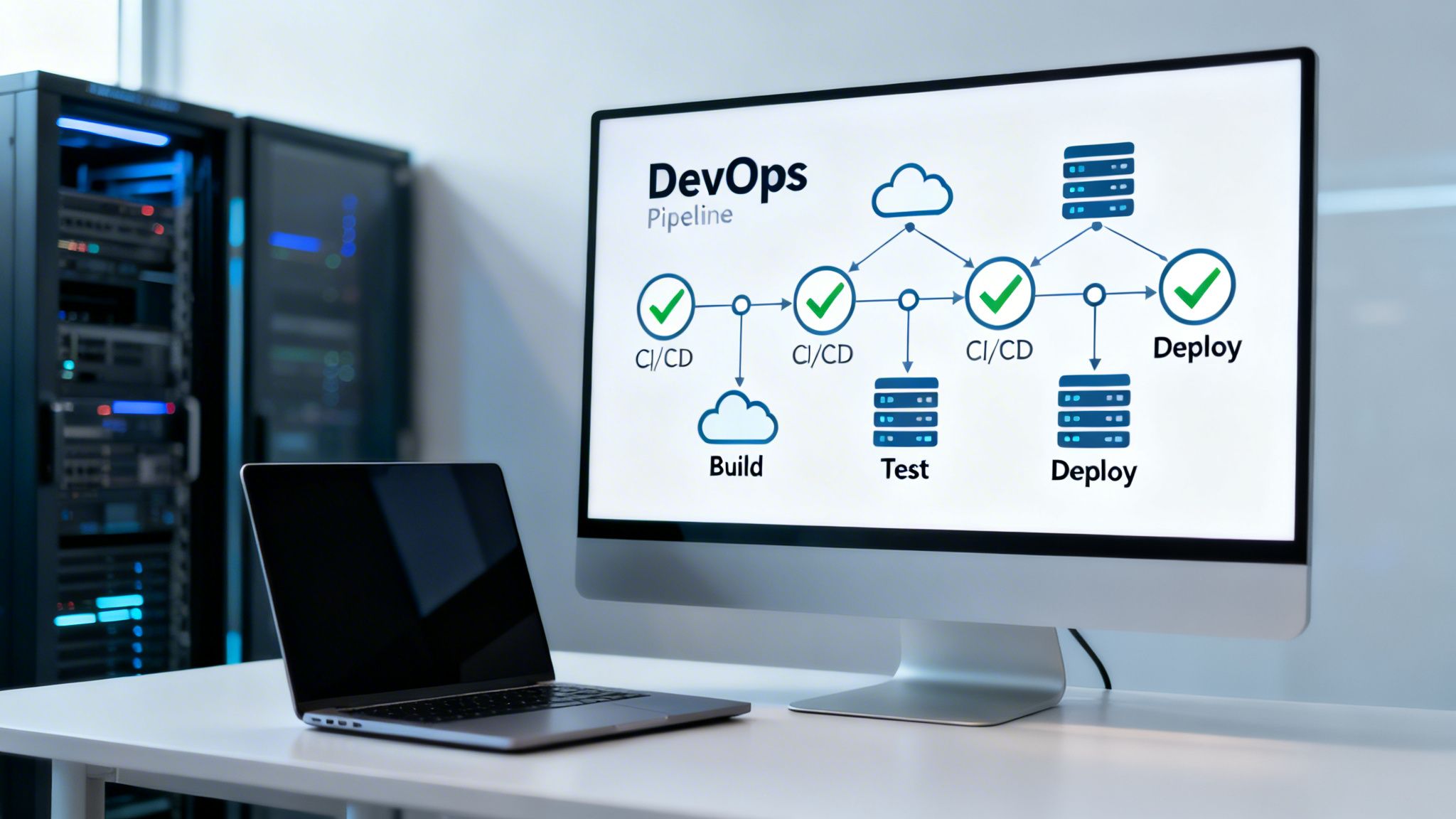
6. DevOps Pipeline and Infrastructure Performance Monitoring
Another powerful business intelligence example involves applying BI to monitor the DevOps lifecycle and underlying infrastructure. This moves beyond simple server uptime checks; it's about creating a complete view of engineering velocity, system stability, and resource efficiency. For a DevOps as a Service provider like Group107, this is crucial for demonstrating value and ensuring client systems are performant and cost-effective.
This data-driven approach allows engineering leaders to pinpoint bottlenecks in their CI/CD pipelines, proactively address infrastructure issues before they cause outages, and make informed decisions about cloud spending. The goal is to create a feedback loop that continually improves both development speed and operational reliability.
How It Works: A Tactical Breakdown
BI systems for DevOps aggregate telemetry data from dozens of sources to provide a single source of truth for engineering performance and system health. This integration is the foundation for effective monitoring and optimization.
- Data Sources: Key sources include application performance monitoring (APM) tools (e.g., Datadog, New Relic), infrastructure monitoring platforms (e.g., Prometheus, CloudWatch), CI/CD pipeline logs (e.g., Jenkins, GitLab CI), and cloud provider billing APIs (e.g., AWS Cost Explorer).
- Key Metrics & Dashboards: A central dashboard visualizes critical engineering and operational metrics. Core metrics include the DORA (DevOps Research and Assessment) metrics:
- Deployment Frequency: How often code is successfully released to production.
- Lead Time for Changes: The time from code commit to production deployment.
- Mean Time to Recovery (MTTR): The average time it takes to restore service after an incident.
- Change Failure Rate: The percentage of deployments that cause a failure in production.
- Implementation: At Group107, we establish observability across the entire stack for our clients. By connecting these BI insights to alerting systems, we can automate responses to performance degradation and share SLA compliance metrics directly with stakeholders. You can learn more about these infrastructure monitoring best practices in our detailed guide.
Key Insight: The true value of BI in DevOps is linking engineering activity to business outcomes. By tracking DORA metrics alongside cloud costs, you can prove that investing in pipeline automation not only accelerates delivery but also reduces operational overhead and improves system reliability, directly impacting customer satisfaction and the bottom line.
7. Accessibility and Compliance Audit Tracking
A critical, and often overlooked, business intelligence example is the application of BI to monitor digital accessibility and compliance. This involves tracking adherence to standards like the Web Content Accessibility Guidelines (WCAG), ADA, and Section 508. It moves accessibility from a one-time check to a continuous, data-driven process that ensures all users, regardless of ability, have an equitable digital experience.
For a firm like Group107 that builds solutions for financial services and enterprise clients, this is non-negotiable. We use BI to provide transparent, ongoing proof of compliance, track remediation efforts, and embed accessibility into the core of the development lifecycle.
How It Works: A Tactical Breakdown
BI platforms consolidate data from various testing and project management tools to create a central command center for accessibility initiatives. This integration provides a real-time view of an organization's compliance posture.
- Data Sources: Data is pulled from automated accessibility testing tools like Deque Axe or WAVE, which are often integrated into CI/CD pipelines. This is supplemented with results from manual audits, issue trackers (e.g., Jira), and project management software.
- Key Metrics & Dashboards: A compliance dashboard visualizes progress and pinpoints problem areas. Key metrics include:
- WCAG Conformance Level: Tracks overall compliance against A, AA, or AAA standards.
- Violations by Severity: Categorizes issues as critical, serious, or minor.
- Remediation Velocity: The rate at which accessibility bugs are identified and fixed.
- Compliance Over Time: A trendline showing improvement or regression in accessibility scores.
- Implementation: At Group107, we configure dashboards to report on accessibility compliance across different client projects or even specific product features. This allows us to include these metrics in client reports and service-level agreements (SLAs), demonstrating our commitment to inclusive design and helping clients meet their legal and ethical obligations. For a deeper dive into the specific legal requirements, you can explore the fundamentals of ADA website compliance requirements.
Key Insight: BI transforms accessibility from a developer-centric task into a strategic business objective. By tracking violations and remediation times, leadership can identify gaps in team training, allocate resources more effectively, and reduce legal risk. It quantifies the effort required to build and maintain inclusive products, making accessibility a measurable part of business performance.
8. Financial Services Compliance and Risk Monitoring
Another critical business intelligence example is its application in financial services for compliance and risk monitoring. For fintech companies, staying aligned with strict regulatory frameworks is not optional; it's a core business function. BI provides the tools to automate the monitoring of transactions, security controls, and compliance standards, turning a complex, manual process into a manageable, data-driven operation.
In our work with fintech clients, Group107 uses BI to create systems that track everything from Anti-Money Laundering (AML) patterns to data security protocols. The objective is to build a verifiable, auditable trail that satisfies regulators and protects the business from significant financial and reputational risk.
How It Works: A Tactical Breakdown
BI platforms aggregate data from diverse operational systems to provide a single source of truth for compliance officers and security teams. This real-time visibility is essential for proactive risk management.
- Data Sources: Key sources include transaction databases (SQL, NoSQL), cloud infrastructure logs (AWS CloudTrail, Azure Monitor), security information and event management (SIEM) systems like Splunk, and identity access management (IAM) platforms such as Okta.
- Key Metrics & Dashboards: A compliance dashboard is built to monitor specific regulatory requirements. Essential metrics include:
- AML Alert Volume: The number of transactions flagged for suspicious activity.
- Compliance Status: Real-time tracking against standards like SOC 2 or the Payment Card Industry Data Security Standard (PCI DSS).
- Vulnerability Scan Results: Data on identified security weaknesses and remediation progress.
- Audit Log Activity: A detailed record of user access and system changes for accountability.
- Implementation: At Group107, we configure BI dashboards to automate evidence collection for audits. For example, a dashboard can automatically display all system changes, user access reviews, and security patch statuses required for a SOC 2 examination, dramatically reducing manual effort.
Key Insight: Effective compliance BI is about creating an irrefutable audit trail. Instead of simply reporting on compliance status, the system should allow auditors to drill down into specific events, policies, and controls. This level of transparency builds trust with regulators and transforms audits from a disruptive event into a routine verification.
9. Marketing Performance and Lead Quality Analysis
Among the most critical business intelligence examples is the application of BI to marketing performance and lead quality. This moves beyond vanity metrics like clicks and impressions to focus on what truly matters: generating high-quality leads that convert into profitable customers. By connecting marketing efforts directly to sales outcomes, BI gives businesses a clear picture of their marketing return on investment (ROI).
For a service provider like Group107, this means understanding which digital marketing channels attract the most qualified client prospects for our integrated services. The objective is to stop spending on low-performing campaigns and double down on channels that deliver measurable business results.
How It Works: A Tactical Breakdown
BI platforms integrate with various marketing and sales tools to create a single source of truth for lead generation and nurturing. This unification is the foundation for effective performance analysis.
- Data Sources: Key sources include marketing automation platforms (HubSpot, Pardot, Marketo), web analytics tools (Google Analytics 4), data connectors (Segment), and the company's CRM (Salesforce). This provides a full view of the customer journey, from first touch to closed deal.
- Key Metrics & Dashboards: A marketing performance dashboard visualizes the entire funnel. Essential metrics include:
- Lead Quality Score: A numerical value assigned to leads based on their firmographic data and engagement level.
- Customer Acquisition Cost (CAC) by Channel: The total cost to acquire a new customer from a specific marketing channel (e.g., content, paid ads, webinars).
- Marketing-Influenced Revenue: The amount of revenue connected to deals where marketing played a role.
- Funnel Conversion Rates: The percentage of leads moving from one stage (e.g., MQL to SQL) to the next.
- Implementation: At Group107, we analyze which fintech use cases or content topics attract the highest-quality prospects. This allows our marketing team to create more targeted content and campaigns that speak directly to the needs of ideal clients, such as those seeking secure fintech software development.
Key Insight: The real value of marketing BI is shifting the conversation from lead volume to lead quality and revenue impact. By implementing consistent UTM tagging and defining lead scoring criteria with the sales team, you can precisely track which campaigns, content, and channels produce the best business outcomes, enabling data-driven budget allocation.
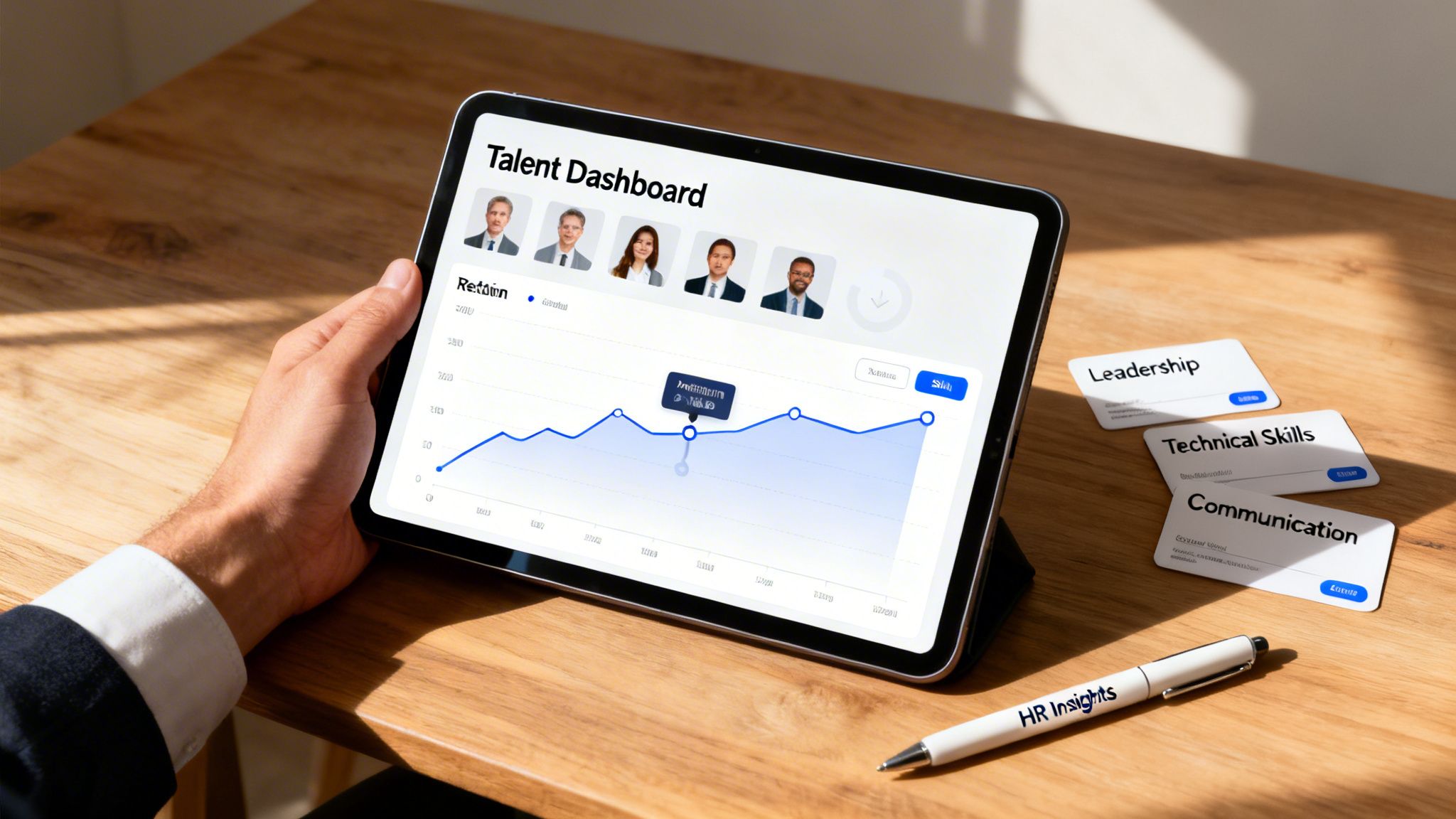
10. Team Retention and Talent Analytics
Another powerful business intelligence example is applying BI to talent analytics to improve employee retention. For a business like a consultancy, where talent is the core product, retaining skilled professionals is a direct driver of revenue and client satisfaction. This approach moves beyond simple HR reporting to build a predictive system for understanding and improving team stability.
At Group107, this is crucial for the success of our dedicated offshore teams. We use BI to identify attrition risks, understand the drivers of employee satisfaction, and proactively manage team composition. The objective is to shift from reactive problem-solving to a data-driven strategy that ensures team continuity and maintains high-quality service for our clients.
How It Works: A Tactical Breakdown
BI tools connect disparate HR and operational systems to create a unified, real-time view of the workforce. This integration is the foundation for building meaningful talent analytics.
- Data Sources: The primary source is an HR Information System (HRIS) like BambooHR or Workday. This is enriched with data from performance management tools (e.g., Lattice), engagement survey platforms (e.g., Culture Amp), project management systems (e.g., Jira), and client feedback databases.
- Key Metrics & Dashboards: A central talent dashboard provides insights into workforce health. Core metrics include:
- Attrition Rate: The percentage of employees who leave over a specific period, segmented by department, role, or manager.
- Employee Net Promoter Score (eNPS): A measure of employee loyalty and satisfaction gathered from engagement surveys.
- Performance vs. Potential: A 9-box grid that helps identify high-performers and future leaders.
- Compensation Ratios: A comparison of internal salaries to market benchmarks.
- Implementation: At Group107, we correlate project satisfaction scores with retention data for our offshore development teams. This helps us see which types of projects or client relationships lead to higher engagement and lower turnover, informing how we structure future engagements.
Key Insight: The real value of talent analytics is in identifying lead indicators of attrition, not just tracking lag indicators like turnover rates. By analyzing factors like decreasing engagement survey scores, reduced activity in communication channels, or extended time on the bench, you can create a risk score for each team member and implement targeted retention plans before they decide to leave.
Top 10 Business Intelligence Use Case Comparison
| Solution | Implementation complexity | Resource requirements | Expected outcomes | Ideal use cases | Key advantages |
|---|---|---|---|---|---|
| Sales Pipeline and Revenue Forecasting | Medium — CRM integration + forecasting models | CRM data, analytics platform, sales discipline | More accurate revenue forecasts; capacity planning | Sales-driven engagements; pipeline management | Improved budgeting; sales-delivery alignment; early gap detection |
| Client Project Health and Delivery Performance Monitoring | High — integrate PM, time and QA systems | Dev tools (Jira, ADO), time tracking, dashboards | Early risk detection; on-time delivery improvements | Multi-project delivery; dedicated teams; client reporting | Transparency; proactive mitigation; utilization optimization |
| Engineer Skill Inventory and Team Composition Analysis | Medium — skill matrix and assessment tooling | HR data, skill assessments, maintenance processes | Faster team matching; targeted upskilling plans | Building dedicated teams; succession planning; hiring | Optimal team fit; reduced ramp time; training prioritization |
| Client Profitability and Account Performance Analysis | Medium–High — cost allocation and billing integration | Financial systems, time costs, analytics rules | Clear margin visibility; account prioritization | Pricing strategy; account management; resource allocation | Identify unprofitable accounts; inform pricing and sales focus |
| Digital Product Performance and User Engagement Metrics | Medium — event instrumentation and analytics | Event tracking, analytics platform, privacy controls | Data-driven product decisions; higher retention/conversion | SaaS, fintech platforms, ongoing product iteration | Evidence-based roadmap; UX improvements; experiment insights |
| DevOps Pipeline and Infrastructure Performance Monitoring | High — observability across stack and CI/CD | Monitoring tools, telemetry, engineering effort | Faster deployments; reliability improvements; cost savings | DevOps-as-a-Service; cloud optimization; CI/CD scaling | Delivery velocity; cost optimization; early incident detection |
| Accessibility and Compliance Audit Tracking | Medium — audits + automated/manual testing | Accessibility tools, specialists, remediation resources | Demonstrable compliance; reduced legal/reputational risk | Regulated sectors; public-facing platforms; accessibility services | Legal compliance; inclusive UX; audit-ready documentation |
| Financial Services Compliance and Risk Monitoring | Very High — regulatory, security, anomaly detection | Compliance experts, secure infra, continuous updates | Regulatory compliance; fraud detection; audit readiness | Fintech products; payment platforms; banking clients | Reduced legal liability; early fraud detection; trusted platforms |
| Marketing Performance and Lead Quality Analysis | Medium — cross-channel attribution and tracking | Marketing analytics, UTM/CRM integration, tagging | Better ROI; optimized channel spend; higher-quality leads | Demand gen, campaign optimization, lead scoring | Data-driven budget allocation; improved conversion insights |
| Team Retention and Talent Analytics | Medium — HRIS integration + surveys | HRIS, engagement tools, analytics models | Lower attrition; targeted retention programs; continuity | Distributed/offshore teams; talent planning; retention efforts | Early attrition signals; informed HR investments; improved stability |
Your Next Steps: Building a Data-Driven Culture
The business intelligence examples detailed throughout this article, from sales forecasting to DevOps pipeline monitoring, reveal a core truth: market leaders view data not as a byproduct but as a central pillar of their strategy. They have moved beyond simple data collection and are actively embedding analytics into their daily operations and decision-making processes. This is the fundamental shift that separates high-performing organizations from the rest.
We’ve seen how financial services firms use BI to manage risk, how product teams use it to understand user behavior, and how operations managers monitor project health in real-time. The common thread is a commitment to replacing guesswork with verifiable insights. The result is a more agile, efficient, and competitive business.
From Examples to Execution: Your Action Plan
Seeing these business intelligence examples is one thing; implementing them is another. The journey toward a data-driven culture can seem daunting, but it starts with a single, focused initiative. Don't try to boil the ocean. Instead, build momentum by following a structured, iterative approach.
Here are the actionable steps you can take to start building your own BI capabilities, inspired by the successes we've analyzed:
- Step 1: Identify One Critical Problem. Start small. What is the single biggest pain point or unanswered question in your department or organization? Is it client churn? Poor marketing ROI? Inefficient engineering workflows? Choose one high-impact area to focus on.
- Step 2: Define Your "North Star" Metrics. For the problem you've identified, determine the 3-5 key performance indicators (KPIs) that truly define success. As seen in our product analytics example, this could be user retention rate and feature adoption. For an operational use case, it might be project profitability and on-time delivery percentage.
- Step 3: Map Your Data Sources. Where does the necessary information live? Identify the specific systems, databases, and platforms (e.g., Salesforce, Jira, Google Analytics, your application database) that hold the raw data. This step is critical for planning your data architecture.
- Step 4: Build a Minimum Viable Dashboard. You don't need a perfect, all-encompassing BI system from day one. Start with a simple dashboard in a tool like Tableau, Power BI, or even Google Data Studio that tracks only your North Star metrics. The goal is to deliver initial value quickly.
- Step 5: Establish a Rhythm of Review. A dashboard that no one looks at is useless. Integrate a review of your new BI dashboard into an existing weekly or bi-weekly team meeting. Make it a routine to discuss the numbers, ask "why," and assign action items based on the insights.
The True Value of Mastering Business Intelligence
Mastering these approaches isn't just about creating nice-looking charts. It's about building a system of accountability and continuous improvement. When your teams have direct access to performance data, they become more empowered to make smart, autonomous decisions that align with broader company goals. This is how you scale intelligence across your organization.
Strategic Insight: The most successful BI implementations are not top-down mandates. They are grassroots efforts that solve a real, tangible problem for a specific team, prove their value, and then expand organically throughout the business.
By applying the frameworks from these business intelligence examples, you create a feedback loop that drives progress. Marketing can see which campaigns generate qualified leads and adjust spend accordingly. Product teams can identify underused features and prioritize development resources. Leadership can get a clear, unfiltered view of business health without waiting for manual reports. This operational clarity is the ultimate competitive advantage, enabling you to move faster, allocate resources more effectively, and respond to market changes with confidence.
Ready to turn your data from a static resource into a dynamic driver of growth? Group 107 specializes in building the data engineering, custom software, and AI automation solutions that power modern business intelligence. We help organizations like yours design and implement the technical architecture needed to translate raw data into actionable insights, just like in the examples you've seen here. Contact Group 107 today to discuss how our expert teams can help you build your data-driven future.