
Once viewed as a simple cost-cutting tactic, custom software development outsourcing has evolved into a powerful strategic lever for business growth. Forward-thinking companies now partner with specialized firms to create bespoke digital products, gaining a competitive advantage that off-the-shelf software simply cannot provide. This strategic move frees up your internal team to focus on core business operations while accelerating innovation and market entry.
This guide provides a clear, actionable framework for leveraging custom software outsourcing to achieve tangible business outcomes. We'll cover everything from selecting the right engagement model to protecting your intellectual property, ensuring you have the insights needed to make informed, high-impact decisions.
Why Outsourcing Custom Software Is a Strategic Growth Engine
Generic, one-size-fits-all software is a barrier to differentiation. It rarely delivers the unique user experiences or handles the complex operational integrations your business needs to stand out and scale effectively. This is where custom software development becomes a real lever for growth, transforming your technical aspirations into a tangible competitive advantage.
The goal has shifted from just saving money to building a decisive market advantage. For SaaS platforms, financial institutions, and e-commerce leaders, a unique digital platform is no longer a luxury—it's critical for survival and scalability.
Accelerate Time-to-Market and Drive Innovation
In today's fast-paced market, speed is a non-negotiable advantage. Outsourcing gives you immediate access to a pre-vetted, specialized talent pool. Instead of getting bogged down in a months-long recruitment cycle, you can have a full team of engineers, UI/UX designers, and QA specialists operational in weeks.
This approach drastically shortens your development timeline, getting your product in front of customers faster so you can start generating revenue and gathering feedback. For example, a SaaS company can build and launch a full-featured MVP in just three months with an expert offshore partner—a feat that could take over a year when wrestling with in-house hiring. This speed fuels the rapid, feedback-driven iteration that defines successful digital products.
Access Specialized Skills and Modernize Systems
The hunt for top-tier talent in high-demand areas like AI, DevOps, or legacy system modernization is a significant challenge for many businesses. The local supply of experts often fails to meet the demand. Custom software outsourcing provides the solution, connecting you with global experts who live and breathe these technologies.
- AI and Automation: Integrate intelligent features like predictive analytics or automated workflows into your products without the massive overhead of building an in-house data science team.
- Legacy Modernization: Re-architecting clunky, outdated systems into scalable, cloud-native applications is no longer a daunting prospect. It becomes a direct path to enhanced performance, security, and lower maintenance costs.
- Process Efficiency: Develop solutions like custom internal tooling to streamline internal operations, reduce manual effort, and boost company-wide productivity.
By tapping into these skills on an as-needed basis, you can execute complex technical projects that would otherwise be out of reach. To see how this plays out in practice, our guide details the many benefits of offshore software development.
Ultimately, outsourcing is about strategic resource allocation. By entrusting technical execution to a dedicated partner, you free up internal capital and leadership to concentrate on what they do best: growing market share, delighting customers, and driving core business forward.
Choosing Your Software Outsourcing Engagement Model
Selecting the right engagement model is one of the most critical decisions in your outsourcing journey. This choice defines the level of control you retain, the flexibility you have to pivot, and the overall structure of your partnership. The right model aligns with your project's complexity, timeline, and strategic importance.
Getting this wrong can lead to budget overruns, missed deadlines, and a final product that fails to meet your business objectives. Each model is designed for a different type of challenge. A project intended to become a core part of your company's DNA requires a different setup than a small, one-off application with a fixed scope. The first step is to clearly define why you need custom software—this will guide you toward the best partnership structure.
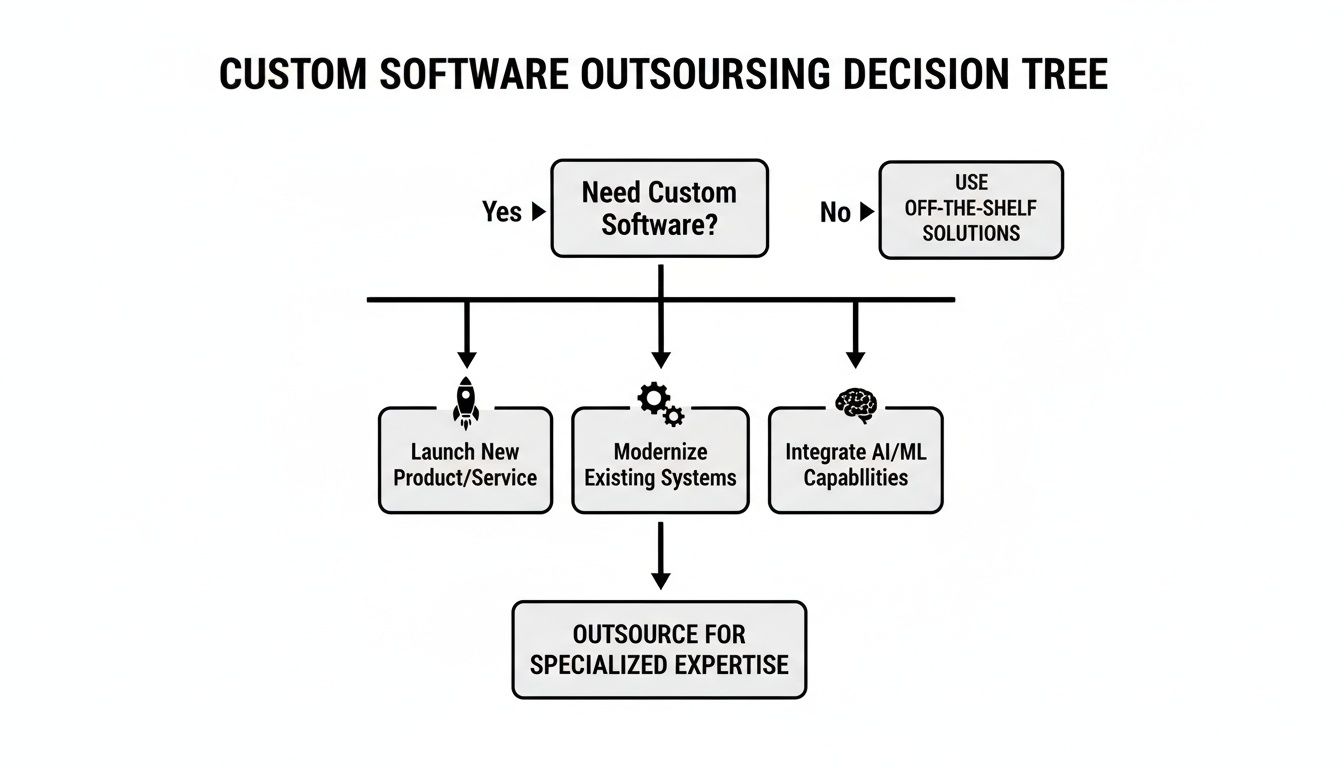
As the decision tree illustrates, your strategic goal—whether building a new platform from scratch or integrating AI into an existing system—heavily influences which engagement model will deliver the best results.
Dedicated Team Model
For large-scale, complex, and long-term product development, the Dedicated Team model is the gold standard. In this model, a provider like Group107 assembles a full team of engineers, QA specialists, and project managers who work exclusively on your project. They become a genuine, integrated extension of your own company.
This team immerses itself in your company culture, adopts your communication tools, and collaborates directly with your internal staff. Think of them as a new, remote department focused solely on your product's success.
Choose a dedicated team when you are:
- Building a core product from the ground up that requires deep domain knowledge and continuous development.
- Working on a long-term project where requirements will naturally evolve over time.
- Needing to significantly scale your development capacity, not just fill a temporary gap.
The key benefit here is deep alignment and knowledge retention. The team isn't just shipping code; they are building expertise in your business logic and user needs. Over time, this allows them to become more proactive and efficient, contributing strategic insights beyond simple execution.
Staff Augmentation
Staff Augmentation is a surgical approach to filling specific skill gaps within your existing team. With this model, you bring on one or more developers with precise expertise to work under your direct management, integrating them into your current projects and workflows.
Think of Staff Augmentation like hiring a world-class freelance cinematographer for a film you’re already directing. You maintain complete creative and managerial control but instantly gain access to a specialized skill set you don't have on your payroll.
This is the right move when:
- You already have strong project management in-house and simply need more development power.
- You need to accelerate a project by bringing in a specialist with hard-to-find skills, like a senior DevOps engineer for a cloud migration.
- Your project has short-term needs, or you expect your team size to fluctuate.
While both models involve external talent, they solve very different business problems. For a deeper dive into their strategic differences, check out our guide on staff augmentation vs outsourcing.
Project-Based Outsourcing
The Project-Based model is the most traditional form of outsourcing. You come to the partner with a project that has a clearly defined scope, a firm deadline, and a fixed budget. The outsourcing partner then assumes full responsibility for managing the entire process and delivering the finished product as specified.
This model excels for:
- Well-defined, standalone projects like a marketing website, a simple mobile app, or a specific feature where the scope is locked in.
- Situations where you lack the internal resources or expertise to manage the development process yourself.
- Building a proof-of-concept (POC) or minimum viable product (MVP) to test an idea with a predictable cost.
The success of a project-based engagement depends entirely on a meticulously detailed project brief. Any ambiguity or unstated assumption can lead to scope creep and difficult renegotiations, as any change typically requires a new contract.
Comparing Software Outsourcing Engagement Models
To help you decide, here’s a breakdown of how the three models compare across key business factors.
| Factor | Dedicated Team Model | Staff Augmentation | Project-Based Model |
|---|---|---|---|
| Control | High. You manage the team's priorities and strategic roadmap directly. | Highest. You manage individual developers day-to-day. | Low. The vendor manages the entire project from start to finish. |
| Flexibility | High. Easy to pivot and adapt to changing business requirements. | Medium. Flexible for scaling resources, but tied to your internal team's scope. | Low. Changes often require formal change requests and contract renegotiation. |
| Cost Structure | Predictable monthly cost per team member. A mid- to long-term operational expense. | Variable based on the number of staff and duration. Often higher hourly rates. | Fixed price for the entire project. Most predictable upfront. |
| Speed to Market | Fast ramp-up time. Team velocity increases as they gain domain knowledge. | Fastest for adding specific skills to an existing project. | Slower start due to detailed scoping, but offers a fixed delivery date. |
| Team Integration | Deep integration into your company culture, tools, and workflows. | Seamless integration into your existing team's structure and processes. | Minimal integration. The vendor works mostly independently as a separate entity. |
| Knowledge Retention | High. The team builds and retains deep product and business knowledge over the long term. | Low. Knowledge is held by individuals and leaves with them. | Low. The vendor holds the knowledge; transfer at project end can be a challenge. |
| Best For | Long-term, complex products with an evolving scope (e.g., a core SaaS platform or enterprise system). | Short-term skill gaps, project acceleration, or accessing highly specialized expertise. | Small, well-defined projects with a fixed scope and budget (e.g., an MVP or a marketing site). |
Ultimately, there is no single "best" model—only the best model for your specific business goals. The project-based approach offers budgetary certainty, staff augmentation provides surgical precision, and a dedicated team delivers a true, long-term strategic partnership that drives continuous innovation.
Understanding the True Costs of Custom Development Outsourcing
Viewing custom software development outsourcing as merely a way to find "cheaper" developers is a massive strategic misstep. While cost efficiency is a significant benefit, the real value lies in the total return on investment (ROI). A smart outsourcing decision is not about trimming an expense line—it's about maximizing your financial firepower and reallocating capital to high-growth activities.
To understand the complete financial picture, you must look beyond hourly rates and compare the fully-loaded costs of hiring in-house versus partnering with an outsourced team. This includes every expense tied to an employee: recruitment fees, salaries, benefits, hardware, office space, and ongoing training.
Breaking Down In-House vs. Outsourced Costs
An in-house team comes with a mountain of hidden and recurring expenses. A senior developer in the US with a base salary of $150,000 actually costs your business far more.
Consider the true annual cost of a single senior developer in a major US tech hub. When you factor in bonuses, healthcare, 401(k) matching, payroll taxes, and recruitment fees, that figure can easily surpass $185,000. For many growing companies, this represents an unsustainable cash burn for just one hire.
This is where the financial model of custom software development outsourcing truly shines. By partnering with an expert offshore firm like Group107, you can access world-class talent in global tech hubs and achieve labor cost reductions of up to 60%. But the savings extend far beyond lower salaries—it's about eliminating overhead.
With an outsourced partner, you have a straightforward, predictable monthly fee. This single payment replaces dozens of separate costs:
- Recruitment and HR: Eliminate headhunter fees and months lost to interviewing and onboarding.
- Benefits and Payroll: Your partner manages all compensation, taxes, and benefits administration.
- Infrastructure and Tools: Laptops, software licenses, and office space are all included.
- Training and Retention: You get access to engineers who are already at the top of their game, without footing the bill for their professional development.
By converting heavy, fixed overheads into a predictable operating expense, you unlock significant capital. To get a clearer idea of these numbers for your own project, use our guide for creating a software development cost calculator.
The Strategic Value of Reallocated Capital
The financial upside of outsourcing goes far beyond initial savings. The capital you free up can be reinvested directly into activities that drive business growth. Instead of sinking another $200,000 into a small in-house engineering team, you can redirect that budget to areas with a more immediate impact on your bottom line.
This financial agility is a game-changer. You could double your marketing spend, expand into new markets, or accelerate your product roadmap—all while your dedicated team handles the technical execution.
The global outsourcing market’s projected value of $618 billion by 2026 is a testament to this strategic shift, with custom software development growing at a massive 22.4% CAGR. This shows how many companies are moving away from generic tools to build unique solutions. You can learn more about the trends driving software development outsourcing statistics to see where the market is headed.
Ultimately, smart outsourcing transforms your entire cost structure. It converts a capital-intensive R&D department into a flexible, scalable engine that builds your product faster and for less, giving you the financial runway needed to win your market.
How to Select the Right Custom Software Development Partner
Choosing your outsourcing partner is the most critical decision you will make in your custom software development outsourcing journey. The right partner becomes a true extension of your team, driving your vision forward with technical excellence. The wrong one leads to expensive delays, significant technical debt, and a final product that misses the mark.
This selection process is not a race to the bottom on price. It is a search for a strategic ally who understands your business goals and demonstrates a commitment to achieving them. A successful partnership is built on proven technical skill, transparent communication, and a shared dedication to your product's success.

Essential Criteria for Vetting Potential Partners
A thorough and systematic vetting process is essential. Look past the polished marketing materials and demand concrete proof of their capabilities and reliability.
Deep Technical Expertise: Don't settle for a jack-of-all-trades. You need a partner with a proven track record in your specific technology stack. If you're building a secure fintech application or a complex SaaS platform, their portfolio must demonstrate relevant experience.
Proven Methodologies: A modern software firm must operate with Agile and DevOps principles. Ask them to walk you through their development process. How do they handle sprint planning, daily stand-ups, and CI/CD pipelines? The clarity and detail of their answer reveal their level of professionalism.
Relevant Portfolio and Case Studies: A portfolio is more than a gallery of logos. Dig into the details. What was the business challenge? What technical solution did they implement? What were the measurable business outcomes? Look for projects that mirror your own in complexity and scale.
Strong Communication Protocols: Get specific about communication. What is the plan for day-to-day interaction? Which tools (like Slack or Jira) do they use? What are their standards for response times and reporting? Transparent, proactive communication is the bedrock of a successful outsourcing relationship.
Critical Red Flags to Watch For
Knowing what to look for is only half the battle; knowing what to avoid is equally important. Certain warning signs indicate that a partner is not equipped for a serious engagement.
A partner who is vague about their team, prevents you from speaking with their developers, or offers a price that seems too good to be true is almost always hiding something. These are not negotiable points; they are foundational to success.
Be vigilant for these red flags during your vetting process:
Lack of Transparency: If a company hesitates to let you interview the engineers they propose for your team, it's a major problem. You must vet their technical skills and cultural fit yourself. A refusal often means they are subcontracting the work or do not have the senior talent they claim.
Ambiguous or Weak Communication: Vague answers and slow response times during the sales process will only deteriorate after the contract is signed. You need a partner who is clear, concise, and proactive from the very first interaction.
Weak IP and Security Policies: Your intellectual property is your core business asset. A potential partner must provide clear, documented policies on IP protection, NDAs, and data security standards (like ISO 27001 compliance). Any ambiguity here is an immediate deal-breaker.
Vague Resource Allocation: Be wary of vendors who won't commit specific individuals to your project or suggest their developers will be splitting time. A dedicated team must be 100% dedicated to you. Shared resources lead to divided attention, constant context-switching, and a lower-quality product.
Choosing a partner is a high-stakes decision. By focusing on these core criteria and watching for red flags, you can establish a true strategic partnership, not just a transactional vendor relationship.
How to Handle IP Protection and Security When Outsourcing
When you build custom software, your intellectual property (IP) and data are the core of your business. This is especially true in competitive industries like fintech, SaaS, or e-commerce. Entrusting these assets to an outsourcing partner without robust protections is an unacceptable business risk.
Effective protection is not merely about trust; it’s about establishing a clear, legally enforceable framework from day one. A strong partnership is built on a foundation where everyone understands the rules, enabling confident and secure collaboration. Anything less is an open invitation to losing your competitive advantage or facing serious compliance violations.
Building Your Legal Framework
Your contracts are your primary line of defense. They must be airtight, specific, and tailored to the realities of software development. The process should begin with a strong confidentiality agreement to establish a trusted relationship.
Following this, your Master Services Agreement (MSA) and Statement of Work (SOW) must include these non-negotiable clauses:
- Clear IP Ownership: The contract must state, without ambiguity, that 100% of the code, designs, and documentation created for the project belongs exclusively to you. Vague "work-for-hire" language is insufficient—the ownership transfer must be absolute and explicit.
- A Rock-Solid NDA: The non-disclosure agreement must extend beyond the partner company to bind every individual developer on your project. It should protect everything from your business logic and trade secrets to proprietary user data.
- Data Protection & Compliance: The agreement must specify how your partner will handle data according to regulations like GDPR, CCPA, or HIPAA. Define how data is stored, transferred, and destroyed, ensuring they adhere to the same high standards you do.
If a potential partner pushes back on signing a robust IP clause or offers a flimsy, generic NDA, consider it a major red flag. A true partner understands that protecting your IP is a core responsibility and will have strong legal protections as a standard part of their process.
Verifying Their Security Practices
Legal documents are crucial, but they are only one part of the equation. Your partner must demonstrate a commitment to security in their daily operations. Promises on paper mean nothing without real-world practices to support them.
Look for a partner who can prove their commitment to security with recognized certifications and well-defined processes. This transforms security from a vague promise into a verifiable reality.
Here are key items to verify:
- Security Certifications: A partner holding a certification like ISO 27001 for information security management or having SOC 2 compliance has undergone rigorous third-party audits. This proves their adherence to strict international security standards.
- A Secure Development Lifecycle (SDLC): Ask them to detail their SDLC. Do they integrate security at every stage—from design and coding to testing and deployment? Security should be a proactive discipline, not a reactive afterthought.
- Regular Security Audits: A mature vendor doesn't wait for a breach to discover vulnerabilities. They should conduct regular internal and third-party security audits and penetration tests to proactively identify and remediate issues.
By locking down your legal agreements and verifying their operational security, you create a safe environment for custom software development outsourcing. This gives you the peace of mind to stop worrying about risk and focus on what truly matters: building an exceptional product.
Best Practices for Seamless Onboarding and Collaboration
A custom software development outsourcing partnership succeeds or fails in its first few weeks. The real work begins the moment the contract is signed, not with the first line of code. A clunky, disorganized onboarding process creates frustration and misalignment that can derail a project before it starts. Conversely, a smooth, structured integration transforms your vendor into a true extension of your team.
This process is about more than just sharing access to a code repository. It's about deeply embedding your new partners into your company's culture, workflows, and strategic vision. Your objective is to move beyond a simple client-vendor dynamic and cultivate a unified "one team" culture where everyone is aligned and invested in the same outcome.

Establish Clear Communication Channels
Effective collaboration is built on a foundation of open, real-time communication. Your first action should be to integrate your outsourced team into the same digital environment your in-house staff uses daily to eliminate information silos.
- Shared Project Management Tools: Provide immediate access to your primary platform, whether it's Jira or Asana. All tasks, tickets, and documentation must reside in this single source of truth.
- Instant Messaging Integration: Add every new team member to your company’s Slack or Microsoft Teams. Create dedicated channels for the project, technical Q&A, and even informal team-building.
- Defined Communication Cadence: Establish a predictable rhythm for meetings. This includes daily stand-ups, weekly sprint planning sessions, and bi-weekly demos or retrospectives. A consistent schedule is your best tool for bridging time zones and keeping everyone synchronized.
Execute a Thorough Knowledge Transfer
You cannot expect your new team to deliver effectively without a clear roadmap. A comprehensive knowledge transfer is critical for accelerating their productivity and must extend beyond technical specifications.
A common point of friction in new partnerships is a lack of business context. Your outsourced developers are expert problem-solvers, but they can only solve the right problems if they understand the "why" behind your product and the needs of your customers.
Your knowledge transfer plan should cover:
- Product Vision and Business Goals: Schedule dedicated sessions to explain the product’s mission, its target audience, and the core business objectives it is designed to achieve.
- Technical Architecture and Codebase: Conduct a deep-dive walkthrough of the existing system. Be transparent about the architecture, coding standards, and any known technical debt.
- User Personas and Workflows: Share all available information on your end-users. The team should feel a direct connection to the people they are building for.
Foster a Unified Team Culture
The most successful outsourcing relationships are those where the external team feels a genuine sense of belonging. Breaking down the "us vs. them" mentality requires conscious effort, especially when working across different locations and time zones.
The industry is already moving in this direction. The global software development outsourcing market is projected to reach $977 billion by 2031, with an 18% annual growth in long-term contracts, indicating a clear shift toward deeper, more integrated partnerships. You can see more on how businesses are building these lasting relationships in these software development outsourcing statistics that highlight this trend.
Small actions can make a significant difference. Invite your offshore team to virtual company all-hands meetings. Give them public recognition for their achievements. Encourage informal "water cooler" chats in a dedicated channel. When your partners feel valued and included, their investment in your project's success increases dramatically.
Your Next Steps and Takeaways
Choosing to pursue custom software development outsourcing is a strategic decision that can unlock significant growth, innovation, and efficiency. By moving beyond a simple cost-saving mindset and focusing on finding a true strategic partner, you can build a powerful engine for achieving your business goals.
Key Takeaways:
- Focus on Strategic Value: Outsourcing is not just about reducing costs; it's about gaining access to specialized talent, accelerating time-to-market, and reallocating capital to growth-focused activities.
- Choose the Right Model: Your project's goals dictate the best engagement model. Use a Dedicated Team for long-term, complex products; Staff Augmentation for specific skill gaps; and a Project-Based model for well-defined, fixed-scope initiatives.
- Vet Partners Rigorously: Look for deep technical expertise, proven methodologies, and strong communication protocols. Watch for red flags like a lack of transparency or weak IP protection policies.
- Prioritize Integration: A seamless onboarding process and a unified team culture are critical for success. Integrate your outsourced team into your tools, workflows, and company vision from day one.
Ready to build the custom software that will drive your business forward? Group107 provides premium offshore development teams that integrate seamlessly into your organization, delivering the technical excellence and strategic insight you need to accelerate growth.
Scale your engineering capacity and launch your next product with us.