
When your product roadmap feels more like a wish list than an actionable plan, you've hit a common growth bottleneck. Your in-house team is at capacity, but the market isn't waiting. This is the precise moment to hire dedicated software developers. This isn't just about filling seats; it's a strategic move that unlocks a global talent pool, accelerates your time-to-market, and delivers significant cost savings without the traditional HR overhead.
This guide provides a step-by-step framework for finding, vetting, and integrating a high-performance dedicated team that acts as a true extension of your business.
Why Hiring Dedicated Developers Is a Strategic Growth Move
A dedicated team is not a temporary fix like a freelancer or as cumbersome as a full-time hire. It is a seamless, long-term extension of your own crew, fully integrated into your processes. They live and breathe your project, adopt your business goals, and provide the focused, consistent momentum required to outpace the competition.
This model is a game-changer for companies in a high-growth sprint. We’ve seen it deliver exceptional results for SaaS platforms needing to accelerate feature releases and FinTech firms building complex, highly secure applications. You gain immediate access to specialized skills that are either difficult to find locally or prohibitively expensive. If you're weighing your options, this guide on In-House vs. Outsourcing: A Guide for Modern Tech Teams is an excellent starting point.
Key Business Drivers for Dedicated Teams
The decision to hire a dedicated team is always tied directly to business outcomes, efficiency, and growth. Here are the primary drivers:
- Accelerated Time-to-Market: A dedicated team is 100% focused on your project, enabling them to build, test, and deploy faster than an internal team juggling multiple priorities.
- Access to Global Talent: Why limit your search to a 50-mile radius? You can tap into world-class expertise from specialized tech hubs across the globe. We explore the benefits of offshore software development in more detail on our blog.
- Significant Cost Efficiency: Businesses can reduce development costs by up to 60%. These savings come from lower recruitment fees, competitive global salaries, and eliminating overhead for benefits and office space.
- Enhanced Scalability: Need to ramp up for a major product push or scale back after a launch? A dedicated team allows you to adjust your development capacity on demand, without a lengthy HR process.
Comparing Talent Sourcing Models
To understand the strategic advantage, it's crucial to compare the dedicated team model against other common approaches. The table below breaks down the key differences to help you align the right model with your specific needs for cost, speed, and control.
| Factor | Dedicated Team | Freelancers | In-House Employees |
|---|---|---|---|
| Cost | Moderate, predictable monthly cost. No overhead. | Low, hourly or project-based. Can be unpredictable. | High, includes salary, benefits, and overhead. |
| Speed | Fast to assemble and onboard. | Very fast for short-term tasks. | Slow, lengthy recruitment and onboarding process. |
| Scalability | High, easily scale team size up or down. | Moderate, depends on individual availability. | Low, slow and costly to adjust team size. |
| Control | High, direct management and full process control. | Low, limited control over process and availability. | Full, complete control over all aspects. |
The dedicated team model strikes a powerful balance, offering the control of an in-house team with the flexibility and cost-effectiveness of an external partner. It is purpose-built for sustained, long-term growth.
When you need to expand your engineering capacity, the engagement model you choose is a critical decision that impacts your project's budget, speed, and ultimate success. While contractors and full-time hires have their place, the dedicated team model consistently delivers the best results for serious, long-term product development. This isn't just about outsourcing tasks; it's about building a cohesive, remote unit that operates as a genuine extension of your core team.
To make an informed decision, compare the fully-loaded cost of an in-house employee—salary, benefits, taxes, equipment, office space—against the predictable monthly fee of a dedicated team. This decision tree can help map out the right path based on your specific needs.
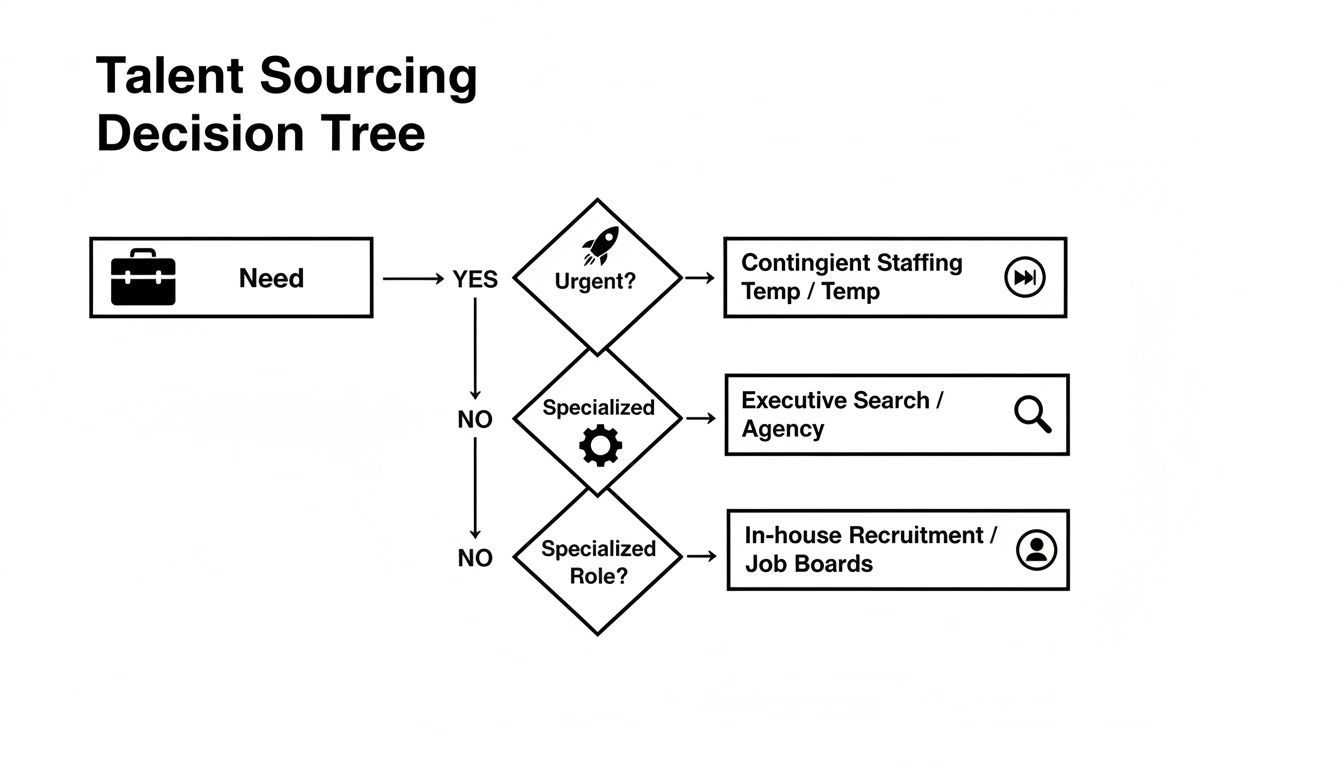
The dedicated team model excels when you need specialized skills, want to scale quickly, and require a high degree of control over daily operations. It’s the ideal bridge between the gig-based nature of freelancers and the commitment of full-time hires.
Dedicated Teams: The Strategic Sweet Spot
The dedicated team model is engineered for the long haul. It thrives on complex, ongoing projects where deep domain knowledge and consistent team velocity are non-negotiable. Your developers are 100% focused on your project, eliminating the context-switching and divided attention common in agency or freelance setups. This singular focus allows them to build a deep, intuitive understanding of your business logic, technical architecture, and long-term vision.
For example, a SaaS company rolling out a new feature suite or a FinTech firm building a secure trading platform can leverage a dedicated team as a strategic asset. They become stewards of institutional knowledge, enabling rapid iteration and high code quality over time.
Freelancers: Best for Quick, Contained Tasks
Hiring individual freelancers makes sense for well-defined, isolated tasks, such as a one-off website migration, a specific API integration, or designing a small set of marketing assets. The appeal is clear: they are fast to hire and require a lower initial commitment.
However, attempting to build a core product with a patchwork of freelancers is a recipe for operational chaos. Common risks include:
- Lack of Cohesion: Managing multiple freelancers creates significant overhead and often leads to fragmented code, inconsistent quality, and accountability issues.
- Availability Issues: A key freelancer can become unavailable unexpectedly, creating bottlenecks that derail your product roadmap.
- Limited Scalability: When you need to ramp up, you are back to square one—finding, vetting, and onboarding new individuals, which kills momentum.
Full-Time Employees: The Highest Control, The Highest Cost
Hiring a full-time, in-house employee provides the highest level of control and cultural integration. They are fully immersed in your company and contribute beyond just writing code. While this is the traditional route, it is also the most expensive and time-consuming.
The primary challenges are the significant overhead and slow pace. The hiring process can take months, and the total cost includes not just salary but also benefits, payroll taxes, training, and infrastructure. For a tech company focused on speed and agility, this high-cost model can become a serious competitive disadvantage, especially when you need niche skills immediately.
Key Takeaway: The right choice depends on your project's complexity and timeline. A dedicated team offers the focus and control of an in-house team with the agility and cost-efficiency of a strategic partnership. For sustained product innovation, it’s an unbeatable model.
One of the most compelling arguments for the dedicated team model, particularly with an offshore partner, is the substantial cost savings. Companies that hire dedicated offshore software developers often achieve dramatic cost reductions, with top-tier partners delivering up to 50-60% savings on development costs compared to hiring senior engineers in North America. This is driven by global salary differences and the built-in efficiencies of a focused team. For example, Ukrainian engineering talent is known for providing a 40–60% cost advantage over US markets without sacrificing quality, a trend you can explore further in this analysis of how the software engineer job market is evolving on mev.com.
How to Find and Vet the Right Development Partner
Hiring dedicated developers isn't a commodity purchase; it's a strategic partnership. The goal is to find a partner that acts as a true extension of your team, not merely a group of ticket-takers.
The search requires looking beyond polished sales pitches to find a partner with a proven track record, deep expertise in your industry, and a genuine commitment to transparent, Agile methodologies. This demands rigorous due diligence focused on technical capabilities and cultural alignment.
Identifying Potential Sourcing Hubs
The global talent pool is vast, but certain regions have developed reputations for specific strengths. Understanding these nuances helps you target the right location for your needs.
- Eastern Europe (e.g., Ukraine): A technology powerhouse known for a strong engineering culture, deep expertise in complex systems, and excellent English proficiency. It's a top choice for demanding SaaS, FinTech, and enterprise-level projects requiring robust architecture.
- South America (e.g., Colombia, Brazil): The primary advantage is time-zone alignment with North America, which facilitates real-time collaboration. This hub is growing rapidly, with a deep talent pool in modern web and mobile development.
- Southeast Asia (e.g., Philippines, Vietnam): Ideal for businesses seeking significant cost savings and large, scalable talent pools. This region is particularly strong for QA, support roles, and front-end development.
The global developer population is projected to reach 47.2 million professionals in 2025, a significant increase from 31 million in early 2022. Key offshore markets like South America are booming, demonstrating the vast availability of capable, long-term talent.
Creating a Due Diligence Checklist
Once you have a shortlist of potential partners, your evaluation must be methodical. Do not be swayed by a slick website; demand verifiable proof of their capabilities. To ensure you choose the right partner, a comprehensive pre-employment assessment strategy is essential. Your internal checklist should cover these key areas:
- Technical Portfolio and Case Studies: Request detailed case studies relevant to your business. For a FinTech company, this might be a secure payment gateway; for a SaaS product, a scalable multi-tenant architecture. Look for evidence they have solved similar problems before.
- Client Testimonials and References: Insist on speaking with their current or past clients. Ask direct questions about communication, proactivity, and how they handled project challenges. A partner’s willingness to provide references is a strong indicator of confidence.
- Communication and Project Management Protocols: Clarify their process for keeping you informed. Confirm they use standard tools like Jira or Slack, and understand their meeting cadence and reporting structure. Proactive communication is non-negotiable.
- IP Protection and Security Policies: Verify their policies on intellectual property, data security, and NDAs. Any reputable firm will have iron-clad, well-documented security measures to protect your code and sensitive data. Learn more in our guide to building offshore software development teams.
Expert Insight: A top-tier partner won’t just showcase their wins. Ask about a project that went off track and how they corrected it. Their answer will reveal more about their problem-solving skills and integrity than any polished success story.
This structured approach shifts the process from hiring a vendor to selecting a strategic technology partner, ensuring the team you build is technically brilliant, operationally sound, and a perfect cultural fit for your long-term goals.
Running an Effective Technical and Cultural Evaluation
Your development partner has provided a shortlist of promising candidates. Now it's time to dig into what truly matters: can they code, and can they collaborate effectively?
Many companies make the mistake of focusing on abstract algorithm puzzles that have little relevance to daily software development. The goal is not to hire a computer science theorist but a practical problem-solver who can build, ship, and integrate seamlessly with your team. A great developer is a proactive thinker and a collaborative team player, and your evaluation process must identify both qualities.

Assessing Technical Chops Beyond the Resume
A resume shows where a developer has been, but a well-designed technical interview reveals how they think. A multi-stage process that stress-tests different skills is most effective.
Here is a practical, three-part framework:
- Take-Home Skills Test: Provide a small, self-contained coding challenge that mirrors a real-world task. This offers a clean look at their code structure, testing habits, and attention to detail without consuming excessive interview time.
- Live Coding Session: The focus here is on their process, not just the right answer. Observe how they articulate their thought process and what they do when they get stuck. A pair programming session on a simplified, real-world problem is ideal.
- System Design Interview: This is essential for any senior role. Pose a high-level challenge, such as, "Design a scalable image-upload service for a social media app." You are evaluating how they think about architecture, trade-offs, and building for scale.
This structured approach helps you hire dedicated software developers who build resilient, maintainable systems.
Gauging Cultural Fit for a Remote Team
Technical brilliance is useless if a developer disrupts your team's dynamics. Cultural fit isn't about hiring clones; it's about finding individuals who share your core values on communication, ownership, and collaboration. This is even more critical when hiring remotely.
Move beyond generic questions. Instead of asking, "Are you a team player?" use targeted behavioral questions to explore past experiences.
Consider these examples:
- "Tell me about a time you disagreed with a technical decision from your team lead. What did you do?" This reveals how they handle professional conflict.
- "Describe a situation where the project requirements were vague. How did you proceed?" This tests for proactivity and problem-solving initiative.
- "How do you prefer to receive feedback on your code?" This provides insight into their ego, coachability, and commitment to improvement.
Key Insight: A candidate's success in a remote team often comes down to communication habits. Look for evidence of proactive, clear, and asynchronous communication—the gold standard for a great remote teammate.
Recent labor market trends underscore the importance of this dual evaluation. With more than half of advertised positions now for senior-level roles, experienced engineers are in high demand. This is a primary reason more companies choose to hire dedicated software developers from offshore markets—to access top-tier talent without the local price tag. Furthermore, with roughly 62% of developers using AI coding tools, you must evaluate how they integrate modern tools to enhance productivity. You can get more context from this software engineer job market analysis.
By combining a rigorous, real-world technical assessment with sharp behavioral questions, you get a complete picture, ensuring the developers you hire are both technically proficient and a perfect long-term fit for your team.
Finalizing the Paperwork and Kicking Off Onboarding
You've selected your developers. Now it's time to formalize the partnership and lay the legal and operational groundwork. A vague contract or a messy onboarding process can kill momentum before you begin, creating confusion and misalignment. Getting this right is about building a solid foundation for a productive relationship from day one.
Crafting a Bulletproof Contract
Your contract is the single source of truth for the engagement. It must be clear, comprehensive, and designed to protect your interests. While legal counsel should always conduct a final review, these non-negotiable elements must be included:
- Intellectual Property (IP) Rights: The contract must state unequivocally that all code, work product, and related IP created by the team belongs 100% to your company.
- Data Security and Confidentiality: Clearly define your data handling protocols, NDA requirements, and any compliance needs (e.g., GDPR, CCPA). This protects your sensitive company and customer data.
- Service Level Agreements (SLAs): Define expectations for uptime, response times for critical bugs, and general availability. SLAs transform vague promises into measurable standards.
- Termination Clause: Specify notice periods, offboarding procedures, and how knowledge transfer will be managed. A clear exit ramp is as critical as a smooth on-ramp.
Strong contracts are the bedrock of any successful remote partnership. For a deeper look, check out our guide on how to hire a remote team safely, which details critical security protocols.
Rolling Out a Seamless Onboarding Plan
Onboarding is your first opportunity to integrate new developers into your company culture. A well-structured 30-day plan accelerates their ramp-up and makes them feel like part of the core team. The goal is to move them from newcomer to confident contributor efficiently.
Week 1: Systems and People
The first week is about access. Ensure they have all necessary hardware, software licenses, and credentials—Git repositories, project management tools like Jira, and communication hubs like Slack. Facilitate introductions to key stakeholders and their in-house counterparts.
Weeks 2-3: Diving into the Product
Immerse them in the product vision, technical architecture, and customer personas. Assign small, low-risk "starter tasks" to let them get hands-on with the codebase, build confidence, and achieve early wins.
Week 4: Full Integration and Setting Benchmarks
By the end of the month, they should be fully integrated into your sprint ceremonies, including planning, daily stand-ups, and code reviews. This is also the time to introduce the Key Performance Indicators (KPIs) you will use to track their success.
Defining KPIs That Actually Matter
Measuring the ROI of your dedicated team requires connecting their work directly to business outcomes.
Here are the metrics to track:
- Team Velocity: Measures the amount of work the team completes per sprint. A stable or increasing velocity is a strong indicator of productivity.
- Cycle Time: The time it takes for an idea to move from "in progress" to "deployed." Shorter cycle times mean you are delivering value to customers faster.
- Code Quality Metrics: Track metrics like code churn, bug counts per feature, and adherence to coding standards to ensure long-term system health.
- Impact on Business Goals: The ultimate measure of success. Track their contributions against key business objectives, such as feature adoption rates, customer satisfaction scores, or revenue growth.
Integrating Your Dedicated Team for Peak Performance
You’ve hired your team. The final and most crucial step is to make them feel like a genuine part of your company. This is where many businesses falter. Success depends on treating your new developers as valued colleagues, not temporary resources, and eliminating the "us vs. them" mentality from the start.

True integration is about shared access and shared purpose. Add your new team members to core communication channels like Slack on day one. Involve them in high-level roadmap discussions. When developers understand the why behind their work, their engagement and problem-solving capabilities increase dramatically.
Fostering a Unified Team Culture
Building a cohesive culture across different time zones requires deliberate effort. The goal is to create seamless collaboration where physical location is irrelevant.
Actionable strategies include:
- Unified Communication Hubs: Ensure everyone, regardless of location, uses the same platforms for real-time and asynchronous communication.
- Inclusive Ceremonies: Involve your dedicated developers in all sprint planning meetings, retrospectives, and demos. Their perspective is invaluable.
- Shared Ownership: Assign full ownership of features or modules to your dedicated developers. This builds accountability and deepens their commitment to the product's success.
Success is built on a shared mindset, not just shared tools. When your dedicated team feels fully empowered and included, their performance will reflect that investment, resulting in higher-quality code and faster innovation.
Managing Time Zones and Asynchronous Work
Different time zones are a logistical challenge, not an insurmountable barrier. The key is smart scheduling and a strong emphasis on asynchronous communication.
Establish a few hours of daily overlap for critical, real-time meetings. For all other communication, rely on detailed, written updates in tools like Jira. This approach protects focus time and allows everyone to contribute on their own schedule.
Ultimately, when you hire dedicated software developers, their integration is the primary determinant of the partnership's ROI. By fostering a culture of inclusion and trust, you create a high-performing, globally distributed team that delivers exceptional results.
Common Questions About Hiring Dedicated Teams
When considering a dedicated development team, several key questions consistently arise. Addressing these upfront ensures a smooth and successful partnership.
How Do I Make Sure My Intellectual Property Is Safe?
Protecting your IP is non-negotiable and begins with the contract. Your agreement must clearly state that 100% of the source code, work product, and any related IP created by the team belongs to you.
Beyond legal agreements, your partner's security posture is critical. Verify the following:
- Ironclad NDAs: Every team member must sign a comprehensive non-disclosure agreement before gaining access to any project materials.
- Secure Infrastructure: Inquire about their network security, data encryption standards, and access control for your code repositories.
A professional partner will proactively address IP protection as a core component of their process.
How Do We Actually Handle the Time Zone Difference?
Time zones can be a strategic advantage, not an obstacle. The key is to design a communication cadence that blends real-time syncs with focused, asynchronous work.
Establish a few hours of daily overlap for essential meetings like sprint planning or problem-solving sessions. For everything else, embrace asynchronous communication through detailed tickets and well-documented code reviews. This protects everyone's focus time and can create a 24-hour development cycle, where your project progresses even while your local team sleeps.
What Should I Insist On in the Service Level Agreement (SLA)?
A robust Service Level Agreement (SLA) transforms a verbal agreement into a professional engagement. It serves as your blueprint for accountability, ensuring the quality you expect is the quality that's delivered.
Key Takeaway: Vague promises are insufficient. Your SLA needs specific, measurable metrics that define success and outline remedies if standards are not met. This is a hallmark of a serious, professional partner.
Ensure your SLA clearly defines:
- Team Availability: The exact core working hours and expected response times.
- Issue Resolution Times: A tiered system for addressing critical, major, and minor bugs.
- Performance Metrics: Concrete KPIs such as system uptime, code quality scores, and other vital project metrics.
- Reporting Cadence: The frequency and format for all progress updates.
Summary and Next Steps
Hiring dedicated software developers is a strategic decision that can accelerate your roadmap, provide access to elite global talent, and deliver significant cost savings. The key to success lies in a methodical approach:
- Define Your Needs: Clearly articulate your project goals, required skills, and budget to determine if a dedicated team is the right fit.
- Vet Partners Rigorously: Move beyond sales pitches. Scrutinize case studies, speak with references, and verify security protocols.
- Evaluate for Skill and Fit: Implement a multi-stage technical assessment and use behavioral questions to ensure cultural alignment.
- Integrate Deliberately: Treat your dedicated team as an extension of your own. Provide full access to tools and processes to foster a unified culture.
By following this playbook, you can build a high-performing development team that drives real business impact and gives you a decisive competitive edge.
At Group 107, we build dedicated teams that function as a seamless extension of your own, backed by iron-clad contracts and transparent processes. Let us help you scale your development capabilities with elite, offshore talent. Learn more at group107.com.