
Hiring remote software engineers is no longer a temporary measure or a simple cost-cutting tactic. It's a core strategic imperative for any business aiming to build a world-class team and accelerate its product roadmap. To gain a true competitive advantage, you must think globally, tapping into premier talent pools to assemble engineering teams that drive innovation and deliver results.
Why You Must Hire Remote Engineers

The decision to hire remote software engineers has shifted from a "nice-to-have" option to an essential business strategy. In 2026, the primary benefit isn't just saving on operational costs—it's about securing a genuine competitive edge by accessing talent unavailable in your local market.
This global approach enables you to build highly specialized teams on your timeline, bypassing the intense bidding wars and inflated salary expectations that define crowded tech hubs. For businesses building complex solutions in AI, fintech, or DevOps, this global reach is non-negotiable. It’s how you find and hire senior engineers with the specific, niche expertise required to move faster, innovate better, and enhance the quality of your deliverables.
The Strategic Value of a Global Talent Pool
The current tech landscape makes a global hiring strategy more valuable than ever. We're witnessing a sustained surge in demand for elite engineering talent, creating a significant opportunity for companies that know how to source it effectively.
The data confirms this trend. In 2026, the demand for remote and hybrid tech roles continues to climb, driven by the need for scalable engineering teams to handle everything from AI integrations to new fintech platforms. A global approach unlocks access to talent markets with deep technical expertise, allowing you to build the ideal team for your project without compromise. For a balanced perspective, explore our guide on the pros and cons of remote offshore employment.
Choosing Your Engagement Model
Before sourcing candidates, you must select the right engagement model. Each option presents different trade-offs in terms of management overhead, cost structure, and level of control. This decision is not one-size-fits-all and should align with your business objectives.
Remote Hiring Models at a Glance
| Hiring Model | Best For | Management Overhead | Cost Structure |
|---|---|---|---|
| Independent Contractors | Short-term projects, niche tasks, or when you need immediate but temporary help. | High (direct management, vetting, and performance tracking required). | Hourly or project-based. Can be unpredictable. |
| Dedicated Team | Long-term projects, core product development, and building a lasting asset for your company. | Low (partner handles admin, HR, and payroll; you focus on product). | Fixed monthly fee per engineer. Highly predictable. |
| Managed Services | Outsourcing an entire function or project where you define the outcome, not the process. | Very Low (vendor manages the entire project and team). | Project-based or retainer. Often the highest cost. |
For companies focused on building a durable, long-term product, the choice often comes down to control and focus.
The Dedicated Team Model: Beyond Standard Contracting
While freelance platforms are suitable for quick, isolated tasks, a dedicated team is a far more powerful model for achieving long-term success. This isn't about hiring a temporary contractor; it's about building a true, integrated extension of your in-house team.
A dedicated team model ensures your remote engineers are 100% focused on your projects, vision, and success. This eliminates the divided attention and context-switching common with freelancers, fostering deep project ownership and alignment with your business goals.
At Group107, we specialize in building these premium offshore teams with top engineers from Ukraine. This model provides critical advantages:
- Exclusive Focus: Your engineers work only for you, becoming deep subject matter experts on your product and company.
- Full Transparency: You gain direct access to your team. You manage their work, and they integrate seamlessly into your tools like Slack and Jira. It’s your team.
- IP Protection: Strong legal and security protocols are built in from day one to ensure your intellectual property is always protected.
Partnering with an expert firm allows you to offload the risks and administrative burdens of global hiring—legal, compliance, payroll—freeing you to focus on building a great product with your team.
Building Your Global Sourcing Strategy

Finding elite remote software engineers is the result of a systematic, multi-channel sourcing strategy. Simply posting a job on a single platform and waiting for applicants is no longer sufficient. A winning strategy involves proactively hunting for talent where it lives, focusing on regions known for specific technical strengths.
The goal is to build a robust talent pipeline before you are in desperate need of a hire. This approach takes you beyond generic freelance marketplaces and into the niche networks, professional circles, and direct sourcing channels where top-tier engineers are active. To succeed, it helps to see things from their perspective; this guide to landing remote software engineer jobs offers valuable insights.
Sourcing Channels: A Comparative Look
Not all talent platforms are created equal. The right mix of channels depends on your specific needs, whether it's particular skills, experience levels, or a specific engagement model.
- Mainstream Freelance Platforms (Upwork, Fiverr): Best for short-term, task-based projects with a clearly defined scope. They are generally a poor fit for finding dedicated, long-term engineers who can become a core part of your product team. The high volume makes it difficult to identify exceptional talent.
- Direct Sourcing on LinkedIn: A precision tool for targeting engineers by specific skills, company history, and industry experience. It's perfect for finding professionals with deep SaaS, finance, or enterprise backgrounds. The trade-off is that it's a manual, time-consuming process that requires significant recruiting expertise.
- Niche Talent Networks (Toptal, Braintrust): These platforms improve quality by pre-vetting their talent. They are an excellent source for skilled professionals, but this quality comes at a higher cost and often with less control over team integration.
Targeting Global Tech Hubs
Your talent search must be geographically intentional. Different regions have cultivated unique technical strengths, and aligning your search with these hotspots provides a significant competitive advantage.
A targeted regional strategy allows you to tap into concentrated pools of excellence. Instead of a worldwide search for one developer, you can focus your efforts on a region known for the exact talent you need.
Focus on these primary hubs:
- Eastern Europe (especially Ukraine): A powerhouse for deep technical expertise and complex problem-solving. This region is renowned for its strong engineering culture, making it an ideal location for building core product teams for advanced web development, AI, and enterprise-grade software.
- Latin America: A fantastic choice for nearshore collaboration, offering ideal time-zone alignment with North American companies. The talent pool here is rapidly expanding, with particular strengths in front-end and mobile technologies.
For a deeper dive into structuring these engagements, refer to our complete guide to software development outsourcing.
The Senior-Level Shift and Partnering for Access
Recent market analysis reveals a significant trend: a large portion of open tech roles are for senior-level positions. As tech giants and startups prioritize experience to fuel AI and other advanced initiatives, an opportunity has opened for other businesses to connect with battle-tested offshore engineers from key global hubs.
This is where a specialized firm like Group107 becomes a strategic accelerator. We provide direct access to pre-vetted, high-caliber engineers in tech hotspots like Ukraine. By partnering with us, you bypass the noise of public job boards and tap directly into a curated talent pool. This saves you countless hours and resources while significantly mitigating the risks associated with a bad hire.
Crafting Job Descriptions That Attract Top Talent
Your job description is the most critical piece of marketing you will produce when you need to hire remote software engineers. In a market saturated with generic listings, a well-crafted description acts as both a filter and a magnet. It's not a mere checklist of technologies; it's a direct pitch to ambitious engineers who want to build something meaningful.
Top-tier engineers aren't just looking for a job—they're seeking their next significant challenge. A generic post asking for "5+ years of experience in JavaScript" will attract applicants who are simply checking boxes. In contrast, a description that frames the real-world problem—like "building a real-time fraud detection engine for our high-volume fintech platform"—attracts professionals who want to make a tangible impact.
Go Beyond the Technical Checklist
The most common mistake is focusing entirely on the "what" (the tech stack) while ignoring the "why" (the mission and the role's impact). Senior developers already know they need to be proficient with their tools. What they don't know is why they should apply their expertise to your company instead of another.
Your job description must answer three fundamental questions for any serious candidate:
- What is the mission? Clearly state your company's purpose and the problem you're solving. For instance, a SaaS company might be "helping small businesses compete with enterprise giants through affordable automation."
- What is the challenge? Frame the work as a compelling opportunity. Instead of "maintain our existing codebase," try "re-architecting our legacy application into a scalable, microservices-based system to support our next 10 million users."
- What is the impact? Show how their code will drive business outcomes. An engineer wants to know their work matters. For example, "Your contributions will directly reduce customer churn by 15% by improving application performance."
A job description that reads like a challenge is far more compelling than one that reads like a shopping list. Top talent is drawn to solving hard problems, not just possessing a list of skills. This is your chance to articulate the intellectual puzzle they get to solve.
Tailoring the Description for Different Hiring Models
The focus of your job description should also adapt to your hiring model. You are selling a different proposition to a long-term team member than to a short-term contractor.
- For a Dedicated Team Member: Emphasize partnership, long-term growth, deep product ownership, and cultural integration. Use phrases like "become a core part of our product team," "influence our technical roadmap," and "grow with us as we scale."
- For a Short-Term Contractor: Clarity is paramount. Focus on the specific project, technologies involved, and defined scope. Be clear about the expected duration and deliverables. This attracts experts who want to execute a task efficiently.
The Impact-First Job Description Checklist
Before publishing your next job opening, run it through this quality check. A great job description not only attracts candidates but also pre-qualifies those who are already aligned with your mission.
Job Description Quality Checklist:
- [ ] Strong, Impact-Oriented Title: Does the title go beyond "Senior Software Engineer"? Try "Senior Backend Engineer (Fintech Payments Platform)."
- [ ] Lead with the Mission: Is the "why" behind your company clear in the first few paragraphs?
- [ ] Frame the Role as a Challenge: Is the core technical problem presented as an exciting puzzle to be solved?
- [ ] Connect to Business Impact: Does the description show how the role contributes to real business outcomes?
- [ ] Detail the Tech Stack in Context: Are technologies listed as tools to solve problems, not just a list of keywords?
- [ ] Showcase Company Culture & Values: Do candidates get a genuine feel for what it's like to work on your team?
- [ ] Clear Call to Action: Does it explain the next steps in your hiring process?
By shifting your mindset from a list of requirements to a story of impact, you will stop filtering for mediocrity and start attracting the high-caliber remote engineers who can drive your business forward. For more on building elite teams, see how we approach building AI-powered digital marketing solutions with top-tier talent.
A Modern Vetting and Interviewing Playbook
Outdated interview processes are a liability. They actively deter the very talent you are trying to attract. In a competitive market where top engineers field multiple offers, a slow, disrespectful, or irrelevant vetting process is the quickest way to be rejected. To successfully hire remote software engineers, you need a modern framework—one that is efficient, respectful, and accurately predicts on-the-job performance.
This means abandoning tired whiteboard puzzles and abstract brain teasers. The true goal is to simulate the work environment as closely as possible. This playbook will guide you from the initial screening call to making a final, data-backed decision, helping you identify candidates with both the technical skills and the soft skills essential for remote success.
This flowchart illustrates how we frame the opportunity to attract the best candidates.
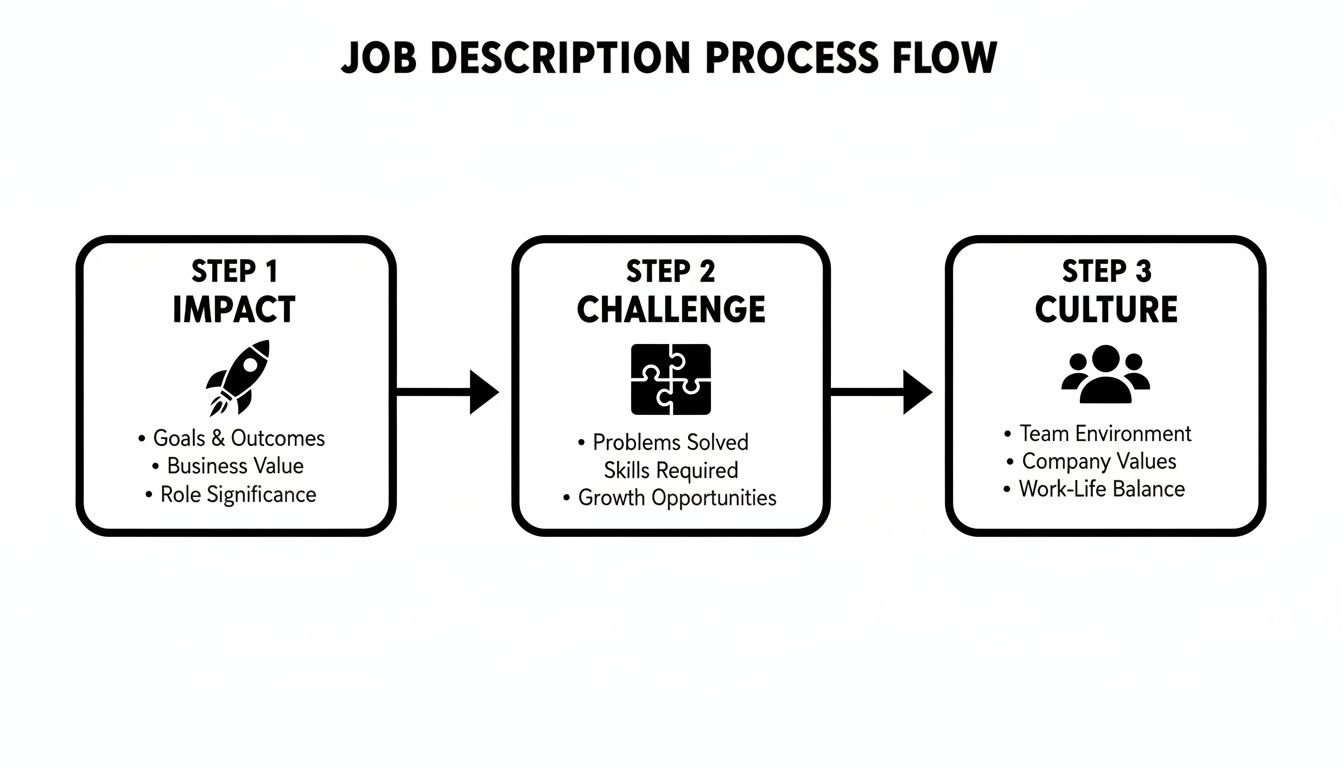
Starting with impact, then moving to challenge and culture, mirrors how elite engineers evaluate opportunities. It’s about more than just a list of required technologies.
Initial Screening for Communication and Culture Fit
First impressions are critical. For a remote engineer, success depends as much on communication habits and autonomy as it does on code quality.
Treat the initial 30-minute screening call as more than a resume check. Use it to probe for the soft skills that are crucial for remote work:
- Clarity and Conciseness: Can they explain their project contributions without getting lost in jargon? Is their thinking clear?
- Proactive Problem-Solving: Ask about a time they encountered an unexpected roadblock on a remote project. What did they do? How did they communicate the issue?
- Remote Work Alignment: Discuss specifics. Talk about their preferred communication styles, how they like to receive feedback, and what they do to stay connected to a distributed team.
Remember, this is a two-way conversation. It's your opportunity to sell the vision and unique challenges of the role, ensuring a genuine fit before both sides invest more time.
A candidate's ability to communicate complex ideas and navigate asynchronous collaboration is a direct indicator of their potential success in a remote setting. Prioritize this as much as you do technical proficiency.
Even as some companies push for a return to the office, the demand for high-caliber remote talent remains strong. Smart companies understand that tapping into global talent is a massive advantage—a model we've perfected at Group107 by connecting businesses with elite Ukrainian engineering teams. You can find more on the lasting power of remote work here.
Replacing Whiteboards with Real-World Assessments
The core of any modern interview process is the technical assessment. Asking candidates to solve generic algorithm challenges on a whiteboard only tests a narrow and often irrelevant skill: memorization under pressure. A far better approach is to observe how a candidate solves problems that resemble the ones your business actually faces.
We've found a few methods that provide a much more accurate signal of ability.
Technical Assessment Method Comparison
| Assessment Method | Pros | Cons | Best Used For |
|---|---|---|---|
| Take-Home Project | Low-pressure environment. Shows real coding style, architecture, and attention to detail. | Time-consuming for both parties. Risk of plagiarism if not managed well. | Mid-to-senior roles where design choices and code quality are paramount. Always compensate for their time. |
| Pair-Programming | Excellent for assessing collaboration, communication, and real-time problem-solving. | Can be stressful for some candidates. Requires significant time from your senior engineers. | Any role. It's the best way to simulate day-to-day collaboration and see how a candidate thinks on their feet. |
| System Design | Great for senior roles. Reveals ability to think at a high level about architecture, scalability, and trade-offs. | Highly abstract. Doesn't test hands-on coding ability. Can be difficult to standardize. | Senior, Staff, or Principal Engineer interviews where architectural vision is a key requirement. |
| Code Review | Simulates a common engineering task. Shows attention to detail, knowledge of best practices, and ability to give constructive feedback. | Limited scope. Doesn't show how they write code from scratch. | Evaluating mid-level engineers or assessing a candidate’s fit within your existing engineering culture. |
A combination is often best. For example, a take-home project followed by a pair-programming session to discuss and extend their solution provides a well-rounded view of a candidate's abilities.
Making Data-Driven Decisions with Scorecards
"Gut feeling" has its place, but it shouldn't be the deciding factor in hiring. Unstructured interviews are notoriously susceptible to bias. The simplest and most effective way to combat this is with a structured interview scorecard.
Before interviews begin, create a scorecard listing the core competencies for the role—both technical and behavioral. Each interviewer uses this to rate the candidate on a simple scale (e.g., 1-5) and provides specific, evidence-based notes to justify their rating.
Sample Scorecard Competencies:
- Technical Proficiency (e.g., Python, AWS)
- System Design & Architecture
- Problem-Solving & Critical Thinking
- Communication Skills (Written & Verbal)
- Team Collaboration & Cultural Alignment
This tool forces everyone to ground their feedback in tangible evidence observed during the interview, leading to fairer, more consistent, and more defensible hiring decisions. When you work with a partner like Group107, this entire rigorous vetting process is handled for you. We screen every engineer for deep technical expertise and essential soft skills, meaning you only speak with candidates who have already cleared a very high bar. It's a process designed to save you hundreds of hours and deliver exceptional results.
Navigating Contracts, Compliance, and Security
When you bring a remote software engineer onto your team, you're forging a cross-border business relationship. This introduces a new set of legal, compliance, and security considerations. While it may seem daunting, these challenges are entirely manageable with a clear, deliberate strategy.
Getting this wrong can expose your company to IP theft, legal challenges, and data breaches. The key is to transform these potential hurdles into a standard, risk-mitigated part of your hiring process, starting with a contract that leaves no room for misinterpretation.
Crafting a Bulletproof Remote Contract
Your contract is the single most important document protecting your business. Using a generic contractor agreement is a common mistake that can lead to serious legal and financial consequences. A contract for a remote engineer must be specific, comprehensive, and built for an international context.
A solid remote contract should always cover these non-negotiables:
- Intellectual Property (IP) Ownership: The agreement must state unequivocally that all work product—every line of code, design, and idea created during the engagement—belongs 100% to your company.
- Confidentiality (NDA): A rock-solid Non-Disclosure Agreement is critical. It must protect your source code, business strategies, customer data, and internal processes. This should be signed on day one, before any access is granted.
- Scope of Work & Deliverables: Define expectations with total clarity. Detail responsibilities, desired outcomes, and how performance will be measured. This is your best tool for preventing scope creep and disputes over what "done" means.
A core part of this is understanding the legal distinction between a consultant and an employee, as misclassifying an employee as a contractor is a costly mistake.
The Two Paths to Compliance: Direct vs. Partner
You have two main options for managing the legal side of remote hiring. The path you choose will directly impact your administrative workload and risk exposure.
1. Direct Contractor Engagement
This DIY approach involves hiring engineers as independent contractors. It offers flexibility but places the entire compliance burden on your company. You are responsible for drafting region-specific contracts, managing international payments, and ensuring you don't inadvertently create a taxable presence in another country.
2. Partnering with a Firm like Group107
The alternative is to offload this complexity to an Employer of Record (EOR) partner like Group107. We handle all legal, payroll, and compliance work. Your remote engineers are legally employed by us in their home country but work exclusively for you, fully integrated into your team.
This model provides all the advantages of a global team with none of the administrative pain. We manage the maze of local labor laws, tax withholding, and benefits, ensuring you're fully compliant. You just focus on building your product with your new team members.
A Security Checklist for Your Remote Team
Once the contract is signed, your focus must shift to security. Onboarding a remote engineer means granting access to sensitive systems. A proactive security plan is essential.
Use this checklist as a practical starting point:
- Implement Role-Based Access Control (RBAC): Grant engineers access only to the systems and data they absolutely need for their job. The principle of least privilege is your best friend.
- Mandate VPN Usage: All access to internal networks, code repositories, and sensitive data must go through a secure, company-managed VPN. No exceptions.
- Enforce Strong Authentication: Use multi-factor authentication (MFA) everywhere possible, especially for critical services like GitHub, AWS, and team collaboration tools.
- Establish Device Management Policies: Set clear standards for work devices, whether they are company-issued or BYOD. This includes requirements for disk encryption, up-to-date anti-malware software, and prompt security patches.
Taking these steps builds a secure foundation for your distributed team from day one. For a deeper dive, learn more about how to hire a remote team safely in our dedicated article.
Onboarding and Integrating Your Remote Engineers

Securing a "yes" on an offer is just the beginning. The onboarding process is the single biggest predictor of a remote software engineer's long-term success. A weak, disorganized start makes a new hire feel like an afterthought, whereas a thoughtful, structured process demonstrates your investment in them from day one.
This is your opportunity to transform a new hire into a high-impact team member. It’s not just about setting up accounts; it's a deliberate blend of technical setup, team integration, and cultural immersion.
The First 90 Days: A Structured Onboarding Framework
A great remote onboarding experience requires a clear, phased plan that sets expectations and builds momentum. We've found that a 90-day journey is key.
Week 1: Setup and Immersion
The first week is about creating a frictionless entry. The goal is simple: have everything—accounts, hardware, access—ready before they log in for the first time.
- Pre-Day One: All accounts are created (email, Slack, Jira, GitHub) and hardware is shipped and confirmed delivered.
- Day One: Kick off with a welcome call with their manager and an "onboarding buddy"—a peer they can ask informal questions. The main goal is getting their local dev environment set up and running their first build.
- End of Week One: The engineer should know the team's communication rhythms, have met key project members, and ideally, have pushed a tiny, low-risk change to a non-production environment.
Days 8-30: Contribution and Learning
The focus now shifts to real contribution. The new hire starts picking up tickets, participating in code reviews, and learning the product architecture. Their onboarding buddy remains a critical resource for context and guidance.
- Assign a well-documented, low-complexity "first real ticket" to provide a quick, meaningful win.
- Schedule deep-dive sessions with senior engineers to walk through key parts of the codebase.
- Ensure they are an active voice in all team ceremonies like stand-ups, sprint planning, and retrospectives.
Days 31-90: Ownership and Impact
After the first month, the new engineer should feel settled. The next two months are about moving from comfort to ownership. This is when they might lead development on a small feature, contribute to system design discussions, and proactively identify areas for improvement.
The ultimate goal of onboarding is to empower an engineer to achieve psychological safety and project ownership. They should feel confident not just to write code, but to question assumptions and help shape the team's direction.
Building a Strong Remote Engineering Culture
A strong remote culture is built with intention. Without the casual interactions of a physical office, you must intentionally create opportunities for connection and alignment.
- Structured Communication Rituals: Establish clear ground rules for asynchronous (Slack, Jira) and synchronous (video calls) communication. Daily stand-ups, weekly team syncs, and bi-weekly one-on-ones are essential.
- Virtual Team Building That Actually Works: Go beyond virtual happy hours. Try a "lunch and learn," schedule pair programming sessions on a fun side project, or do a team-based online escape room. Create shared experiences that aren't 100% work-focused.
- Transparent Career Paths: Remote engineers need to see a clear path for advancement. Document and share career ladders that show what skills and impact are needed to progress. Regular performance reviews and development talks are vital.
This deep integration is a core principle of our dedicated team model. By embedding engineers exclusively within a single client’s team, Group107 fosters an environment of complete focus and loyalty. This is our strategy for building high-performance, lasting teams that drive your project forward while protecting your intellectual property.
Summary and Next Steps
Successfully hiring remote software engineers in 2026 requires a strategic, systematic approach that goes far beyond simply posting a job online. It's about defining your needs, sourcing talent globally, crafting compelling job descriptions, running a modern vetting process, and ensuring seamless onboarding and integration.
Your Action Plan:
- Define Your Model: Choose between contractors, managed services, or a dedicated team. For long-term product development, a dedicated team offers the best balance of focus, control, and ROI.
- Sharpen Your Sourcing: Look beyond mainstream platforms to niche networks and targeted global hubs like Eastern Europe for deep technical expertise.
- Optimize Your Vetting: Replace outdated whiteboards with practical, real-world assessments like take-home projects and pair-programming sessions.
- Prioritize Onboarding: Implement a structured 90-day plan to move new hires from setup to full ownership and impact.
Ready to accelerate your product roadmap with a world-class remote engineering team, minus the operational headaches? Group107 builds premium, dedicated offshore software development teams from Ukraine, giving you access to elite talent that is fully embedded in your organization.