
Hiring remote developers effectively requires a strategic, repeatable process. It begins with a clear blueprint: defining the precise skills your project demands, choosing the right engagement model, and understanding the trade-offs before you write a single job post. This foundational work is what separates a strategic hire from a costly mistake.
Building Your Remote Hiring Blueprint
You can't find the right developer if you don't know who you're looking for. A vague job description attracts generic candidates and wastes valuable time. The goal isn’t just to fill a role; it’s to integrate an engineer who can deliver immediate business value.
Move beyond generic titles like "Software Engineer." Get specific. Detail the exact tech stack and the business problem they will solve. For instance, are you building a fintech platform that requires deep Python and Django experience for secure transaction processing? Or is it a SaaS front-end that needs a senior React developer proficient with specific data visualization libraries? Documenting these details acts as your first and most critical filter.
Defining Your Ideal Candidate Profile
An effective hiring blueprint goes beyond technical skills to include the non-negotiable soft skills that determine success in a remote environment. A developer's GitHub profile shows they can code, but it reveals little about their aptitude for asynchronous communication or their ability to solve problems autonomously.
Your ideal candidate profile must clearly define:
- Core Technical Skills: Be specific about languages (e.g., JavaScript, Python), frameworks (e.g., React, Node.js), and cloud platforms (AWS, Azure) that are critical for the role.
- Essential Soft Skills: Prioritize traits like clear written communication, autonomy, and a proven ability to meet deadlines in a remote setting.
- Business Context: Explain the why behind the project. An engineer who understands the business impact of their work is more engaged and delivers a superior product.
Choosing Your Engagement Model
A critical decision is how you engage with talent: hiring individual freelancers or partnering with an agency that provides a dedicated offshore team. This choice impacts scalability, management overhead, and project continuity.
Over half of HR leaders are increasing international hiring to access global talent pools, fill skill gaps, and reduce costs. This strategy can slash labor expenses by up to 60%.
This isn't just about cost savings. It's about building a resilient and scalable engineering function. A dedicated team provides stability and shared institutional knowledge that is impossible to achieve with a revolving door of short-term contractors.
Hiring individual contractors works for short-term projects but carries a high administrative burden. You are responsible for sourcing, vetting, payroll, and compliance for each individual. As you scale, this management overhead becomes a significant bottleneck, diverting focus from your core product.
Here’s a breakdown to guide your decision.
Choosing Your Engagement Model: Freelancer vs. Dedicated Team
| Factor | Individual Freelancer/Contractor | Dedicated Offshore Team (via Partner) |
|---|---|---|
| Management Overhead | High. You manage sourcing, vetting, payroll, and compliance. | Low. The partner handles all HR, legal, and admin tasks. |
| Scalability | Slow and difficult. Hiring is done one person at a time. | Fast. Access to a pre-vetted talent pool for quick scaling. |
| Knowledge Retention | Low. Knowledge leaves when the contractor's project ends. | High. The team builds institutional knowledge over the long term. |
| Team Cohesion | Non-existent. They are individual contributors. | Strong. The team works together, fostering collaboration. |
| Cost Structure | Typically hourly rates, can fluctuate. | Predictable monthly cost per team member. |
| Best For | Short-term projects, specialized tasks, quick fixes. | Long-term projects, core product development, scaling a team. |
The choice hinges on your long-term strategic goals.
Partnering with a provider of dedicated offshore teams, like Group107, removes the operational headache. You gain immediate access to a curated pool of top-tier talent and a ready-made infrastructure for payroll, legal compliance, and HR. This model is designed for long-term collaboration, ensuring knowledge retention and team cohesion. For a deeper analysis, see our guide on the pros and cons of remote offshore employment. This approach lets you focus on your product while your partner manages the complexities of a global workforce.
Finding and Attracting Elite Global Talent
With your hiring blueprint defined, the next challenge is finding engineers who can execute your vision. Posting a job on a massive, generic board and hoping for the best is a strategy for mediocrity.
Elite developers aren’t scrolling through endless job listings. They are active in specialized communities where their skills are recognized and valued. To hire the best, you must meet them where they are. This requires precision targeting, not casting a wide net.
Sourcing Beyond The Usual Suspects
The best engineers are often passive candidates—not actively job hunting but open to compelling opportunities. You will find them contributing to projects and leading discussions on platforms that showcase their capabilities.
- GitHub and GitLab: These platforms are living resumes, not just code repositories. Identify top talent by observing contributions to open-source projects relevant to your tech stack. An engineer actively maintaining a popular library demonstrates technical expertise, commitment, and collaboration skills.
- Specialized Communities: Niche forums and dedicated Slack or Discord communities for languages like Python or frameworks like React are invaluable. Engage authentically—participate in discussions and add value before posting a job link.
- Targeted Global Talent Hubs: Certain regions are renowned for exceptional technical talent. Ukraine, for example, has a deep pool of IT specialists with strong engineering fundamentals and creative problem-solving skills. Tapping into these hubs provides access to world-class developers. Learn more from our experience building effective offshore software development teams.
Crafting An Irresistible Employer Value Proposition
Attracting top remote talent is not just a salary competition. The best engineers are motivated by complex challenges, growth opportunities, and a culture of trust and autonomy. Your Employer Value Proposition (EVP) must clearly articulate why a great developer should choose your team.
The most compelling EVPs for remote engineers are built on three pillars: challenging problems to solve, opportunities for continuous learning and mastery, and a culture of high trust and autonomy. Forget office perks and focus on what truly matters to a skilled professional.
For example, a fintech company shouldn't just say it needs a backend engineer. It should describe the complexity of building a secure, high-throughput payment system. A SaaS startup should highlight the opportunity to work on a game-changing AI feature that will define the product's future. Emphasize the impact their work will have.
Positioning Your Company As A Top Remote Employer
Your reputation as a remote employer is your most powerful recruiting tool. The market has shifted permanently; an analysis from August 2025 shows that a staggering 87% of software engineers prefer remote or hybrid work.
With software development jobs projected to grow by 17% by 2033, a strong remote-first brand is essential for attracting top talent.
To stand out, be specific about what makes your remote culture superior. Do you champion asynchronous communication to minimize meetings? Do you offer stipends for home office setups or professional development? Highlighting these tangible benefits demonstrates a serious commitment to creating an environment where remote developers thrive. By focusing on niche channels and a powerful EVP, you will build a consistent pipeline of skilled, motivated engineers.
Running A Vetting Process That Actually Works
A bad hire is a significant setback, impacting your budget, timeline, and team morale. For remote developers, the vetting process is your most important defense against costly mistakes.
Forget abstract algorithm puzzles and whiteboard exercises; they are poor predictors of on-the-job performance. An effective process validates practical, real-world skills, problem-solving abilities, and the soft skills essential for an asynchronous environment. The goal is not to find an engineer with memorized answers, but one who asks the right questions, communicates clearly when facing challenges, and can translate business requirements into clean, functional code without constant supervision.
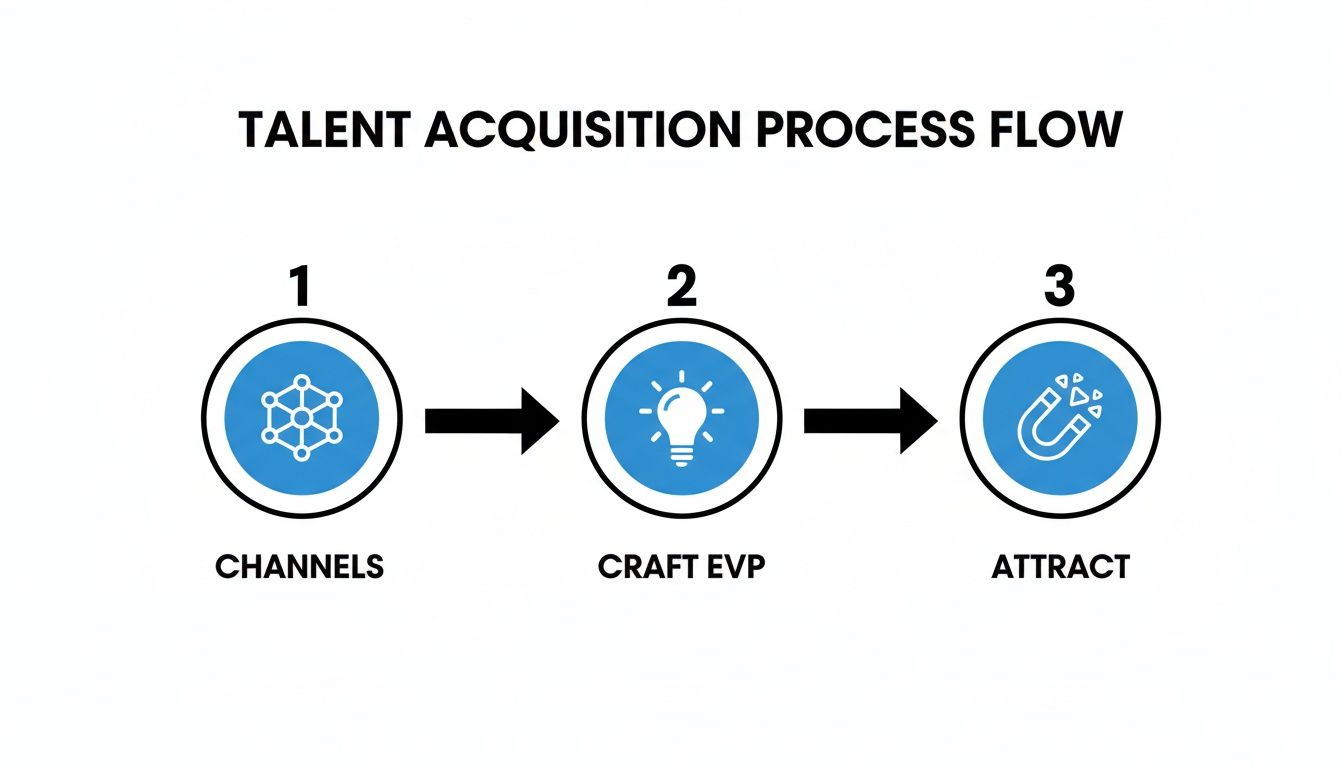
A successful hire begins long before the first interview. It starts with selecting the right channels and crafting a value proposition that attracts top talent.
The Multi-Stage Interview Framework
A robust remote vetting process is layered. Each stage evaluates a different skill set, saving time and ensuring only the most qualified candidates advance.
- Initial Screening (30 minutes): A technical lead should conduct this call to assess communication skills, confirm core knowledge alignment, and discuss past projects. The primary goal is to identify red flags early.
- Take-Home Coding Challenge (3-4 hours): This is the practical test. Assign a small, self-contained task that mirrors a real-world problem your team solves. This reveals more about their ability to work autonomously and deliver a polished result than a high-pressure live coding session.
- Technical Deep-Dive & Code Review (60 minutes): The candidate walks through their take-home assignment with your engineers. This is a collaborative discussion about their design choices, trade-offs, and problem-solving approach, offering a clear view of their thought process.
- System Design Interview (60 minutes): This is non-negotiable for senior roles. Pose a high-level problem, such as "design a URL shortening service." You are evaluating how they scope requirements, identify bottlenecks, and discuss architectural patterns, not looking for a perfect textbook solution.
Designing A Practical Take-Home Challenge
The ideal take-home assignment is specific, relevant, and respects the candidate’s time. A vague or overly complex task will deter the best candidates.
Example Task for a Mid-Level Backend Developer:
Objective: Build a simple REST API using FastAPI. Create an endpoint that accepts a product ID, fetches details from a public API (like FakeStoreAPI), and returns a curated response.
Requirements:
- Containerize the application using Docker.
- Include a
README.mdwith clear setup and run instructions.- Write basic unit tests for the endpoint.
What We Look For: Clean code, proper REST principles, effective error handling, production-ready practices (like containerization), and clear documentation.
This task efficiently tests a developer's understanding of modern workflows, API design, and core engineering practices without demanding excessive time.
Evaluating The Non-Negotiable Soft Skills
In a remote team, technical brilliance without strong soft skills is ineffective. Your process must be designed to evaluate these traits.
- Asynchronous Communication: Assess the clarity of their emails and the quality of the README in their coding challenge. This written clarity is a strong indicator of their effectiveness in a remote environment.
- Proactivity and Ownership: Did they ask clarifying questions about the task or make assumptions? Proactive engineers seek to fully understand requirements before coding, demonstrating a sense of ownership.
- Problem-Solving Approach: During the code review, note how they discuss their process. Do they explain challenges they encountered and how they overcame them? This reveals resilience and a practical mindset.
A successful vetting process provides a holistic view of a candidate—not just what they know, but how they think, communicate, and solve problems. This rigorous approach is the best investment you can make in building a high-performing remote team.
Managing Legal And Security From Day One
Hiring remote developers, especially across borders, introduces significant legal and security complexities. A proactive approach is essential to avoid IP disputes, compliance fines, and security breaches.
Your first line of defense is a robust contract. This document is the legal foundation of your remote relationship and must be written to protect your company, regardless of the developer's location.
Crafting An Airtight Remote Work Contract
Do not use a generic employment template. Your agreement needs specific clauses designed for distributed work and international law. Ambiguity is your enemy; spell everything out in detail.
Your contract must include these non-negotiables:
- Intellectual Property (IP) Ownership: This clause must state unequivocally that all code, designs, and ideas created during the engagement belong 100% to your company.
- Non-Disclosure Agreement (NDA): A strong confidentiality clause is vital to protect your trade secrets, roadmap, and internal data. It must remain in effect after the engagement ends.
- Data Protection and Security: The contract must outline the developer’s responsibility to adhere to your company’s security protocols and comply with regulations like GDPR or CCPA if you handle customer data.
For a more detailed breakdown, our guide on how to hire a remote team safely and securely covers other critical contractual points.
Warning: Never assume your standard domestic contract is suitable for international engagements. Worker classification laws vary significantly by country. Misclassifying an employee as a contractor can lead to severe penalties.
Worker Classification And Compliance
Correctly classifying workers is a critical legal hurdle. The distinction between an independent contractor and an employee is narrow, but the consequences of misclassification—impacting taxes, benefits, and labor law—are substantial.
An error can result in back taxes, fines, and forced reclassification. The rules are complex and often depend on the level of control you exert over the work.
Implementing Essential Security Protocols
With a distributed team, your security perimeter extends to every developer's home network. You must enforce strict security practices from day one.
Implement this baseline security checklist without exception:
- Mandatory Multi-Factor Authentication (MFA): Enable MFA on all company accounts, including email, GitHub, and AWS. It is your most effective defense against unauthorized access.
- Required VPN Usage: All access to the company network must be through a secure, company-managed VPN to encrypt traffic and protect data.
- Secure Device Management: Enforce a clear policy for work devices, whether company-issued or BYOD, mandating disk encryption, endpoint security software, and regular updates.
Establishing these legal and security frameworks builds a resilient, scalable foundation for your remote team, allowing you to focus on product development instead of risk management.
Mastering Remote Onboarding And Retention

Signing the contract is just the beginning. The most critical phase—onboarding—is about to start. A structured onboarding process is the single greatest predictor of a new remote developer's long-term success.
A clumsy onboarding experience—where a new hire spends their first week struggling for system access or basic information—signals organizational chaos and kills momentum.
The First 90 Days: A Structured Plan
Effective remote onboarding is a deliberate process designed to integrate a developer into your team’s codebase, workflows, and culture. The objective is to remove friction and facilitate an early win.
Structure your 90-day plan in distinct phases:
- First 30 Days (Integration & Context): Focus on setup and learning. Provide access to all tools and repositories before day one. Assign an "onboarding buddy"—a peer engineer—to answer informal questions. Their first task should be a small, low-risk bug fix to provide the satisfaction of a successful deployment.
- Days 31-60 (Contribution & Collaboration): The developer should begin taking on more complex tasks and collaborating with other team members. Schedule 1:1 meetings with key product and design stakeholders. Maintain clear documentation in a tool like Confluence as your single source of truth.
- Days 61-90 (Ownership & Autonomy): The new hire should now operate with greater independence, taking ownership of features and contributing to technical discussions. Set clear performance expectations and conduct a 90-day review to provide feedback and align on future goals.
Onboarding is just the start. Long-term success requires mastering the best practices for managing remote teams.
Proven Strategies For Retaining Top Remote Talent
Onboarding brings talent in; retention keeps them. In a competitive market, you cannot afford to lose great engineers to a company with a better remote culture.
Effective retention isn’t about perks. It’s about creating an environment where skilled developers feel challenged, respected, and connected to the company's mission.
The best remote engineers don't leave for a slightly higher salary. They leave due to a lack of professional growth, poor communication, or feeling disconnected from the team's purpose.
To retain your best people, focus on what matters:
- Create Clear Career Paths: Document transparent career ladders that show a clear path for advancement from a mid-level to a senior or principal role.
- Foster a Culture of Recognition: Be intentional about recognition. Use a dedicated Slack channel for shout-outs, establish peer-nominated awards, or highlight wins in team meetings to make good work visible.
- Master Asynchronous Communication: Avoid burnout from excessive meetings across time zones. Champion detailed, written communication in tools like Jira and Slack to respect focus time and create a record of decisions.
- Invest in Their Growth: Provide a budget for courses, conferences, and certifications. This shows you are invested in their career development, not just their current output.
Investing in skills is more critical than ever, with AI proficiency becoming a top remote hiring trend for 2025. Businesses need engineers who can build intelligent systems, and AI/ML roles are the fastest-growing segment. Upskilling your current team is a win-win: it fosters their growth and provides your business with a significant competitive advantage.
Common Questions About Hiring Remote Developers
Hiring remote developers can present unique challenges. Here are direct answers to the most common questions from business leaders building and managing global teams.
What Are The Biggest Mistakes To Avoid When Hiring Remote Developers?
The most common mistakes occur long before the first interview. Starting with a vague job description attracts unqualified applicants. Using abstract brain teasers instead of practical coding challenges fails to assess real-world skills.
Beyond technical skills, overlooking a candidate's ability to communicate clearly in an asynchronous environment is a frequent error.
Finally, underestimating the legal and security aspects is a critical failure. Using a weak contract that fails to protect your intellectual property or neglecting to enforce basic security measures like MFA and VPN usage exposes your business to significant risk.
How Do You Manage Time Zone Differences Effectively?
Effective time zone management relies on a two-part strategy: establishing a few "core overlap" hours for real-time collaboration and embracing asynchronous communication for everything else.
Use the overlap window—2-4 hours is typically sufficient—for essential live interactions like daily stand-ups or critical planning sessions.
For all other work, empower your team with robust asynchronous tools. Detailed, well-written updates in platforms like Jira, Slack, and Confluence are non-negotiable. This approach preserves context, respects deep focus time, and builds a culture of documentation over meetings.
What Is The True Cost Of Hiring A Remote Developer?
The total cost of a remote developer extends beyond their salary. While accessing global talent can reduce direct labor expenses, a comprehensive budget must account for all associated costs.
Factor in these additional expenses:
- Recruitment Fees: Costs for job boards, recruitment platforms, or agency partnerships.
- Software and Tooling: Licenses for IDEs, project management software, and communication tools.
- Legal and Compliance: Professional fees for drafting international contracts and ensuring compliance with local labor laws.
Hiring individual contractors directly also involves the administrative burden of managing international payments and compliance. Partnering with a dedicated team provider like Group 107 often proves more cost-effective by consolidating these expenses into a single, predictable fee, eliminating hidden costs and administrative overhead.
How Do I Keep Company IP And Data Secure With A Remote Team?
A multi-layered security strategy is essential for a distributed team. Security must be integrated into your operations from day one.
Start with a robust legal agreement that explicitly defines IP ownership and confidentiality. This is your foundational layer of protection.
On the technical side, enforce strict, role-based access controls to limit system access to only what is necessary. Mandate multi-factor authentication (MFA) across all company services without exception. Require the use of a company-managed VPN for all network access to encrypt traffic. Regular security training and peer code reviews add another critical layer, helping to identify and mitigate risks proactively.
Summary and Next Steps
Hiring remote developers successfully is a strategic process that requires a clear plan, a rigorous vetting process, and a commitment to building a strong remote culture. By defining your needs precisely, sourcing talent from specialized channels, implementing robust legal and security protocols, and mastering remote onboarding, you can build a world-class engineering team that drives business growth.
Actionable Next Steps:
- Develop Your Hiring Blueprint: Define your ideal candidate profile, including both technical and soft skills, and choose the right engagement model for your long-term goals.
- Refine Your Vetting Process: Implement a multi-stage interview framework with a practical take-home challenge to assess real-world skills.
- Strengthen Your Security Posture: Audit your contracts and enforce mandatory security protocols like MFA and VPN usage.
- Optimize Your Onboarding: Create a structured 90-day plan to integrate new hires effectively and set them up for success.
Ready to build a world-class engineering team without the operational overhead? Group 107 provides dedicated, pre-vetted offshore development teams from Ukraine, helping you scale faster while reducing costs. Learn how we can build your team.