
Improving developer productivity used to be about one thing: writing more code, faster. That’s an outdated model. Today, boosting engineering performance is a strategic blend of creating a superior developer experience (DX), automating CI/CD pipelines, and intelligently integrating AI tools.
The paradigm has shifted from measuring lines of code to focusing on tangible business outcomes—like shipping better software, faster, with greater stability and impact.
Rethinking Developer Productivity in the Age of AI

True developer productivity is no longer about raw output. With AI assistants becoming a standard part of the engineering toolkit, the conversation has moved from how much code gets written to how much impact that code creates.
Whether you're a fast-moving SaaS startup or a large enterprise, it’s time to look past old-school metrics like story points and focus on what genuinely moves the needle for your business.
A modern approach to engineering efficiency stands on three pillars: People, Process, and Technology. This guide provides a playbook for optimizing all three. We'll explore how to build a high-impact engineering culture, streamline your development lifecycle with smart automation, and use the right technology to amplify your team's talent.
The New Landscape of Engineering Efficiency
AI has fundamentally changed the daily work of a developer. A recent survey from JetBrains found that 85% of developers now regularly use AI tools for coding, with 62% stating they depend on AI assistants.
These tools deliver real time savings. Nearly 90% of developers reported saving at least one hour a week, and one in five gets back a full workday.
But there's a disconnect: a staggering 66% of developers feel their current metrics don't capture their true contributions. This is a clear signal that a new approach to measuring productivity is needed. You can review the complete findings in the JetBrains research about developer trends.
The gap between tool adoption and meaningful measurement is where many teams get stuck. The real win for leaders is creating an environment that removes friction and empowers developers to solve complex business problems, not just complete tasks.
The goal is to maximize creative problem-solving time and minimize "toil"—the manual, repetitive work that drains energy and slows innovation. A superior developer experience (DX) directly translates to higher engagement, better code quality, and faster delivery cycles.
The way we measure productivity must evolve with the tools we use. What mattered yesterday—like lines of code or commits—is far less relevant than the business outcomes engineering teams drive today.
The Evolution of Developer Productivity
| Pillar | Traditional Focus | Modern Focus (with AI) | Business Impact |
|---|---|---|---|
| People | Individual output (lines of code, tasks) | Team collaboration, skill growth, reduced cognitive load | Higher retention, innovation, faster onboarding |
| Process | Following a rigid methodology | Flow efficiency, short feedback loops, CI/CD automation | Quicker time-to-market, fewer bugs, predictability |
| Tools | Standard IDEs and debuggers | AI-powered code completion, automated testing, DX platforms | Amplified output, improved code quality, less toil |
Ultimately, focusing on these areas helps build engineering teams that are not just productive, but genuine engines for business growth. For a deeper look at effective workflows, check out our guide on agile development best practices.
Building a Culture That Drives Performance
You can have the best tools on the planet, but they won’t fix a broken culture. The foundation of engineering efficiency is your team. A motivated, unblocked developer is an unstoppable force. To see a significant jump in productivity, you must cultivate an environment where people can do their best work.
It starts with psychological safety—the shared belief that it’s safe to take interpersonal risks. When developers feel safe, they aren't afraid to ask "dumb" questions that often uncover major issues. They experiment with new approaches and give candid feedback in code reviews without fear of backlash. A SaaS company that runs blameless post-mortems after an outage, for example, is focused on fixing the system, not pointing fingers.
This safety net gives your team permission to fail fast, learn, and innovate at a much higher velocity.
Protecting Deep Work and Developer Flow
Constant interruptions are productivity's worst enemy. A developer in a "flow state"—a zone of deep concentration—is incredibly effective. A single five-minute interruption can cost them up to 30 minutes of productive time as they regain that focus. Protecting this time is essential.
Here’s how to shield your team from distractions:
- Eliminate low-value meetings. If a meeting lacks a clear agenda and a specific outcome, it should be an asynchronous update.
- Embrace asynchronous communication. Tools like Slack or Teams are powerful but require guardrails. Encourage status updates in channels instead of constant check-ins and respect "focus time" statuses.
- Block "no-meeting" time. Dedicate specific blocks of time—like Tuesday and Thursday afternoons—as protected deep work periods for the entire engineering organization.
By reducing context-switching, you lower the cognitive load on your engineers, allowing them to focus on solving the complex problems you hired them for.
Onboarding for Speed and Impact
The time it takes a new hire to become a productive contributor reveals a lot about your culture. A chaotic, sink-or-swim onboarding can leave new developers feeling lost for months. A well-structured process can cut that ramp-up time in half.
For example, a high-impact onboarding plan at a fintech company might include:
- A "ready-to-code" setup. The new hire's laptop is pre-configured on day one with all necessary tools, access keys, and a local build that works out of the box. No friction.
- A "first day" pull request. Assign a small, well-documented, non-critical bug to fix. It’s a quick win that familiarizes them with the code review and deployment process immediately.
- A dedicated mentor. Pair them with a senior engineer who can answer questions about the codebase, architecture, and unwritten team norms.
This structured approach builds confidence and integrates new hires into the team's workflow from day one.
A culture of continuous learning is just as critical. Encourage developers to explore new technologies, share knowledge through internal tech talks, and attend conferences. An investment in your team's skills is a direct investment in your product's future.
Ultimately, a strong culture is the bedrock of operational excellence. To establish effective workflows, our guide on agile development best practices offers a framework for building predictable, high-performing teams.
Streamlining Your SDLC with DevOps Automation
Slow, manual processes are the silent killers of developer productivity. Every minute a developer spends waiting for a build, manually deploying code, or wrestling with a test environment is a minute they aren’t shipping business value. The solution is to optimize the entire software development lifecycle (SDLC) through intelligent automation and a true DevOps culture.
This isn't just about ticking a "CI/CD" box. True efficiency comes from creating fast, reliable feedback loops that shorten the journey from a developer's keyboard to production.
Eliminating Pipeline Bottlenecks
A common pitfall is the "fire-and-forget" approach to CI/CD. Teams set up a pipeline and assume it's done. In reality, pipelines require constant tuning. As projects grow, bottlenecks inevitably emerge—slow code reviews, flaky tests, and manual approval gates grind progress to a halt.
Proactively diagnose these issues by asking:
- How long does our pipeline take from commit to deployment? If it’s measured in hours instead of minutes, you have a problem.
- Where are pull requests getting stuck? Are they waiting for review, failing tests, or lingering for a manual sign-off?
- How much time is spent on manual release coordination? Quantify the effort spent on staging environment setups, database migrations, and post-deployment checks.
The answers will illuminate the real friction in your process. For many organizations, the solution is adopting a DevOps-as-a-Service model. This brings in specialized expertise to fine-tune automation and implement best practices, freeing your internal team to focus on building features.
Advanced Automation Strategies
Once you've pinpointed bottlenecks, apply advanced automation to resolve them. This is where you graduate from basic continuous integration to true continuous delivery, enabling faster and safer releases.
A strong engineering culture is built on three pillars: focus, collaboration, and continuous learning. These principles directly support the advanced practices required for a high-performing DevOps setup.
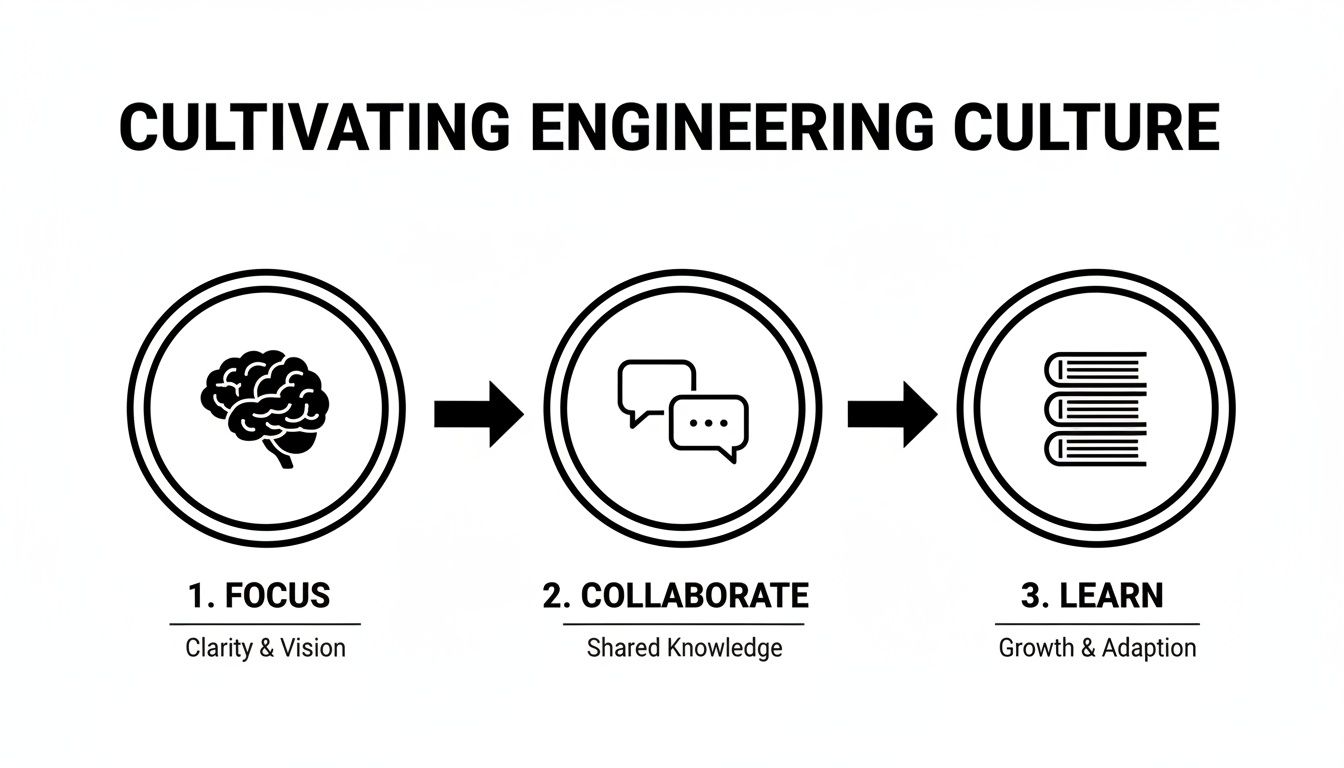
This cycle of continuous improvement—driven by protected focus, strong collaboration, and a learning mindset—is the engine for a modern DevOps environment.
Key strategies to implement include:
- Infrastructure as Code (IaC): Use tools like Terraform or Bicep to define and manage infrastructure in code. This makes creating environments repeatable, consistent, and fast, eliminating the "it works on my machine" problem.
- Comprehensive Automated Testing: Move beyond unit tests. Integrate automated integration, end-to-end, and performance tests directly into your pipeline to build confidence and catch bugs early.
- Feature Flagging: Decouple deployment from release. Push code to production behind a toggle, then activate features for specific users or roll them back instantly without a full redeployment. This dramatically reduces the risk of big-bang releases.
An optimized CI/CD pipeline isn’t just a technical asset; it's a business accelerator. Shipping smaller updates more frequently reduces risk, accelerates customer feedback loops, and increases market agility.
If your team is just starting, our guide on what a CI/CD pipeline is is an excellent primer. To ensure these automated workflows run smoothly, adopting proven API development best practices will ensure your services communicate effectively.
Using Technology and AI to Amplify Developer Output
The right tech stack is a massive force multiplier for an engineering team. The wrong one is a source of soul-crushing friction. This isn't about chasing trends on Hacker News; it's about deliberately selecting tools that solve real problems for your developers. This is especially critical with AI, which holds immense promise but requires a thoughtful strategy to deliver real value.
The ultimate goal is a superior Developer Experience (DX)—an environment where developers can achieve and maintain a flow state. A great DX means building, testing, and shipping feels seamless, not like a battle against a clunky toolchain.
Creating a Superior Developer Experience
Everything begins with a fast, reliable local development environment. A developer waiting five minutes for a local build to finish is five minutes of lost focus. This "tooling tax" adds up quickly, costing teams thousands of hours annually.
To optimize your DX, focus on these core areas:
- Fast, Consistent Environments: Tools like Docker are non-negotiable. They ensure every developer has an identical, production-like environment that spins up in seconds, killing the "it works on my machine" problem.
- Well-Maintained Internal Tooling: Treat internal scripts, CLIs, and platforms like real products. This means clear documentation, reliable performance, and dedicated ownership.
- Streamlined Debugging and Observability: Provide easy access to logs, traces, and metrics. Tools that offer clear insight into application behavior slash the time required to hunt down and fix bugs.
A great DX is a competitive advantage. It helps attract and retain top engineering talent and enables your team to ship better software, faster.
Integrating AI Coding Assistants Intelligently
AI coding assistants are powerful but come with a hidden cost if used carelessly. They excel at generating boilerplate code, writing unit tests, and suggesting fixes. The danger arises when developers blindly accept this output, introducing subtle bugs or poor architectural choices.
This creates a "rework tax"—engineers spend more time debugging the AI's flawed suggestions than if they had written the code themselves.
A 2025 field study found that experienced developers using early-2025 AI tools took 19% longer to complete realistic coding tasks. The reason? The generated code was often flawed and required significant debugging, erasing any perceived speed boost. You can dive into the details in the full METR study on AI and developer speed.
The key is to treat AI as an assistant, not an oracle.
The real win with AI isn't generating mountains of code. It's automating toil—repetitive tasks like writing documentation, creating test data, and refactoring simple patterns. Booking.com, for instance, saw a 16% productivity lift by using AI to increase merge rates and reduce time spent on such mundane work.
A Framework for Strategic Tool Selection
Adopting new technology should always be driven by a problem, not hype. Before introducing any new tool, use a clear framework for evaluation.
Here is a simple, effective process:
- Identify the Friction: Pinpoint the specific, recurring problem that is slowing your team down. Is it slow build times? Inconsistent dev environments? Manual testing?
- Evaluate Solutions, Not Hype: Research tools that directly solve that problem. Create a shortlist and run a small proof of concept (POC) with a few developers.
- Measure the Impact: Track relevant metrics before and after the POC. If builds were slow, measure average build time. The data must tell the story.
- Consider Total Cost of Ownership: Look beyond the sticker price. Factor in the time for setup, training, and ongoing maintenance. A "free" open-source tool can become expensive if it requires constant attention from senior engineers.
By using technology and AI to solve actual problems, you build an environment where developers can focus on what they do best: creating great software that moves your business forward. For more on this, read our guide on how to use AI in business for a deeper look at strategic implementation.
Measure What Matters: From Busy Work to Business Impact

You can't improve what you don't measure. But measuring the wrong things will actively sabotage your team's performance.
If you’re still counting lines of code or story points, you’re judging a chef by the number of pans they dirtied. These meaningless metrics encourage developers to game the system instead of building high-quality software.
The goal is to measure business impact (outcomes), not busy work (output). This requires a smarter approach that blends quantitative system data with the qualitative experience of your developers.
Get Rid of Vanity Metrics
Traditional metrics often create perverse incentives. Reward developers for commit volume, and you'll get a flood of tiny, insignificant changes. Push for velocity above all else, and teams will inflate estimates to look productive.
None of this tells you if you're building the right thing or building it well.
Good measurement should function as a vital signs monitor for your engineering organization, helping you answer the questions that actually matter:
- Are we shipping valuable features to our customers faster?
- Is our platform becoming more stable and reliable over time?
- Is our development process getting smoother, or is it a source of frustration?
Answering these requires focusing on metrics that reflect speed, stability, and developer well-being.
How to Use DORA and SPACE Frameworks
Two of the most effective frameworks for this are DORA and SPACE. They provide a structured way to measure what high-performing teams do.
The DORA metrics, from the DevOps Research and Assessment team, provide four key vitals for delivery performance:
- Deployment Frequency: How often do you successfully ship code to production? Elite teams deploy on-demand, multiple times a day.
- Lead Time for Changes: How long does it take for a commit to reach production? Shorter is always better.
- Change Failure Rate: What percentage of your deployments cause a production failure? A low rate indicates built-in quality.
- Time to Restore Service: When an incident occurs, how long does it take to recover? Elite teams recover in under an hour.
These four metrics offer a data-driven view of your delivery pipeline's health.
DORA is fantastic for measuring system performance, but it's only half the story. The SPACE framework adds the critical human element. It reminds us that productivity also encompasses Satisfaction, Performance, Activity, Communication, and Efficiency, providing a holistic view.
Tying It All Back to Business Outcomes
Tracking DORA metrics is the start, but the real value comes from connecting them to tangible business results. A 25% reduction in Lead Time for Changes isn't just a technical win; it means you can ship a new feature for a key enterprise client a week ahead of schedule, securing a critical renewal.
Your leadership dashboard shouldn't just be engineering graphs; it needs to speak their language.
| DORA Metric Improved | Business Impact | Example Scenario (SaaS) |
|---|---|---|
| Increased Deployment Freq. | Faster time-to-market and quicker response to user feedback | Shipping three small feature updates weekly instead of one big monthly release. |
| Reduced Change Failure Rate | Higher customer trust and lower support costs | A 90% reduction in post-release hotfixes, freeing up developers for new work. |
This is how you prove the ROI of your investments in people, process, and technology. It reframes the conversation from "how busy are the developers?" to "how much value is engineering delivering?"
This perspective is even more critical with AI integrated into the workflow. Google's 2025 DORA report found that 90% of software professionals now use AI, and 59% say it's improving their code quality. By focusing on outcomes, you can accurately measure the real-world impact of these powerful tools. You can learn more about the AI findings in the full report.
Summary and Next Steps
Improving developer productivity is a continuous process, not a one-time fix. It requires a holistic strategy focused on three core pillars:
- People: Foster a culture of psychological safety, protect deep work, and streamline onboarding to empower your team.
- Process: Automate your SDLC, eliminate pipeline bottlenecks, and adopt a DevOps mindset to create fast, reliable feedback loops.
- Technology: Invest in a superior developer experience (DX), integrate AI tools strategically, and use a data-driven framework for tool selection.
Instead of tracking vanity metrics like lines of code, measure what truly matters using frameworks like DORA to connect engineering efforts directly to business outcomes. By focusing on flow, feedback, and continuous learning, you can build a high-performing engineering organization that serves as a powerful engine for business growth.
Frequently Asked Questions
When improving engineering performance, several common questions arise. Here are straightforward answers based on our experience helping numerous teams navigate these challenges.
What Are the First Steps for a Small Team?
For small teams and startups, developer time is the most precious resource. Focus on high-impact, low-effort changes that protect it.
Start by aggressively defending your team's focus. Block out "no-meeting" afternoons or shift status updates to a Slack channel. The goal is simple: less context switching, more deep work.
Next, optimize your code review process. A pull request that sits idle is a major productivity killer. Set a team goal to review PRs in under 24 hours. Using PR templates can also make reviews faster and more consistent.
Finally, implement basic deployment automation. A simple CI/CD pipeline using a tool like GitHub Actions or GitLab CI can save hours of manual work, reduce errors, and provide a solid foundation for future growth.
How Should We Measure the ROI of New Developer Tools?
Measuring the ROI of a new tool requires a blend of quantitative data and qualitative feedback.
First, establish a baseline. Know your current DORA metrics, such as deployment frequency and lead time for changes. After implementing a new tool, like an AI coding assistant, track those same metrics for a quarter to see what has changed.
Data only tells half the story. Collect direct feedback from your developers. Don't just ask if they "like" it. Send a targeted survey asking how much time they feel they are saving or how much friction the tool has removed from their workflow.
When you combine hard data ("Our lead time for changes dropped by 30%") with qualitative feedback ("I'm saving at least three hours a week on debugging"), you build an undeniable business case for the investment.
Can Offshore Teams Be as Productive as In-House Teams?
Yes, absolutely—but it depends entirely on the partnership model. The outdated approach of throwing tasks over the wall to a vendor is a recipe for communication gaps, missed deadlines, and frustration.
Productivity from a global team is achieved through deep integration, not delegation.
A modern partner provides dedicated engineers who become a true part of your team. They participate in your daily stand-ups, contribute directly to your codebase, and are aligned with your company culture and business goals.
This integrated approach avoids the classic pitfalls of project-based outsourcing. You gain seamless collaboration and shared ownership, leading not only to significant cost savings but also an acceleration of your product roadmap. The secret is to treat your offshore talent as a genuine extension of your team to unlock their full potential.
Ready to build a high-impact, scalable engineering team? Group 107 provides premium offshore software development teams and end-to-end digital solutions that drive business growth. Learn how we can help you accelerate your roadmap and achieve your goals.