When businesses first explore offshore software development costs, the conversation almost always starts—and often ends—with the hourly rate. While attractive, that single number is just the tip of the iceberg. True cost efficiency isn't found in the cheapest rate but in the total value a partnership delivers, including team performance, speed to market, and significant operational savings.
Focusing solely on the hourly price is a common but costly mistake. The real objective is to build a high-performing team that accelerates your business goals and delivers a strong return on investment (ROI).
Beyond the Hourly Rate: Why Total Value Matters

We’ve seen it happen time and again: a company chases the lowest possible hourly rate, only to face budget overruns, missed deadlines, and a subpar product. While lower labor costs are a key benefit of offshoring, the true strategic advantage lies in accessing world-class talent that can execute your vision efficiently and effectively.
A cheap but slow or inexperienced team will cost you far more in the long run through project delays, endless bug fixes, and missed market opportunities. This is a classic case of being penny-wise and pound-foolish, where initial savings are quickly erased by poor outcomes.
The Concept of Total Value of Ownership (TVO)
A more strategic approach is to evaluate offshore partnerships through the lens of Total Value of Ownership. This framework shifts the focus from cutting costs to maximizing the return on every dollar invested. It accounts for all factors contributing to a successful outcome, including:
- Skill and Efficiency: A top-tier team writes clean, scalable code. They work faster, which means fewer billable hours, less rework, and a more stable product that requires less long-term maintenance.
- Faster Time-to-Market: An efficient offshore partner can help you launch months ahead of competitors. This allows you to capture market share, generate revenue sooner, and gain a critical first-mover advantage.
- Reduced Operational Overhead: Partnering with a dedicated team provider eliminates the significant costs and administrative burdens of in-house recruitment, HR, benefits, and office management.
For example, a business can find exceptional value in Eastern Europe, where rates for senior talent often range from $25 to $55 per hour. This is a dramatic reduction compared to the $100-$300 per hour common in North America. In a tech hub like Ukraine, a skilled mid-level developer at $35-$55/hour can reduce labor costs by up to 70% without sacrificing quality on complex projects.
The goal of offshoring shouldn't be to find the cheapest labor. It should be to build the most effective, high-performing team possible within a strategic budget. True value is achieved when cost savings are a direct result of superior efficiency, quality, and a strong partnership.
Deconstructing Offshore Cost Components
To build a reliable budget, you must understand every component that contributes to the final price. The table below breaks down the primary factors that shape your total offshore software development costs. To learn more, our guide on the advantages of offshore software development provides additional context.
| Cost Component | Description | Impact on Budget |
|---|---|---|
| Team Composition | The mix of senior, mid-level, and junior developers, plus specialized roles like QA, DevOps, and Project Management. | High |
| Technology Stack | The programming languages, frameworks, and platforms used. Niche or legacy technologies often command higher rates. | Medium |
| Project Complexity | The intricacy of features, third-party integrations, and compliance requirements (e.g., HIPAA or PCI DSS). | High |
| Engagement Model | The pricing structure you choose, such as a dedicated team, fixed price, or time and materials. | High |
| Provider Overhead | The partner's operational costs, including management, infrastructure, and legal support, which are factored into their rates. | Medium |
Understanding these drivers from the start is the key to creating a realistic financial plan and fostering a successful, transparent offshore partnership.
How to Choose the Right Pricing Model
The engagement model you select will have the single greatest impact on your budget, flexibility, and project outcomes. This decision establishes the financial and operational foundation of your partnership.
There are three primary models in software development. Each is suited to different project types, and understanding their trade-offs is essential for a predictable and successful engagement.
The Fixed Price Model
A Fixed Price contract locks in a precise scope, a firm deadline, and a single, all-inclusive price before any work begins. It is an attractive option for small, well-defined projects with immutable requirements, such as a simple Minimum Viable Product (MVP) or a proof-of-concept.
The primary benefit is budget certainty. However, this predictability comes at the cost of flexibility. Any change, no matter how small, requires a formal change request, leading to renegotiations, delays, and additional costs. This rigidity is the model's biggest weakness.
The Fixed Price model offers budget certainty but stifles agility. It works for short projects with crystal-clear requirements but often creates friction when market feedback or new ideas inevitably emerge.
The Time and Materials (T&M) Model
With a Time and Materials (T&M) model, you pay for the actual hours your team spends on the project, plus the cost of any resources they use. This pay-as-you-go approach provides the freedom to adjust priorities, add features, and adapt to new information as the project evolves.
This adaptability makes T&M a strong choice for projects where the scope is not fully defined. The challenge, however, is that it requires rigorous project management and clear communication to prevent scope creep and budget overruns.
The Dedicated Team Model
The Dedicated Team model is the optimal approach for complex, long-term software initiatives and is the cornerstone of our service at Group107. With this model, you are not just buying billable hours; you are onboarding a complete, handpicked team of engineers, QA specialists, and a project manager who work exclusively for you. They become a genuine extension of your organization.
This model delivers the best of both worlds: the cost-efficiency of offshoring combined with the control and deep integration of an in-house team. Key benefits include:
- Deep Integration: The team immerses itself in your business, goals, and culture, leading to more proactive and innovative solutions.
- Full Control: You direct the team’s priorities and workload just as you would with your own employees, ensuring alignment with strategic objectives.
- Predictable Budgeting: Costs are highly predictable, as you pay a consistent monthly fee for your team, which simplifies long-term financial planning.
- Scalability: Ramping the team up or down is straightforward, giving you the agility to respond to shifting project needs or new market opportunities.
A dedicated team is the ideal fit for building SaaS platforms, fintech products, and other enterprise-grade systems that demand continuous development and deep domain expertise. It is a model built for creating a true strategic partnership.
For a deeper analysis, our guide on software development pricing models breaks down the pros and cons of each option in detail.
A Global Breakdown of Offshore Development Rates
The hourly rate is just one data point. When evaluating offshore software development costs, strategic leaders look beyond the price tag to assess the total value a region offers. This means balancing hourly rates with critical factors like technical expertise, communication skills, time zone overlap, and cultural alignment.
Choosing the right location is a strategic decision that depends on your project's unique needs. A secure fintech platform requires a different skill set and risk profile than a fast-moving e-commerce application. The global market is generally divided into three major regions, each with distinct advantages.
Eastern Europe: The Hub for Complex Engineering
Eastern Europe, particularly countries like Ukraine and Poland, has earned a stellar reputation as a powerhouse for complex software engineering. This is the destination for businesses that require deep technical expertise to tackle challenges in AI, DevOps, big data, and large-scale enterprise systems.
- Ukraine: A top-tier destination for senior-level talent. The engineering culture is focused on problem-solving and product ownership, meaning developers act as strategic partners, not just order-takers. Excellent English proficiency and significant time zone overlap with both Europe and the US East Coast ensure smooth, effective collaboration.
- Poland: Like Ukraine, Poland has a mature IT market with a strong emphasis on quality. It is an excellent choice for projects requiring compliance with strict EU regulations like GDPR.
The key advantage of this region is access to elite engineering talent at a cost that delivers significant savings over hiring in the US or Western Europe. It's the go-to choice for companies that cannot compromise on technical quality and leadership.
Latin America: The Balance of Proximity and Talent
Latin America, with thriving tech hubs in Brazil, Argentina, and Colombia, has become a leading nearshoring destination for North American companies. The biggest advantage is time zone alignment, which enables real-time collaboration throughout the workday. This seamless communication helps integrate the offshore team as a true extension of your in-house crew.
The talent pool is strong and growing, particularly in popular web and mobile technologies. While it may be less concentrated in some highly specialized fields compared to Eastern Europe, it is an excellent fit for most SaaS and e-commerce businesses. The combination of solid technical skills, cultural familiarity, and real-time communication is powerful.
As you evaluate options, consider the factors that make a country attractive for remote work overall. This ultimate guide to the best countries for remote workers offers a great deep-dive into the broader ecosystem.
Asia: The Leader in Scale and Cost-Efficiency
Asia, particularly India and Vietnam, has long been a dominant force in IT outsourcing. This region offers unmatched scale—access to a massive pool of developers at some of the most competitive offshore software development costs in the world.
For large-scale projects, application maintenance, or massive QA testing efforts where volume and budget are the primary drivers, Asia is often the default choice. However, it's important to be aware of the trade-offs. Significant time zone differences can create communication lags, and variable English proficiency may require more structured project management to ensure alignment.
The infographic below illustrates how different pricing models align with project needs, which can help guide your choice of region.
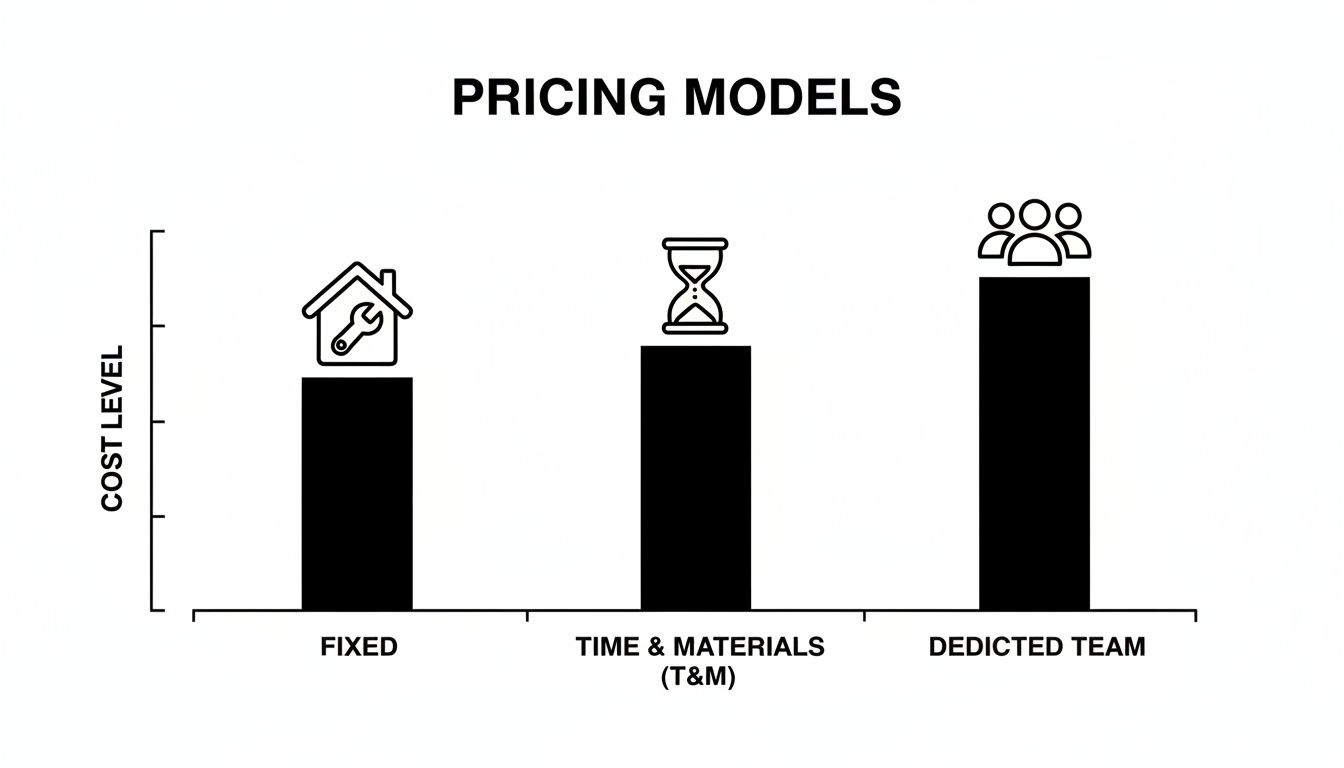
This visual guide helps clarify whether your project is better suited for a model that prioritizes a fixed budget, flexibility, or deep team integration—a decision that heavily influences which region makes the most sense.
Ultimately, choosing a region is a strategic business decision. For mission-critical products requiring elite senior engineers, Eastern Europe offers unmatched value. For projects demanding daily real-time collaboration, Latin America is the best bet. And for initiatives driven by cost and scale, Asia remains a dominant force. Align your choice with your core business goals to maximize ROI.
The Hidden Costs of Offshoring: What Your Hourly Rate Excludes

The developer’s hourly rate is the most visible part of your offshore software development costs, but it is rarely the full picture. Like an iceberg, the greatest risks lie in the massive expenses hidden below the surface. Overlooking these costs is a classic mistake that can derail budgets and timelines.
To build a realistic financial model, you must think in terms of Total Cost of Ownership (TCO), not just the rate card. These additional expenses will absolutely impact your project's bottom line. A strategic leader anticipates these costs and builds a budget based on reality, not just the advertised price.
Onboarding and Knowledge Transfer
A new team cannot be productive from day one. The initial ramp-up period carries a real cost in both time and money.
- Initial Training: Your new team needs time to understand your company’s vision, product roadmap, existing codebase, and workflows. This can take anywhere from a few days to several weeks of billable time that is not yet fully productive.
- Documentation and Handover: If you are transitioning from another team, documenting processes and conducting knowledge transfer sessions is a project in itself. This is all billable time that does not directly contribute to new features.
The best way to mitigate this is to partner with a firm that has a structured and efficient onboarding process. At Group107, we integrate this ramp-up into our project plans from the start, ensuring a swift, organized transition that minimizes unproductive time.
Legal, Compliance, and Transaction Fees
Protecting your business requires upfront legal and financial due diligence. For any serious company, especially in regulated industries like finance or SaaS, these costs are a non-negotiable part of doing business responsibly.
A common blind spot is failing to budget for the legal work required to establish a secure partnership. Robust contracts covering intellectual property, confidentiality, and data protection are not just nice-to-haves; they are your primary defense against future risk.
In addition to legal fees, international payments come with their own costs. When paying invoices in a foreign currency, you are exposed to market fluctuations and transaction fees. Beyond the basic rate, an often-overlooked financial detail is the foreign exchange (FX) cost. Understanding the FX trading spread and how it costs your business can reveal additional layers of expenditure.
The Real Cost of Miscommunication and Rework
Chasing the lowest hourly rate often leads to the most expensive hidden cost of all: rework. Miscommunication is the primary cause, with studies indicating that communication or cultural issues affect over half of all offshore projects.
This problem manifests in several ways:
- Language Barriers: Even with high English proficiency, subtle meanings can be lost in translation, resulting in features that are built to spec but are functionally incorrect.
- Cultural Differences: Different work cultures have varying norms for giving feedback, asking for help, or reporting issues, which can lead to friction and silent delays.
- Cost of Rework: Every bug caused by a misunderstanding, every feature built on a wrong assumption, and every hour spent debating requirements is a direct hit to your budget. A cheaper, less experienced team can easily cost 2-3x more in the long run due to time spent fixing their own mistakes.
You can avoid this by choosing a partner who prioritizes clear communication. Look for teams with a proven track record of working with Western clients, established communication protocols, and a culture that encourages proactive dialogue. That investment in a higher-quality partner pays for itself by eliminating the expensive cycle of build, test, misunderstand, and rebuild.
A Step-by-Step Framework to Calculate Your Offshore Budget
Estimating offshore software development costs can feel like guesswork, but it doesn’t have to be. By taking a methodical approach, you can create a budget that accurately reflects your project's scope and business objectives. It’s about moving from vague estimates to a clear, data-driven financial plan.
A solid budget acts as your project's financial compass. It helps secure funding, measure ROI, and select a partner who can deliver within your financial constraints. Here’s how to demystify the numbers and create a reliable financial model.
Step 1: Define Your Ideal Team Structure
Your team is the single largest cost driver. The specific mix of roles and seniority levels directly determines your monthly burn rate. The right team structure depends entirely on your project's goals.
For example, building a new fintech MVP from scratch requires a different team than migrating a legacy enterprise system. Start by outlining the essential roles needed to build, test, and manage your product.
A well-rounded dedicated team for a new product launch often includes:
- Senior Developers (2): Own the architecture and tackle the most complex features. Investing in seniority pays dividends in quality and speed.
- Mid-Level Developer (1): The workhorse of the team, responsible for building standard features and supporting senior engineers.
- QA Engineer (1): Critical for ensuring code quality through manual and automated testing, preventing costly bugs from reaching users.
- Project Manager (Part-Time): Keeps the project on track by facilitating communication, managing the backlog, and ensuring deadlines are met.
Step 2: Estimate Your Project Timeline
With your team defined, the next question is: how long will it take? Overly optimistic timelines often lead to rushed work and technical debt. A better approach is to break your product roadmap into major phases.
- Phase 1: MVP Development (6 Months): Focus on building the core features required for a market launch.
- Phase 2: Post-Launch Iteration (Ongoing): Budget for continuous improvements based on user feedback and evolving business needs.
For this exercise, we will budget for the initial six-month MVP phase. This provides a clear and manageable timeframe to calculate a baseline cost.
Step 3: Calculate the Baseline Cost with a Practical Example
Let's apply real numbers using our five-person team, assuming we are hiring from a top-tier talent hub like Ukraine. By applying typical mid-range hourly rates, we can calculate the monthly cost and the total MVP budget.
Example Budget: Fintech MVP (6-Month Project)
Here is a sample monthly cost breakdown for our five-person team:
| Role | Number of Experts | Average Hourly Rate (Ukraine) | Monthly Cost (160 hours/month) |
|---|---|---|---|
| Senior Developer | 2 | $55 | $17,600 |
| Mid-Level Developer | 1 | $45 | $7,200 |
| QA Engineer | 1 | $40 | $6,400 |
| Project Manager (Part-Time) | 1 (at 50%) | $50 | $4,000 |
| Total Monthly Cost | 5 | $35,200 |
Now, we multiply the monthly cost by our six-month timeline to determine the total baseline budget for the project.
Total 6-Month MVP Budget: $35,200/month * 6 months = $211,200
This figure, $211,200, represents your core investment in the talent needed to bring your product to market. It provides a predictable monthly expense and makes it easier to compare quotes from different offshore partners.
This structured calculation provides a solid foundation for your financial planning. To model different scenarios, our interactive software development cost calculator can help you explore how team compositions and regional rates affect the bottom line. Building a detailed budget is the first step toward a transparent and successful partnership.
From Cost Center to Value Driver: A Strategic Approach to Offshoring
If you are only looking at the hourly rate for offshore software development costs, you are starting with a flawed strategy. Chasing the lowest price is a shortsighted game that often ends in disappointment. The real victory lies in maximizing your ROI and proactively mitigating risks from day one.
True success requires a mindset shift. Stop thinking of your offshore team as a disposable vendor and start treating them as a strategic extension of your company. When deeply integrated into your operations, an offshore team unlocks sustainable value that a low hourly rate alone could never deliver. This integration is where the real business impact happens. To achieve it, you need a structure with clear governance, meaningful performance indicators, and a shared culture. When your offshore team feels part of your vision, they transform from task-takers into proactive problem-solvers invested in your success.
Establishing Clear Governance and KPIs
Effective governance is the framework that prevents projects from derailing. It is not about micromanagement but about creating a system of transparency and accountability that aligns everyone with your business goals.
Your governance plan should be simple and consistent:
- A Regular Meeting Cadence: Implement daily stand-ups for the development team, weekly syncs to review progress, and monthly steering meetings for high-level strategy. This ensures continuous communication flow.
- Transparent Reporting: Ensure everyone is working from the same data. Shared dashboards in project management tools like Jira are ideal for tracking progress against key milestones.
- Defined Roles and Responsibilities: Create a clear map of who owns what to eliminate confusion and finger-pointing on both sides.
A strong framework is only half the battle; you must also measure what matters. Move beyond vanity metrics like "hours billed" and focus on KPIs that demonstrate real business impact.
Don’t just measure activity; measure outcomes. Your KPIs should tell a story about code quality (e.g., bug density), development velocity (e.g., story points completed per sprint), and, most importantly, the delivery of tangible value to your customers.
Proactive Risk Mitigation Strategies
A successful offshore partnership is one where you identify and address risks before they become costly disasters. This is critical for any business, but for those in regulated sectors like fintech or healthcare, a robust risk mitigation plan is non-negotiable.
Focus on these key areas from the very beginning:
- Intellectual Property (IP) Protection: Your contract must be ironclad, stating unequivocally that 100% of the code, documentation, and work product created by the team is owned exclusively by you. This is the foundation of a secure partnership.
- Data Security and Compliance: With regulations like GDPR and CCPA, data security cannot be an afterthought. Your partner must demonstrate a commitment to security through secure coding practices, regular audits, and full compliance with all relevant industry regulations.
- Business Continuity: Your partner should have a clear business continuity plan detailing how they will maintain operations and keep your project on track during unforeseen events.
This is why choosing a provider whose business model is designed to manage these risks is so important. For example, our dedicated team approach at Group107 is built on strong legal frameworks that protect client IP and ensure full compliance. This structure transforms your provider from a contractor into a strategic ally invested in your security and long-term success.
Summary and Next Steps
Understanding offshore software development costs requires looking beyond the hourly rate. True value is found in a strategic partnership that delivers high-quality software, accelerates time-to-market, and provides a significant return on investment.
Key Takeaways:
- Focus on Total Value: Evaluate partners based on skill, efficiency, and their ability to reduce your operational overhead—not just their price tag.
- Choose the Right Model: The dedicated team model offers the best balance of cost-predictability, control, and scalability for long-term projects.
- Budget for Hidden Costs: Account for onboarding, legal fees, and the potential cost of rework when building your financial plan.
- Mitigate Risks Proactively: Ensure your contract includes ironclad IP protection and that your partner adheres to strict security and compliance standards.
Actionable Next Steps:
- Define Your Team Needs: Outline the ideal team structure (roles and seniority) required to achieve your project goals.
- Build a Baseline Budget: Use our framework or cost calculator to estimate your monthly and total project costs based on realistic timelines and regional rates.
- Vet Potential Partners: Assess providers not just on price but on their communication processes, legal frameworks, and track record of delivering measurable business results.
Ready to build a high-performing team without the high costs? Group107 provides premium offshore software development teams that integrate seamlessly with your business. Contact us to start building your dedicated team today.