
Building an offshore software development team is no longer just a cost-saving tactic; it's a strategic move for businesses aiming to accelerate engineering, access a global talent pool, and ship products faster. The conversation has evolved from a budget line item to a powerful competitive advantage.
Why Offshore Teams Are a Strategic Growth Lever
The outdated view of offshoring as simple labor arbitrage is obsolete. Today, it's a sophisticated strategy for building resilient, high-performance engineering organizations. This shift is driven by two primary factors: the persistent tech talent shortage in local markets and the soaring demand for specialized skills in fields like AI, fintech, and DevOps.
Engaging an offshore team allows you to scale your engineering capacity almost on demand, filling critical roles in weeks, not months. In a competitive market, this speed is a decisive factor for success.

Beyond Cost: The Modern Business Case
While cost-efficiency remains a factor, the modern business case for offshoring is built on three pillars that directly fuel growth and innovation.
- Access to Specialized Talent: The expert you need—whether a senior Python developer with machine learning expertise or a cybersecurity specialist for your new fintech platform—may not be available locally. Offshoring opens access to a global talent pool.
- Accelerated Time-to-Market: By adding a dedicated offshore unit, you can implement around-the-clock development cycles. This allows you to clear backlogs and launch features faster than competitors. For a SaaS startup, this can be the difference between leading the market and falling behind.
- Enhanced Scalability and Focus: An offshore team can handle large-scale projects, such as modernizing a legacy system, freeing your in-house engineers to focus on core innovation and future-facing initiatives. This is strategic resource allocation, not just work delegation. Explore more strategic advantages in our guide to the benefits of offshore software development.
The ability to scale engineering capacity without being constrained by local hiring limitations is a game-changer. It transforms your development roadmap from a list of constraints into a field of opportunities.
Market Growth and Strategic Adoption
Offshoring is not a niche trend. The global market is projected to reach between $152 billion and $179 billion by 2025, with some forecasts predicting exponential growth into the 2030s.
North America is the largest market, accounting for 35–39% of revenue, with large enterprises driving nearly 80% of this spending to scale their engineering power. You can find more statistics in this detailed report.
This growth highlights a fundamental truth: a key advantage is quickly hiring specialized software experts at a low cost. When executed correctly, offshoring is not just outsourcing; it's building a distributed, high-impact engineering engine that delivers measurable business results.
Choosing Your Offshore Engagement Model
Before evaluating vendors, the first step is internal analysis. Selecting the right partner for your offshore team begins with a clear vision of your specific needs. Vague goals like "we need more developers" are insufficient.
Start by mapping your precise skill gaps. Are you a fintech startup lacking senior backend engineers with payment processing experience? Do you have a complex CI/CD pipeline that requires a seasoned DevOps specialist? Defining these requirements is the foundation for choosing an engagement model that aligns with your project and long-term goals.
The Three Core Engagement Models
Once your needs are defined, you can evaluate different partnership structures. Each model offers varying levels of control, integration, and cost. This choice distinguishes a simple vendor transaction from a true strategic partnership.
There are three primary models for building an offshore software development team:
- Dedicated Team: This model provides a full-time, exclusive group of engineers who function as a remote extension of your in-house team, fully embedded in your culture and processes.
- Staff Augmentation: Ideal for filling specific skill gaps or increasing capacity for a short-term project. You integrate individual specialists who work under your direct management alongside your existing employees.
- Project-Based Outsourcing: In this model, you delegate an entire project to the offshore partner. You provide the requirements, scope, and deliverables, and the partner manages the project from start to finish with minimal day-to-day involvement from you.
Comparing Your Options
Each model serves a distinct strategic purpose. A dedicated team is ideal for long-term product development requiring deep domain knowledge and cultural alignment. Staff augmentation is perfect for rapidly scaling for a specific feature release without long-term hiring commitments. Project-based outsourcing is best suited for well-defined, isolated projects like building a marketing site or a standalone mobile app.
The right model isn't just about cost; it's about control, integration, and strategic alignment. Your choice directly impacts the offshore team's contribution to your business outcomes and their operational seamlessness.
To help you decide, here is a comparative breakdown.
Comparing Offshore Engagement Models
This table compares the key characteristics of Dedicated Teams, Staff Augmentation, and Project-Based Outsourcing to help you choose the best fit for your business.
| Model | Best For | Control Level | Integration | Cost Structure |
|---|---|---|---|---|
| Dedicated Team | Long-term product development, complex projects, and core business functions. | High | Deeply integrated with your in-house team and company culture. | Monthly fee per team member. |
| Staff Augmentation | Filling temporary skill gaps, accelerating specific project phases, or short-term capacity boosts. | High | Integrated into specific project teams under your direct management. | Hourly or monthly rate per specialist. |
| Project-Based | Well-defined, standalone projects with clear deliverables and minimal scope changes. | Low | Minimal integration; communication is typically handled through a project manager. | Fixed price or time and materials. |
For most companies building a core product, a dedicated team consistently provides the optimal blend of expertise, control, and long-term value.
To understand the financial implications, our offshore team cost calculation guide provides a detailed breakdown of how these models affect your budget. Making the right choice ensures you build a powerful extension of your engineering team, not just an invoice line item.
The Playbook for Vetting Your Offshore Partner
Selecting the right offshore partner is the most critical decision in this process. A successful choice creates a strategic asset; a poor one leads to long-term operational friction.
A true partner is more than a code vendor; they are an extension of your team who provides strategic input and takes ownership of outcomes. The goal is not to find the cheapest option but the right one that aligns with your company culture and business objectives. This requires a rigorous vetting process that assesses everything from engineering capabilities to communication protocols.
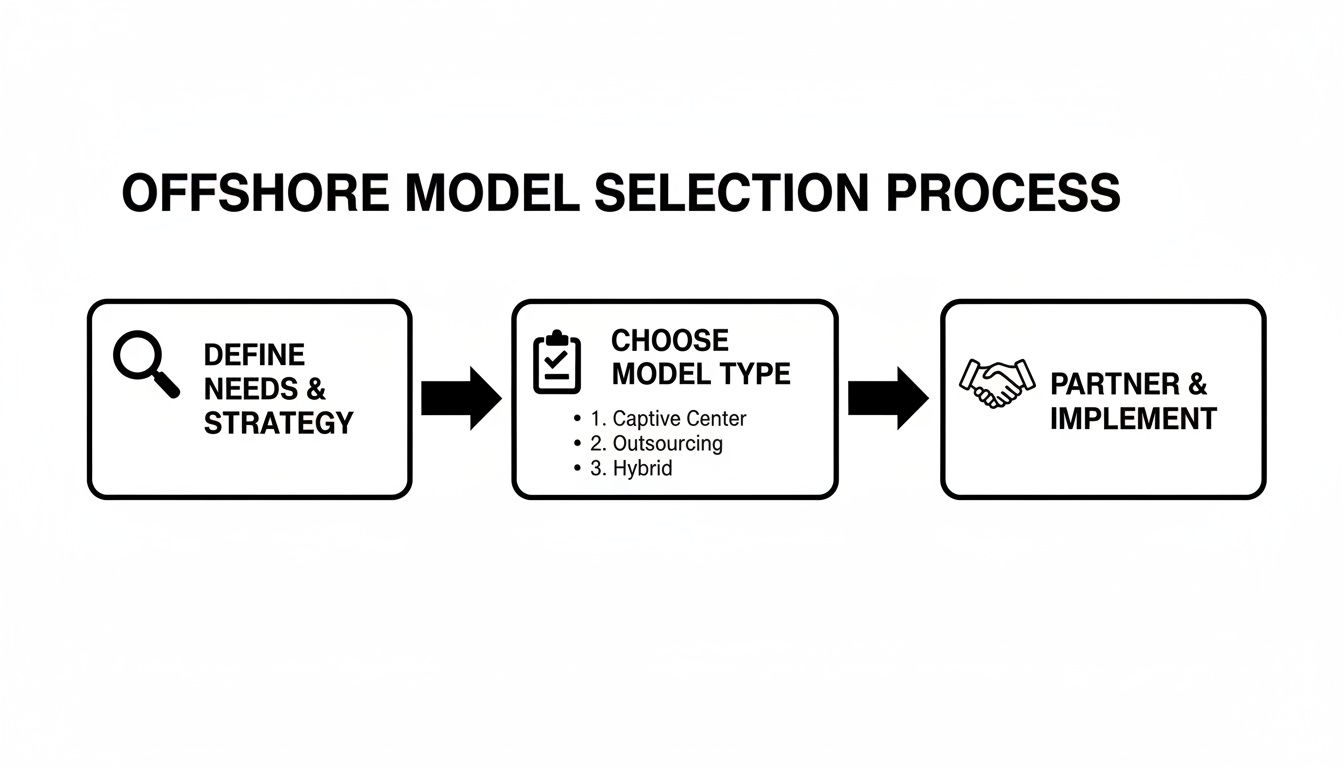
As illustrated, choosing a partner is the final, crucial step, effective only after you have defined your goals and selected the right engagement model.
Assessing Technical Excellence
Every potential partner will claim to have "top-tier developers." Your task is to verify these claims. Do not rely on polished resumes; you need to witness their skills directly.
- Demand Practical Code Reviews: Request anonymized code samples from projects relevant to your industry. Have your senior engineers conduct a thorough review for cleanliness, efficiency, and structure. This is a non-negotiable step for gauging their real-world standards.
- Insist on Live Technical Interviews: Your technical leads must participate in the final interview loop for any proposed team members. This is about quality assurance, not micromanagement. A partner confident in their talent will welcome this collaboration.
This hands-on approach cuts through marketing claims and provides concrete evidence of engineering quality, ensuring the offshore software development teams they assemble can deliver.
Scrutinizing Security and IP Protection
For any SaaS, fintech, or e-commerce company, security and IP protection are paramount. A single breach can be catastrophic. Your vetting process must be uncompromising in this area.
Demand a detailed review of their security protocols, including development environment security and data encryption standards. A reputable firm will have documented processes and relevant certifications. On the legal front, confirm they will sign a robust NDA and that their contracts assign 100% of IP ownership to you. There can be no ambiguity.
A partner's reluctance to discuss security details or provide transparent contracts is a significant red flag. True partners understand these are business-critical issues and will proactively demonstrate how they protect your assets.
Key Questions for Your Vetting Checklist
Use these questions during discussions with potential partners to assess their operational maturity.
-
Walk me through your developer hiring and vetting process.
- Look for a multi-stage process including technical screening, live coding challenges, cultural fit interviews, and background checks. This indicates a commitment to quality.
-
What is your average developer retention rate?
- A rate above 90% suggests a healthy work culture and stable teams. High turnover is detrimental to project continuity and knowledge retention.
-
Can you connect us with client references in our industry?
- Speaking with other companies in your sector provides unfiltered, real-world insight. A refusal to provide references is an immediate disqualifier.
-
How do you handle cultural alignment and ensure transparent communication?
- Listen for specific strategies regarding onboarding, communication tools (like Slack or Microsoft Teams), and team integration. A focus on creating a "one team" culture should be evident in their plan.
Choosing an offshore partner is a foundational business decision. By thoroughly vetting technical skills, security, and operational transparency, you find not just a vendor, but a strategic ally for long-term growth.
Structuring Contracts and Protecting Your IP
When engaging an offshore software development team, the legal framework and intellectual property (IP) protection are top priorities. A verbal agreement is insufficient.
Your contracts form the foundation of the partnership, defining responsibilities, deliverables, and—most importantly—safeguarding your company’s valuable assets. Without a robust agreement, you expose your business to significant financial and operational risks, especially in sectors like fintech or SaaS where data security and IP ownership are non-negotiable.

Core Components of a Rock-Solid Agreement
Your legal framework should consist of two primary documents: a Master Services Agreement (MSA) and a Statement of Work (SOW).
- Master Services Agreement (MSA): This foundational contract outlines the long-term rules of the partnership, including confidentiality, IP ownership, liability, and dispute resolution. It is signed once and governs all subsequent work.
- Statement of Work (SOW): This document details the specifics of an individual project, defining the scope, deliverables, timelines, payment schedules, and acceptance criteria. A new SOW is created for each project under the MSA's umbrella.
These documents must clearly define payment terms, performance expectations, and exit strategies. Contractually defined answers to questions about project delays or contract termination are essential from day one.
Non-Negotiable IP Protection Measures
Protecting your IP is the single most critical function of your legal agreement. Your code, designs, and business logic are your competitive advantage. A reliable offshore partner will not only agree to this but will proactively support it.
Implement a multi-layered IP protection strategy:
- Ironclad IP Ownership Clause: The contract must state unequivocally that 100% of the work product—including source code, documentation, and all related materials—is the sole and exclusive property of your company from the moment of creation.
- Individual NDAs: Every member of the offshore software development team, from junior developers to project managers, must sign a Non-Disclosure Agreement directly with your company.
- Secure, Isolated Environments: Your partner must provide a secure, access-controlled development environment, including VPNs, encrypted data storage, and restricted access to production servers to prevent data leakage.
Your intellectual property is not a negotiating point; it is a core business asset. Any hesitation from a potential partner to sign an agreement granting you unequivocal ownership of all work product is an immediate disqualification.
Ensuring Data Compliance and Security
If your business handles sensitive data, compliance with regulations like GDPR is mandatory. Your MSA must require your offshore partner to adhere to all relevant data protection laws.
This extends beyond paperwork to include stringent security measures, such as regular security audits, vulnerability scanning, and secure coding practices integrated into their workflow. A top-tier partner will have documented security policies and be able to demonstrate their enforcement, building a partnership founded on trust and a shared commitment to protecting your business.
Integrating Your Offshore Team for Seamless Collaboration
Hiring a talented offshore team is only the first step. Success is determined by how effectively you integrate them into your onshore operations. Many initiatives fail because integration is treated as an afterthought. The value of your offshore team is directly proportional to how well they are woven into your company's fabric, becoming a true extension of your team.
This requires more than just adding them to a Slack channel. It involves consciously building a system for communication, collaboration, and cultural alignment that makes physical distance irrelevant. The objective is to create one unified team driving toward the same goals.

Bridging Time Zones with Smart Processes
Time differences are the most immediate challenge with offshore software development teams. However, with the right processes, this can be turned into an advantage for round-the-clock productivity. This requires a combination of real-time connection and proficient asynchronous communication.
Establish core collaboration hours—a mandatory 3-4 hour daily window where all team members are online. This time should be reserved for high-value activities like sprint planning, complex feature brainstorming, and critical architectural decisions.
Outside of these hours, your team must excel at asynchronous work. This requires discipline and the right tools:
- Bulletproof Task Management: Tickets in tools like Jira must be crystal clear, with detailed acceptance criteria, links to relevant documents, and attached design mockups to eliminate ambiguity.
- Communicate in Public: Shift conversations from direct messages to shared channels in Slack or Teams. This creates a transparent, searchable record of decisions accessible to everyone.
- A Single Source of Truth: Maintain a well-organized wiki in Confluence or Notion. All technical documentation, project briefs, and meeting summaries should be stored here, serving as the team's collective knowledge base.
Creating a Unified "One-Team" Culture
Technical integration is only half the battle; cultural alignment is crucial. Your offshore engineers must feel like part of the company, not just external contractors. This sense of belonging transforms them from coders into proactive partners invested in the product's success.
Start with an onboarding process identical to your onshore one. Provide them with the same welcome kit and company-wide introduction. Ensure they understand the "why"—the business goals, the customer profile, and the market objectives.
The ultimate goal is to erase the "us versus them" mentality. When your offshore developers start suggesting product improvements and challenging assumptions, you have successfully integrated them. They have transitioned from execution to ownership.
Fostering personal connections is also vital for building trust:
- Virtual Coffee Chats: Schedule regular, non-work video calls to allow team members to connect on a personal level.
- Inclusive Agile Ceremonies: Conduct daily stand-ups, retrospectives, and demos at a time that accommodates everyone. Encourage camera use and ensure every voice is heard.
To support this, invest in the essential tools for effective remote collaboration. By prioritizing integration, you are not just outsourcing tasks but building a resilient, global team that operates as a single, powerful unit—turning a cost-saving tactic into an engine for growth.
Measuring Success and Scaling Your Operations
Once your offshore team is integrated, the focus shifts to performance, growth, and demonstrating ROI. Success is measured in business value—shipping better products faster and achieving strategic goals—not in hours billed.
You need a clear framework for measuring what matters and a strategic plan for scaling effectively. A true partner will work with you to track performance and plan for future growth, transforming your offshore team from a cost center into a core growth driver.
Defining KPIs That Drive Business Value
Focus on key performance indicators (KPIs) that directly link to productivity, quality, and business objectives. This data provides a clear view of your team's impact.
- Team Velocity: A classic Agile metric that measures the amount of work a team completes per sprint. Consistent or increasing velocity indicates a healthy, predictable team.
- Cycle Time: The time it takes for a task to move from "in progress" to "done." Shorter cycle times indicate agility and market responsiveness.
- Code Quality (Bug Density): Track the number of bugs that reach production. A low bug density reflects strong engineering practices and a commitment to quality.
- Roadmap Alignment: Ensure the team's output directly supports the product features your customers and business need.
Fostering Continuous Improvement
Metrics are only valuable when acted upon. Establish a consistent feedback loop to drive continuous improvement and create a culture of shared ownership.
Regular, transparent performance reviews are non-negotiable. They create a dedicated space to discuss successes, challenges, and future goals. When done correctly, feedback becomes a collaborative tool for growth, not a critique.
Implement a rhythm of bi-weekly or monthly KPI check-ins to manage day-to-day progress. Complement this with quarterly strategic reviews to discuss the bigger picture, including team structure, skill gaps, and the long-term roadmap.
A Framework for Strategic Scaling
Scaling your team should be a deliberate, data-driven process. When KPIs are strong and the product roadmap demands more capacity, it is time to consider expansion.
Knowing when and how to scale is critical. While offshore teams can reduce labor costs by up to 60%, the primary benefit is scaling your talent pool without sacrificing quality. The global talent market is vast; India has an estimated 13 million IT professionals, while Eastern Europe and Latin America are hubs for senior engineers with niche skills. You can explore more data on global talent distribution on joingenius.com.
Use your performance data to guide scaling decisions. If testing bottlenecks are slowing cycle time, hire a QA specialist. If developers are bogged down by deployment issues, add a dedicated DevOps engineer. This methodical approach ensures you add the right talent at the right time, enabling sustainable growth.
Answering Your Toughest Offshore Questions
Building an offshore software development team inevitably raises questions, primarily centered on communication and quality.
To manage collaboration across a 9-hour time difference, you establish a smart overlap of 3 to 4 hours each day for real-time synchronization, stand-ups, and critical discussions, rather than forcing late-night work. The remainder of the day operates on asynchronous communication, supported by meticulous documentation in tools like Jira and Confluence. This keeps work moving forward around the clock.
To ensure code quality, you must own the vetting process. Have your senior engineers conduct technical interviews and assign practical coding challenges that reflect real-world problems. A trustworthy partner will not only permit this but will actively encourage it to demonstrate the quality of their talent.
Ultimately, maintaining control requires deep integration. This means running sprint reviews together, tracking KPIs transparently, and treating the offshore team as an integral part of your organization, not just a group of remote contractors.