
The dialogue around offshore software development has evolved. What was once viewed primarily as a cost-reduction tactic is now a core strategic imperative for companies aiming to dominate their market. It's about building a competitive advantage, accelerating time-to-market, and accessing a global reservoir of specialized talent.
This is not a trend; it's a fundamental operational shift in how high-performing businesses build and scale. Partnering with a premier offshore software development company empowers you to assemble elite engineering teams without the constraints of local talent shortages or prohibitive hiring costs. This guide provides an actionable framework for navigating the process, from selecting the right model to integrating your new team for maximum ROI.
Why Top Companies Are Hiring Offshore Developers
In today's competitive landscape, speed, deep expertise, and operational agility are non-negotiable. This is why organizations from nimble SaaS startups to established enterprises are adopting a global talent strategy. It provides a direct and effective solution to the critical roadblocks most businesses encounter in their domestic markets: talent scarcity and spiraling operational costs.

The data underscores this shift. The global offshore development market is projected to reach $283 billion by 2031, growing at a robust 10.13% CAGR. North American companies are at the forefront, accounting for 38.5% of this market as they seek premium engineering talent that delivers a strong return on investment.
This trend has spotlighted technology hubs like Eastern Europe, particularly Ukraine. With a talent pool exceeding 650,000 IT professionals and highly competitive rates—often up to 60% lower than in the U.S.—the region has become a primary destination for high-caliber engineering. You can find more detail in these offshore development statistics.
The following table breaks down the strategic value this model delivers.
Offshore Development at a Glance: Business Impact
| Strategic Driver | Key Benefit | Business Impact & Real-World Application |
|---|---|---|
| Speed to Market | Rapid team assembly & accelerated development cycles. | Launch MVPs faster, beat competitors, and capture market share. A fintech startup can deploy a product in months, not years. |
| Access to Talent | Tap into a global pool of specialized engineers. | Secure rare skills in AI, DevOps, and cybersecurity without local hiring wars. An e-commerce platform can build a recommendation engine with top-tier data scientists. |
| Cost Efficiency | Significant savings on salaries, benefits, and operational overhead. | Reallocate capital to growth initiatives like marketing, R&D, and sales to drive revenue. |
| Scalability | Flexibly scale engineering capacity up or down on demand. | Respond instantly to new project demands and market opportunities without the friction of traditional hiring and layoffs. |
This model transcends simple cost savings; it's about reallocating that capital into core business functions to fuel tangible, sustainable growth.
Fueling Innovation and Rapid Growth
For the forward-thinking companies we partner with, budget optimization is a benefit, but the primary goal is gaining a competitive edge through speed and innovation. An offshore software development company provides the engineering capacity required to outmaneuver the competition.
Consider a SaaS company aiming to launch its MVP. Instead of spending months recruiting a full-stack team locally, they can engage a dedicated offshore partner and have a complete unit—developers, QA, and UI/UX—operational within weeks. This dramatically shortens the development timeline, gets the product into users' hands faster, and accelerates the feedback loop for rapid, market-driven iteration.
Alternatively, take a large enterprise grappling with a legacy system. An offshore team can introduce advanced DevOps practices, implement CI/CD pipelines, and facilitate a migration to a modern microservices architecture, all without disrupting daily operations.
Accessing Scarce and Specialized Skills
Recruiting local experts in high-demand fields like AI, advanced cybersecurity, or digital accessibility (a11y) is often a prolonged and expensive challenge. An offshore software development company removes these barriers, providing immediate access to a global pool of niche expertise.
By tapping into global talent, you transform a hiring bottleneck into a strategic advantage. You secure world-class engineers who can build complex, secure, and compliant solutions, freeing your in-house team to focus on core business strategy and innovation.
This access directly impacts product quality, security posture, and your ability to meet regulatory requirements.
- AI and Machine Learning: A SaaS company can build a sophisticated predictive analytics engine by hiring a team of data scientists from a region known for its strong quantitative talent.
- Cybersecurity: A financial services firm can fortify its platform against emerging threats by partnering with offshore experts specializing in penetration testing and secure coding practices.
- Accessibility (a11y): An enterprise can ensure its digital products meet WCAG standards by working with developers deeply trained in inclusive design and assistive technology, mitigating legal risk and expanding market reach.
Ultimately, building a global team is a powerful strategic decision that drives growth, innovation, and resilience. To see the full picture, explore the benefits of offshore software development in our detailed article.
Choosing Your Ideal Engagement Model
Selecting the right partnership structure is a critical decision that forms the foundation of a successful offshore engagement. It directly impacts control, budget, scalability, and how effectively the external team integrates with your own. Let's analyze the three primary engagement models through the lens of real-world business objectives.
The wrong model creates friction and impedes progress. The right one, however, acts as a powerful accelerator for your goals. Your choice of an offshore software development company must be driven by your specific project requirements, long-term strategy, and in-house capabilities.
The Dedicated Team Model
Think of the Dedicated Team model as building a remote-first extension of your own company. You gain a full-time, exclusive group of engineers who are fully immersed in your projects. They integrate into your company culture, understand your product roadmap, and contribute to your long-term vision. This is the optimal model for long-term projects, building complex products from the ground up, or any initiative requiring deep, evolving domain knowledge.
A prime example is a fintech company developing a secure trading platform. They require a stable, consistent team to build, iterate, and maintain the platform over several years, accumulating critical product knowledge in the process. This model provides the stability and deep integration that mission-critical projects demand.
The Dedicated Team model is about building an asset. You are not just purchasing development hours; you are investing in a cohesive unit that grows with your product, ensuring a level of continuity and deep expertise unattainable through fragmented, project-based work.
The Staff Augmentation Model
Staff Augmentation is a precision tool for addressing specific skill gaps or capacity constraints within your existing team. Perhaps you need to scale up for a single project phase but don't want the overhead of a permanent hire. With this model, you handpick individual specialists who integrate directly into your team and report to your internal managers.
Imagine a large e-commerce company building an AI-powered recommendation engine. Their in-house team is strong but lacks a data scientist. Instead of a lengthy and expensive recruitment process, they can bring in an offshore AI specialist to augment their team. This expert integrates into their existing workflow, delivers the specific feature, and can be ramped down once the project is complete, offering exceptional flexibility and targeted impact.
For a deeper dive, you can explore the nuances in our guide on staff augmentation vs outsourcing.
The Project-Based Model
The Project-Based model, also known as a fixed-price model, is most effective for projects with a clearly defined scope, locked-in requirements, and a predictable timeline. You and the offshore company agree on the deliverables, schedule, and total cost upfront. The vendor then assumes responsibility for managing the entire process and delivering the finished product as specified.
This model is well-suited for smaller, self-contained tasks like developing a simple marketing website, creating a standalone mobile app with a fixed feature set, or migrating a single database. However, its inherent rigidity makes it a poor choice for complex or evolving projects where requirements are likely to change.
Comparing the Engagement Models
Choosing your model involves balancing control, cost, and flexibility. This table provides a clear comparison of how each model stacks up against key business factors.
| Factor | Dedicated Team | Staff Augmentation | Project-Based |
|---|---|---|---|
| Control | High: Full control over team, processes, and priorities. | High: Direct management of augmented staff within your team. | Low: The vendor manages project execution to meet agreed-upon deliverables. |
| Scalability | Moderate: Scaling is a planned process to maintain team cohesion. | High: Easily scale individual roles up or down to meet immediate demand. | Low: Fixed scope makes changes difficult and costly. |
| Cost Structure | Monthly fee per team member. | Hourly or monthly rate per specialist. | Fixed price for the entire project. |
| Integration | Deep: The team becomes a core, long-term part of your organization. | Seamless: Specialists integrate into your existing team structure for a specific duration. | Minimal: The team operates as a separate, external unit. |
| Best For | Long-term product development, complex projects, and building core assets. | Filling specific skill gaps, short-term scaling, and maintaining internal control. | Small, well-defined projects with a fixed scope and minimal uncertainty. |
Ultimately, a clear-eyed assessment of your project's goals, timeline, and internal capabilities will guide you to the model that delivers the highest ROI and sets your partnership up for success.
The Vetting and Selection Framework That Actually Works
Choosing the right offshore software development company is an investigative process, not a box-ticking exercise. You must dig deeper than the slick sales pitch to validate their true capabilities. A polished portfolio is meaningless if the underlying engineering quality is poor.
This framework separates a true strategic partner from a low-cost vendor that will burn your budget and derail your roadmap. It requires a hands-on approach to evaluate everything from their code quality to their company culture. A mistake at this stage can cost far more than money—it can sink your project and set your business back.
Beyond the Portfolio: Assessing True Technical Depth
A polished portfolio is designed to impress, but it rarely reveals the full story. You need to look behind the curtain to evaluate the engineering rigor that produced those results.
Start by requesting case studies for projects that match your needs not just by industry, but by technical complexity. If you're building a scalable, multi-tenant SaaS platform, their work on a simple marketing website is irrelevant. Then, go deeper with this actionable checklist:
- Request and Review Code Samples: Have your senior engineers conduct a thorough code review. They should analyze for clean architecture, maintainability, test coverage, and adherence to best practices. Is the code a solid foundation you can build on, or is it a tangled mess of technical debt?
- Conduct Technical Interviews with Their Engineers: Insist on speaking directly with the senior and mid-level engineers who would potentially join your team, not just a sales representative. Present them with a small, real-world problem from your backlog to assess their problem-solving skills, communication, and thought process.
- Verify DevOps and CI/CD Maturity: Ask for specifics. What tools are in their CI/CD pipeline (e.g., Jenkins, GitLab CI, CircleCI)? How do they manage infrastructure as code (e.g., Terraform, Ansible)? A mature offshore software development company will have these automated processes deeply integrated, ensuring both quality and velocity.
The most insightful conversations occur with engineers, not the sales team. If a company is reluctant to grant you access to their technical talent, it's a significant red flag. True partners are proud of their engineers and eager to demonstrate their capabilities.
This process flow illustrates the core engagement models and the need for a tailored vetting approach.
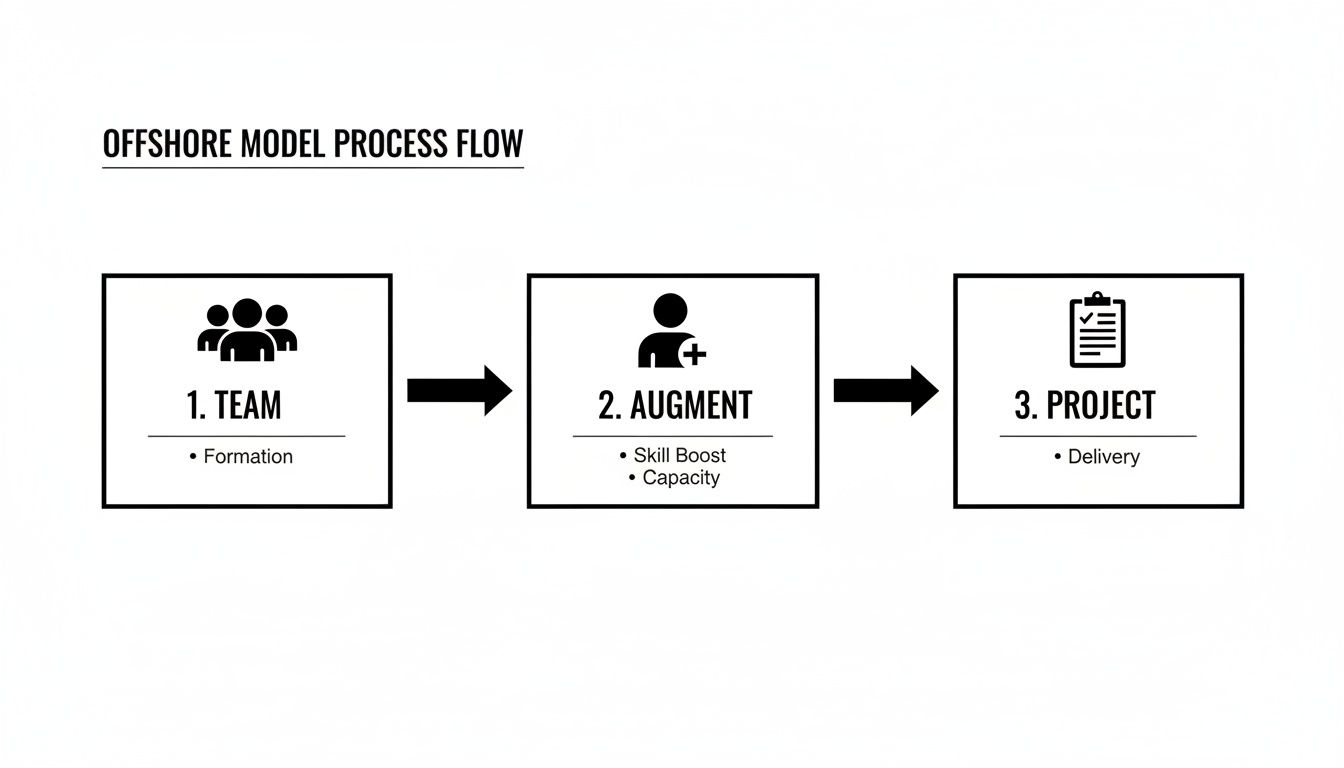
Whether you are building a dedicated team or augmenting your staff, you must confirm that the partner has the right structure, processes, and people to succeed.
Evaluating Communication, Culture, and Process
Technical skill is only half the equation. A team of brilliant but siloed engineers who struggle with communication, especially across time zones, is a recipe for project failure. You must verify that their culture and communication practices are compatible with yours.
If you operate in an Agile framework, ask them to walk you through how they execute a typical sprint.
- What do their sprint planning and retrospective ceremonies look like?
- How do they manage the product backlog and accommodate change requests?
- What is their standard process for providing status updates and maintaining transparency?
Their answers should be confident and supported by specific examples from past projects. Vague responses often indicate a lack of disciplined process. Furthermore, confirm they have a robust internal QA process. Is testing integrated throughout the development lifecycle, or is it an afterthought?
A critical part of this evaluation is conducting thorough third-party due diligence to ensure the company is financially stable and operationally sound before you commit.
Verifying Security and IP Protection
Finally, you must be rigorous in your assessment of security and intellectual property (IP) protection. This is non-negotiable, particularly in regulated industries like finance, SaaS, or government, where a security breach can be catastrophic.
Start by verifying their security certifications, such as SOC 2 or ISO 27001, which demonstrate a formal commitment to security best practices. But don't stop there. Ask for detailed documentation of their data handling policies, encryption protocols (for data in transit and at rest), and access control measures.
Ensure their standard contracts include robust IP clauses that explicitly state all work product and intellectual property created for you belongs 100% to you. A top-tier offshore software development company will have these protections embedded in their core operations, not just added upon request.
Building the Legal and Contractual Foundation
Once you've vetted potential partners, the next step is establishing the legal framework. This is not a mere formality; it's the bedrock of a secure, transparent, and successful partnership. Getting this wrong can lead to disputes over scope, IP ownership, or data security down the line.
Two key documents will form the foundation of your agreement: the Master Service Agreement (MSA) and the Statement of Work (SOW). The MSA establishes the rules for your entire relationship, while each SOW will map out the specifics of an individual project. Nailing both is absolutely critical.
Your Master Service Agreement (MSA): The Foundation of Trust
The Master Service Agreement is the high-level constitution governing your entire engagement. It's a long-term document that sets the ground rules for all future work, so it must be comprehensive and clear.
Here are the essential clauses to scrutinize:
- Intellectual Property (IP) Ownership: This clause must state, without ambiguity, that all code, designs, documentation, and other work products created by the team for your projects belong 100% to you.
- Confidentiality (NDA): A robust non-disclosure agreement is essential to protect your trade secrets, proprietary data, and any sensitive information shared with your offshore software development company.
- Data Security and Compliance: This section must detail the specific security protocols the partner must follow. For regulated industries, this is where you specify adherence to standards like GDPR, HIPAA, or SOC 2.
- Liability and Indemnification: This clarifies who is responsible in the event of a security breach, IP infringement claim, or other issues.
- Termination Clause: A clear exit strategy is crucial. This outlines the process for how either party can terminate the agreement, including required notice periods and transition procedures.
A Free AI Contract Generator can provide a useful starting template, but always have your legal counsel review and customize these critical documents.
The Statement of Work (SOW): Your Project’s Blueprint
If the MSA is the constitution, the Statement of Work is the specific law for a single project. A new SOW is created for each initiative launched under the MSA. A vague SOW is a direct path to scope creep, budget overruns, and missed deadlines.
Your SOW should be painstakingly specific and include:
- Project Scope and Deliverables: A precise, detailed description of what is being built, including features, functions, and technical specifications.
- Timeline and Milestones: A clear project schedule with firm dates for key deliverables and phases.
- Payment Structure: The terms for compensation, whether based on milestones, a monthly retainer for your dedicated team, or a fixed project price.
- Change Management Process: A formal process for how changes to the scope or requirements will be requested, evaluated, and approved.
A well-crafted SOW is more than a legal document; it's a vital communication tool. It ensures everyone—from your executive team to their junior developer—shares the exact same understanding of what "done" looks like.
For more insights into establishing a secure framework, our guide on how to hire a remote team safely offers additional layers of protection to consider.
Measuring Success with SLAs and KPIs
Finally, embed performance metrics into your SOW to make success measurable. Service Level Agreements (SLAs) and Key Performance Indicators (KPIs) hold your offshore partner accountable for the quality and efficiency you expect.
Crucial SLAs and KPIs to Define:
- Team Velocity: An Agile metric that tracks the amount of work a team completes per sprint, providing a predictable measure of output.
- Bug Resolution Time: An SLA defining the maximum time allowed to fix critical, major, and minor bugs.
- Code Quality Metrics: Set objective standards for code reviews, test coverage (aim for >80%), and adherence to coding best practices.
- System Uptime and Availability: For ongoing support, an SLA guaranteeing a specific percentage of uptime (e.g., 99.9%) is a must.
By carefully defining these legal and contractual details, you build a partnership on a foundation of clarity and trust, ensuring your offshore engagement delivers measurable business results.
Integrating and Managing Your Offshore Team for Success
Signing the contract is the starting point, not the finish line. The real work of forging a high-performing partnership with an offshore software development company begins with integration. A poorly executed onboarding process can erode trust and kill momentum, while a strategic, deliberate approach will turn your offshore developers into a genuine extension of your in-house team.

The primary goal is to eliminate the "offshore" distinction and cultivate a unified "one team" culture from day one. This requires concrete actions to align your tools, processes, and people into a single, cohesive operational backbone.
Establishing a Unified Operational Framework
True integration begins when you stop viewing your offshore developers as "contractors" and start treating them as colleagues. This means providing them with the same access to tools, documentation, and communication channels as your local team. A fragmented environment where information is siloed is a direct path to delays, miscommunication, and frustration.
Your immediate priority is to create a single source of truth for all project-related information. This involves:
- Unified Communication Channels: Immediately add your new team members to all relevant Slack or Microsoft Teams channels. They must be part of the informal problem-solving and daily discussions, not just scheduled meetings.
- Shared Project Management Tools: Grant them full access to your Jira, Asana, or Trello boards. They should see the entire backlog, understand priorities, and have a voice in sprint planning.
- A Common Development Environment: Standardize everything. Ensure all developers, regardless of location, use the same development, staging, and production environments. This includes identical access to code repositories, CI/CD pipelines, and infrastructure documentation.
Fostering a 'One Team' Culture Across Borders
While geography presents challenges, it doesn't have to be a barrier to a cohesive team. A strong culture is built with intention and proactive effort to bridge cultural gaps and ensure every team member feels included, valued, and psychologically safe.
One highly effective tactic is to assign an "onboarding buddy" from your in-house team to each new offshore developer. This peer can help them navigate internal processes, explain unwritten rules, and serve as a go-to resource for questions, fostering a vital human connection.
The most successful offshore partnerships are those where the lines between "us" and "them" completely disappear. When your in-house engineer and your offshore developer are collaborating in real-time to solve a complex bug, you have achieved true integration.
While cost savings—often up to 60% in Eastern Europe, where top developers average $25–$55/hour versus $100–$200/hour in North America—are a compelling driver, successful integration multiplies that value. Smart collaboration can boost productivity by over 30%, delivering an exponential ROI. You can get more details on how these offshore development rates impact budgets.
Managing Progress Without Micromanagement
Trust is the currency of any distributed team. The most effective way to build it is by focusing on outcomes, not on tracking hours. Agile methodologies provide a transparent framework for accountability that eliminates the need for micromanagement.
Instead of monitoring activity, focus on tangible Agile metrics:
- Sprint Velocity: This measures the volume of work your team completes each sprint. Once it stabilizes, it provides remarkably predictable delivery forecasts.
- Burndown Charts: These charts offer a clear visual of progress throughout a sprint, enabling you to identify and address roadblocks proactively.
- Cycle Time: Tracking the time it takes for a task to move from "in progress" to "done" is a powerful indicator of your team's overall efficiency.
Code reviews are another essential management tool. Frame them as collaborative learning opportunities, not as a forum for criticism. A healthy code review process not only improves code quality but also disseminates knowledge and reinforces a culture of shared ownership. By automating quality gates within your CI/CD pipeline—enforcing standards like test coverage and static analysis—you ensure that all code meets the same high standard before deployment.
Your Top Questions About Hiring Offshore Developers, Answered
Even after thorough due diligence, practical questions often remain. These questions move beyond the contract to address the day-to-day realities of working with an offshore software development company. Getting clear, direct answers is essential for a successful partnership.
How Do I Protect My Intellectual Property with an Offshore Team?
This is a critical concern. Protecting your IP requires a two-pronged approach: ironclad legal agreements and robust operational security.
- Legal Protection: Your Master Service Agreement (MSA) must contain a clear, unambiguous clause stating that 100% of the work product—all code, documentation, designs, and other materials—is the exclusive property of your company. This is non-negotiable.
- Operational Security: Your partner must demonstrate:
- Secure Infrastructure: A managed, secure development environment with strict access controls.
- Comprehensive NDAs: Every individual on the project, from architect to developer, must sign a strong non-disclosure agreement.
- Legal Protections: Partnering with a company that has a legal entity in your country (or one with strong reciprocal IP laws) provides a stronger legal recourse if needed.
What Are the Biggest Red Flags to Watch For When Hiring?
Identifying warning signs early can prevent significant problems. Look beyond the polished portfolio for subtle but critical indicators of potential issues.
A major red flag is a company that prevents you from speaking directly with their engineers during the vetting process. If you are only allowed to communicate with a salesperson, it may signal a lack of technical depth or poor communication skills within the team.
Other critical red flags include:
- Vague Security Practices: If they cannot clearly articulate their security protocols or provide evidence of certifications like SOC 2 or ISO 27001, it indicates a weak security posture.
- Inflexible Processes: A true partner adapts to your workflow. If they insist on a rigid, one-size-fits-all process, expect ongoing friction.
- Hesitation to Provide Client References: A reputable offshore software development company will be eager for you to speak with their current and past clients. Reluctance is a sign that there may be issues they don't want you to discover.
Is It Better to Hire an Offshore Company or Individual Freelancers?
While freelancers can be suitable for small, isolated tasks, a dedicated offshore software development company is the superior strategic choice for building a serious product or for long-term needs. You are not just hiring developers; you are gaining an entire operational support system.
An established company provides project management, QA, HR, and IT support. This creates stability and resilience. If a developer departs, the company has a process to backfill the role with a qualified professional, ensuring project continuity. With a freelancer, you are left to start the recruitment process over. A company also manages all legal and administrative overhead, providing greater security and peace of mind.
How Do You Handle Time Zone Differences and Communication?
This is a challenge that mature offshore partners have long since solved. The solution is not about forcing people to work unreasonable hours but about establishing a deliberate and efficient communication strategy.
The most effective model involves establishing a 4-5 hour daily overlap in work schedules. This window is dedicated to real-time collaboration, including daily stand-ups, planning sessions, and problem-solving. Outside of this overlap, the team relies on asynchronous communication tools like Slack and detailed tickets in project management systems like Jira. When executed correctly, this "follow-the-sun" model can significantly accelerate project velocity.
Summary and Next Steps
Hiring an offshore software development company is a strategic lever for achieving significant business outcomes—from accelerating speed-to-market and accessing specialized talent to optimizing operational costs and scaling on demand. Success hinges on a methodical approach that goes beyond surface-level evaluations.
Your actionable next steps are:
- Define Your Needs: Clearly articulate your project goals, technical requirements, and the specific skills you need to determine the best engagement model (Dedicated Team, Staff Augmentation, or Project-Based).
- Execute a Rigorous Vetting Process: Move beyond portfolios. Review code, interview engineers, and verify security protocols to find a true partner, not just a vendor.
- Establish a Solid Legal Foundation: Work with legal counsel to craft a comprehensive MSA and detailed SOWs that protect your IP and align expectations.
- Prioritize Integration: From day one, focus on creating a "one team" culture by unifying tools, processes, and communication channels.
At Group 107, we have built our model on transparency, deep integration, and elite engineering talent. Our clients gain direct access to top-tier Ukrainian engineers, benefit from our rigorous security and IP protection protocols, and experience a unified culture that makes distance irrelevant.
Ready to see how a premium offshore team can transform your development velocity and drive real business outcomes? Contact us today to build your dedicated team.